
A zero-foreign-exchange-fee card for emerging markets, launched as a standalone app in October 2026
 Available in US
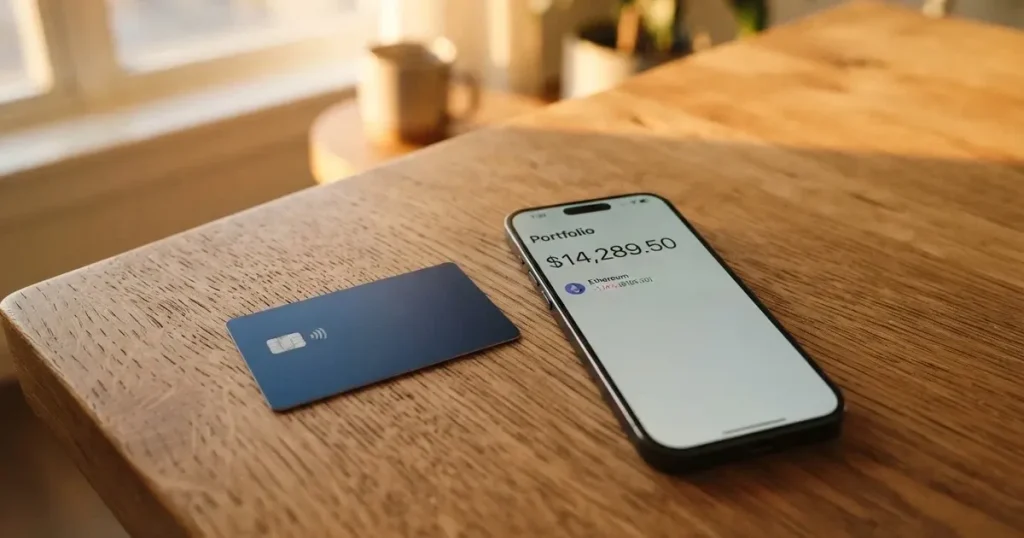
The OKX Money card is a payment card built on top of a dollar-backed stablecoin balance rather than on a bank account. It came out of the gate with one genuinely attractive promise — zero foreign exchange fees and no conversion markup on purchases in another currency — plus accounts that can be funded in more than 50 fiat currencies. That is the strongest part of the offer, and it is the reason to keep reading.
Everything around that promise is thinner than the marketing suggests. The public pages do not publish the list of countries, the card network, the issuing bank, the issuance or monthly fee, ATM terms, delivery time, withdrawal rules, or the verification tiers. The card also launched very recently, as a standalone app on 6 October 2026, so there is almost no independent track record for the card itself. I scored it 6.7 out of 10 — respectable, not convincing.
The conditions described below are current as of October 28, 2026.
Verdict: 6.7 out of 10
OKX Money suits one person fairly well: someone in an emerging market who already holds dollars in stablecoin form, wants to spend them locally, and is currently paying a punishing foreign-exchange fee on every purchase. For that person the fee structure is genuinely good and hard to argue with.
It suits almost everyone else only conditionally. If you need a card you can trust for subscription payments, for online shops that check billing addresses, for travel, or for anything where you need a named issuer, a published fee schedule, or a support line, this card is a poor fit — not because those features are broken, but because nobody has published whether they exist.
| Criterion | Mark | Why |
|---|---|---|
| Who can get it | 6 / 10 | Selected emerging markets in Latin America, Africa, South Asia and the Middle East; the list is not published |
| Cost | 8 / 10 | Zero currency fee, no conversion markup; issuance and servicing are not disclosed |
| Top-up options | 6 / 10 | Account funded in 50+ currencies and converted into USDG, USDC or USDT; networks not named |
| Reliability and complaints | 6 / 10 | OKX operates under licensing frameworks in 30+ jurisdictions; issuer not named; no official incidents for the card; Trustpilot for the exchange is 1.9/5 from 1,624 reviews |
| Everyday use | 7 / 10 | Virtual or physical card from one app; up to 10% cashback; Apple Pay, Google Pay and ATM not disclosed |
| Total | 6.7 / 10 | A cheap converter wrapped in a card, with too much left unpublished |
Will they give you the card?
Selected emerging markets in Latin America, Africa, South Asia and the Middle East — and that is the entire published eligibility statement. The exact list is not published, and OKX expands market by market, so card access depends on your country. Third-party reporting names South Africa, Kenya, Nigeria, Pakistan and Bangladesh as launch markets, but that is unofficial and not confirmed by the card.
This matters more than it sounds. “Emerging markets” is a description, not a rule. If you are reading this from a country that was never named, there is no published way to check. The honest position is: ask, or try to register and see.
Two further points of principle apply to everyone regardless of card. Card and account age limits of 18 or over are standard in this category. And the rules that decide whether you are served tend to follow citizenship as well as residence, because sanctions screening and issuer risk policy are usually applied to both — which is why a country list alone cannot tell you the whole story.
How to get it
New users sign up and pass identity checks before funding. What documents are required is not stated anywhere on the public pages, and how many verification tiers exist is likewise not stated. Expect the standard set that regulated businesses collect — identity document, a selfie or liveness check, proof of address in many cases — but treat that as an expectation, not a promise, because the card does not commit to it.
After verification, you choose between a virtual card and a physical card, and both come from the same app. The network is not named on the official page. Independent reporting says Mastercard. That one is unofficial, so do not plan around it — but note that if it is true, it puts the card in the mainstream rails.
Delivery time for a physical card is not stated. Neither is how long the virtual card takes to appear once you have passed checks. Those two blanks are the ones to chase in support if a physical card is what you actually need, because “we will post it” and “it arrives in three weeks” are very different plans.
Fees and what a payment really costs
Here is the number that matters, stated by the card: OKX Money charges zero foreign exchange fees and adds no conversion markup on purchases in another currency. Converting between supported stablecoins carries no conversion fees either.
That is the whole published fee position. The card’s public pages do not state an issuance fee, a monthly or servicing fee, ATM terms, spending caps, or any tier structure. No amounts are given at all. Spending limits can be set by you in the app, which is a useful control even without knowing the ceiling.
| Fee or limit | What the card says |
|---|---|
| Issuance / card cost | not stated |
| Monthly or servicing fee | not stated |
| Conversion between supported stablecoins | no conversion fees |
| Foreign exchange on purchases | zero FX fees, no conversion markup |
| ATM | not stated |
| Daily limit | not stated |
| Monthly limit | not stated |
| User-set spending limits | available in the app |
Two or three everyday payments, and what applies to each:
- Buying coffee in your local currency from a dollar balance. This is the case the zero-FX promise is built for. No foreign exchange fee and no conversion markup, per the card. The balance underneath is dollar-backed, so you are spending something that behaves like dollars, not like your local money.
- Converting between USDG, USDC and USDT inside the balance. No conversion fees, per the card. Rates between the three are not discussed on the public pages.
- A subscription or a hotel. I cannot tell you which fees apply, because the card publishes none for these, and because transaction limits, hold behaviour and merchant-category handling are not disclosed. Ask before you rely on the card for anything recurring.
One thing to keep in mind about the fee that is *not* on the card: if you ever move value onto the blockchain yourself, the network charges its own fee — gas on Ethereum, resources on Tron — and that comes from the blockchain, not from OKX. That belongs in your mental model of “cheap to spend” only if you ever self-fund.
How to top it up
This is the strongest practical feature after the fee promise, and it is also the part with the biggest unanswered question.
Accounts are funded in more than 50 supported currencies. That money is converted into dollar-backed stablecoins — USDG, USDC or USDT — and held as an app balance. Top-up covers 50+ fiat currencies convertible to stablecoins. So the shape of it is: you send local currency in, you end up holding dollars, and the card spends those dollars.
What is not stated: which networks are supported for a deposit, what the fees and minimums are, and how you withdraw money back out. Those three blanks together are the reason this scores 6 rather than 8 on funding. If you plan to convert your own dollars into the account by sending a stablecoin from another wallet, the network question is not academic — a deposit sent on a network the provider does not support can be lost or need manual recovery with no guarantee, because blockchain transfers cannot be reversed. Withdrawal rules matter just as much: a card you cannot get money off is a spending toy, not an account.
Paying with it every day
Everyday use looks like this: one app, a virtual or physical card, and a stablecoin balance behind it. The app is a standalone OKX Money app, launched 6 October 2026 — the source article was modified 15 October 2026, so even the launch coverage is days old at the time of writing. I did not read store ratings.
The rewards are real but conditional. Up to 10% cashback on qualifying purchases for eligible customers, with rates varying by region and eligibility and the payout currency not stated. There is also up to 10% APY on eligible USDG balances, and referral commissions. Read the “eligible” carefully: the headline number is a ceiling, not a rate you should budget on.
The things you would use a card for most, the card is silent on. Apple Pay and Google Pay support are not stated for OKX Money — worth separating from the other OKX product, the separate European OKX Card, which does support Apple Pay and Google Pay; different card, different licence, different market. ATM access is not stated. Address verification, which is what lets an online shop accept a foreign-issued card at checkout, is generally unavailable for foreign-issued cards anyway and can cause declines; on top of that, the payout currency for your cashback is unknown.
Dispute handling is not stated. A chargeback is a refund ordered by the card issuer, and reason codes exist for fraud, duplicate billing or goods not received — but whether you can use that route here, and in which country’s law, is a question for support, not for me. If your income depends on this card, treat the missing dispute and support information as a cost.
What can go wrong
The most likely problems are boring rather than dramatic.
Nobody will tell you who is behind the card. OKX (OKX INC. per card.md) operates under licensing frameworks in more than 30 jurisdictions, but the card issuer is not named. In this category the issuer is the entity that actually holds the money side of the programme and stands behind disputes, and a card brand is often only a programme manager or front-end. Not knowing which one you are dealing with is a genuine gap, not a technicality.
The track record belongs to the exchange, not the card. I found no official incidents for OKX Money itself — which is unsurprising for a card weeks old. Trustpilot themes are about the OKX exchange, with a user report of tiresome support and one identity-theft case; the exchange’s main Trustpilot page sits at 1.9/5 from 1,624 reviews, while its app page shows 4.5/5 from 34 reviews, dated 21 October 2026. The recurring theme in user reports is support loops. For the card, complaint detail is not stated.
Custody risk. This is a custodial arrangement. Control of the crypto belongs to whoever holds the credentials, so you are trusting the provider completely. That trust has a history: Mt. Gox (about US$350 million reported stolen 2011–2014), Coincheck (about US$400 million, 2018) and Ronin Network (US$625 million, 2022) are all custodial failures. Your balance here is dollar-backed stablecoin rather than exchange-native tokens, which narrows the exposure, but it does not remove counterparty or hack risk.
Programmes close. FTX: Visa terminated its global agreements on 13 November 2022 and the FTX US debit card was wound down by its issuer. WaveCrest, a Visa issuer that supplied crypto card brands, was suspended by Visa in Europe in 2018, closing all WaveCrest-issued Visa programmes. Closures typically give notice, then stop spending and loading, then ask users to withdraw remaining balances. Those balances are e-money, not bank deposits, and may not sit under a deposit guarantee scheme even where one exists.
Stablecoins and sanctions. Stablecoins can depeg — TerraUSD collapsed in May 2022, USDC temporarily lost its peg in March 2023 during the US banking crisis — and they are not censorship-proof: Tether says it disables tokens in wallets on the OFAC sanctions list and has frozen funds tied to illicit activity.
Declines and holds. Some merchants decline prepaid or foreign BINs because the lookup reveals the card type and issuer country. A declined authorisation may leave a hold on funds that can last several days, typically up to 7. And a card with no published network and no published issuer is a card I cannot tell you will be accepted everywhere.
Support, security safeguards and dispute terms are all not stated. In this category the usual safeguards are app-based 2FA, instant card freeze, spending limits and tokenised mobile wallets; whether OKX Money has them is unknown.
What to take instead
I looked at three alternatives with comparable scores. None of them is a slam dunk either — the category is young and disclosure is thin across the board — so I am comparing them on what is actually published.
| Card | Score | Card details | Cost and fees | Rewards |
|---|---|---|---|---|
| OKX Money | 6.7 / 10 | Virtual or physical; network not named officially | Zero FX, no conversion markup; issuance and servicing not stated | Up to 10% cashback, up to 10% APY on eligible USDG |
| Young Card | 5.7 / 10 | not stated officially | not stated | Cashback paid in YNG tokens by Club tier: Essential 0.1%, Gold 1.8%, Platinum 3.6% (Bronze and Silver not stated) |
| MSX | 6.4 / 10 | not stated officially | not stated | not stated |
| Bybit Card | 6.0 / 10 | Virtual and physical; Mastercard or Visa prepaid/credit depending on region; card currency varies by region | Virtual issuance free in all regions until further notice; crypto conversion fee 0.9% (0.5% Argentina); FX fee 2% on top of network rate in most regions | Tier cashback from 2.00% (Base) to 10% (Infinite), with monthly caps |
Bybit Card is the informative comparison, because it publishes what OKX does not. It tells you which regions it serves, which network each region gets, what the card currency is, how long the card is valid (3 years in most regions, 6 in Argentina, 5 in Brazil, Mexico and Peru), and it prices everything: virtual card free in all regions until further notice, physical card 29.99 USD in Australia, 5 USD/USDT in Argentina, 29.99 USDT in Georgia and Kazakhstan (AIFC), 5 USDT in Asia Pacific, and none in Brazil and Mexico, with no annual fees. Its fees are heavier — 0.9% crypto conversion over the One-Click Sell rate in most regions and a 2% FX fee on top of the network rate — but they are visible.
Its structure is also worth copying as a mental model. The card has no balance of its own: it draws on the Funding Account and the Flexible Easy Earn balance, fiat first, and sells crypto only if fiat runs short. Supported coins are BTC, ETH, XRP, USDT, USDC and GRAM, with a default priority order that you can rearrange. One sharp change matters if you compare rewards honestly: from 5 October 2026 at 10:00 UTC, only crypto-funded transactions earn points or cashback, and fiat-funded spending does not. Tiers run from Base at 2.00% with a 5 USD monthly cap up to Infinite at 10% with a 600 USD cap.
Its regional rules are the strictest in the group, and the language is worth reading as a template for what OKX has not told you. The cards page states the product is not meant for European Economic Area customers and that all European Economic Area participation is strictly prohibited. The application asks for your country of residence, and if the country is not supported, Bybit registers your interest rather than opening the card.
So: Bybit is more expensive but legible, OKX Money is cheaper but opaque. Young Card scores lower and pays cashback in its own token, which is a caution in itself. MSX publishes so little that I could not confirm card details, cost, fees, funding or rewards from an official page at all.
Who I would recommend it to
I would recommend the OKX Money card to one specific person. You are in a market in the Middle East, South Asia, Africa or Latin America where it has launched. You already hold dollars or dollar-backed stablecoins, or you can comfortably convert local currency into them through the app’s 50+ currency funding. You spend your balance locally, in a single currency, and the foreign-exchange fee is currently costing you real money. And you have checked — genuinely checked, with support or in the app — that the things you need from a card work: the network, the ATM, mobile wallets, subscription payments, and who to call when a payment goes wrong.
I would tell everyone else to wait, or to use a card whose issuer, network and fee schedule are written down. Not because OKX Money is a bad card, but because after reading its own pages I still cannot tell you what it costs to open, how long delivery takes, how to get your money out, or which of your usual payments will work. A card that costs you nothing in currency fees can still cost you a subscription you could not cancel, or a deposit that landed on a network the provider does not support.
When OKX publishes the country list, the issuer, the network, the full fee table and the withdrawal terms, this score moves. The bones look good.
Frequently asked questions
What is the OKX Money card?
The OKX Money card is a payment card that spends a dollar-backed stablecoin balance instead of a bank account. You fund the app balance in more than 50 fiat currencies, which are converted into USDG, USDC or USDT, and the card draws on that balance. It is part of OKX and arrived as a standalone app on 6 October 2026. It is not a bank account and not a deposit.
Is OKX Money a bank?
Not as far as the published pages say. OKX (OKX INC. per card.md) operates under licensing frameworks in more than 30 jurisdictions, but the card issuer is not named anywhere on the card’s public pages. A card can be issued by a bank or by a licensed e-money institution, and until the issuer is named you cannot tell which applies to yours or what regulation backs it.
Is the OKX Money card free?
Partly, and the answer changes with currency. The card charges zero foreign exchange fees and adds no conversion markup on purchases in another currency, and converting between supported stablecoins carries no conversion fees. But issuance, monthly or servicing fees, ATM terms and spending limits are all not stated on the public pages, so “free” is only accurate about the currency conversion.
Does the OKX Money card require KYC?
Yes. New users sign up and pass identity checks before funding the account. Which documents are required and how many verification tiers exist are not stated. KYC is not bureaucracy for its own sake here — it is the legal process that decides whether you are served, because due diligence rules require an institution to stop a relationship it cannot verify.
Which countries can get the OKX Money card?
Selected emerging markets in Latin America, Africa, South Asia and the Middle East, with the exact list not published and expansion happening market by market. Third-party reporting names South Africa, Kenya, Nigeria, Pakistan and Bangladesh as launch markets, but that is unofficial and not confirmed by the card. Whether you are eligible depends on your country, and citizenship matters as well as address in practice.
What network is the OKX Money card on?
Not named on the official page. Independent reporting says Mastercard. Treat that as unofficial rather than settled. It matters practically because the network sets acceptance rules, and because the country the card is issued in can make a shop treat it as foreign at checkout.
How do I top up the OKX Money card?
You fund the account in more than 50 supported fiat currencies, and the money is converted into dollar-backed stablecoins — USDG, USDC or USDT — held as your app balance. Fees and minimums are not stated. If you are thinking of sending a stablecoin from another wallet instead, check the network first, because a deposit on an unsupported network can be lost with no guarantee of recovery.
Can I add the OKX Money card to Apple Wallet?
That is not stated for OKX Money. Do not confuse it with the separate European OKX Card, which does support Apple Pay and Google Pay — a different product for a different market. Worth asking support directly if phone payments are the main thing you want, since tokenised mobile wallets are standard in this category and their absence here is an information gap rather than a confirmed no.
Is the OKX Money card safe?
There are no official incidents I could find for the card, which is expected for a product weeks old — but that is not the same as a clean record. The balance is custodial, so the provider holds the credentials and you trust them completely. OKX as an exchange carries a 1.9/5 Trustpilot score from 1,624 reviews, with recurring complaints about support loops. Treat this as a card for smaller everyday sums until more is published.
Is the OKX Money card worth it?
Worth it if your money problem is the foreign-exchange fee on everyday spending and you are funded in dollars or stablecoins already. Not worth it if you need published limits, a known issuer, mobile wallets, ATM access or subscription reliability — because none of those are disclosed. The fee advantage is real and stated by the card; almost everything else about the operating terms is still a question to ask.
Exchange cards put to the test – cryptocardtested
Content created by the «cryptocardtested» team