
Oobit review: a wallet-linked card with a 1% fee and a 3.8 Trustpilot score
 Available in US
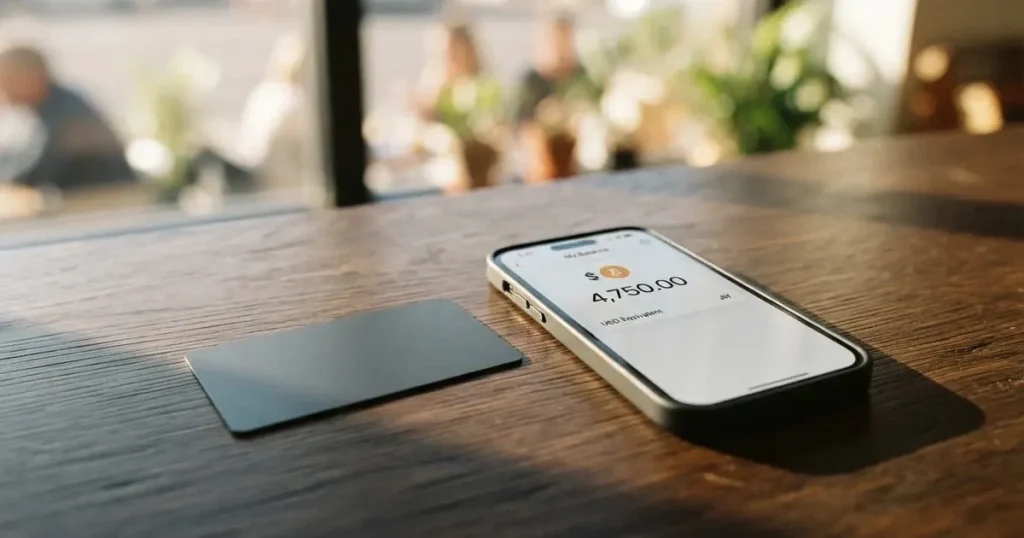
If you already hold crypto in a wallet of your own and you have had trouble getting an ordinary bank card — a declined application, a closed account, a card that works only in one country — the Oobit card exists precisely for that situation. It is a Visa Platinum card that spends from a self-custody wallet or from a balance inside the app, and Oobit says it is available in 75+ countries. That is a genuinely useful thing to have. The catch is that it is not a bank account, it is not anonymous, and it is not free to use: every card purchase costs 1%.
I went through the card’s own pages, its help centre and its app store listings, then read the user reviews underneath. My score is 6.8 out of 10. That is not a bad score. It is a “works, with conditions” score — good enough for the specific person it was built for, not good enough for someone who wants a plain everyday debit card with predictable statements and no crypto in the picture at all.
The terms and figures below are current as of October 28, 2026.
Verdict: 6.8 out of 10
| Criterion | Score | Why |
|---|---|---|
| Who can get it | 7 / 10 | 75+ countries: 43 in Europe, 10 in Asia and the Middle East, 17 in the Americas, 3 in Africa, 2 in Oceania |
| Cost | 7 / 10 | Issuance and servicing are free; purchase 1% (minimum $0.25), ATM 2.5% (minimum $0.25), conversion 0.95% |
| Top-up options | 7 / 10 | USDT, Bitcoin, Ethereum and other stablecoins; connect MetaMask, Phantom, Trust Wallet or Base; networks are not named |
| Reliability and complaints | 5 / 10 | Issuer not named; Trustpilot 3.8 out of 5 from 495 reviews: held funds, card blocks, slow support |
| Everyday use | 8 / 10 | Virtual Visa, Apple Pay and Google Wallet, ATM up to $250 per withdrawal; physical card not named |
| Total | 6.8 / 10 | Strong on reach and everyday convenience, weak on trust and transparency |
The highest single mark is everyday use, at 8. It earns that because a virtual Visa you can drop into Apple Pay is exactly what most people want from a crypto card, and the ATM ceiling of $250 per withdrawal is generous for the category. Cost comes next at 7 — there is no issuance fee and no monthly fee, which puts Oobit ahead of cards that charge $50 to $200 a year for a metal version, but the 1% on every purchase is real money on a $40 shop.
The weak spot is reliability and complaints, at 5. That is not a marketing judgement; it is what the score reflects when the issuer is not named on the public pages and 495 public reviews average 3.8 out of 5 with held funds and suspended cards among the recurring themes. A card that spends your money is only as good as the company standing behind it, and that company is not clearly identified.
Who does this suit? Someone who already thinks in crypto, keeps their funds in a self-custody wallet, and wants to pay for things directly from it without sending the money to an exchange first. Someone who travels and wants one card that works across many countries. Someone who cannot open a conventional bank account, and who has accepted that a card provider will look at their identity documents.
Who does it not suit? Anyone who wants the protections of a bank deposit. Anyone who needs a physical plastic card in the post — the card I can confirm is virtual, and the physical version is not stated either way. Anyone who cannot live with a 1% fee on every shop. Anyone in a hurry: if you need your money back through a bank transfer, the fee on that is not specified on the public pages, and that alone can be a deal-breaker at the scale of a real transfer.
Will they give you the card
The card is available in 75+ countries, with the distribution covering 43 in Europe, 10 in Asia and the Middle East, 17 in the Americas, 3 in Africa and 2 in Oceania. Named European countries include the UK, Germany and Spain. Named African countries are Kenya, South Africa and Tanzania.
That list is the single most useful thing about Oobit for many readers, because the typical blocker for a crypto card is not eligibility in principle but a narrow country list. 75 countries is a long list. Two countries from the region list are worth knowing about: Georgia, Serbia, Kazakhstan, Kyrgyzstan and the UAE are listed, while Turkey and Armenia are not listed. Russia and Belarus appear on the “Not supported in” list.
There is no citizenship rule stated on the pages I could read. What is missing, and what you should check yourself before you spend an afternoon on the application, is the full country list — it is on the support site and was not read for this review. If your country is not one of the 75, do not assume.
One thing to understand about how these things are built, because it explains why the list looks the way it does. A payment card number begins with six or eight digits that identify the issuing institution. Merchants look those digits up and can see which institution and which country issued the card, and some apply extra scrutiny when the issuer country differs from the address you type at checkout. That is why a card issued in one country can look foreign to a shop in another, and it is a structural feature of card issuing rather than something Oobit does differently. A crypto card is frequently run by an e-money institution that is not the same company you have an account with: the network routes the payment, a licensed issuer holds the card programme, and the crypto brand is often the front end. Oobit says it operates through multiple entities globally, and in the US its crypto services run in partnership with Bakkt Financial Solutions I, LLC. The card issuer itself is not named — the pages say only that it works with “licensed partners depending on your location”.
How to get it
Getting the card means installing the app, completing identity verification, and requesting a virtual Visa card in the app. The card has a status that moves from Pending to Active once it is issued, and it can be added to Apple Pay, Google Wallet or a smartwatch. Delivery of a physical card, and any replacement cost, is not stated — so if you need plastic in the post, that is a question to ask support before you commit.
Verification is mandatory. You need a passport or a driving licence, and sometimes proof of address. There is one more step worth knowing about: bank transfers need a one-time proof of address before the first payout. Most accounts are verified in minutes, though some take up to 24 hours. If yours is rejected, the documented causes are expired documents, unclear photographs, or a mismatch between the document and the details you typed; the fix is to resubmit in the app.
Is Oobit a bank? No — the public pages do not describe it as one, and it is not described as a bank anywhere I could find. It is a card programme manager sitting on top of a licensed issuer. That distinction matters more than it sounds. An electronic money institution in the EU can issue e-money, payment cards and wallets, but it cannot lend, and its customer funds must be safeguarded in segregated accounts or insured — funds that are not the same as a bank deposit and may sit outside any deposit guarantee scheme.
Two age and identity points that are worth stating plainly. Prepaid and debit cards are generally available to adults of 18 and over, and some issuers set higher limits. And under anti-money-laundering rules, if due diligence cannot be completed, the institution is required to hold off on the transaction or the relationship and, where necessary, end an existing one. That is the legal background to the card blocks and pauses people write about in reviews. It is also why your nationality is screened separately from where you live: sanctions checks often apply to citizenship and country of birth as well as to your address.
Fees: what it really costs
There is no issuance fee and no monthly fee stated. What there is, is a per-transaction charge.
| Fee or limit | Value |
|---|---|
| Card issuance | Free |
| Monthly fee | Not stated on the page; account creation, card issuance and holding described as free |
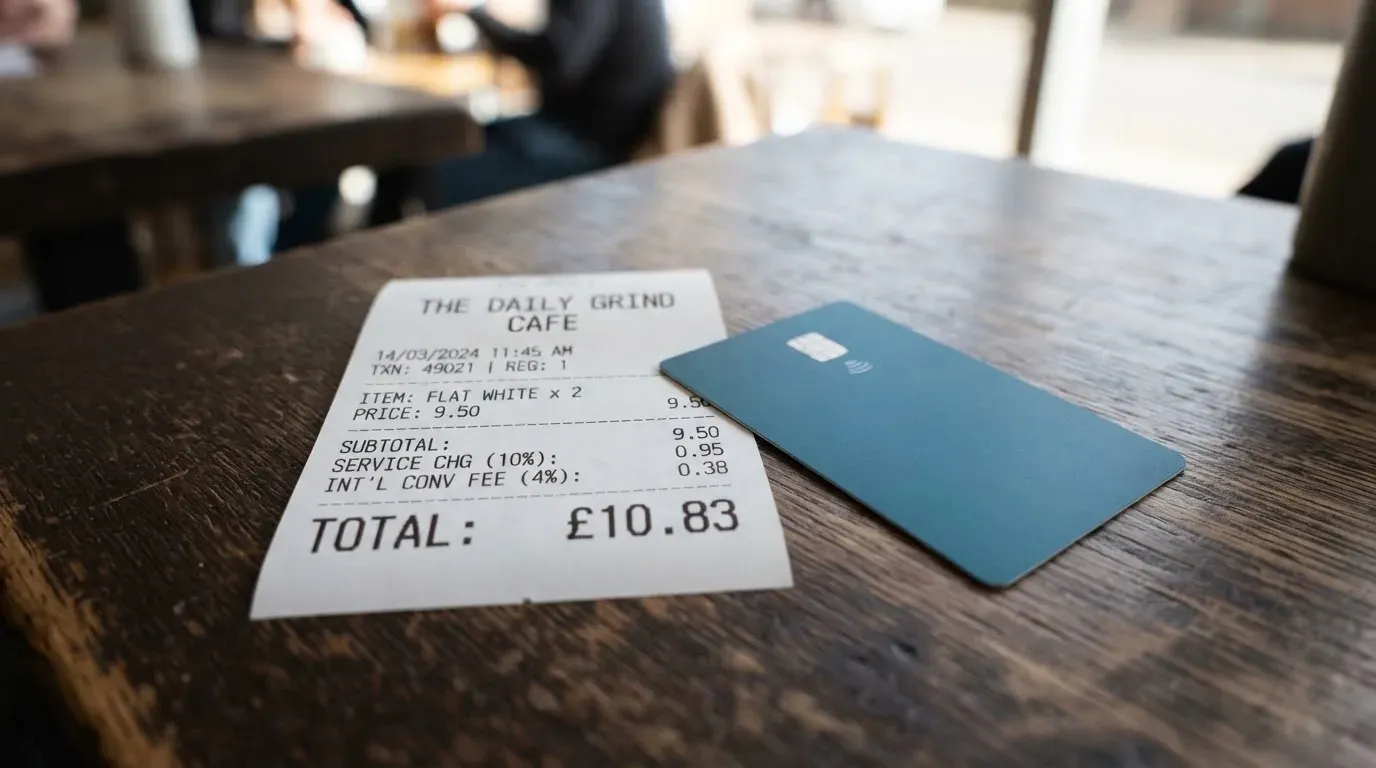
| Card purchase | 1%, minimum $0.25 (Brazil: 1% with no minimum, plus IOF and FX charges) |
| Conversion / swap | 0.95%; 3% when receiving OOB |
| FX fee | Not separately stated; Visa settles in local currency |
| ATM withdrawal | 2.5%, minimum $0.25, plus any fee the ATM operator charges |
| Free allowance | Not stated |
| Card purchase limits | $1 to $2,000 per purchase, up to $25,000 per rolling 24 hours (one FAQ page says up to $10,000 per day — the two official pages differ) |
| ATM limits | Up to $250 per withdrawal including operator charges, 3 attempts per 24 hours |
| Swap limits | $5 to $10,000 |
| Crypto withdrawal | $1 to $50,000 per withdrawal ($5 minimum for US residents), daily limit per asset (amount not stated) |
| Bank transfer out | Up to $50,000 per transfer, minimum €10 / £10 / $10; fee not specified |
| Card inactivity | A card unused for 90 days is cancelled; a new one can be requested |
Now let us walk three ordinary payments through that table, because “1%” means very different things depending on what you buy.
A $4.80 coffee. The purchase fee is 1% with a $0.25 minimum, so you pay 4.8 cents and the minimum takes over: 5.2 cents. On a small purchase the minimum is what you actually feel, and it is the reason small daily buys are where these cards are weakest value-wise. If the coffee is in a country that is not the US, the local-currency conversion is on top, and the FX fee is not separately stated — one Trustpilot reviewer reported about 7% on non-USD payments on 24 August 2026, which is that person’s account, not a figure Oobit has confirmed.
A $180 flight. One per cent is $1.80, well clear of the minimum. Here the FX question matters more than the fee: the card settles in local currency over the Visa network, so an airline pricing in dollars while you pay in euros puts the conversion spread in front of you with no stated FX line to point at. In Brazil the picture is stated more concretely — 1% with no minimum plus IOF and FX charges — and a local and an international card can coexist there.
$60 out of a cash machine. The withdrawal fee is 2.5% ($1.50) with a minimum of $0.25, then whatever the ATM operator charges on top. So your $60 becomes $61.50 before the operator’s own charge. Three attempts per 24 hours, $250 ceiling per withdrawal including the operator’s fee. That ceiling is high for this category and is the reason everyday use scored well, but the percentage is the highest on the card and it is the one to think about twice.
Two further fee notes that are not obvious. Network fees for a deposit are charged by the blockchain, not by Oobit. And there are reward levels rather than paid tiers: one card, no paid upgrades, and points that scale with cumulative spend over a 90-day cycle — Level 1 at $0 gives 1x, Level 2 at $250 gives 2x, Level 3 at $500 gives 3x, Level 4 at $1,000 gives 4x, Level 5 at $1,500 gives 5x, with 1,000 points worth $1. Stablecoin rewards are 5% of eligible payments up to $200 of spend, or 10% if you hold OOB tokens, up to $5,000 of spend. Read that second one carefully: the headline 10% is a real figure, and the cap that goes with it is $5,000, so the number in the advert is not the number you will get on your normal spending.
Top up: how money gets into the card
This is where Oobit is more interesting than a plain prepaid card, and also where the detail is thinnest. There is no preloading step required: the card pays from a connected self-custody wallet through DePay, or from the Oobit balance. Supported assets are named as USDT, Bitcoin, Ethereum and other stablecoins, and you can connect MetaMask, Phantom, Trust Wallet or Base. The networks are not stated.
That missing detail is the one thing I would not skip. Transfers are irreversible, so a deposit sent on a network the provider does not support, or to an address belonging to a different network, can be lost or need manual recovery with no guarantee attached. If the card provider names no networks on its public pages, find out which ones are accepted before you move anything of size. A deposit minimum of $0.10 applies to crypto, and if you are buying crypto with fiat rather than sending it, the limits are set by Transak and shown at checkout. Fiat top-up fees are not stated. A withdrawal to an external wallet shows its network fee before you confirm it.
Getting money back out is where the picture is most complete and, honestly, most usable. Crypto withdrawal runs from $1 to $50,000 per withdrawal, with a $5 minimum for US residents and a daily limit per asset that is not quantified. Bank transfers go up to $50,000 per transfer with a minimum of €10, £10 or $10 — and the bank-transfer fee is not specified, which for a large withdrawal is not a small omission. Failed bank transfers are automatically refunded to the balance, which is at least something.
If you close the account, you can do it in the app or through Support. What happens to a remaining balance on closure is not stated, so drain it first rather than assuming.
Paying with it every day
This is the part Oobit does best. The card runs over the Visa network and settles in local currency, and it can be added to Apple Pay, Google Wallet or a smartwatch. That is the everyday experience: no plastic to lose, unlock and pay. When you add a card to Apple Pay, the card number on the device is replaced with a device-specific number stored in the phone’s secure hardware, never on Apple’s servers, and each payment uses a one-time security code. You can also lock the card in the app instantly.
The app is on iOS and Android. The site shows ratings of 4.8 on the App Store from 22K+ reviews and 4.7–4.8 on Google Play from 25K+; the US App Store listing itself showed 4.5 from 134 ratings, iPhone only, requiring iOS 15.4+, on 20 October 2026. Both figures come from the same product and they disagree, which usually means regional listings rather than anything sinister — but check your own store in your own country rather than trusting either.
Two things about daily use that the card does not spell out. Which merchant categories are blocked is not stated, so you cannot tell from the public pages whether gambling or any other category is off-limits; blocked lists vary by issuer anyway. And what the rewards actually pay out in, and what the caps are, is not stated, even though the headline is “10% Cashback Anywhere” and the FAQ speaks of cashback and 5x Rewards points on card purchases from level 1.
One scenario worth rehearsing before it happens to you. If a payment is declined, the documented response is to check the in-app notification and retry. If a merchant charges more than the amount first approved — an authorisation hold, a tip, a petrol pump, a hotel — the difference can leave your balance negative and the card paused. Declined authorisations can also leave a hold on funds that stays for days, typically up to seven. If a card is suspended and support is slow, a small buffer above what you actually need is worth keeping.
What can go wrong
Start with the most concrete risk, which is the company behind the card. The issuer is not named on the public pages, which means that if something goes wrong, the entity you would complain to is not the one whose name you would recognise. In the US, crypto services run in partnership with Bakkt Financial Solutions I, LLC; globally, Oobit Technologies says it operates through multiple entities. In December 2025 there was a US launch via Bakkt covering all 50 states, and in November 2025 an expansion to South Africa, both reported at the time; no 2026 licence news surfaced.
Then the reviews. On Trustpilot, Oobit sits at 3.8 out of 5 from 495 reviews as of 20 October 2026, with no recent history of asking for reviews, which makes the number more meaningful rather than less. The recurring themes are held or missing funds between July and September 2026, an unresolved Amazon refund on 8 October 2026, unresponsive support from July to October 2026, card suspension and account blocks in July and September 2026, and opaque fees in August 2026. Individual reports include a deposit from another wallet that never arrived with no support response in April 2026, high fees converting USDC and EURC to euros and on withdrawals in March 2026, a delayed USDC-to-BTC conversion in March 2025, and an LTC transaction not accepted within two hours in February 2025, to which Oobit replied that delays can come from network conditions. Oobit answers 100% of negative reviews, often with a template — that is worth something, and a template answer is worth rather less than a specific one.
On the company side, the official record is quiet: no official incidents were found, and no Reddit threads surfaced. The page figures for merchant reach are inconsistent (175M versus 150M), which is a small thing but tells you the marketing pages are not tightly maintained.
There is a structural risk that is easy to underestimate. Programme closures happen. Visa terminated its global agreements with FTX on 13 November 2022 and the FTX US debit card was wound down by its issuer; WaveCrest, a Visa card issuer that supplied crypto card brands, was suspended by Visa in Europe in 2018, closing every WaveCrest-issued programme. When that happens the sequence is always the same: a notice period, then spending and loading stop, then you are asked to withdraw whatever is left. One 2026 closure reported by a secondary source ended new loads on 8 July 2026 and spending on 8 August 2026, though that is a single unconfirmed source. The general lesson is that a balance sitting in a crypto card is not a balance you can leave indefinitely and forget.
If you lose money through fraud or a bad transaction, the recovery routes are thinner than with an ordinary bank card. No formal card dispute process is described in the help centre. A chargeback is a refund ordered by the issuer, with reason codes for fraud, duplicate billing or goods not received, and US rights come from Regulation E for debit and Regulation Z for credit — prepaid coverage varies and should not be assumed. On the positive side, 3-D Secure can shift liability for a fraudulent online payment away from you, though the direction of that shift is contested.
And the risk that belongs to you rather than to them. Self-custody means the crypto stays in your wallet until you authorise a payment — the honest upside is that a provider failure cannot take it — but it also means you carry the whole burden of key loss, phishing, and clipboard malware that silently swaps a copied address. Transfers are typically irreversible and a stolen key has no recovery path: the network cannot freeze or return the funds. For scale, custodial platforms have a real history of failure — Mt. Gox with roughly $350 million reported stolen in 2011–2014, Coincheck around $400 million in 2018, and Ronin Network $625 million in 2022. Oobit also claims bank-grade encryption and real-time blockchain monitoring, and offers a lock in the app; what is not stated is two-factor authentication, insurance, or a safeguarding policy, so do not read the marketing line as an answer.
One last thing, and it is not the card’s fault. Tax treatment follows from the crypto side, not the card. In the US the IRS treats digital assets as property, so exchanging them for goods, services or dollars generally produces a taxable gain or loss, measured in local currency at fair market value on the date of the transaction — which means each card payment funded from crypto can be a separate disposal. I am not offering tax advice; if your situation is more than a handful of payments, that is a question for a professional in your own country.
What to take instead
Three alternatives came up in my comparison, and each fails in a different direction, which is the point of showing them.
TokenPocket, scored 5.8 out of 10. Its coverage is the widest on paper: a Visa debit for a list of European countries and territories including Germany, France, Spain and Switzerland, and Mastercard debit for Australia, Canada, Hong Kong, Japan, Taiwan, New Zealand, Singapore, South Korea and the UK, with the Americas planned for Q2 2025. Cards run on Arbitrum and balances are held in EUR24 and USD24; Fiat24 cards are virtual. The catch is the fee structure: 1% on depositing cryptocurrency into the card, described as refunded later through rewards or reduced transaction fees. A refund later is not a refund now, and no cashback figure is stated. Specific coins and networks are not listed in the FAQ.
MetaMask, scored 7.1 out of 10 — the highest of the three. Sign-up is open in 45 listed countries and territories including Andorra, Argentina, Brazil, Canada, Mexico, Germany, France, Spain and Uruguay, with other regions on a waitlist and US/UK sign-ups temporarily closed per the FAQ. Proof of residency is required, and the honest framing is that ineligible regions limit sign-ups, not spending. It issues a virtual Mastercard instantly, with a metal card pre-orderable afterwards and one card per user; the issuer is Monovate and the card provider Crypto Life. The virtual card is free with no annual or maintenance fee; the metal one is $199 a year. Fees are described as a minimal per-transaction amount, with no additional MetaMask fees and no foreign transaction fee — but the amount itself is not stated on the pages read. It spends directly from the connected wallet on Linea, Base, Monad and Solana, holding mUSD, wETH, EURe, GBPe, USDC and USDT, and pays 1% cashback in mUSD on the virtual card (3% on metal up to the first $10,000 spent, then 1%).
KAST, scored 6.1 out of 10, and the one with the most transparent pricing in this whole comparison. It offers virtual and physical cards, up to 10 per user, in Visa Platinum Standard, Visa Infinite metal Premium and Visa Infinite gold plated Private, plus other designs. Stablecoin top-up is 0%, card spend in USD is 0%, transaction fee is 0%, Apple and Google Pay are 0%, and the non-USD FX fee is 0.5%–1.75% depending on your residence, the transaction country and the card programme; non-USD transactions under $25 cost $0.10 and a declined transaction costs $0.50. Stablecoin deposits convert 1:1 with a 0% spread. What balances that is cost elsewhere: Standard is $0 a year, Premium is $1,000 a year and Private is $10,000 a year, billed annually upfront, with a $2 fee for an extra virtual card, a 40 USD delivery fee on the Standard physical card, and a $1 monthly inactivity fee after 12 months. It also accepts USDT, USDC, PYUSD and RLUSD on Ethereum, Solana, Polygon, Arbitrum and TRON, though its own terms say the acceptable tokens are “currently USDT and USDC” — a contradiction worth noticing in any provider’s documentation.
| Oobit | MetaMask | KAST | TokenPocket | |
|---|---|---|---|---|
| Score | 6.8 / 10 | 7.1 / 10 | 6.1 / 10 | 5.8 / 10 |
| Reach | 75+ countries | 45 countries/territories listed | Residence list shown at KYC, not published | Europe, Asia-Pacific; Americas planned |
| Purchase fee | 1%, min $0.25 | Minimal fee, amount not stated | 0% on USD spend | 1% on crypto deposit |
| Annual cost | None stated | Free (virtual); metal $199 | $0 / $1,000 / $10,000 by tier | Not stated |
| Card | Visa Platinum, virtual | Mastercard virtual, metal optional | Visa virtual and physical | Visa/Mastercard debit, virtual |
| Cashback | 10% headline, caps apply | 1% virtual, 3% metal to $10,000 | 1.5% / 2% / 3% USD by tier, capped | None stated |
My read on that table: Oobit is the broadest of the four for reach and the cheapest to hold. MetaMask is the strongest all-rounder if your country is on its list and you will use the virtual card. KAST wins outright on transaction costs but charges like a private bank for the privilege, so it only makes sense if you spend enough to earn that back. TokenPocket I would think twice about, because a fee that is refunded later is a fee you are paying now.
Who I would recommend it to
I would recommend the Oobit card to three people in particular.
First, the self-custody user. If you keep your crypto in MetaMask, Phantom, Trust Wallet or Base and you would rather spend it directly than route it through an exchange, the design fits: with DePay the crypto stays in your wallet until you authorise the payment. You take on the key-management risk knowingly, and in exchange nobody can freeze the balance because of a company decision. That is a real trade, and for someone who has already made it, it is a good one.
Second, the person without a usable ordinary card. If you have been declined, closed or refused a bank card, this is the practical answer. Seventy-five-odd countries, a virtual Visa, Apple Pay, and no dependence on a local banking relationship. Just check that your country is on the actual list rather than on my summary of it.
Third, the frequent traveller who wants one card in many currencies. It settles in local currency over the Visa network, which is the right default for spending abroad.
I would steer everyone else elsewhere or towards caution. If you need deposit protection, a physical card in the post, a formal dispute process, or a written fee for a bank transfer out, this is not the card. And if you are the kind of person who reads the 1% on a purchase and the missing issuer name and feels uneasy, that feeling is data — take it seriously and pick the option whose company you can name.
Whichever you pick, do three things before you rely on it: confirm your country and your eligibility on the provider’s own support pages, send a small test amount first and watch it arrive, and withdraw a small amount back out to prove the path works. Then keep only what you need on the card, not what you would mind losing.
Frequently asked questions
What is the Oobit card?
Oobit is a crypto payment card issued in the Visa Platinum category that spends from a connected self-custody wallet or from a balance held in the Oobit app. Transactions run over the Visa network and settle in local currency. It is described as a Visa Platinum card with a virtual version issued in the app, and Oobit says it is available in more than 75 countries. It is not a bank account and it is not anonymous.
How does Oobit card work?
You install the app, complete identity verification, and request a virtual card, which moves from Pending to Active. At payment, either your crypto leaves your own wallet through DePay after you authorise it, or it is drawn from your Oobit balance. The card then behaves like an ordinary Visa: you can add it to Apple Pay or Google Wallet, pay online or in person, and withdraw cash. Nothing needs to be preloaded.
Is Oobit a bank, and who owns it?
No, Oobit is not described as a bank. Oobit Technologies says it operates through multiple entities globally, and in the US its crypto services run in partnership with Bakkt Financial Solutions I, LLC. The card issuer is not named on the public pages, which refer only to licensed partners depending on your location. That matters because the entity you would complain to is not the brand you signed up with.
Is the Oobit card available in my country?
Oobit says the card is available in 75+ countries, and the breakdown behind that figure is 43 in Europe, 10 in Asia and the Middle East, 17 in the Americas, 3 in Africa and 2 in Oceania. Named countries include the UK, Germany, Spain, Kenya, South Africa, Tanzania, Georgia, Serbia, Kazakhstan, Kyrgyzstan and the UAE. Russia and Belarus are on the not-supported list.
How much does the Oobit card cost to use?
Card issuance and account holding are free with no monthly fee stated. Card purchases cost 1% with a minimum of $0.25, ATM withdrawals cost 2.5% with a minimum of $0.25 plus any ATM operator fee, and swaps cost 0.95%, or 3% when receiving OOB. No FX fee is separately stated. In Brazil the purchase fee is 1% with no minimum, plus IOF and FX charges.
Why do I need to verify my identity, and what do I need?
Verification is mandatory, and you need a passport or driving licence, sometimes with proof of address. Bank transfers need a one-time proof of address before the first payout. Most accounts are verified in minutes and some take up to 24 hours. Rejections usually mean expired, unclear or mismatched documents, and you resubmit in the app.
How do I top up the Oobit card?
No preloading is needed — the card pays from a connected wallet or your Oobit balance. Supported assets include USDT, Bitcoin, Ethereum and other stablecoins, and you can connect MetaMask, Phantom, Trust Wallet or Base. Crypto deposits start at $0.10, networks are not stated on the public pages, and network fees are paid to the blockchain. Test with a small amount first.
Is the Oobit card safe and is the money insured?
The card can be locked in the app, and Oobit describes bank-grade encryption and real-time blockchain monitoring, but two-factor authentication, insurance and a safeguarding policy are not stated on the pages I read. Trustpilot shows 3.8 out of 5 from 495 reviews, with held funds, unresolved refunds, card blocks and opaque fees as recurring themes. Assume you are dealing with a payment provider, not a bank.
What are the limits?
Card purchases run from $1 to $2,000 each and up to $25,000 per rolling 24 hours, though one FAQ page says $10,000 a day, so the two official pages differ. ATM withdrawals are capped at $250 including operator charges, with three attempts per 24 hours. Swaps run $5 to $10,000, and crypto withdrawals $1 to $50,000 per withdrawal, with $5 minimum for US residents.
How do I close my account and get my money out?
Account deletion is done in the app or through Support, but what happens to a remaining balance on closure is not stated, so withdraw it first. Bank transfers go out up to $50,000 per transfer with a minimum of €10, £10 or $10, and the transfer fee is not specified — that omission alone can decide whether this is the right card for you. Failed bank transfers are automatically refunded to your balance.
Wallet cards put to the test – cryptocardtested
Content created by the «cryptocardtested» team