
The card that publishes almost nothing: what a Digital Treasures review can and cannot tell you
 Available in US
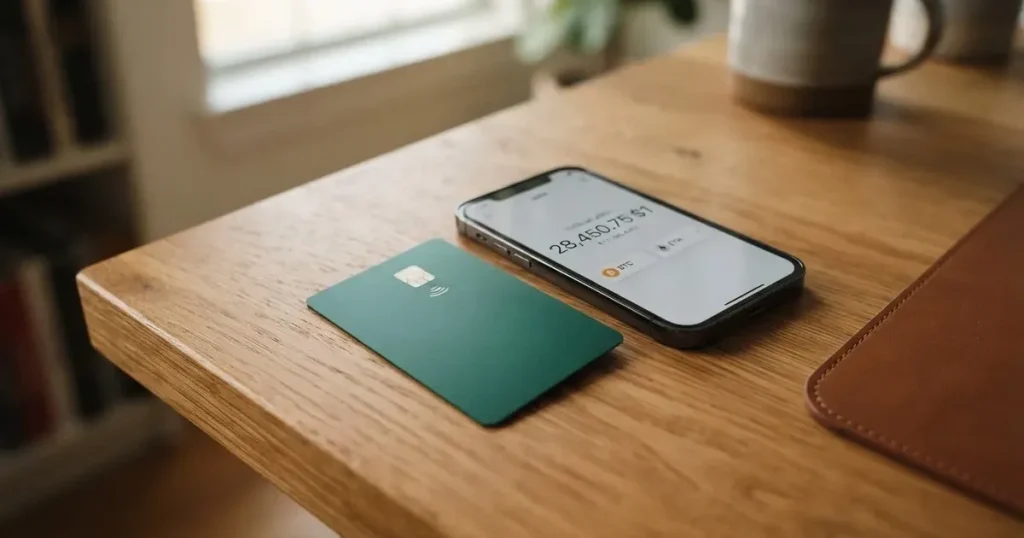
I have read the Digital Treasures Card’s public pages, the coverage of its launch, the terms that were quoted at the time, and the complaint record that sits behind the brand. What follows is what I found, set out in the order you would need it: whether you can get it, what it costs, how money goes in, what happens when you pay, and what can go wrong. There is a great deal here that the card’s own public pages simply do not say, and I will mark those gaps as plainly as I mark the facts.
If you came here looking for a number — the monthly fee, the conversion percentage, the daily spending cap — you will not find it, and that is not me being evasive. It is the finding. The one commercial promise that is published is the phrase “competitive exchange rates” for the real-time stablecoin-to-fiat conversion, and no digits come with it.
The conditions described below are current as of October 28, 2026.
Verdict: 4.7 out of 10
The Digital Treasures Card scores 4.7 out of 10. It is a thin file: one card, one clear technical idea, and a great deal of silence. The idea is not bad — convert stablecoins into fiat in real time and spend the result on a Visa Infinite card that works in ordinary shops — and for one specific person that idea is genuinely useful. For everyone else, the absence of published fees, limits, eligibility rules and an issuing bank makes it impossible to compare the card against anything else, including a plain bank card.
Who it suits: someone who already holds a large stablecoin balance, converts it to fiat regularly, and spends in high-value transactions where a premium card’s usual benefits matter. That is the picture: high-net-worth holders converting stablecoins to fiat on a Visa card. Who it does not suit: anyone who needs a bank card they can rely on day to day, anyone in a hurry, and anyone who would be guessing at the fee.
| Criterion | Mark | Why |
|---|---|---|
| Who can get it | 4 / 10 | Countries are not disclosed officially; unofficial accounts describe a card aimed at ultra-high-net-worth clients, issued from Singapore, with the United States excluded |
| Cost | 5 / 10 | Issuance, monthly fee and ATM charges are not disclosed; only “competitive exchange rates” without figures |
| Top-up options | 6 / 10 | Stablecoins converted to fiat in real time via the dtcpay Wallet app; USDT, USDC, BTC and ETH in the starting data, networks not named |
| Reliability and complaints | 4 / 10 | Digital Treasures Center Pte Ltd, Singapore, describes itself as an MAS-licensed Major Payment Institution; the issuing bank is not named; Trustpilot shows 2.6 out of 4 reviews |
| Everyday use | 5 / 10 | Visa Infinite; virtual or physical; Apple Pay and Google Pay; ATM terms not disclosed |
| Total | 4.7 / 10 |
Note what the top-up row does: it is the strongest of the five, and it is strong on mechanism rather than on price. You can describe the plumbing. You cannot describe the cost of using it, which is precisely the thing that decides whether a conversion is worth doing.
Will they give you the card?
Officially, the answer is not published. The card’s public pages do not say which countries qualify, how much you need, what your status must be, or whether your nationality is relevant. That is the honest headline of this section, and I want to keep it visible rather than bury it under the unofficial material.
What circulates outside the official pages, and which I am giving you as unofficial and not confirmed by the card, is this: per Fintech News Singapore in February 2025, the card targets ultra-high-net-worth individuals. And in the starting data — the initial description the project began from — the card is presented as Singapore-issued, with the United States excluded under the issuer’s terms. Again: not confirmed by a readable official source.
So the honest picture is of a narrow, invitation-shaped product aimed at a small circle of wealthy clients, not an open consumer card. If you are reading this because you cannot get an ordinary bank card where you live, you should assume with the working hypothesis — not as a fact — that this is not aimed at you. If you are a high-net-worth stablecoin holder with a legitimate reason to convert to fiat, you may already be in the intended audience. Either way, the way to find out is to go to the app, and the way to be sure about eligibility is to ask them in writing before you send anything.
How to get it
The application runs through the dtcpay app — that is the unofficial account from Fintech News Singapore, February 2025, and the app is named as the place where you apply and where you fund the card. That much at least is concrete.
What the card’s public pages do not state: what identity verification involves, or at what level; how long delivery takes if you get a physical card; whether you choose between virtual and physical; what the card currency is; or whether there are verification tiers.
Read that list again, because each gap is a question you would otherwise have to discover the answer to by trying. “Does this require KYC?” is not answerable from public materials. If that is a blocker for you, it is a blocker at the application stage, and you would rather find out from them than from a rejection. Ask, before you send anything: what documents are required, what the review time is, whether you receive a physical or virtual card, which currency the card holds, and which countries you may use it in.
Fees: what it really costs
This is the section where the card’s silence is most consequential, so I will be blunt: issuance fee, monthly fee, ATM charges, daily limits and monthly limits are not stated in the public sources, and neither is the card currency. There are no tiers either — this is a single card, the Visa Infinite — so there is no published schedule that would let you work out which band you would fall into.

| Fee or limit | What is published |
|---|---|
| Issuance fee | Not stated |
| Monthly fee | Not stated |
| Stablecoin-to-fiat conversion | “Competitive exchange rates” only — no figures published |
| ATM withdrawal | Not stated |
| Card currency | Not stated |
| Daily limit | Not stated |
| Monthly limit | Not stated |
Now let me walk three ordinary payments through what is actually knowable, because that is how you test whether the missing numbers matter.
A coffee. You pay. The Visa network routes it, the issuer authorises it, the balance moves. What you pay beyond the price of the coffee is not published — there is no conversion figure to compute it against, and if the card converts from a stablecoin at the moment of payment, the spread is somewhere inside that unpublished conversion rate. Nobody can tell you what this coffee cost in fees. That is the point.
An online subscription. Here other things can enter the picture that are outside the card’s own fee list. Online payments typically run a 3-D Secure check — Visa’s brand of it is Visa Secure — where the issuer decides frictionlessly or challenges you with a one-time code or a biometric prompt. Address verification also matters: the AVS comparison of the numeric parts of your billing address against issuer records is mainly offered in the US, Canada and the UK and is generally unavailable for foreign-issued cards, which can cause declines. For a card whose issuer country is not published to you, that is a real category of friction, and no merchant category or blocklist is published for this card either. Some merchants decline prepaid or foreign BINs because the BIN lookup reveals the issuer and the country.
An ATM withdrawal. Not disclosed. No amount, no per-transaction charge, no monthly allowance. If cash matters to you at all, this is a question to ask before you rely on the card, not after.
Two further costs belong to the wider category rather than to this card’s published terms, but you will meet them. Network fees for your deposit are charged by the blockchain, not by the card provider. And a declined authorisation can leave a hold on your funds for several days — typically up to 7 — so an ordinary shop-side hiccup can strand money out of your balance.
Top up: how money gets in
This is where the card is clearest, and it is worth saying so plainly, because a review that only lists gaps is not much use to anyone.
Stablecoins are converted to fiat in real time through the dtcpay Wallet app. The coin becomes spendable balance as you use it, rather than sitting on-chain waiting for you to sell it somewhere else first. In the starting data, USDT, USDC, BTC and ETH are the assets named. Networks are not stated — which, as I will come to, is not a small gap.
Other top-up routes and withdrawal terms are not stated.
The network gap is the one I would press hardest on. Here is why, in general terms about this category of card. Blockchain transfers are irreversible, so a deposit sent on a network the provider does not support, or to an address belonging to a different network, can be lost or need manual recovery with no guarantee. Getting a network wrong is a known, common way to lose money, and with the networks not published here, you cannot check before you send. If you are depositing USDT, for example, know that Tether has issued it on networks including Ethereum, Tron, Solana, Polygon and Avalanche — so “USDT” alone tells you nothing about where to send it. And if you were thinking of USDC over Tron, Circle stopped supporting USDC on that network in February 2024, so that is not a native option. The correct procedure is simply to ask the provider which networks they accept, in writing, before your first transfer.
A further point on stablecoins generally, since you will be holding them long enough to use the card: they aim to be stable against a fiat currency, but as the BIS put it plainly in July 2025, stablecoins are not necessarily stable. Tether’s USDT and Circle’s USDC are US-dollar-pegged, and the BIS put about 90% of stablecoin market capitalisation in those two. Circle says USDC is redeemable 1:1 for USD and 100% backed by cash and cash equivalents, mostly in an SEC-registered government money market fund, with monthly reserve attestations. That is Circle’s position, and it is not the same as a bank deposit. USDC also temporarily lost its peg in March 2023.
Paying with it every day
The card is a Visa Infinite, called the Digital Treasures Card. Virtual or physical is not stated, and neither is the card currency.
Mobile wallets are supported — Apple Pay and Google Pay — which is genuinely the normal way most people would use a card like this. There is a reason this matters beyond convenience. In Apple Pay, the card number is replaced with a device-specific Device Account Number stored in the Secure Element, never on Apple’s servers, and each payment uses a one-time dynamic security code. You are not typing your card number into a café website, which removes a large category of risk you would otherwise take on every online purchase.
ATM access is not disclosed. Rewards, cashback or any incentive are not stated. Supported wallets and networks beyond Apple Pay and Google Pay are not stated. Most importantly: what to do when a payment goes wrong is not stated. No dispute process, no chargeback route, no timeframe. That is the single most useful piece of information to ask for, and it is the one most often missing from cards in this category.
| What you want to know | What is published |
|---|---|
| Card network and tier | Visa Infinite |
| Virtual or physical | Not stated |
| Apple Pay / Google Pay | Supported |
| ATM withdrawal | Not stated |
| Card currency | Not stated |
| Rewards or cashback | Not stated |
| Dispute and chargeback process | Not stated |
The card was announced with a wide acceptance footprint: the 2025 launch release put acceptance at over 150 million Visa locations, with an earlier release citing 130 million across 200-plus countries. Accepting places is not the same as being accepted everywhere — a foreign-issued card can still be declined at the counter, and some merchants avoid prepaid or foreign BINs outright.
What can go wrong
The most important risk here is not a fee. It is that the financial details you would need to judge this card are not published.
Beyond that, the complaint record deserves to be read carefully rather than quoted as a verdict. There is no official incident I found. But the third-party picture: Trustpilot reviews of dtcpay report blocked or inaccessible accounts, funds not returned, and allegations of fraud — user reports, spanning 2024 to 2026. The Trustpilot detail for dtcpay, company-wide rather than card-specific, is a TrustScore of 2.6 out of 5 from 4 reviews, all one star, dated January 2024, January 2026, May 2026 and July 2026; I read that on 2026-10-21. The themes are accounts blocked or missing, delayed or unreturned funds, fraud allegations and slow support. The company has not replied.
Four reviews is not a statistically meaningful sample, and one-star reviews on a company-wide page are not card-specific findings. But the pattern matters because of what it touches: account access and money coming back. Those are exactly the two things you would be relying on.
On the company itself: dtcpay is a brand of Digital Treasures Center Pte Ltd, Singapore, which describes itself as a Major Payment Institution licensed by the Monetary Authority of Singapore. The Visa partnership was announced in September 2024. The card-issuing bank is not named — and it is worth being precise about what that means. A card payment involves several parties: Visa routes the messages and sets the rules, the issuer holds the card programme and is the entity licensed to issue under Visa’s licence, and the crypto brand is often only a programme manager or front-end. When you cannot see who the issuer is, you cannot work out who you complain to when a payment goes wrong, or which deposit protection scheme, if any, covers your balance. Under EU rules, for example, electronic money institutions must safeguard customer funds by segregating them or insuring them, but such funds are not the same as bank deposits and may not be covered by deposit guarantee schemes.
Support terms are not stated. Security measures are not stated. There is a category-level pattern worth knowing about: programmes do close. Visa terminated its global agreements with FTX on 13 November 2022 and the FTX US debit card was wound down by its issuer. Visa also suspended WaveCrest in Europe in 2018, closing all WaveCrest-issued Visa programmes. Closures typically give notice, then stop spending and loading, then ask users to withdraw remaining balances. Visa and Mastercard do not issue crypto cards to consumers themselves; they license issuers and can suspend a programme.
Then there is the counterparty risk that comes with the model. Control of crypto belongs to whoever holds the private key or seed phrase. Where a provider holds the credentials, you must trust them completely, and transfers are typically irreversible with no built-in recovery. The category has a record: Mt. Gox, about US$350 million reported stolen between 2011 and 2014; Coincheck, about US$400 million in 2018; Ronin Network, US$625 million in 2022. Holding funds with a custodian carries counterparty and hack risk. Tether also says it disables tokens in wallets on the OFAC sanctions list and has frozen funds tied to illicit activity, so stablecoins are not censorship-proof.
And if a payment is disputed, what remedy do you have? US debit card reversal rights come from Regulation E and credit card rights from Regulation Z; prepaid-card coverage varies and should not be assumed. The card’s own dispute process is not stated here, so do not assume a prepaid-style balance is treated the same as a bank account balance.
I am not going to tell you how to get around any identity check, sanctions rule or country restriction. If the card’s terms exclude your country, that is the answer for you, and the honest one.
What to take instead
I want to be fair to the other cards in this category before I rank them: none of them publishes enough either. That is a real characteristic of crypto cards, and it is why every comparison below is a comparison of what is disclosed, not a verdict on quality.
| Card | Score | Card and form | Fees published | Top-up assets |
|---|---|---|---|---|
| Digital Treasures | 4.7 / 10 | Visa Infinite; virtual/physical not stated | Only “competitive exchange rates” | USDT, USDC, BTC, ETH |
| Cardex | 5.6 / 10 | Debit card on VERVE, Visa, Mastercard and UnionPay; virtual and physical; listing is Naira-focused | Real-time conversion at payment, “AI-Powered Conversion Rate”; no percentage stated | USDT, USDC, BTC |
| CardFlow | 4.9 / 10 | Virtual USD Mastercard, created in about 3 minutes | “Creating a virtual card is completely free”; monthly fee not stated | Bitcoin, USDT, ETH or Naira bank transfer |
| HyperCard | 4.7 / 10 | Prepaid; network not stated on the app-store page; balance in USD or EUR | None found | Crypto such as USDT, BTC, ETH, converted to USD or EUR |
Cardex scores highest of the four at 5.6. Its position is “one crypto card, 200+ countries” with no country list and no exclusions published; its app-store listing is Naira-focused, paying in Naira. It names four networks, which is more transparency about rails than the Digital Treasures Card gives you, and it publishes a description of how it picks a conversion rate — a scan of global exchange rates that selects the best one when you spend — though still no percentage.
CardFlow at 4.9 positions itself as “Nigeria’s smartest fintech card platform” for “Nigerians and global users”, with no country list or exclusions stated. Its one real advantage is a published price: creating a virtual card is completely free. A virtual USD Mastercard is a quick answer to “I need a card now”.
HyperCard sits level with this card at 4.7. Its app-store page says the card works in more than 176 countries — an acceptance claim, not an eligibility claim, which is an easy distinction to miss. Prepaid form, USD or EUR balance, crypto deposited in the app. No fees are listed anywhere on the pages I could read.
What this table actually shows is how thin the whole category is. If your problem is “I need a usable card quickly and I already hold crypto”, CardFlow’s free virtual card is the clearest first step. If your problem is “I hold a large stablecoin balance and want to spend it at scale on a premium card”, the Digital Treasures idea is the closest fit — but you are accepting the disclosure I have described to get it.
Who I would recommend it to
Three groups, in order.
You should look at this if you hold substantial crypto or stablecoins, you convert to fiat regularly, you spend in high-value transactions where a Visa Infinite’s usual benefits are worth something, and you are comfortable with a product that publishes almost no numbers and has a thin, one-star-skewed complaint record. In that situation the real-time stablecoin-to-fiat conversion inside the dtcpay Wallet app is a genuine convenience, and Apple Pay and Google Pay mean you would live in the mobile wallet rather than handle the card much.
You should look elsewhere if your priority is knowing what you pay. Any of the three alternatives will tell you more, and one of them will tell you the price of getting started. If your spending is ordinary — groceries, transport, subscriptions — an unpublished conversion rate is a problem with no workaround, because you cannot budget around a number nobody has published.
You should not rely on it as your primary card if you have no alternative. Blocked accounts, funds not returned and slow support are the recurring themes in the complaint record, the issuing bank is not named, the dispute process is not stated, and card programmes in this category have a documented history of closing. Put another card behind it.
And if you are in the position of trying to get a card at all — because the ordinary route is closed to you — my honest read is that this is a worse first step than CardFlow’s free virtual card. The reason is not that I expect trouble. It is that you cannot evaluate either, and the second one at least tells you its price.
Before you send anything, get four things in writing: which networks you can deposit on, what the conversion and monthly costs are, who the issuing bank is, and how a disputed payment gets resolved. If any of those four comes back vague, that is your answer.
Frequently asked questions
What is the Digital Treasures card?
It is a Visa Infinite card issued by Singapore-based Digital Treasures Center Pte Ltd, the company behind the dtcpay brand. Its distinguishing feature is that stablecoins are converted to fiat in real time inside the dtcpay Wallet app, so crypto you hold becomes spendable card balance without selling it elsewhere first. It launched in February 2025, after dtcpay and Visa announced a Singapore card launch in September 2024.
How does the Digital Treasures card work?
You apply and fund through the dtcpay Wallet app. Stablecoins are converted to fiat at the moment they are loaded, and the resulting balance spends on Visa. The card is described as available virtual or physical, supports Apple Pay and Google Pay, and was announced as accepted at over 150 million Visa locations. Exactly which wallets, networks and currencies are supported is not stated publicly.
Is Digital Treasures a bank?
No — it is not a bank. dtcpay is a brand of Digital Treasures Center Pte Ltd in Singapore, which describes itself as a Major Payment Institution licensed by the Monetary Authority of Singapore. The card-issuing bank is not named. That distinction matters because a licensed payment institution is not the same thing as a deposit-taking bank, and its customer funds are not bank deposits.
Who owns Digital Treasures?
The company behind the dtcpay brand is Digital Treasures Center Pte Ltd, registered in Singapore and self-described as an MAS-licensed Major Payment Institution. The Visa partnership was announced in September 2024. No individual owners are named on the pages I read, and the issuing bank behind the card is not identified.
Does the Digital Treasures card require KYC?
The card’s public pages do not say, so treat this as unanswered rather than as no. Any regulated provider will run identity checks as part of anti-money-laundering law — in the EU that means name, address, date of birth, nationality, documents, a sanctions check and a politically-exposed-person check — and where due diligence cannot be completed, EU rules require the institution to decline or end the relationship. Ask before you apply.
How do I top up the Digital Treasures card?
Through the dtcpay Wallet app: stablecoins are converted to fiat in real time, with USDT, USDC, BTC and ETH named in the starting data. Critically, the supported networks are not stated, and blockchain transfers are irreversible — sending on an unsupported network can mean losing the money. Get the supported networks in writing before your first transfer.
How much does the Digital Treasures card cost?
Nobody can tell you from the public pages. Issuance, the monthly fee, ATM charges, daily and monthly limits and the card currency are all not stated. The only published commercial claim is “competitive exchange rates” for the real-time stablecoin-to-fiat conversion, with no figures attached. So there is no honest way to calculate what the card costs you per year or per payment.
Can I use the Digital Treasures card in my country?
The eligible countries are not disclosed on the official pages. Unofficial accounts say the card is Singapore-issued, targeted at ultra-high-net-worth individuals, and excludes the United States under issuer terms — none of that confirmed by the card. Whether the card works where you are is separate from whether you qualify for it; both need asking directly.
Is the Digital Treasures card safe?
There is no official incident I found, but the record is thin and skewed. Trustpilot shows dtcpay at 2.6 out of 5 from 4 reviews, all one star, with reports of blocked accounts, unreturned funds, fraud allegations and slow support, and no company reply. Only 4 reviews is not a verdict — but with the issuing bank unnamed, safeguards unstated and a history of programme closures in this category, I would not make it a primary card.
Is the Digital Treasures card worth it?
Only if you already hold significant stablecoins and convert regularly enough that in-app conversion saves you real work — and only if you are comfortable without published fees. For ordinary day-to-day spending, the alternatives disclose more: CardFlow publishes free virtual card creation, Cardex names four card networks, and this card publishes neither price nor limits. If predictability matters to you, predictability is the feature you are buying.
Virtual cards put to the test – cryptocardtested
Content created by the «cryptocardtested» team