
ZAZO card review: a USDC card you can top up from your own wallet
 Available in US
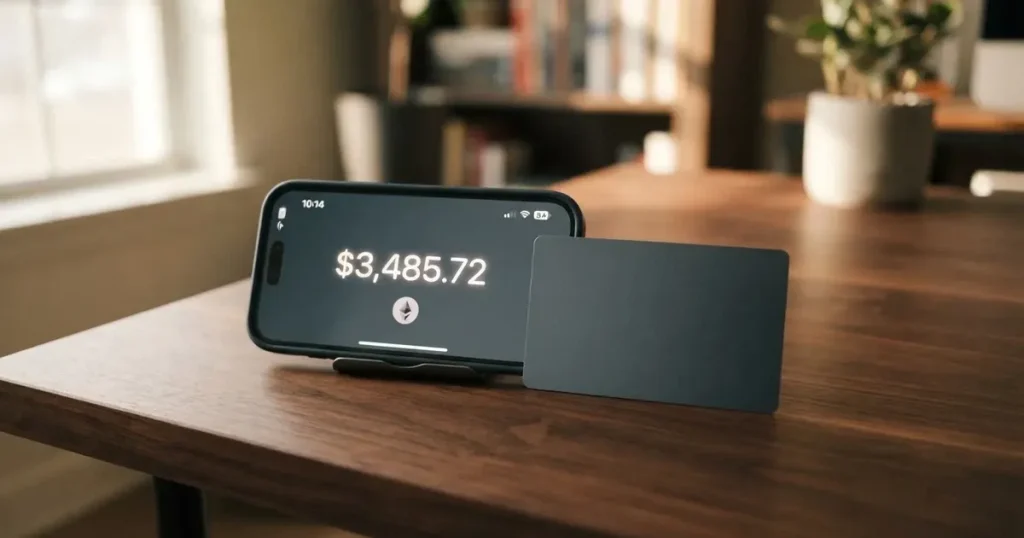
ZAZO is a payment card aimed at people who want to spend USDC from a crypto balance in everyday shops, without an off-ramp fee or a foreign-exchange spread. The marketing line is simple: load stablecoins, pay anywhere cards are accepted, earn a small cashback. The reality, as I found reading the card’s public pages and digging around for what isn’t published, is a little less complete. The score below sums up where the promise holds up and where I’d want more information before signing up.
Conditions on this page are current as of October 28, 2026.
Verdict
ZAZO lands at 6.8 out of 10 in my book. That’s a respectable middle-of-the-pack score for a crypto card, and it reflects a card that does a few things genuinely well (broad country reach, USDC settlement, no stated FX spread) and leaves a lot of operational detail to the imagination. If you live in one of the 170+ countries ZAZO says it serves, hold USDC in a non-custodial wallet, and want a low-friction way to convert that balance into card payments, ZAZO is worth a look. If you want a fully transparent fee schedule, a clearly named issuer, a published complaints history or a known support process, this is not yet the card to commit a large balance to.
The breakdown by criterion is below. The numbers are the card’s own scoring, with my reasoning underneath.
| Criterion | Score | Why it lands there |
|---|---|---|
| Who can get it | 9 / 10 | “170+ countries” — a very wide list, but the actual countries aren’t published. |
| Cost | 8 / 10 | “No Off-Ramp Fee” and “0 FX Spread” are strong claims, but the issuance price isn’t disclosed. |
| Top-up options | 5 / 10 | USDC top-up with non-custodial wallet support, but the fees, minimums and supported networks aren’t listed. |
| Reliability and complaints | 5 / 10 | No issuer or operating company disclosed, no complaints found online, and the card’s custodial model isn’t stated. |
| Everyday use | 5 / 10 | A USDC card for “50M+ merchants” with a choice of virtual or plastic, but mobile-wallet and ATM support aren’t stated. |
| Total | 6.8 / 10 |
If the audience note matters to you, this is a card built for spending USDC, with cashback, by people who prefer to keep their funds in non-custodial wallets. That positioning is the strongest part of the pitch. The execution is what the rest of the review is about.
Who ZAZO will give the card to
The headline number is 170+ countries. That’s a wide net, and it matters because the usual friction with crypto cards is geography: many programs roll out in the EU first, then the UK, then dribble out a list of “supported” countries that often leaves Latin America, Africa, the CIS and most of Asia on the outside looking in. ZAZO doesn’t publish the country list, which is a small frustration — I would normally want to check my own country before getting excited about 170+ — but the stated number covers a lot of ground.
ZAZO’s main draw for this section is that you don’t need a US Social Security number: signing up is email-first, then KYC, and once verified you can also be issued a USD ACH account with the line “No SSN required”. For a US-style bank account, that’s a meaningful unlock for non-US residents and people who don’t have an SSN. The exact documents ZAZO accepts at KYC aren’t listed on the public pages I read — the research notes this as “not stated” — so I’d plan to have a government-issued photo ID and a proof of address ready, and assume the verification team may ask for more.
One thing that is missing is citizenship. Several crypto cards treat your citizenship as a separate signal from your country of residence, and an ID from a restricted region can disqualify you even if you live in a supported country. ZAZO doesn’t say either way. The most likely reading is that it follows the same pattern — if your country of residence is on its list and your ID is from a list it accepts, you pass — but the lack of a public policy means this is something to confirm with support before you go through a full KYC.
What I’d check first, if I were applying:
- Is my country of residence in ZAZO’s list (the page says 170+ but doesn’t enumerate them)?
- Does my ID document type get accepted at KYC?
- Are there any tiered verification levels (basic, enhanced) that lift spending or loading limits?
The card itself, once issued, is described as a USDC card accepted at “50M+ merchants” — that’s the Mastercard/Visa acceptance footprint in disguise, and it means anywhere the network is taken. The network itself (Visa or Mastercard) and whether you get virtual, physical or both aren’t stated on the public pages I read.
How to get the ZAZO card
Sign-up starts with an email, then KYC. The flow is conventional for a regulated crypto card: prove who you are, link a USDC funding source, request a card, activate it. Beyond that, the operational steps that other cards tend to publish (delivery time, activation steps, virtual-versus-physical default) aren’t on the page. I’d treat it as a “register, verify, wait” process and not promise myself the card will arrive by a particular date.
The fact that the ACH account is “No SSN required” is worth pausing on. ACH is the US bank-to-bank rails, and a US-denominated account reachable from a non-US KYC profile is unusual; it’s most useful for people who get paid in USD or who want to move dollars in and out of the US system without a US bank. The fees for that account, the receiving limits and the supported transfer types aren’t stated — so this is one of the “interesting feature, check the small print” items on the card.
One small flag: the company behind ZAZO and the card’s issuer are not disclosed in the public material. That isn’t unique — several crypto card programs have a small front-end brand on top of a licensed issuer — but it does mean you can’t pre-vet who you’re giving your documents to. You’d be relying on the regulated issuer underneath, whoever that turns out to be, to handle your data and your balance correctly. If that’s important to you, ask support for the issuer’s name and regulator before you upload your passport.
What it really costs: ZAZO fees
The cost story is the part ZAZO tells most clearly, and the part I’d put the most weight on. The two headlines are “No Off-Ramp Fee” and “0 FX Spread”. An off-ramp fee is what most crypto cards charge when they convert your crypto into the fiat they need to settle a payment — typically 0.5% to 1.5% on top of the network’s exchange rate. ZAZO’s claim is that you don’t pay it. The “0 FX Spread” claim is the same idea from the other side: the rate you get when ZAZO converts USDC into, say, euros for a European merchant is the market rate, with no markup. These are real, concrete savings if the claim holds up at the till.

What’s missing is the rest of the schedule. The public pages I read don’t publish an issuance fee, a monthly fee, ATM fees, daily or monthly limits, top-up minimums, or any tier-based pricing. The table below is what I could confirm, and what I couldn’t.
| Fee or limit | Value | Source |
|---|---|---|
| Off-ramp fee (crypto-to-fiat) | None | “No Off-Ramp Fee” |
| FX spread on conversion | 0% | “0 FX Spread” |
| Card issuance fee | Not stated | — |
| Monthly / annual account fee | Not stated | — |
| ATM withdrawal fee | Not stated | — |
| ATM withdrawal limits | Not stated | — |
| Daily spend limit | Not stated | — |
| Monthly spend limit | Not stated | — |
| Top-up fee (USDC) | Not stated | — |
| Top-up minimum | Not stated | — |
To make this less abstract, three everyday payments. I’ll use the published facts, not invented figures.
1. A USDC cardholder buys lunch in a café in Paris for €15. ZAZO converts USDC to euros at the market rate, with no FX spread. Whether the café adds a “DCC” mark-up (dynamic currency conversion — the terminal offers to charge you in dollars at a worse rate) is a separate risk; if you always pay in the local currency, the only ZAZO fee is the off-ramp fee, which is zero. So the cost is the cost of the coffee, in euros, at the rate on your screen. If the merchant passes on a payment surcharge for foreign cards, that’s the merchant’s policy, not ZAZO’s.
2. A USDC cardholder buys a $200 item from a US online store. USDC is converted to USD at the market rate. There’s no off-ramp fee. If the merchant applies 3-D Secure, you confirm in your banking app or with a one-time code. Whether the merchant passes AVS or address checks successfully depends on the billing address ZAZO attaches to the card — which the public pages don’t describe.
3. A USDC cardholder withdraws €100 from an ATM abroad. This is the case I can’t fully answer. ATM fees and limits aren’t published. I’d assume there is some fee — every crypto card I’ve looked at charges for ATM cash — and that the foreign ATM operator adds its own surcharge. So the realistic cost is: ZAZO ATM fee (unknown) + ATM operator fee (typically €2–€5) + the FX from USDC to local currency (at market rate, no spread). Until ZAZO publishes the ATM fee, this is the cost of trust.
If you want to use the card seriously, the fees to nail down before you commit a balance are: ATM withdrawal fee, issuance fee (especially for a metal card, if one exists), and any inactivity or closure fee. None of these are on the public pages.
How to top up ZAZO: networks, wallets and minimums
The funding model is the second place ZAZO is unusually clear. You top up in USDC — the dollar-pegged stablecoin from Circle — and the card supports non-custodial wallet funding. That second point is the one I’d underline: it means you can keep your USDC in a wallet you control (a hardware wallet, a self-custody app, a browser extension) and push it to ZAZO at payment time, rather than parking a fiat balance on the card provider’s books.
The practical version of “non-custodial support” is usually: you connect a wallet, or you send USDC from a wallet address to a deposit address ZAZO gives you, on a network ZAZO specifies. The networks ZAZO supports for USDC deposits are not listed on the public pages I read — the research marks this as “not stated”. USDC is natively issued on a long list of networks including Ethereum, Solana, Base, Polygon, Arbitrum, Avalanche and others, and the network you pick affects your gas fees and your speed. On Solana the fees are fractions of a cent; on Ethereum mainnet they can be several dollars during busy periods. Until ZAZO publishes a list of accepted deposit networks, the safe assumption is: ask support before you send, because an on-chain transfer to a network ZAZO doesn’t accept is, in practice, irreversible.
Beyond the on-chain route, ZAZO also offers a USD ACH account with no Social Security Number required. ACH is the US bank-to-bank rails; the practical use is to receive USD payments (salary, invoice settlement, US clients) into the account, then load that balance onto the card. The fees and minimums for ACH funding, the receiving limits and the cut-off times for same-day credit aren’t stated.
The off-ramp — getting your money back out of the card — is described only as “No Off-Ramp Fee”. The actual method (back to a USDC wallet, back to a bank account, both) and the closure balance treatment aren’t described. As with the rest of the funding model, this is “ask before you act” territory.
If I were planning a first top-up, the order would be:
- Confirm with ZAZO support which USDC networks are accepted for deposit.
- Send a small test amount first — much smaller than the balance I planned to move.
- Wait for the test amount to credit, then send the remainder.
- Keep enough USDC outside the card to cover an emergency, because the card’s spending limits and the issuer’s policy on its own balance are not described.
Paying with ZAZO day to day
Once the card is loaded, the everyday use case is the same as any other Visa or Mastercard debit card. You tap to pay, insert the chip, swipe, or enter the card details online. The merchant’s terminal routes the payment through the card network, ZAZO’s issuer authorises it, the USDC balance is converted to the merchant’s currency, and the merchant gets paid. From the merchant’s point of view, it’s a normal card payment.
The card accepts at “50M+ merchants” — that figure is the network’s global acceptance footprint, the number of shops, sites and ATMs that take the network’s cards. What the card’s BIN will look like to a merchant is a more specific question: a merchant who runs a BIN lookup can see the issuing institution and the issuing country. If that country differs from the customer’s billing address, some merchants apply extra checks or decline the payment. For a card with a US-style BIN and an account opened from another country, that’s a real risk for online checkout.
Two things ZAZO does publish about everyday use:
- 1% cashback in USDC on card spending.
- Up to 3% “network earnings” — a share of the spending of people you invite to the card.
So the headline reward is 1% base, with the possibility of up to 3% if your invite network spends enough. The terms of the network-earnings program (how invites are counted, when payouts happen, whether they expire) aren’t on the public pages I read, and “up to 3%” is the kind of figure that depends heavily on conditions I’d want to see in writing. Mobile wallet support (Apple Pay, Google Pay) and ATM access aren’t stated.
What I’d want to know before relying on the card as a daily driver:
- Is there a virtual card option for online subscriptions and one-off purchases, or only a physical card?
- Can the card be tokenised into Apple Pay or Google Pay?
- Are there merchant category blocks (gambling, crypto purchases, adult content) by default, and can they be lifted?
- What happens if a payment is declined — is there a hold, and for how long?
The research also flags that the dispute process, the app’s interface, and the wallet integrations are not described. For a card that holds a meaningful balance, the dispute process is the single most important operational feature: if a merchant doesn’t deliver, if a subscription keeps charging after cancellation, if a payment is duplicated, the dispute path is what protects you. Without a published disputes policy, I’d treat it as a card for small everyday spends, not for a large balance.
What can go wrong with ZAZO
A risk section is honest only if it covers what the card doesn’t tell you, and ZAZO has more gaps than most.
The company and the issuer are not disclosed. I couldn’t find a parent company, a registration number, a regulator, or a named issuing bank on the public pages. That doesn’t mean ZAZO is unregulated — most crypto cards are issued by a licensed e-money institution or bank that isn’t named on the marketing site — but it does mean you can’t pre-vet the entity holding your data and your balance. The research also found no Trustpilot page and no public complaints history, which on its own is neither a positive nor a negative — it just means there’s no track record to read.
Whether the card balance is custodial isn’t stated. This is a meaningful question. The card supports non-custodial wallet funding, which suggests the wallet side is in your control, but the card’s own spendable balance — the USDC that sits on ZAZO’s side, ready to be spent at the next tap — could be either custodial (ZAZO holds the USDC, you trust them with it) or non-custodial (you sign a transaction each time). Crypto custody has a long history of failure, and the most prominent 2022 collapse (FTX) included a card programme. The card industry has its own version of that risk: Visa terminated its global agreements with FTX in November 2022, and the FTX US debit card programme was wound down. Five years earlier, Visa suspended WaveCrest, a card issuer that supplied several crypto brands, and every WaveCrest-issued Visa programme in Europe was closed. Card programmes can be killed by the network above the issuer, and they can be killed by the issuer below the brand.
Stablecoins are not risk-free. USDC is a US-dollar stablecoin, redeemable 1:1 according to Circle, with monthly reserve attestations. USDC has held its peg through most of its history; it briefly lost it in March 2023 during the US banking stress, and Circle has previously stopped supporting USDC on certain networks (it stopped on Tron in February 2024). Tether, the other major dollar stablecoin, has a different reserve structure and is regulated differently. Neither is risk-free, and “stablecoin” is a description of intent, not a guarantee.
Country and identity rules can lock an account. Standard KYC/AML practice in most regulated jurisdictions is to screen citizenship, residence and ID-document country, and to refuse or freeze relationships where screening fails. ZAZO follows that pattern, like every regulated card. If the card is later used in a way that triggers sanctions screening or PEP checks, a balance can be frozen pending documents. Crypto transfers themselves are typically irreversible: a USDC transfer to the wrong address or the wrong network is not reversible on the blockchain.
Phishing and address-swap malware are a generic crypto risk that becomes specific when you top up from a non-custodial wallet. Clipboard-hijacking malware replaces a copied wallet address with the attacker’s, so the USDC you copied from a ZAZO page can be sent to a thief. The mitigation is the same as for any self-custody transfer: verify the full address on the device, send a small test first, and use a hardware wallet for large balances.
Reward and earnings programs can change. The “1% cashback in USDC plus up to 3% network earnings” structure is presented as a feature, not as a contract. Reward programs on crypto cards are adjusted, capped and, in some cases, discontinued. Treat the headline rate as a marketing number unless the card’s terms say otherwise.
What I would do, in order, before loading a meaningful balance:
- Ask support who the issuer is and which regulator supervises them.
- Ask whether the card’s spendable balance is custodial or non-custodial.
- Ask which USDC networks are accepted for deposit, and on which network the deposit address sits.
- Check whether the card has a published disputes and refunds policy.
- Test the dispute process with a small merchant before relying on it.
What to take instead of ZAZO
If ZAZO’s gaps are deal-breakers for you, the comparison below is a way to think about what the alternatives actually offer. I’m using the same scoring scale for each, taken from the alternatives’ own research summaries. None of these is a ZAZO clone; each makes different trade-offs.
| Card | Score | Who can get it | What it costs | How you fund it | Rewards |
|---|---|---|---|---|---|
| ZAZO | 6.8 / 10 | 170+ countries (list not published) | No off-ramp fee, 0% FX spread, other fees not stated | USDC from non-custodial wallet; USD ACH account | 1% cashback in USDC + up to 3% network earnings |
| MetaMask Card | 7.1 / 10 | 45 listed countries/territories (others join a waitlist); US and UK sign-ups temporarily closed | Virtual free; Metal $199/year; minimal per-transaction fee; no foreign transaction fee | Spends directly from connected wallet on Linea, Base, Monad, Solana; mUSD, USDC, USDT, wETH, EURe, GBPe | Virtual 1% in mUSD; Metal headline 3%, footnote limits 3% to first $10,000 then 1% |
| KAST | 6.1 / 10 | Residence-based list at KYC; citizenship and ID country both checked | Standard $0/year, Premium $1,000/year, Private $10,000/year; non-USD FX 0.5%–1.75% | Stablecoin top-up in USDT, USDC, PYUSD, RLUSD on multiple networks | 1.5%–3% USD cashback by tier, plus KAST Points on higher tiers |
| TokenPocket Card | 5.8 / 10 | Visa debit for several European countries; Mastercard debit for Australia, Canada, Hong Kong, Japan, Singapore, South Korea, UK, others | NFT creation fee partly covered by TP, user pays a small portion; no other TP fees stated | Crypto deposits from the TokenPocket wallet on Arbitrum | No cashback stated; 1% deposit fee later refunded via rewards |
How I’d think about the choice. If your top priority is breadth of country coverage, ZAZO is the most aggressive on paper. If you want a named issuer and a published fee schedule, MetaMask Card (Monovate as issuer, Crypto Life as card provider) gives you both, in exchange for a much shorter country list. If you want predictable monthly pricing with no surprise stablecoin fees, KAST’s three tiers make the cost legible, and the FX fee band is published; the trade-off is a $1,000–$10,000 annual fee for the top two tiers. If you live in one of the countries TokenPocket supports and your balance is already in the TokenPocket wallet, the Arbitrum-native flow is the simplest — the trade-off is the least-published fee structure of the four.
None of these cards solves the underlying category problem: a card that spends crypto is still two products (a regulated card and a regulated crypto service) with two licences, and the failure modes of one can affect the other. The category facts in the next section put that in context.
Background: how crypto cards work
This is the wider context I think it helps to know when reading any review of a card like this. The same facts apply whether the card is ZAZO, MetaMask or KAST.
A payment card number starts with a six- or eight-digit BIN (or IIN) that identifies the issuing institution. The rest of the number is an account identifier and a check digit. Merchants can look up the BIN to see which institution and country issued the card, and they sometimes decline cards whose issuer country differs from the customer’s billing address. That’s why a card issued in one country can look “foreign” to a shop in another.
Crypto cards are usually prepaid in spirit: you load a balance (in crypto or stablecoin, sometimes in fiat) and the card spends that balance. They behave like a standard debit card at the till, but the balance isn’t held in a bank account in your name — it’s held in a pool associated with the card programme. Some cards spend directly from a wallet you control; others sit on a custodian’s books until the moment of payment. The difference matters when something goes wrong.
A card payment involves several parties: the card network (Visa or Mastercard) routes messages and sets the rules; the issuer (a bank or e-money institution) holds the licence and runs the card programme; and the crypto brand is often a programme manager or front-end on top. Visa and Mastercard themselves don’t issue crypto cards to consumers — they license issuers, and they can suspend a programme. That’s what happened with FTX in November 2022 (Visa terminated its global agreements on 13 November 2022, and the FTX US debit card programme was wound down) and with WaveCrest in 2018, whose Visa programmes in Europe were closed after Visa suspended the issuer.
In the EU, the relevant licences for the crypto side are governed by MiCA (Regulation (EU) 2023/1114), which took legal effect in June 2023. The stablecoin provisions applied from 30 June 2024; the rest, including the crypto-asset service provider (CASP) rules, from 30 December 2024. E-money tokens may be issued only by a credit institution or an e-money institution. CASPs authorised in one member state can serve the EU, which is why some US crypto brands now hold a single EU-wide licence. There’s a transitional period letting existing national-law providers continue only until 1 July 2026 or until they receive or are refused a MiCA authorisation. EMIs must safeguard customer funds by segregating them in dedicated accounts or insuring them; those funds are not bank deposits and aren’t covered by deposit guarantee schemes.
On the stablecoin side, USDC and USDT together account for about 90% of the stablecoin market capitalisation. Circle says USDC is redeemable 1:1 and backed by cash and cash equivalents, with monthly Big Four attestations. USDC is natively issued on a long list of networks (Circle lists 38 as of September 2026). Tether’s USDT is on Ethereum, Tron, Solana, Polygon, Avalanche and others. Stablecoins are not guaranteed to hold their peg — TerraUSD collapsed in May 2022, and USDC briefly lost its peg in March 2023 — and “stable” is a description of intent. Tether has also frozen funds tied to illicit activity, so stablecoins are not censorship-proof. Circle stopped supporting USDC on Tron in February 2024, so “USDC over TRC20” is no longer a native option.
Card payments have a few mechanics worth knowing. A merchant category code (MCC) is a four-digit number (ISO 18245) that classifies a business; MCC 7995 covers gambling, and many issuers block that MCC by policy. 3-D Secure (Visa Secure, Mastercard Identity Check) adds an identity check to online payments and shifts some fraud liability. Address Verification Service (AVS) is mainly available in the US, Canada and the UK, and is generally unavailable for foreign-issued cards — which can cause declines. Apple Pay replaces the card number with a device-specific account number stored in the Secure Element; the issuer can restrict the tokenised number (block magnetic stripe, restrict to website, etc.). A declined authorisation can leave a hold on funds for several days, typically up to seven.
A chargeback is a refund the issuer orders to settle a dispute (fraud, duplicate billing, goods not received). In the US, debit reversal rights come from Regulation E and credit card rights from Regulation Z; prepaid-card coverage varies. If the card is custodial, the chargeback process is the issuer’s, and the issuer is the one that can recover the funds. If the card is non-custodial and the funds left your wallet at payment time, chargeback is more complicated, because the funds have already moved.
For tax purposes, the IRS treats digital assets as property, so exchanging them for goods, services or other digital assets generally produces a taxable gain or loss. Each card payment funded from crypto is, in principle, a separate disposal, measured in local fiat at fair market value on the day of the transaction. Tax treatment varies by jurisdiction, and this isn’t tax advice — it’s the category context.
Who I’d recommend ZAZO to
A card review is more useful if it tells you not just what the card is, but who I’d feel good about pointing towards it. So three profiles.
You’re a good fit for ZAZO if:
- You live outside the typical EU/UK footprint of most crypto cards and ZAZO’s “170+ countries” actually includes yours.
- You hold USDC in a non-custodial wallet and want to spend it directly, without going through a centralised exchange first.
- You care about the off-ramp fee and the FX spread more than any other line item — those are the two ZAZO publishes, and both are at zero.
- You’re willing to use the card for small, everyday amounts while you test the dispute process, the support response time, and the actual flow of a non-custodial deposit.
You’re a less good fit if:
- You want a fully published fee schedule and a clearly named issuer before you sign up — MetaMask Card publishes both, with a smaller country list.
- You want predictable monthly pricing and a published FX band — KAST’s tiered structure gives you that, with a price tag.
- You want a long track record of customer support and a public complaints history to read — ZAZO doesn’t have one yet.
- You want a card whose balance you can clearly describe as custodial or non-custodial — ZAZO doesn’t say.
I’d wait if:
- You’re about to load more than you can afford to lose in a programme-shake or a stablecoin-depeg event.
- The lack of a published disputes policy matters to you, and the type of purchase you want to make (large online orders, travel bookings) depends on chargeback protection.
- You live in a country whose treatment under ZAZO’s list you can’t confirm.
If the fit is right, ZAZO is genuinely interesting: a card that holds USDC, spends it anywhere, and lets you keep the underlying wallet in your own hands. The score reflects that the promise is real, and the disclosure around the promise is still catching up.
Frequently asked questions
What is the ZAZO card?
ZAZO is a payment card that lets you spend a USDC stablecoin balance at merchants that take cards, with no off-ramp fee and a 0% FX spread. It supports top-up from non-custodial wallets and a USD ACH account, and says it’s available in 170+ countries.
How does the ZAZO card work?
You sign up with an email, complete KYC, and load the card with USDC, either from a non-custodial wallet you control or via a USD ACH account. At payment, the card converts USDC to the merchant’s currency at the market rate and routes the payment through the card network to the merchant.
Is ZAZO a bank?
ZAZO markets a USD ACH account, but the public pages don’t name the bank or e-money institution behind the card or the account. Treat ZAZO as a card programme and a payment account, not as a chartered bank, until the issuer is published.
Who owns ZAZO?
The operating company, the issuer and the regulator are not disclosed on the public pages I read. The card programme is run by an entity called ZAZO; the licensed issuer underneath the brand isn’t named in the materials available.
Is the ZAZO card available in my country?
ZAZO states “170+ countries” but does not publish the country list. To confirm, the practical step is to start the sign-up flow and see whether KYC is offered in your country of residence, or to ask support directly before you upload documents.
How do I get a ZAZO card?
Sign up with an email, complete the KYC verification (photo ID and proof of address are the typical minimum), fund the card with USDC or via the USD ACH account, and request the card. The public pages do not describe the delivery time, the activation steps, or whether the default card is virtual or physical.
Does ZAZO require KYC?
Yes. Sign-up is email first, then KYC, and the card uses the identity data to comply with anti-money-laundering and sanctions rules. The specific documents requested and any tiered verification levels aren’t described on the public pages.
How do I top up the ZAZO card?
Top up in USDC from a non-custodial wallet, or via the USD ACH account. The accepted USDC networks and the deposit minimums aren’t published, so confirm with support before sending — blockchain transfers to a wrong network are typically irreversible.
Is the ZAZO card free?
The published fees are “No Off-Ramp Fee” and “0 FX Spread”. The issuance fee, monthly account fee, ATM fee, inactivity fee and top-up minimums are not stated on the public pages, so the total cost depends on fees ZAZO hasn’t published.
How do I add ZAZO to Apple Wallet or Google Pay?
Mobile wallet support isn’t described on the public pages I read. After you have a card, the typical path is to open Apple Wallet or Google Pay, choose “Add card”, and follow the issuer’s verification — but the ZAZO-specific steps aren’t published, so check the app or contact support.
Wallet cards put to the test – cryptocardtested
Content created by the «cryptocardtested» team