
A euro crypto card that looks tidy on paper, but the public record on support and account closures is hard to ignore
 Available in US
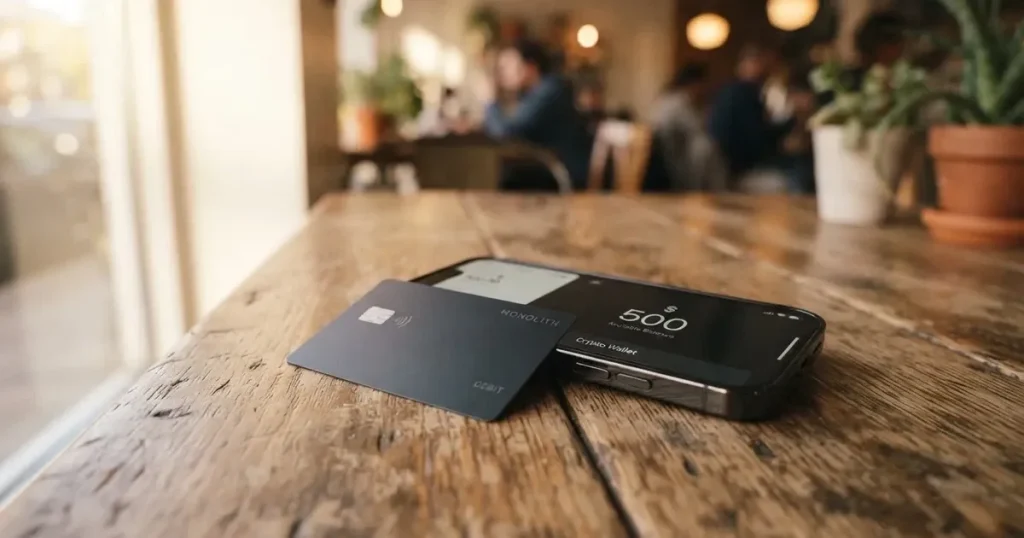
The Kauri card is a euro-denominated payment card tied to a custodial crypto wallet run by an Estonian-licensed virtual asset service provider. On paper it looks tidy: a euro balance, Apple Pay, a physical card delivered in the EU/EEA, and a flat 1% top-up fee. In practice the things that decide whether a card works day to day, namely which coins and networks you can actually fund it with, what the limits are at each verification level, and what happens when something goes wrong, are the things the card’s own pages say least about. The Trustpilot trail of frozen accounts after deposits, a 2026 closure notice mentioned in reviews, and an unresponsive support desk reported across 2024 and 2025 are hard to square with the calm marketing.
This review walks through who the card is for, what it costs you in euros, how you fund it, where the risks sit, and what to use instead. I have not used the card. Everything below comes from the card’s published pages, its user agreement, the Estonian and Polish licence records, and the small set of user reports on Trustpilot as of late 2025 and 2026, read together with general facts about crypto cards that explain why some of these issues are structural rather than specific to Kauri.
The conditions described are current as of October 28, 2026.
Verdict
Kauri scores 5.3 out of 10 in my reading. That is a mid-range score, not a red flag and not a recommendation. The card does some things well and several things poorly, and the balance of those is what the table below tries to show.
| Criterion | Mark | Why it lands there |
|---|---|---|
| Who can get it | 6 / 10 | Virtual cards in many countries; physical card and IBAN only in the EEA/EU; the card page gives no country list. |
| Cost | 4 / 10 | 20 EUR to issue, 1 EUR per card per month, 1% to top up, 1% to auto-convert, 1.5% plus 1.5 EUR per ATM withdrawal, 30 EUR delivery. |
| Top-up options | 5 / 10 | Crypto goes to a custodial wallet and converts to EUR at the till; the card does not list which coins or which networks. |
| Reliability and complaints | 4 / 10 | VASP licence in Estonia, cards issued via a Polish payment institution; Trustpilot at 2.8 from 16 reviews, with frozen accounts, unreturned funds, and a July 2026 closure flagged. |
| Everyday use | 8 / 10 | Virtual and physical cards, Apple Pay, Google Wallet design, ATM access. |
| Total | 5.3 / 10 |
The card is best suited to residents of the EU who want a euro card and an IBAN and are happy to keep their balance on a custodial platform with relatively thin support. It is not a good fit if you live outside the EU/EEA and want a physical card, if you want to fund it from a specific coin or network the page does not name, if you carry large balances, or if a slow support response would be a problem for you.
Will they give you the card
The clearest thing on the eligibility page is also the most frustrating: there is no country list. What the card states, and what I would treat as the starting data, is that virtual cards are available in many countries, while physical cards and IBAN accounts are limited to the EEA/EU. The user agreement adds a quiet but important line: the agreement does not supersede the law of the user’s country. In practice that means the card might be available where you are, but if your local rules say something different, your local rules win.
The IBANs are not actually issued by Kauri itself. They are issued through Breinrock LTD in Canada, a company registered with FINTRAC as a money services business. The card programme is run by Quicko sp. z o.o. in Poland, a national payment institution supervised by the Polish financial authority. Kauri is the brand on the front, but the licences that make the card work sit in three different jurisdictions, and that matters for complaints and for what happens to your money if the brand runs into trouble.
A small but real point about age: the user agreement says no accounts for persons under the legal age of majority in their country, which in most places is 18. The card does not publish a list of the documents it asks for during identity checks, and does not name any verification tiers or per-tier limits. That is unusual for a card that publishes fees down to the half-euro.
How to get it
Sign-up is not described step-by-step on the public page, so what follows is the order the card’s own materials imply, with the bits left open called out as not stated.
You start by creating an account and passing KYC under Kauri’s AML policy. The contact for the KYC team is [email protected]. The agreement sets the rule (no minors) but not the documents the team asks for. Reviews on Trustpilot mention ID rejections, and that the team can be slow to respond, so the documents the team ends up requesting in practice are not something the public page tells you in advance.
Once you are verified, the card page offers three card types: a main virtual card, an additional virtual card, and a physical card. The currency is euro. The card network is not stated on the page, which is a small but real gap if you care whether it runs on Visa or Mastercard, because some merchants and some subscription services treat the two differently. The physical card ships to your door for 30 EUR delivery plus 20 EUR issuance, and is limited to the EEA/EU per the eligibility starting data. The card page does not give a delivery time and does not say what a replacement costs.
There is no per-tier limit table on the public page. The agreement does set a monthly transaction ceiling of 3 BTC across the account, but the limits below that, at basic, intermediate and full verification, are not stated. The Trustpilot reports of slow verification and rejected IDs suggest the team’s tolerance for documents varies case by case, which is a fair description of how KYC works in general rather than a complaint about a specific tier.
What it really costs
The cost picture is one of the more transparent parts of the card. Fees are published in euros, on a single page, and there are no surprise categories. The transparency is welcome; what is harder to find is what the fees mean once you start using the card day to day. Below is the full list the card publishes, then a few small worked examples so you can see what the percentages actually look like on a coffee, a hotel and a cash withdrawal.
Fees
| Fee or limit | Amount |
|---|---|
| Card issuance (any card) | 20 EUR |
| Monthly maintenance | 1 EUR per card |
| Top-up (including P2P) | 1% |
| Auto conversion (deposit, exchange, payment) | 1% |
| FX fee | not listed separately |
| ATM cash withdrawal | 1.5% + 1.5 EUR |
| PIN change | 0.5 EUR |
| Balance inquiry | 0.5 EUR |
| Physical card delivery | 30 EUR |
| Chargeback fee | 30 EUR |
| Monthly transaction limit | 3 BTC |
| Card currency | EUR |
A 50 EUR coffee in a non-euro country, paid in the local currency. The card’s FX fee is not listed separately, so the conversion cost is folded into the 1% auto-conversion that runs on every payment. On 50 EUR that is 0.50 EUR. There is no ATM fee because you are paying in a shop. The total visible cost of the coffee is 50.50 EUR.
A 700 EUR hotel in a non-euro country, paid online. Auto conversion is 1% on the payment, which is 7 EUR. If the hotel later triggers a chargeback you do not agree with, the chargeback fee the card publishes is 30 EUR. So a cardholder who fights a chargeback and loses pays 7 EUR in conversion plus 30 EUR in dispute fees on a 700 EUR transaction. The card’s chargeback policy is published as a separate PDF; the file linked on the card page was not read for this review.
A 200 EUR ATM withdrawal abroad. ATM fee is 1.5% plus 1.5 EUR, so 3 EUR + 1.5 EUR = 4.5 EUR on the 200 EUR. The 1% auto-conversion runs again, adding 2 EUR. The visible cost of taking 200 EUR out of an ATM is therefore 6.5 EUR. The PIN change fee (0.5 EUR) and balance inquiry fee (0.5 EUR) are easy to forget if you check balances at a foreign ATM.
The single-tier structure means there is no cheaper “basic” version of the card you can fall back to while you wait for verification. The 1 EUR per card per month starts the moment the card is issued, not the moment you start using it. If you hold a virtual card and a physical card, that is 2 EUR a month, 24 EUR a year, on top of the 40 EUR you paid to issue both.
How to top it up
Top-up is the part of the card where the public pages are most thin, and that matters because the fees you actually pay depend on it. The card’s description is roughly this: you send crypto to a custodial wallet, and the wallet converts the balance to euro at the moment you pay. A transfer between two Kauri members’ cards is described as 0 fee, which is the one specific number the card does give on funding.
What the card does not give:
- which coins are accepted
- which networks each coin is accepted on
- a minimum top-up amount
- how the EUR conversion rate is set, and how often
- whether the 1% auto-conversion runs on the deposit, on the spend, or both
The general background section below goes into why this matters, but the short version is: if you send the right coin on the wrong network, the funds can be lost or stuck in manual recovery, with no guarantee of return. The card page does not warn you about this in a way a first-time user would find, and there is no in-app network selector described in the public materials. Treat the 1% top-up fee plus the 1% auto-conversion as a 2% round-trip cost on crypto to euro, and check the in-app address screen for the network you are meant to use before sending anything material.
The card does describe what happens to your balance on closure. If the closure is AML-related, funds are sent to an EU/EEA-licensed credit institution rather than back to you directly. Otherwise the funds are returned in fiat or in crypto at the company’s discretion. Dormant accounts (no activity for six months) are charged a fee; the amount is not stated on the page. The dormant-account rule is the kind of clause that does not hurt most people and is easy to miss if you stop using the card for a year.
Paying with it every day
The card is built to be used like a normal debit card. There is a virtual card and a physical card, both in euro. Apple Pay is supported. The card has a “design for Google Wallet” badge on its page, which is a less firm statement than “supported” and is worth verifying in your own wallet app before you rely on it.
Blocked merchant categories are not stated on the card page, which is normal for a card but worth noting. Many crypto cards block gambling (the MCC 7995 family), some block dating and adult content, and a few block cryptocurrency purchases. The card does not publish its block list, and support is the only way to confirm a specific category. The card’s reward structure is also thin: there is no cashback programme on the public page, and the referral scheme pays the referrer 15% of the commissions Kauri earns from the people they refer. That is not the same as a sign-up bonus for the new user.
The card is on a European licence stack (Estonian VASP for the crypto side, Polish payment institution for the card programme, Canadian money services business for the IBAN), and the agreement is under Estonian law with Estonian County Court as the forum. That is meaningful if you ever have to sue: the venue is in Tallinn, and the language of proceedings is Estonian. The chargeback policy is published as a PDF on the card’s site, and the card charges 30 EUR per chargeback regardless of outcome.
The general safety net on a card like this looks like: app-based two-factor authentication, instant card freeze, per-card spending limits, 3-D Secure challenges for online payments, and tokenised mobile wallets. The card mentions 3-D Secure in passing and instant freeze is implicit in any modern card app, but the card does not publish which of these it has turned on by default. Treat the 2 EUR monthly cost on two cards as the price of having a euro balance you can freeze from your phone; treat everything else as a feature you should verify in the app.
What can go wrong
The single biggest risk factor for the card is the public complaint trail, and the single biggest structural risk is that the card holds your funds in a custodial wallet. Both are worth taking seriously.
On the complaint trail, the Trustpilot score for the card brand sits at 2.8 out of 5 from 16 reviews, with 6 of those in the last 12 months, read on 21 October 2026. The themes, in the order the reviews mention them, are:
- accounts frozen or locked shortly after a deposit, especially in 2025
- funds that took weeks or months to come back, or did not come back at the time of the review
- support that did not respond, or responded only after a public Trustpilot message
- identity documents rejected after the first upload, with no clear list of acceptable documents
- high fees on the IBAN account, mentioned in mid-2026 reviews
- a notice of closure circulated in July 2026, in the sense that several reviews around that date reference it
I have not verified the closure notice independently. It is a single-source report, and the card’s public page did not show a closure banner on the date this review was written. Treat the closure report as something to ask support about before you load any material balance, and treat the frozen-account reports as a pattern, not as a single event.
The structural risk is simpler. The card runs on a custodial wallet, which means the private keys for the crypto you deposit are held by the company, not by you. If the company fails, your crypto is subject to the company’s creditors and to whatever recovery process the regulator runs. The card does hold customer funds in a segregated safeguarding account, which is the standard protection an EU e-money institution is required to provide, but segregated funds are not the same as insured deposits and are not covered by deposit guarantee schemes. The card is also PCI DSS certified, which is a payment-data security standard rather than a guarantee about the company itself.
The card’s security defaults are reasonable for a card. Card is blocked after three wrong PIN entries. The card supports 3-D Secure online. The Kauri app is available on the Apple App Store; ratings on the store were not retrieved for this review. The PCI DSS certificate is listed on the card site. None of that changes the fact that on a custodial card, support responsiveness is itself a safety feature, and the support record is the part of the card the public reviews describe most negatively.
A few smaller risks worth knowing about:
- The card charges a 30 EUR fee on every chargeback, win or lose. A cardholder who disputes a transaction and is not satisfied with the outcome pays 30 EUR for the attempt.
- The dormant-account fee kicks in after six months of inactivity. The amount is not stated.
- The card is euro-only. If you spend in a non-euro country, the FX margin is folded into the 1% auto-conversion, and there is no separate disclosure of the interbank rate.
- Network suspensions and programme closures do happen in the crypto card space, and a cardholder has no control over them. Visa’s 2018 suspension of WaveCrest shut down several crypto card programmes in a single day, and the FTX US debit card was wound down in November 2022. The 2026 closure note on Trustpilot would fit that pattern, although as described in the complaints section, it is not independently verified.
What to take instead
Three cards I would compare Kauri to are below, each with a different reason to pick it over Kauri or not. The scores are from the same scale as Kauri’s, and the underlying facts come from the cards’ own pages as of the same date.
International Visa Card
Score: 6.7 / 10. The reason to look at it is geography. The card is not available to residents or legal registrants of a long list of countries, including Russia, Ukraine, Belarus, Turkey, Israel, Iran, Iraq, Syria, Cuba, North Korea, mainland China, India, Myanmar, Nepal, Nicaragua, Venezuela and Vietnam. FATF grey-list countries are reviewed case by case. Purchases are blocked in a smaller set of countries (North Korea, Cuba, Iran, Russia, Syria, Ukraine, Venezuela). The rule is by residence or registration rather than by citizenship, which is the more permissive of the two.
The card is a US-issued Platinum Visa in USD. The virtual card costs $5 to issue, with no monthly fee; the physical card is listed as “Coming soon” and the monthly plans run from a free Classic tier through Pro at $9.00 and Max at $19.00. Card use in USD is free on all plans; foreign currency is charged at the Visa exchange rate plus a 2% FX fee. Deposits of any kind are free, and the card accepts USDC and USDT into the USD account at 1:1.
Pick International Visa over Kauri if you live in one of the countries on the supported list, you are happy with a USD balance, and you want a card whose fee structure is published in dollars and whose top-up side is fully fee-free. Pick Kauri if you specifically need a euro balance and an EU-issued IBAN.
UNi Card
Score: 6.1 / 10. The reason to look at it is the multicurrency model. The card is on the Mastercard network, spends from a UNi.Global account balance, and converts at live OTC rates with no hidden exchange fees and no foreign transaction fee. The card page does not state a monthly fee or an annual fee. The card does run a Spend-to-Earn rewards programme that pays up to 3% back on UNi Card spend, which is the one cashback figure in this comparison.
Pick UNi over Kauri if multicurrency spend and cashback are the features you care about, and if you do not need an EU-issued IBAN. Pick Kauri if you specifically need a euro balance and a euro IBAN with a card programme that is supervised by an EU regulator rather than only by a network licence.
Whop Cards
Score: 5.2 / 10. The reason to look at it is US availability. The consumer card is available in 31 US states (Alabama, Alaska, Arkansas, California, Colorado, Connecticut, Florida, Hawaii, Illinois, Indiana, Iowa, Kansas, Kentucky, Maine, Massachusetts, Michigan, Minnesota, Montana, Nebraska, New Hampshire, New Jersey, New York, North Carolina, Oklahoma, Pennsylvania, South Carolina, Texas, Utah, Virginia, West Virginia, Wyoming), and the business card in 41 states. The unsupported country list overlaps heavily with the International Visa Card list and adds Hong Kong. The card is on the Visa network, spends from a Whop balance, and offers 5% cashback at select merchants (currently Uber, with more planned).
Pick Whop over Kauri if you live in one of the 31 US states, you want a US-dollar balance, and the 5% Uber cashback matters to you. Pick Kauri if you live in the EU and want a euro card with an IBAN.
Who I would recommend it to
Kauri is a reasonable, if unremarkable, euro crypto card for a fairly narrow reader. The card suits you if you live in the EU/EEA, you want a euro balance and a euro IBAN, you are happy to keep your balance on a custodial platform, and you do not need a fast response from support. The fee structure is published clearly enough that you can plan around it, and the everyday mechanics (Apple Pay, ATM, virtual and physical) are in place.
Kauri is not a good fit if you live outside the EU/EEA and want a physical card, if you need to fund it from a specific coin or network the card does not name, if you carry a balance that would be hard to replace if support went quiet for a few weeks, or if you want a cashback programme. In those cases the alternatives above are better places to start. The card’s overall score reflects the gap between a tidy fee page and a thin support record; the gap is real, and the support record is the part you cannot fix by reading the fees.
If you do decide to use it, the small set of things worth checking first:
- the supported coins and networks in the in-app top-up screen before you send anything
- the per-tier limits at the verification level you actually reach, asked of support in writing
- the dormant-account fee, asked of support in writing
- the closure notice mentioned in mid-2026 reviews, asked of support in writing
- the policy on chargebacks and on AML-related fund returns, both in the user agreement
Frequently asked questions
What is the Kauri card?
The Kauri card is a euro-denominated payment card tied to a custodial crypto wallet. The card runs on a virtual asset service provider licence in Estonia, with the card programme run by a Polish payment institution and the IBAN issued by a Canadian money services business. The card is a card brand front-end over licences held in three jurisdictions.
How does the Kauri card work?
You send crypto to a custodial wallet, the wallet holds a euro balance, and you pay with a virtual or physical card in euro. Crypto is converted to euro at the moment of payment. The card does not publish which coins or which networks it accepts; the in-app deposit screen is the place where that information actually appears.
Is Kauri a bank?
No. Kauri is a virtual asset service provider licensed in Estonia and operates an e-money-style card programme through a Polish payment institution. Customer funds are held in a segregated safeguarding account, but that is not the same as a bank deposit and is not covered by a deposit guarantee scheme.
Who owns Kauri?
Kauri is operated by KAURIFINANCE OÜ, a company registered in Tallinn, Estonia (registry code 14559136), under virtual asset service provider licence FVT000328, issued on 17 November 2020. The card programme is operated by Quicko sp. z o.o. in Poland; the IBAN account is operated by Breinrock LTD in Canada.
Is the Kauri card available in my country?
The card page does not publish a country list. The starting data is that virtual cards are available in many countries and that physical cards and IBANs are limited to the EEA/EU. The user agreement also notes that the agreement does not supersede the law of the user’s country, so a card that is technically available may still be restricted by local rules.
How do I get a Kauri card?
You create an account, pass KYC under Kauri’s AML policy, and then order a main virtual, additional virtual, or physical card. The KYC team can be reached at [email protected]. The card page does not publish the documents required for verification, and reviews on Trustpilot mention ID rejections and slow verification, so it is worth treating the verification step as a real step rather than a formality.
Does the Kauri card require KYC?
Yes. The card is a regulated crypto and payment service and runs KYC under its AML policy. The card does not publish the documents it asks for, so the practical answer is that the documents vary and that the team can be slow to respond. Send clear scans and respond to follow-up requests quickly.
How do I top up the Kauri card?
You send crypto to the wallet address shown in the app, and the wallet converts the balance to euro at the moment of payment. The card charges a 1% top-up fee and a 1% auto-conversion fee, and transfers between two Kauri members’ cards are 0 fee. The card does not publish which coins or networks it supports, so check the in-app deposit screen for the network selector before sending anything material.
Is the Kauri card free?
No. The card costs 20 EUR to issue, 1 EUR per card per month, 1% to top up, 1% to auto-convert, 1.5% plus 1.5 EUR per ATM withdrawal, and 30 EUR for physical card delivery. There is no annual fee line as such, but the monthly maintenance and the per-transaction fees add up on a small balance.
How do I add the Kauri card to Apple Wallet?
Apple Pay is supported on the card. The standard flow is to open the Apple Wallet app on an iPhone, tap the plus sign, and follow the on-screen steps; the card app should give you a “Add to Apple Wallet” button that hands the tokenised card to Apple. If the button is missing, the most common cause is that the device region or the card’s region do not match.
App and neobank cards put to the test – cryptocardtested
Content created by the «cryptocardtested» team