
A crypto card that keeps its costs to itself
 Available in US

Reading a crypto card’s website is a bit like reading an insurance policy that names every clause and leaves every number blank. Wasabi is a good example. The card is real, the product is live, the terms name six kinds of fee you can be charged, and not one of those fees is given an amount. Nowhere in the public material I worked from does a monthly fee appear, a conversion rate appear, or an ATM allowance appear. That is not a small gap. It is the gap.
My score for the Wasabi card is 6.4 out of 10. That is not a dismissal. The daily mechanics of this card are genuinely good — a virtual card you can bind to Apple Pay in seconds, a physical card for ATMs, top-up with stablecoins, and a security model that lets you isolate funds per card. Those things work. What holds the score down is disclosure: a company that calls itself a financial technology company, explicitly not a bank and not a custodian, names no issuer, publishes no fee amounts, and has almost no public review history to judge.
Who is this for? Businesses and users who want stablecoin virtual and physical cards, and people who have had trouble getting an ordinary bank card. Who is it not for? Anyone who needs to know what a payment will cost before they make it, anyone in a hurry who needs a working card the same afternoon, and anyone who treats a Trustpilot score as reassurance — here there is exactly one review to read.
| Criterion | Mark | Why, in short |
|---|---|---|
| Who can get it | 9 / 10 | Starting data says 200+ countries and regions; closed to any “prohibited or sanctioned jurisdiction”, with no list published |
| Cost | 5 / 10 | Six fee types named in the terms, zero amounts; monthly fee not stated |
| Top-up options | 6 / 10 | Stablecoin top-up (“Spend with Stablecoin”); unofficial starting data mentions USDT on TRC20 and BEP20; other coins not disclosed |
| Reliability and complaints | 4 / 10 | Wasabi Ltd describes itself as “not bank or custodians”; issuer and licences unnamed; unofficial: a single one-star Trustpilot review dated 8 July 2026 |
| Everyday use | 8 / 10 | Virtual card with instant Apple Pay binding, physical card, ATMs worldwide; Google Pay not stated |
Total: 6.4 / 10
The conditions described here are current as of October 28, 2026.
Will they give you the card?
Broadly, yes — this is the strongest thing about it. Starting data for the card says 200+ countries and regions. That figure appears without a country list on the pages I could read, so treat it as a scale claim rather than a checked eligibility list. The one hard exclusion the terms do state is that users must not be located in, or be residents of, any “prohibited or sanctioned jurisdiction”. The wording is residence-based: where you live, not only where your documents were issued.
That single exclusion is where the practical difficulty lives. The list of prohibited or sanctioned jurisdictions is not printed on the pages I read. So the question “is Wasabi card available in my country?” cannot be answered from public material alone — it is answered by asking support, and the answer you get will reflect internal policy rather than a published list. That is a real gap for someone planning around the card, and it is one of the reasons the availability mark sits high but the reliability mark sits low.
One background fact helps you understand why an issuer-country mismatch causes friction, because it applies to this card as much as to any other. Every card number begins with an issuer identification number — 6 or 8 digits — that identifies the issuing institution. Merchants can look it up and see which institution and which country issued the card, and some apply extra scrutiny when that country differs from the billing address. This is the structural reason a card issued in one country can look “foreign” in a shop in another, and why prepaid cards are declined more often than ordinary debit cards. It is category behaviour, not a mark against Wasabi specifically.
How to get it
The route runs through identity verification. The terms require that you “successfully complete any required identity verification (KYC/KYB) procedures”. They may ask for a government-issued ID, proof of address, and a selfie check; for corporate applicants, registration documents and beneficial-ownership information. The terms are clear that failure to complete these can lead to suspension or termination.
Two things the terms do not tell you. No minimum age is stated anywhere in what I read. And no verification tier structure is published — whether there is a lighter level, a higher level, or how limits change between levels. A help-centre article on KYC exists, which tells you the subject is documented somewhere, just not in a form that answers “what do I have to send to get started”.
Why the ID demand is not arbitrary: anti-money-laundering law requires regulated businesses to verify customers and assess risk, including ongoing monitoring and suspicious-activity reporting. In the EU, due diligence covers name, address, date of birth, nationality and identity documentation, a sanctions check, the purpose of the relationship, and whether you are a politically exposed person. In the US, the customer identification programme requires name, date of birth, address and an identification number, with electronic systems also validating proof-of-address documents. Nationality is recorded and screened separately from residence, because sanctions screening is often applied to citizenship and country of birth as well as to country of address.
If due diligence cannot be completed, EU rules require the institution to hold back from the transaction or relationship and, where necessary, end it. That is the ordinary legal reason behind the account closures and freezes people complain about in this category. Where you live can also decide the outcome: an electronic money institution in the EU may offer services across the EU/EEA from a licence granted in one member state, and a provider authorised in one member state can serve the EU. What you get from Wasabi depends on which of those structures applies to the entity actually holding your money.
Delivery time is not stated. Neither is activation flow. If you need a card working this week, ask support before you send documents, not after.
Fees: what it really costs
This is the section that decides the score. The Wasabi terms list the fee types you may be charged: card issuance, foreign exchange, cross-border transaction, ATM withdrawal, chargeback handling, and replacement card. That is a complete-looking list, and it is honest as far as it goes. But no amounts are attached to any of them, and a monthly fee is not named anywhere.

So I can tell you the shape of the cost and not the size of it. Anyone budgeting with this card has to ask support for the six numbers directly, and the answer will probably not be published.
| Fee or limit | What the card states |
|---|---|
| Card issuance | Fee type listed in the terms; amount not stated |
| Monthly fee | Not stated |
| Currency conversion | “Currency conversion rates may apply”; no figures |
| Cross-border transaction | Fee type listed in the terms; amount not stated |
| ATM withdrawal | Fee type listed; site says competitive rates; fee and allowance not stated |
| Chargeback handling | Fee type listed in the terms; amount not stated |
| Replacement card | Fee type listed in the terms; amount not stated |
| Card types | Virtual and physical; tiers not stated |
| Virtual card limit | “Card limit up to 10,000 USD” |
| Physical card limits | “Flexible spending limits”; terms give no values |
| Sending money | Site mentions sending in 7+ currencies; card currency not stated |
Two everyday payments, and which fees apply to each. First, you buy coffee abroad with the physical card. On the way out, the purchase is a cross-border transaction, so the cross-border fee type applies. The coffee shop’s terminal asks the network for the local amount in euros, the network messages the issuer, the issuer converts at a rate it chooses — and the terms tell you plainly that “currency conversion rates may apply”. Two separate things can therefore stack on one small purchase, and neither has a published number. Second, you top up in dollars and pay a subscription in dollars. No cross-border conversion should arise if the merchant prices in your card currency — but the card currency itself is not stated, so you cannot predict that case in advance either.
Three more things that ride along with the money rather than appearing in the fee table. Network fees for your own deposit are charged by the blockchain, not by the card provider: on Ethereum that means gas paid in ETH, which is why a wallet holding USDT and no ETH cannot send at all. A declined authorisation can leave a hold on your funds for several days, typically up to 7. And a merchant-category code of 7995 covers gambling, so casinos, betting shops and lotteries sit under a code that many issuers block on specific cards by policy rather than by law, with the blocked list varying by issuer.
Wasabi’s own ATM claim is that you can “withdraw cash from millions of ATMs worldwide with competitive rates”. Competitive is not a number either, and no daily or monthly withdrawal allowance is published. If cash is part of your plan, treat the ATM as untested until you have read the allowance in writing.
Top up: how the balance gets there
Top-up is the stablecoin part, and it is where the card’s identity sits. The mechanism is “Spend with Stablecoin”: you load the card from a stablecoin balance rather than from a bank account.
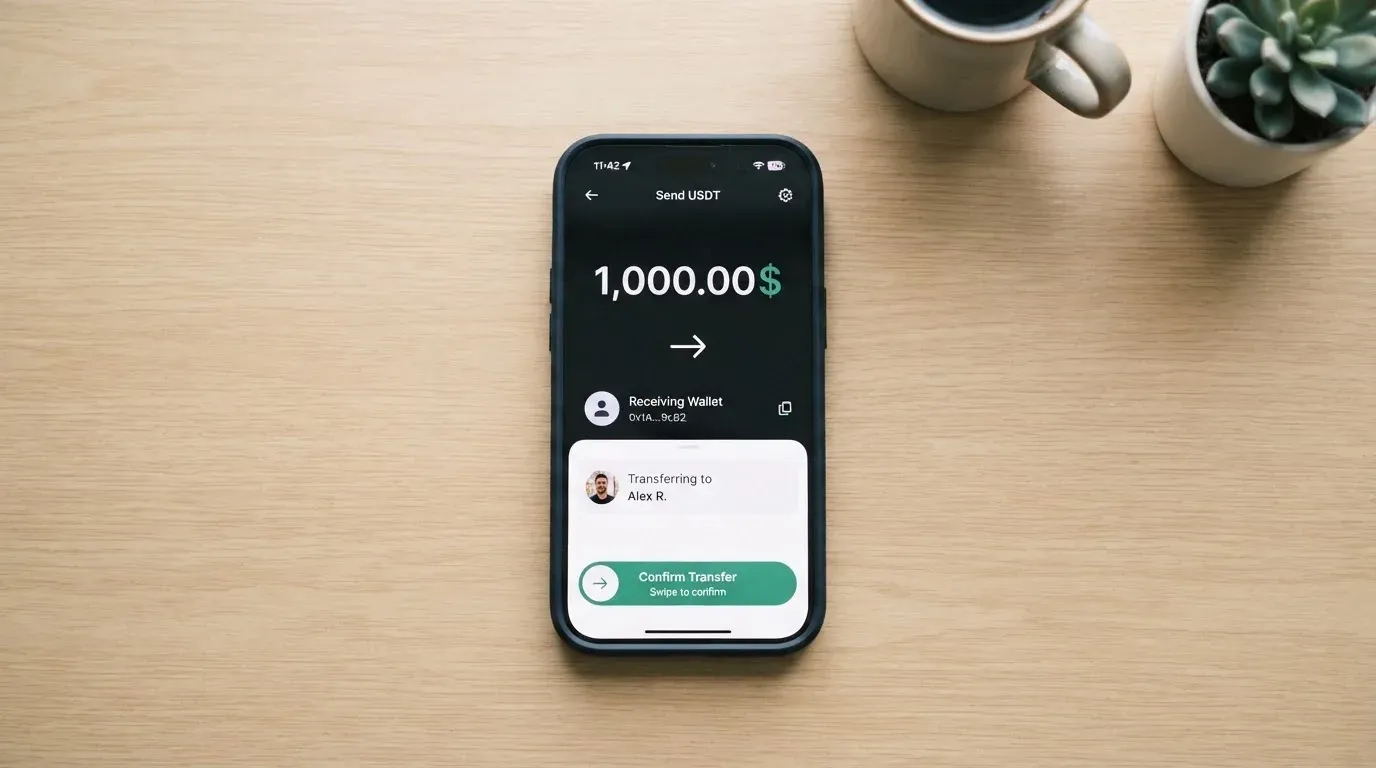
The terms do not say which coins or which networks. Unofficial starting data for the card mentions USDT on TRC20 and BEP20. I want to be careful here: that comes from starting data, not from the card’s own pages, so treat it as a lead to confirm rather than a specification. The rest is not disclosed. There is no published description of the top-up flow itself, no stated minimum, no stated arrival time.
The network question is the one that will bite you, so it is worth understanding why. Stablecoins live on different chains and the same token has different addresses on each of them. USDT has been issued on Ethereum, Tron, Solana, Polygon, Avalanche and others. USDC is listed by Circle as natively supported on 38 networks as of 16 September 2026, including Ethereum, Solana, Base, Polygon PoS, Avalanche, Arbitrum and Stellar — and Circle stopped supporting USDC on Tron in February 2024, so “USDC over TRC20” is not a native option you can rely on. Blockchain transfers are irreversible: a deposit sent on a network the provider does not support, or to an address belonging to a different network, can be lost, or need manual support recovery with no guarantee.
What to do with that is straightforward, and it is not a trick: confirm the exact coin and network from support before you send, and treat sending first as an experiment with a small amount. The withdrawal side is also unpublished. The terms do say “Funds may be temporarily withheld pending investigation”, which is standard but real.
Two background points about stablecoins that bear on your expectations. First, the name is aspirational: despite the name, stablecoins are not necessarily stable. TerraUSD collapsed in May 2022 and USDC temporarily lost its peg in March 2023 during the US banking crisis. Second, they are not censorship-proof either — Tether says it disables tokens in wallets on the OFAC sanctions list and has frozen funds tied to illicit activity. A stablecoin is a promise made by a company about a balance somewhere else.
Paying with it every day
Everyday use is this card’s strongest suit, and it earns its 8 out of 10.
The virtual card supports what the site calls “instant binding” to Apple Pay. That is genuinely instant in a way that adding a physical card to a wallet is not. The physical card can also be added to Apple Pay. Google Pay support is not confirmed, so if Android is your platform, ask before you commit. Card currency is not stated, and neither is a list of blocked merchant categories — both of which change how a payment behaves at the till.
Why the wallet binding is more than convenience. Apple Pay replaces the card number with a device-specific Device Account Number held in the Secure Element, never on Apple’s servers, and every payment carries a one-time dynamic security code. In plain terms: a screenshot of your card number is not the thing that gets stolen from your phone. That is a real reduction in exposure, and it applies to the virtual card immediately.
Cash is the other half of everyday use. The site points to ATMs worldwide, and the physical card exists for exactly that.
Then the parts that are undocumented. A “Cashback” product — “Get Cashback on your card purchases” — and a referral programme are both listed, with no rate and no conditions given. The app is a web app at app.wasabicard.com; I found no store listing and did not read ratings, so I cannot tell you what users think of it. Support runs live chat, email with a stated “respond within 24 hours”, and phone, plus a Telegram channel at t.me/wasabicard_official; languages and opening hours are not stated.
On refunds, the terms say “Refunds may take up to 30 business days to be reflected”. Chargebacks need supporting documentation, and recovery is not guaranteed. That last part is worth sitting with, because in this category the legal grounds for reversal differ by country: US debit card rights come from Regulation E and credit card rights from Regulation Z, while prepaid-card coverage varies and should not be assumed.
Underlying all of this is a set of mechanics that are standard rather than special. Visa and Mastercard do not issue crypto cards to consumers themselves; they license issuers and can suspend a programme — in November 2022 Visa said it had “terminated our global agreements with FTX”, and the FTX US debit card programme was wound down by its issuer. WaveCrest, a Visa issuer that supplied several crypto card brands, was suspended by Visa in Europe in 2018, closing all WaveCrest-issued Visa programmes. Closures follow a pattern: a notice period, then spending and loading stop, then users are asked to withdraw remaining balances. One 2026 closure reported by a single secondary source had new loads ending 8 July 2026 and spending stopping 8 August 2026; that is unconfirmed, and I include it only to show how little warning a card programme can give.
What can go wrong
Four risks, ordered by how much they should affect your decision.
You cannot price a payment. Six fee types, no amounts, no monthly fee. This is the one that should decide things for a lot of readers, because it is not a risk you can hedge — you simply do not know what a foreign purchase costs until it lands.
You do not know who holds your money. Wasabi Ltd describes itself as a financial technology company and says outright that it is “not bank or custodians”. OTC trading and card issuing are stated to be “provided in partnership with licensed institutions or banks” — but the issuer and the licences are not named. A “Licenses & Compliance” page exists at /en/licenses-compliance, which is a start, but the fact set I could verify does not include specific licence names. If you are depositing real money, “partnership with licensed institutions” without names is not enough to satisfy you, and it should not be.
The card could stop working. Wasabi’s own security page describes a “Security by Design” approach: create, delete and isolate funds per card. Custody is stated as non-custodian. Two-factor authentication is not stated. The wider risk picture is not unique to this card: custodial platforms have a record of failures, with Mt. Gox (about US$350 million reported stolen, 2011–2014), Coincheck (about US$400 million, 2018) and Ronin Network (US$625 million, 2022). And card programmes themselves can be closed by a network on short notice, as the FTX and WaveCrest cases show. Non-custody reduces counterparty risk; it does not remove issuer and network risk.
The public record is thin. On Trustpilot, a single one-star review dated 8 July 2026 says the provider is aimed at businesses, charges high setup fees (“$15,000 and up”), and that cards are restricted. I found no Reddit threads. A TrustScore of 3 built from a single review is not a reputation — it is one person’s experience, and the reviewer is describing a product aimed at companies, which may not be you. But with no volume of public feedback, you have nothing to average it against, and that absence is the risk.
Two more that are category behaviour. Because the card looks like a prepaid or foreign BIN to merchants, some shops will decline it, and address verification is largely a US, Canada and UK mechanism that is generally unavailable for foreign-issued cards. And 3-D Secure is where liability for a fraudulent online payment can shift — from the merchant to your bank, or, per its critics, to you.
Regulatory context worth knowing, since it may change under you: MiCA, the EU’s markets-in-crypto-assets regulation, took legal effect in June 2023. Its rules on stablecoins applied from 30 June 2024 and the remaining provisions, including crypto-asset service provider rules, from 30 December 2024. Under it, e-money tokens may be issued only by a credit institution or an electronic money institution. Providers operating under national law could continue only until 1 July 2026 or until they received or were refused authorisation, whichever came first. ESMA maintains an interim register of authorised providers that you can check. And note the split: a card is a payment service regulated separately, so a crypto card often rests on two licences.
I will not advise on your taxes, but one factual point bears on whether this card is convenient for you at all. The IRS treats digital assets as property, so exchanging them for goods, services or dollars generally produces a taxable gain or loss, measured in local currency at the fair market value on the transaction date. Each card payment funded from crypto may therefore be a separate disposal. Ask a professional in your own jurisdiction before you run volume through this.
What to take instead
Two alternatives from the same category, both of which publish more and cost less to read.
| Wasabi | Cardex | CardFlow | HyperCard | |
|---|---|---|---|---|
| Score | 6.4 / 10 | 5.6 / 10 | 4.9 / 10 | 4.7 / 10 |
| Reach | 200+ countries and regions per starting data | “One crypto card, 200+ countries”, no list or exclusions | Aimed at Nigeria and “Nigerians and global users” | Official pages list no countries; app store says works in “more than 176 countries” |
| Networks | Not stated (starting data: Visa or Mastercard) | VERVE, VISA, Mastercard, UnionPay | Virtual USD Mastercard | Not stated on the app store page |
| Card currency | Not stated | Naira per the app store listing | USD | USD or EUR |
| Cost | Fee types listed, no amounts | Not stated | Site FAQ: creating a virtual card is completely free; monthly fee not stated | Not stated; app store page lists no fees |
| Conversion | “Currency conversion rates may apply” | Real-time conversion at payment, an “AI-Powered Conversion Rate” that scans exchanges; no percentage stated | Not stated | Not stated on pages I could read |
| Top-up | Stablecoin (“Spend with Stablecoin”); coins and networks not stated | USDT, USDC and BTC wallets; networks not stated | Bitcoin, USDT, ETH or naira bank transfer; networks not stated | Crypto deposit such as USDT, BTC, ETH, converted to USD or EUR; networks not stated |
| Cashback | Product listed, rate and conditions not stated | Not stated | Not stated | Not stated |
Read that table with the caveat that it deserves. Every “not stated” in the right-hand columns means the same thing it means in the Wasabi column: the information is not published on the pages available. Cardex’s conversion claim is a marketing phrase on its site, not a rate. CardFlow’s “completely free” virtual card is the only concrete price statement in the whole group, and even that card says nothing about a monthly fee. HyperCard’s “more than 176 countries” describes where the card is accepted, not who can get one — a distinction worth holding on to, because acceptance is the easier number for any card to advertise.
The honest comparison, then, is not “Wasabi is better than these”. It is that Wasabi is a broader, more international, more ambitious product than a Naira-focused or Nigeria-focused card, and it discloses about as little as they do. If you are outside those markets, Cardex and CardFlow may not be options at all, and HyperCard’s eligibility is genuinely unclear. The realistic reason to look elsewhere is not a better score; it is that a different provider will tell you what a payment costs.
Who I would recommend it to
I would recommend the Wasabi card to someone with three things in common: money already sitting in stablecoins, a real need for a card in many countries at once, and a tolerance for finding out the fees yourself. Under those conditions the card is genuinely competent — instant Apple Pay binding on the virtual card, a physical card for cash, per-card fund isolation, and top-up from a stablecoin balance rather than from a bank that has already decided against you.
I would not recommend it to someone who spends from a checking account and simply wants a card that works, or to anyone who needs to forecast a payment. Ask five questions before you commit: what is the monthly fee; what is the conversion rate and who sets it; what is the ATM fee and the daily allowance; who is the issuing institution and what licence does it hold; and how do you withdraw, and how long does it take. Support answers by live chat, email within 24 hours, and phone. If the answers to the first two are vague, that is your answer.
The score of 6.4 out of 10 is not a warning about the product’s competence. It is a warning about disclosure. The card does what it says it does, and it tells you remarkably little about what it charges.
Frequently asked questions
What is Wasabi card?
Wasabi is a stablecoin-linked payment card from Wasabi Ltd, offered as a virtual card and a physical card. The virtual card binds to Apple Pay instantly; the physical card is meant for everyday spending and cash withdrawals. The balance is funded from stablecoins rather than from a conventional bank account. Wasabi Ltd describes itself as a financial technology company and says explicitly that it is not a bank and not a custodian.
How does Wasabi card work?
You verify your identity, obtain a card, load it from a stablecoin balance through “Spend with Stablecoin”, and then spend that balance like a prepaid card. Under the pre-loaded balance model the card can never overdraw, because only what you loaded is available to spend. Card currency and card limits beyond the virtual card’s stated “card limit up to 10,000 USD” are not stated in the public material.
Is Wasabi a bank?
No, and the company says so itself — it is a financial technology company, “not bank or custodians”. It states that OTC and card issuing are “provided in partnership with licensed institutions or banks”, but it does not name the issuer or the licences. A “Licenses & Compliance” page exists on its site. If who holds your money matters to you, ask for the licence numbers.
Who owns Wasabi?
The provider is Wasabi Ltd. Beyond that, ownership is not something the public material I read details. There is no founding history, funding or parent-company information in the terms or site pages I worked from. What is stated is the operating posture: a fintech front end over issuing and OTC services provided by licensed partners.
Does Wasabi card require KYC?
Yes. The terms require that you “successfully complete any required identity verification (KYC/KYB) procedures”, and may request a government-issued ID, proof of address and a selfie check. Corporate applicants are asked for registration documents and beneficial-ownership information. Failure to complete verification may lead to suspension or termination. No minimum age is stated in what I read.
Is Wasabi card free?
Nobody can tell you from the published material, and that is the point. The terms list six fee types — card issuance, foreign exchange, cross-border transactions, ATM withdrawals, chargeback handling and card replacement — without a single amount, and no monthly fee is named. Get those numbers in writing from support before you load money.
Can I use Wasabi card in my country?
Most likely, since starting data cites 200+ countries and regions. The only published exclusion is that you must not be located in or reside in any “prohibited or sanctioned jurisdiction” — and that list is not printed. The 200+ figure carries no country list either. Your citizenship may be screened separately from your address, so ask about both.
How do I top up the Wasabi card?
Through stablecoin funding, described by the card as “Spend with Stablecoin”. The terms do not state which coins or which networks; unofficial starting data mentions USDT on TRC20 and BEP20, which you should confirm rather than assume. Confirm coin and network with support before sending, start with a small amount, and remember transfers are irreversible.
Is Wasabi card safe?
It has real design safeguards — create, delete and isolate funds per card, non-custodial custody, and Apple Pay tokenisation that keeps your card number off Apple’s servers. Against that: no issuer or licence is named, two-factor authentication is not stated, and one one-star Trustpilot review dated 8 July 2026 reports high setup fees and card restrictions. Weigh the design against the disclosure.
Is Wasabi card worth it?
Worth it if you hold stablecoins, need a card across many countries, and are willing to ask support for the fee schedule and the issuer’s identity before committing. Not worth it if you need published prices, same-day delivery, or a named bank behind the card. My score is 6.4 out of 10 — competent product, thin disclosure.
Virtual cards put to the test – cryptocardtested
Content created by the «cryptocardtested» team