
A prepaid crypto card with three card options, quiet fees, no official information
 Available in US
If you cannot get an ordinary bank card — because your country is not served, your bank closed your account, or you simply travel and pay in places where your home card fails — then a prepaid card bought with cryptocurrency is one of the few routes left. Card.Club is one of those cards. It is not a bank account, and it does not pretend to be one. It is a way to hold a balance and spend it, topped up from a stablecoin or from rubles.
Here is my problem with reviewing it: the official site is empty. Not “thin”, not “under construction” — empty. Every concrete thing I can tell you about issuance fees, card types, top-up methods, the issuing company and who stands behind disputes comes from third-party review sites, not from Card.Club itself. I have marked those clearly throughout. Where the card’s public pages do not say something, I say it does not say it rather than filling the gap with a plausible guess. This is a genuine finding, and for a card that holds your money it matters more than it would for almost any other product.
My overall score is 5.0 out of 10. That is not a rejection. It is a card with a real, useful shape — three card options including a plastic Visa, Apple Pay and Google Pay on one of them, no monthly servicing fee — attached to a pricing structure that quietly eats value on almost every transaction, and to a level of published information that would make me pause before loading anything substantial.
The conditions described here are current as of October 28, 2026.
Score breakdown
| Criterion | Mark | Why |
|---|---|---|
| Who can get it | 7 / 10 | Unofficial: cards cannot be used in countries on the US sanctions list; the official site is empty |
| Cost | 3 / 10 | Unofficial: issuance $20, $35 or $100; top-up from 4%; $0.25–0.50 per payment |
| Top-up options | 5 / 10 | Unofficial: SBP in rubles, or USDT on TRC-20 and ERC-20 |
| Reliability and complaints | 5 / 10 | Unofficial: Webrex Co., Ltd, issuers unnamed; Trustpilot 3.7 out of 5 on 1 review, crmindex.ru 4.8 on 35; complaints about fees |
| Everyday use | 5 / 10 | Unofficial: three cards, Apple Pay and Google Pay on travel only, a plastic Visa exists, no ATM support |
| Total | 5.0 / 10 | A useful shape, thin information, and fees that bite |
The one number that decides a lot of this is the top-up commission starting at 4%. On a card you top up weekly, that is not a rounding error — it is the price of using the card. I will come back to it in the costs section, because the per-payment fee and the top-up fee stack in a way that is easy to misjudge from a distance.
Will they give you the card?
Short answer: probably, but the card’s own public pages do not say, and what third parties say is narrower than you might expect.
The official site does not state who is eligible. It is an empty page. Card.md from an earlier check described availability as worldwide except for countries on the US sanctions list, including Russia and Belarus. A vendor states the same thing more directly: the cards cannot be used in countries on that list. This is the single most important eligibility fact, and it is not something the card publishes itself.
So there are two separate restrictions to hold in your head, and people often merge them:
- Where you live, which affects whether you can be onboarded at all.
- Where you can use the card, which the vendor ties to the US sanctions list.
Both point at the same practical outcome for most readers in Russia and Belarus: this is not a card you are expected to hold. I am not going to explain how to work around that, and I would be suspicious of anyone who offers to. If you are in a sanctioned country, read this as a “not for you” and close the page.
There is a second thing worth knowing before you commit, and it is about paperwork rather than geography. Disputes are governed by British Virgin Islands law, and Russian-law consumer protection does not apply. That comes from a third-party review site, not from the card. But it is worth taking at face value because it is the ordinary outcome: if something goes wrong, you are not dealing with the consumer protection regime you may be used to, and the practical question of which courts are reachable from where you live becomes part of your risk.
One more general point about eligibility, which applies to this card and every prepaid one. Prepaid and debit cards are generally available to adults aged 18 and over, and some issuers set higher limits for their own reasons. The card’s own pages do not publish any tier structure, age limit or limit amounts — I looked and the pages are blank on all of it.
Who the card is actually built for
The clearest use case, from what reviewers describe, is users who want several separate virtual cards for subscriptions and travel — one card locked to a subscription service so a leaked card number damages only that one service, another for trips. That is a genuinely sensible reason to want three cards, and Card.Club is one of the few options that offers three as a matter of design rather than by accident.
What I would not describe Card.Club as is a replacement for a bank account. It cannot receive salary, it cannot hold a balance without someone else’s involvement, and getting money back off it is not a self-service flow (more on that below).
How to get it
Short answer: through an app or a Telegram bot, with passport and address documents, and reportedly fast — but none of that is confirmed by the card.
The official site does not describe an application process, does not mention what identity documents are required, and does not publish any tier structure. Everything in this section comes from third parties.
What those third parties describe: full access may need a passport, proof of address and sometimes a selfie. The check is said to take one to two days. Card issuance is reported to happen quickly through an app or a Telegram bot. That is fast for a KYC flow and worth sitting with — the same source also says that the full procedure has to be completed again to return a balance from a blocked or closed account, which is a more realistic picture of how long identity work takes when it goes wrong.
If you have been turned away from crypto platforms before, you will recognise the shape here. KYC rules exist because regulated businesses must verify customers and assess risk under anti-money-laundering law, including ongoing monitoring and reporting of suspicious activity. In the EU, customer due diligence covers name, address, date of birth, nationality and identity documents, a sanctions check, the purpose of the relationship, and whether you are a politically exposed person. If that cannot be completed, the institution is expected to hold back from the transaction, and where necessary end the relationship. That is why accounts get closed or frozen pending papers — it is the rule working as designed, not a sign that something went wrong.
Two practical points for you as an applicant, neither of them advice on how to get anything:
- Bring a document that proves where you live, separate from your passport. Address proof is the piece people most often do not have ready.
- Expect the identity check to come back for more. The reported check window of one to two days, against a five-minute card issue, tells you the card is not waiting on the KYC to be finished.
The Telegram bot as an entry point is unusual and worth weighing for what it is: a closed messaging channel as the front door to a financial product. Reviewers do praise the support replies as fast, which I will come back to, but speed of replies is not the same as published terms.
What it really costs: Fees
Short answer: issuance from $20 to $100 depending on which card, servicing free, top-up commission from 4% (unofficial), and $0.25–0.50 per payment (unofficial) including declined ones. None of this is on the official site.

The card’s public pages do not state a single fee. This table is assembled from third-party sources, and one of them contradicts another — see below.
| Fee or limit | Value | Source status |
|---|---|---|
| Issuance, “For subscriptions” card | $20 | Unofficial, third-party review |
| Issuance, “For travel” card | $35 | Unofficial, third-party review |
| Issuance, plastic Visa | $100 | Unofficial, third-party review |
| Monthly servicing | Free | Unofficial, third-party review |
| Top-up commission | From 4% | Unofficial, third-party review |
| Per-payment fee | $0.25–0.50, including declined payments | Unofficial, third-party review |
| Cash withdrawal at ATM | Not supported | Unofficial, third-party review |
| Minimum top-up | $25 (USD/EUR) | Unofficial, third-party review |
| Single payment and monthly volume limits | Exist; amounts not published | Unofficial, third-party review |
| Card currencies | USD and EUR | Unofficial, third-party review |
There is a live conflict on issuance, and you should know about it rather than discover it at checkout. One review site lists issuance as free. Another site carries a review from 25 March 2026 where the reviewer paid 35 EUR. Against that sits the $20/$35/$100 structure above. I would plan for a charge, not for it to be free.
Now let me take three everyday payments and walk you through which fees actually land, because the per-payment figure hides more than it shows.
A $12 subscription renewal. You top up the minimum $25 (unofficial) to start, and the 4% top-up commission applies to that. Then the renewal costs $12 and the per-payment fee of $0.25–0.50 (unofficial) applies. The service is also charged in a currency that is not your card’s currency, which brings in the double conversion issue below. Nothing here is catastrophic, but the overhead on a small recurring charge is proportionally large, and recurring charges are exactly where small percentages compound.
A $60 dinner in a country whose currency is not your card currency. This is the one that hurts. Users report a double conversion when paying in a currency other than the card currency: the merchant’s currency is converted into the card currency, and then the cardholder’s own bank converts it again on the statement. Two conversions, two spreads, neither of them visible on the card’s side. Paying in the card currency where the terminal lets you choose avoids the first conversion; whether it avoids the second depends on your own bank, not on this card.
A payment that gets declined. The per-payment fee of $0.25–0.50 (unofficial) is reported as applying to declined payments too. So a card that gets refused at a terminal — because of the merchant category rules we will come to, or because the issuing bank’s rules do not cover that country — has still cost you that fee to find out. Nobody announces this at the point of sale. This is the fee structure’s sharpest edge and the one I would raise with support before loading anything.
On top of the card’s own fees, remember the network fee underneath: on-chain gas or bandwidth for a deposit is charged by the blockchain, not by the card provider. When you top up with USDT on Tron, some TRX gets consumed; on Ethereum, you need ETH in the wallet to pay gas, and a wallet holding USDT with no ETH cannot send at all.
There is also the underlying category question, which the fees make more expensive. Card numbers start with a six- or eight-digit issuer identification number that a merchant can look up to see which institution and which country issued the card, and shops may apply extra scrutiny when the issuer country differs from the billing address. Some merchants decline prepaid or foreign-issued cards for exactly that reason. Address verification, which compares parts of the billing address against issuer records, is mostly offered in the US, Canada and the UK and is generally unavailable for foreign-issued cards — a common cause of declines. Which is to say: some of the friction you will meet with this card is about how it looks in a database, not about you or your balance.
How to top it up
Short answer: minimum $25 (unofficial), fee from 4% (unofficial), via SBP in rubles or USDT on TRC-20 and ERC-20 — the card does not publish this itself.
The official site does not describe top-ups. Third-party sources list two routes: SBP in rubles, or USDT. For the crypto route, USDT on TRC-20 and ERC-20 through a Telegram Mini App or the iOS and Android apps. An earlier check and one review site both point that way. A later check adds that you can top up with regular currencies or crypto in the app, with the minimum at $25 in USD or EUR.
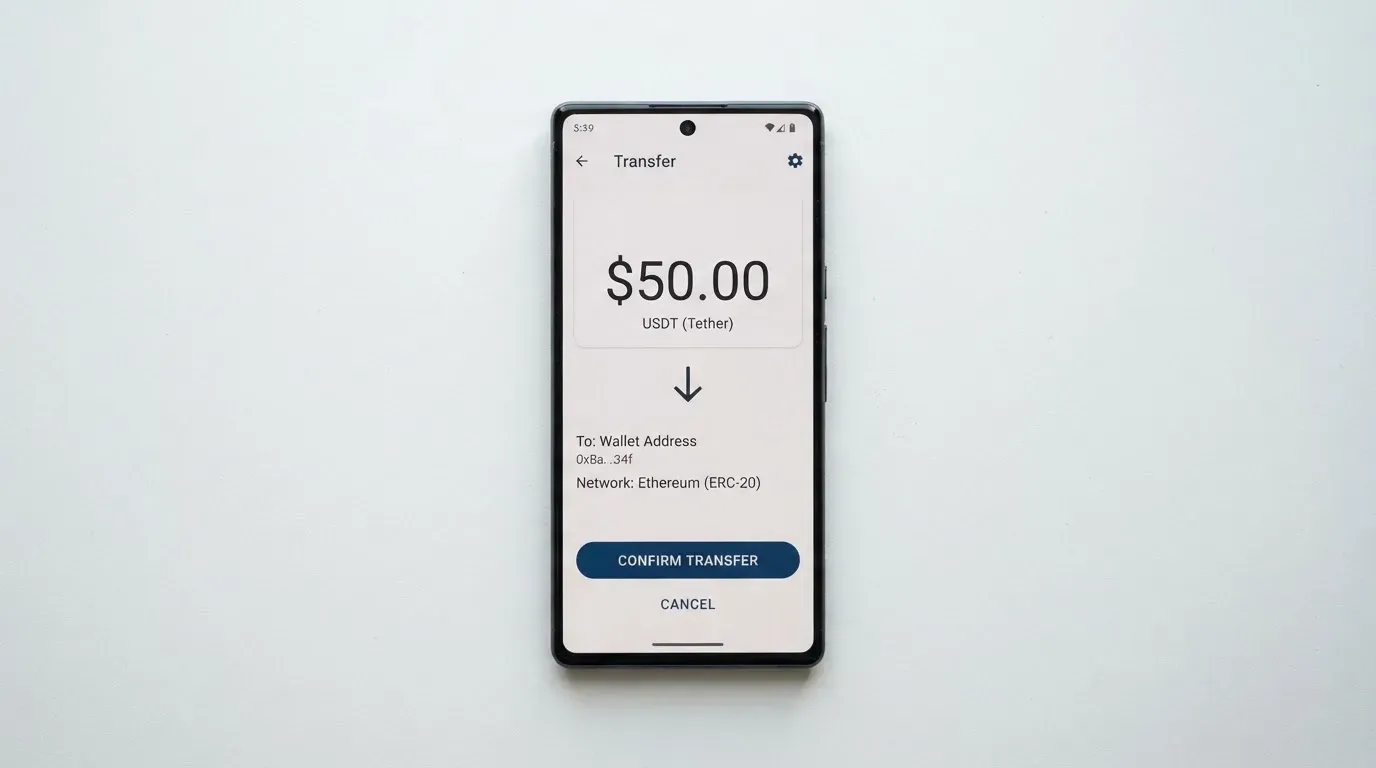
That is a narrower set of options than the score for top-up suggests at first glance, and the reason is worth understanding before you try. The card works in USD and EUR. To hold a balance in those currencies you have to convert into them first, and on-chain transfers are irreversible. A deposit sent on a network the provider does not support, or to an address belonging to a different network, can be lost or need manual recovery through support with no guarantee. Getting this wrong is not a support ticket that ends the same day; it may be a long one.
So the practical questions before your first transfer:
- Which network is the address on? Confirm it from the app’s own instructions at the moment of sending, not from memory of a previous transaction.
- Do you hold the gas token for that network? ERC-20 fees are paid only in ETH, so USDT alone cannot be sent from Ethereum. Tron prices its transactions through bandwidth and energy, often burning TRX.
- Is there a mix-up available? Circle stopped supporting USDC on Tron in February 2024, so “USDC over TRC-20” is not the native option it once was. If you hold the wrong token on the wrong chain, that is a recovery conversation, not a transfer.
None of this is Card.Club’s invention — it is how the networks work — but it is where most first-time failures happen, and this card offers no published list to check against.
Paying with it every day
Short answer: it works like a normal card in most places, with real gaps you should know before you rely on it.
The three cards, as described by third parties, are the core of the product:
| Card | Type and BIN | Wallets |
|---|---|---|
| For subscriptions | Mastercard, Singapore BIN | No Apple Pay |
| For travel | Mastercard, US BIN | Apple Pay and Google Pay |
| Plastic card | Visa, physical | Not stated |
A plastic Visa is available, but no delivery details are published on the official site. The $100 issuance fee buys you a physical card whose delivery time and shipping cost are unknown at the time of purchase. Confirm these details with support before you pay.
Apple Pay and Google Pay work on the travel card only. That is a meaningful limitation given that the subscriptions card — the one most likely to sit in a phone wallet full of recurring-payment cards — is the one that cannot be tokenised. You can add a card to a mobile wallet without the card company ever seeing the real number: the number is replaced with a device-specific account number held in the phone’s secure hardware, and each payment carries a one-time code. But that protection only applies if the token exists, and here it does not for two of the three cards.
Blocked categories are reported and they are not trivial: games, gambling, crypto purchases and financial services. This is issuer policy rather than law, and the exact list varies by issuer — which is the problem, because Card.Club does not name its issuers. The allowed merchant categories are set by the issuing bank, which means the rules can change without the card telling you.
Reviews also report ChatGPT payments being refused on some card regions. If a subscription is part of why you want the card, test that specific one.
Where you can actually spend depends on the BIN country. A Singapore BIN and a US BIN are two different cards to a merchant’s risk system, and they will behave differently at the same checkout. Choosing the travel card for a US-facing subscription and the Singapore card for an Asian merchant is the sort of matching that experienced users do deliberately; it is also the clearest justification for having three cards at all.
One practical note on declines: a refused authorisation can leave a hold on your funds that stays for several days, in some cases up to seven. So a declined payment costs you the per-payment fee, possibly holds the money, and may still be resolved later — sometimes the same day, if a charge turns out to be unauthorised and you get in touch quickly.
What can go wrong
Short answer: the money is held by someone other than you, the issuers are unnamed, and the dominant complaint is fees.
The official site does not state any of this. It does not publish who holds your balance, what security model applies, what support looks like, or any incident history. What follows is what third parties and user reports show.
You do not hold the keys. The model is custodial: Webrex Co., Ltd is named as a technology platform, and the cards are issued by unnamed licensed partner issuers. Control of crypto belongs to whoever holds the private key or the seed phrase; with a custodial wallet the provider holds the credentials and you must trust them completely. A seed phrase is 12 to 24 words in plain form, and anyone who obtains it can restore the wallet and spend the balance. Transfers are typically irreversible, with no built-in recovery — the network cannot freeze or return funds. And custodial platforms have a genuine record of failure: Mt. Gox at about US$350 million reported stolen across 2011–2014, Coincheck at about US$400 million in 2018, Ronin Network at US$625 million in 2022. Holding funds with a custodian carries counterparty and hack risk, whatever any individual provider says about itself.
Which is why the third-party advice — do not keep large sums on the card — is the advice I would give too. If your plan is to use this as a travel and subscriptions card, sized to what you will actually spend, the custody risk is proportionate. If your plan is to use it as a place to hold money, it is not.
Blocks. The reported model is that a high decline rate can lead to an account block. This is the sharpest structural risk I can see. The card decides your merchant categories, your issuing bank applies its own rules on top, and merchants decline foreign and prepaid BINs for reasons that have nothing to do with your behaviour. So a run of ordinary declines can plausibly end with your account frozen — and from there, the same procedure to return a balance from a blocked or closed account applies again. That is the sequence I would want you to picture before you load anything significant.
Withdrawal. Funds can be withdrawn only by contacting support, per a reviewer in May 2026. Not a button. A conversation. And the balance from a closed account needs KYC. I would test a small withdrawal before I trusted the card with money I could not afford to argue about.
Complaints, in what they actually cluster around. User reports on crmindex.ru include recurring $10 charges from a Singapore merchant after a card reissue, refunded the same day on 19 June 2026; game and subscription merchants declined, 5 December 2025; ChatGPT refused by card region, 10 February 2026; and high commissions across several reviews from 2025 into 2026. On the review platforms: Trustpilot 3.7 out of 5 from 1 review, dated 18 January 2026 and positive, with no pattern visible from a single review; crmindex.ru 4.8 out of 5 from 35 reviews; and another review platform 3.8 out of 5 from 18 reviews. One unreliable article calls the service a scam — I could not verify that and I am not treating it as evidence of anything.
Where there is a genuine positive: an unauthorised-charge case was refunded the same day after the user contacted support, on 19 June 2026. Support is via Telegram bot only, and reviewers praise how fast the replies come. Fast replies do help with a disputed charge.
The wider pattern is worth knowing. Card programmes do close. Visa terminated its global agreements with FTX on 13 November 2022, and the FTX US debit card was wound down by its issuer. WaveCrest, a Visa card issuer that supplied crypto card brands, was suspended by Visa in Europe in 2018, closing all its Visa programmes. Visa and Mastercard themselves do not issue crypto cards to consumers — they license issuers, and they can suspend a programme. Closures typically follow a shape: a notice period, then spending and loading stop, then users are asked to withdraw remaining balances. So the relevant question is not “will this company fail” but “if it stops, how do I get my balance out, and does the answer require me to talk to support?” For Card.Club, on the published evidence, it does.
I also want to be straight about a limit on your protections. A chargeback is a refund ordered by the issuer, with reason codes such as fraud, duplicate billing, or goods not received. US reversal rights for debit cards come from Regulation E, credit card rights from Regulation Z, and prepaid-card coverage varies and should not be assumed. Under 3-D Secure, liability for fraudulent online payments can shift — to your bank, or, critics argue, to you. Which protections apply to a British Virgin Islands-governed card disputed on vendor terms, with unnamed issuers, I cannot tell you, because the card does not say.
What to take instead
If you are choosing between cards, these are the comparisons worth making — and the first thing to notice is how much of each alternative’s detail comes from its own site, unlike this one. Where nothing is stated, I say so rather than filling it.
| Card.Club | Cardex | CardFlow | HyperCard | |
|---|---|---|---|---|
| My score | 5.0 / 10 | 5.6 / 10 | 4.9 / 10 | 4.7 / 10 |
| Who it is for | Not stated officially; vendor ties use to the US sanctions list | “One crypto card, 200+ countries”; no country list or exclusions | Aimed at Nigeria; “Nigerians and global users” | No country list; App Store says accepted in more than 176 countries |
| Card | Three cards: two Mastercard (Singapore and US BIN), one plastic Visa | Debit crypto card on VERVE, Visa, Mastercard and UnionPay; virtual and physical | Virtual USD Mastercard, created in about 3 minutes | Prepaid; network not stated; balance in USD or EUR |
| Issuance | $20 / $35 / $100 (unofficial) | Not stated | Creating a virtual card is free (site FAQ) | Not stated; App Store lists no fees |
| Fees | Top-up from 4%; $0.25–0.50 per payment (unofficial) | Real-time conversion at payment; an “AI-Powered Conversion Rate” scans exchange rates and picks the best; no percentage stated | Not stated | Not stated on readable pages |
| Top-up | SBP in rubles; USDT TRC-20 and ERC-20 | USDT, USDC and BTC wallets; networks not stated | Bitcoin, USDT, ETH or Naira bank transfer; networks not stated | Crypto such as USDT, BTC, ETH, converted to USD or EUR |
| Wallets / ATM | Apple Pay and Google Pay on travel card only; no ATM support | Not stated | Not stated | Not stated |
| Rewards | Not stated | Not stated | Not stated | Not stated |
Three honest caveats about that table. Cardex’s “200+ countries” is marketing language with no country list behind it, and its App Store listing is Naira-focused — pay in Naira — which tells you more about its real market than the headline does. CardFlow is built for Nigeria, and its free virtual card is a genuine advantage against a $20 issuance, though its fee structure is not stated either. HyperCard’s “more than 176 countries” is about where the card is accepted, not who can get one — a distinction worth holding onto whenever you read a number like that.
The structural comparison is not really Card.Club against these three. It is this card against a card from an issuer that publishes its fees. The alternatives above all have gaps in their public information too; none of them is a clean answer either.
Who I would recommend it to
I would recommend Card.Club to you if all three of these are true.
- You already know you cannot get an ordinary card, or you specifically want a card that is separate from any bank account you hold.
- You are topping up in small amounts, regularly, and you are paying mostly in the card’s own currency — USD or EUR.
- You are using it for subscriptions and travel, sized to what you will actually spend, not as a place to keep money.
I would steer you away if any of these are true.
- You want to be able to get your money out yourself. Contacting support is not withdrawing.
- You need an ATM. Cash withdrawals are not supported, and in several countries that removes most of what you would use a card for.
- You are paying in many currencies and care about the exchange rate. Double conversion is reported by users, and it is invisible on the card’s side.
- You are putting significant sums on it, or you would be relying on consumer protection you are used to at home. The disputes are governed by British Virgin Islands law.
- Your bank’s complaint route is the thing that makes you feel safe. A support channel that is a Telegram bot is fast and, from the reports, responsive — but it is a different kind of arrangement from a regulated complaints process you can escalate.
If you are in a country on the US sanctions list, the vendor’s own statement means this card is not for you, and I would rather say that plainly than dress it up.
My score of 5.0 out of 10 reflects that split: strong on shape, weak on published information and on the cost of actually using it. The three-card design is genuinely useful, the plastic Visa is a real thing, and travel wallets work. What holds it back is a 4% starting top-up fee, a per-payment fee that charges you for declines, no ATM, and an empty official website for a product that holds your money.
Frequently asked questions
What is Card.Club card?
Card.Club is a prepaid payment card you fund with cryptocurrency or rubles and spend like an ordinary card. It is not a bank account and does not give you one. Third-party sources describe it as three cards: a Mastercard for subscriptions, a Mastercard for travel with mobile wallets, and a plastic Visa, in USD and EUR. The card’s own official site is empty, so none of that is confirmed by the company.
How does Card.Club card work?
You top up a balance, and the card spends that balance — like a prepaid card rather than a debit card, so it cannot overdraw. Card payments run through a network, an issuer and a programme manager: here the named platform is Webrex Co., Ltd, with the actual issuing banks unnamed. Crypto is converted into a fiat balance first. Because the balance is custodial, the provider holds access to the funds.
Is Card.Club a bank?
No, and nothing on the public record suggests it is one. It is described as a technology platform working with licensed partner issuers, and disputes are said to be governed by British Virgin Islands law. Russian-law consumer protection is reported not to apply. If a bank relationship — deposits, interest, a place to be paid into — is what you need, this is the wrong shape of product.
Who owns Card.Club?
The official site does not say. Third-party sources name Webrex Co., Ltd as a technology platform behind the card, with cards issued by unnamed licensed partner issuers. Those unnamed issuers are the part that matters most to you: they set the allowed merchant categories, and they are who a declined payment effectively comes from.
Does Card.Club card require KYC?
Reportedly yes for full access: passport, proof of address, and sometimes a selfie, with a check said to take one to two days. The same procedure is required to return a balance from a blocked or closed account — so expect to go through it again if anything goes wrong. The card does not publish any of this itself.
How much does a Card.Club card cost?
Unofficial figures: $20 for the subscriptions card, $35 for the travel card, $100 for the plastic Visa, with servicing free. One review site says issuance is free, and a reviewer paid 35 EUR in March 2026, so plan for a charge. The ongoing costs are steeper: top-up commission from 4%, plus $0.25–0.50 per payment, including declined ones.
How do I top up the Card.Club card?
Through SBP in rubles or USDT, with USDT on TRC-20 and ERC-20 via a Telegram Mini App or the iOS and Android apps. The minimum top-up is $25 (unofficial) in USD or EUR. Check the network before you send — transfers are irreversible, and a deposit on a network the provider does not support can be lost or need manual support recovery.
Can I use Card.Club card in Apple Pay?
Only on the travel card, per third-party sources. Apple Pay and Google Pay work on the travel Mastercard with the US BIN; the subscriptions card with the Singapore BIN reportedly does not support Apple Pay. No detail is published about the plastic Visa. That is a real limit if your plan was to keep every card in a phone wallet.
Does Card.Club support ATM withdrawals?
No. Third-party sources are consistent that cash withdrawal at ATMs is not supported, and the card itself does not publish a limit or a location list because there is nothing to publish. If you expect to need cash in the country you are visiting, this card will not do that job for you.
Is Card.Club card safe?
I would not call it unsafe, and I would not call it safe either — the card does not publish the information you would need to judge. The balance is custodial, so you are trusting the provider and unnamed issuers; the model reportedly allows an account block after a high decline rate, and reviewers advise not keeping large sums on the card. What is reassuring: a reported unauthorised charge was refunded the same day, and reviewers praise fast support replies via the Telegram bot.
How do I withdraw money from Card.Club?
By contacting support — per a May 2026 review, there is no self-service withdrawal. And if the account is blocked or closed, the balance needs a KYC check before it comes back to you. Before trusting the card with an amount you would mind arguing about, ask support to walk you through a small withdrawal so you know the process works for you.
Virtual cards put to the test – cryptocardtested
Content created by the «cryptocardtested» team