
Wafee card review — what you actually get when the numbers aren't on the page
 Available in US
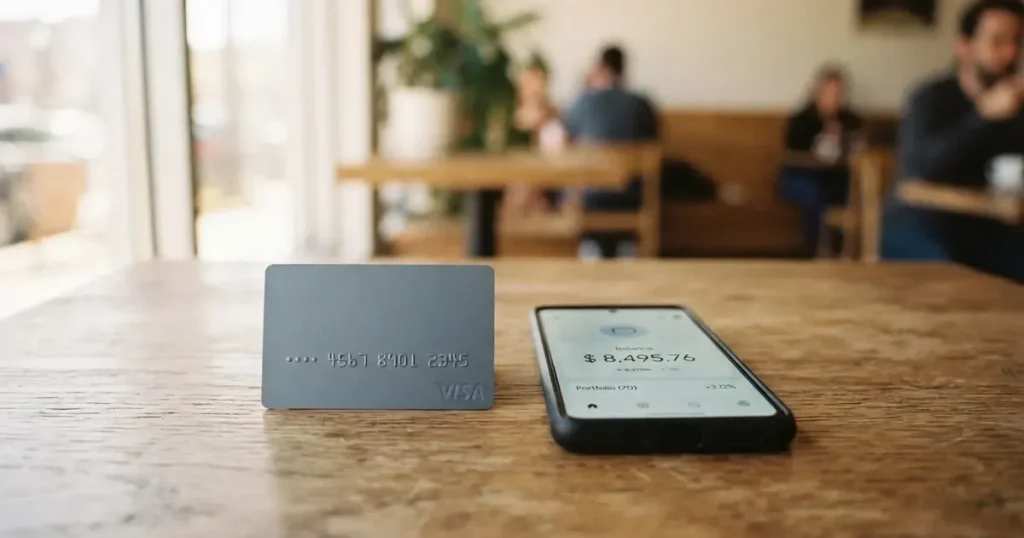
I went through Wafee’s public pages, the App Store and Google Play listings, the company details behind the site and the search results around it. The card itself is a real product: a Visa, physical and virtual, with a euro IBAN sitting next to the crypto balance, accepted wherever Visa is taken and tap-friendly through Apple Pay and Google Pay. The problem is that the public information around it is unusually thin, and that matters a lot when the thing you would normally rely on to decide — fees, limits, supported coins, licences, what to do when something goes wrong — is not on the page. If you are weighing Wafee against the field, this review walks you through what is real, what is missing and what that means for you.
Conditions are current as of October 28, 2026.
Verdict
Wafee lands at 6.5 out of 10 in my scoring. That number is not a verdict on the technology — the technology is straightforward, Visa is everywhere and the IBAN-plus-wallet pairing is genuinely useful for people in countries where opening a normal bank account is hard. The score reflects the gap between what the product does and what the website tells you about it. A crypto card only works if you can read the fees before you pay, know which coins go in and trust that the company behind the card can answer when a transaction goes sideways. On all three of those, the Wafee site asks you to take a lot on faith.

Here is how the scoring breaks down, criterion by criterion.
| Criterion | Mark | Why |
|---|---|---|
| Who can get it | 9 / 10 | Available in 160+ countries with no published list; access decided by Wafee itself |
| Cost | 5 / 10 | Only “competitive exchange rates”; no issuance, conversion or ATM fees published |
| Top-up options | 5 / 10 | Spend crypto anywhere Visa is taken, but coins and networks are not named; EUR IBAN with SEPA and SWIFT |
| Reliability and complaints | 5 / 10 | Wafee Ltd (Nevis), card partner appears to be Walletto, no licences named; no complaints found |
| Everyday use | 8 / 10 | Visa, physical and virtual cards, Apple Pay and Google Pay; ATM fee not stated, app store buttons link to “#” |
| Total | 6.5 / 10 |
The card is best suited to crypto holders who specifically want a euro IBAN account plus a Visa, are comfortable making sense of fees from the app rather than from the website, and live in one of the 160+ countries Wafee says it serves. If you are the kind of reader who decides by comparing published fees, supported coins and licensing up front, you will probably end up somewhere else. I would not point a complete beginner at this card, and I would not point anyone at a card issued by a Nevis company they cannot independently verify at a bank.
Who they will give you the card
Wafee says it is “available in 160+ countries”. That is a big number, and the reason it has to be big is the company’s positioning: it goes after users who cannot easily get a normal bank account. The flags on the homepage hint at where the focus sits — Brazil, Argentina, Mexico, Egypt, Nigeria, Jamaica, Turkey and the UAE — a mix of Latin America, the Middle East and Africa, with a few Caribbean and Eurasian additions. There is no country list, though, and no published way to check whether yours is in or out before you sign up.
The card’s eligibility rules, identity checks and any tier system are not stated on the public pages. In practice, the company decides. The flow most users describe is: create an account, submit the documents the app asks for, and either get a card or get turned down. The Wafee site does not say what those documents are, what is rejected or how long the review takes, so you only find out where you stand once you are already inside the app.
For a person choosing a card, that means you cannot pre-qualify yourself from the website. If you are in a country where opening any kind of card is sensitive, that is something to weigh. If you simply want a Visa on a euro account and you live somewhere the site does not flag, you can sign up and see.
How to get it
The product line is simple: a Visa card, both physical and virtual, that sits on top of an account with a euro IBAN. The site says you can “seamlessly connect physical and virtual cards to your account”, so the two share the same balance and you can use whichever fits the moment. The site is silent on the card’s currency, on delivery times and on what the KYC process actually requires.
You do everything inside the Wafee app, which is available on the App Store and Google Play. There is a web sign-in at app.wafee.co. When I looked at the homepage, the App Store and Google Play buttons on the page itself were not wired up to the real listings — they pointed to “#” rather than the apps — so the practical path is to search for “Wafee” in your store rather than tapping the icons on the site. Once the app is installed, you create an account, pass whatever checks the app runs, and order the card or cards you want. Delivery and the timeline for the physical card are not stated on the public pages.
A subtle thing worth flagging: Wafee’s own FAQ page links out to “Walletto Terms & Conditions” and a “Walletto Annex Prohibited Activity List”. Walletto is not named anywhere else on the Wafee site, but those links strongly suggest Walletto is the card partner, the licensed entity that actually issues the Visa. That is a normal arrangement in this industry — a programme manager on top, a licensed partner underneath — but the fact that the relationship is only visible through the FAQ’s third-party links is part of the transparency problem I keep coming back to. If you are going to put real money through this card, you are also trusting a partner you will have to look up on your own.
What it really costs
This is the section where the Wafee story is thinnest, and the one that dragged the score down the most. The site repeats “competitive exchange rates” more than once and otherwise leaves the numbers off the page. There is no published table of fees, no list of limits, no schedule of what an ATM withdrawal costs and no mention of tiers. If you are deciding between cards, that alone is a reason to pause.
Here is what the Wafee site does and doesn’t say, in one place.
| Fee or limit | What the site says |
|---|---|
| Card issuance | Not stated |
| Monthly or annual fee | Not stated |
| Crypto-to-fiat conversion fee | Not stated (only “competitive exchange rates”) |
| Foreign currency / FX fee | Not stated (cards spent “at competitive exchange rates” abroad) |
| ATM withdrawal fee | Not stated |
| ATM withdrawal limit | Not stated |
| Daily spending limit | Not stated |
| Monthly spending limit | Not stated |
| Tiers or plans | Not stated |
| Minimum top-up | Not stated |
What that table means for everyday use: a few scenarios you can run through your head.
Paying for a coffee in your home country. If your card is loaded in euros and the merchant charges in your local currency, the conversion goes through the rate the app quotes you at the moment of payment. You do not see a separate FX fee in writing on the site, so the only honest thing I can say is that the rate is the rate — read the conversion screen in the app before you tap. The same logic applies if you already hold crypto and the app converts at the point of sale: the rate is what you compare against a competitor, because the fee is not broken out anywhere.
Paying for a hotel abroad. With a Visa, the merchant’s bank will convert the price to the card’s currency. Wafee’s site says cards are spent “at competitive exchange rates” abroad, but it does not say who applies that rate, whether Wafee adds a margin on top of the Visa rate, or what the card’s currency even is. Treat the first foreign-currency transaction as a test: convert the amount the app shows against the rate on a free currency converter and see what margin is hidden in there.
Withdrawing cash from an ATM. There is no published ATM fee and no published ATM limit. ATMs add their own fee on top, sometimes as a percentage, sometimes as a flat fee, and you usually do not know which until after the receipt prints. Plan a small first withdrawal so you are not paying tuition to learn the fee.
The everyday takeaway: until Wafee publishes a fee page, the only way to know what a payment will cost is to look at the app screen right before you confirm. That is workable, but it is not the same as having a number you can compare against other cards before you sign up.
How to top it up
The site describes two ways to put money on the card, and you use them in different situations.
The first is crypto, in the broad sense. The site says users can spend crypto anywhere Visa is accepted, and it lets you exchange between crypto and fiat in the app. The site does not say which coins, which networks, or what the deposit fee is. This is the part to take most seriously before you send anything. Crypto transfers are irreversible, and a deposit sent on a network the card provider does not support, or to an address on the wrong chain, can be lost or need manual support recovery with no guarantee. The Wafee site gives you a destination, but it does not give you a public list of supported assets or chains to check against, so the safe path is to use the deposit address the app shows you, copy it from the app rather than typing it, and send a small test first.
The second is a euro account, which is where the IBAN comes in. Wafee offers EUR IBAN accounts linked to the wallet, so you can receive euros by SEPA, send euros out by SEPA, move money internationally by SWIFT, and send to other Wafee users by P2P transfer. The site does not publish the fees or the minimum top-up for any of these. For a person whose income arrives in euros, that is a meaningful feature: it means Wafee can act like a small bank account in addition to a card. For a person whose income arrives in dollars or another non-euro currency, the SEPA rail adds a conversion step that the site does not price for you.
The site also talks about cashing out: “Cash out your crypto and convert it into traditional currency whenever you need it with our instant conversion feature”, alongside outgoing SEPA euro transfers, SWIFT transfers and P2P transfers. In a card context, “cash out” usually means a withdrawal or a transfer to your own bank account, not a literal ATM cash-out — and the page mixes the two ideas. The conversion rate is the only fee-like number the site acknowledges, and again it is described as competitive rather than quantified.
Paying with it every day
For a card whose public information is so thin, the on-the-ground experience it promises is a lot more complete. The card runs on Visa, so it is accepted at any merchant that takes Visa, including the kinds of places most people actually buy things: supermarkets, online stores, ride-hailing apps, streaming services, restaurants. The site lists both a physical card and a virtual card, and the virtual card is the practical one for online checkout and for keeping a card number out of retailer databases.
Contactless payments through Apple Pay and Google Pay are explicitly supported, so the physical card is optional. The blocked merchant categories — gambling, adult content, cryptocurrency purchases and so on — are not stated. If any of those matter to you, you will only find out whether they work by trying, and a declined transaction is the usual way people discover a block exists.
There is no published rewards or cashback programme. The site makes no mention of points, of a spending tier or of a sign-up bonus. If you are choosing between cards partly on the basis of cashback, that already rules Wafee out.
The mobile app is the centre of the experience, and it is the part that is hardest to evaluate from the outside. The App Store and Google Play buttons on the Wafee homepage link to “#”, so I could not use the site to jump to the listings. The web app is reachable at app.wafee.co. Ratings and reviews on the app stores are the kind of thing a reader should check at sign-up time, because they shift with every release.
There is no published dispute or chargeback process. When a card payment goes wrong — a duplicate charge, goods that never arrive, a merchant that disappears — the path is normally a dispute through the card issuer, then a chargeback if the issuer sides with you. Wafee does not describe this process on its public pages, and the licence and partner behind the card are not named in a way that lets you predict which country’s rules you would be operating under. That does not mean disputes are impossible, only that you cannot read the rulebook before you need it.
What can go wrong
The most important risk with Wafee is not dramatic, it is the everyday kind: you only find out what something costs after the app shows you the number. That is a structural risk for any crypto card whose fees live in the app rather than on the page, and it is more pronounced here because the page really is empty.
The company behind the card is Wafee Ltd, registered in Nevis (company number C 57790), with an address at Suite 1, A.L. Evelyn Ltd Building, Main Street, Charlestown, Nevis. Nevis is a small Caribbean jurisdiction with a flexible corporate regime, used by a lot of crypto companies but not generally associated with retail banking licences. No licences are named on the Wafee site — not a payments licence, not an e-money licence, not a MiCA registration, not a US state money-transmitter list. The FAQ’s link to Walletto’s terms suggests Walletto holds the licence that lets a Visa sit on top, but the site does not explain that relationship.
The site talks about security in general terms: “cutting-edge encryption”, multi-factor authentication and security audits. It links a “Custody Note” PDF for the custody model, but the site does not say whether the underlying crypto is held in a custodial wallet run by Wafee or in a self-custody wallet you control, which is one of the bigger decisions a cardholder makes. If you keep funds on the platform, you are trusting Wafee to keep them; if you keep them in your own wallet, the private key is yours and the deposits depend on your own operational security.
The customer support surface is what you would expect from a small company: an email address at [email protected], a contact form, a FAQ page, and social channels on X, Facebook, Instagram, Discord and Telegram. There is one quirk — the Telegram icon on the site points to the Discord invite — which is a small thing but a useful reminder that this is a small team. Hours and languages are not stated, so live support is best assumed to be in English and best-effort.
I searched for Wafee card reviews on Trustpilot, Reddit and Google, dated 2026-10-21, and did not find any pages about Wafee. That is not the same as a clean record — a card with very few users will not have many reviews, and Trustpilot pages for small issuers often show up only after a problem makes people look. The absence of complaints is mildly reassuring, and the absence of a public reputation is not.
Program-level risk is worth understanding even if it never happens to you. Crypto card programmes can be wound down. In 2018, Visa suspended WaveCrest in Europe, which closed a number of crypto card programmes overnight. In November 2022, Visa terminated its global agreements with FTX and the FTX US debit card was wound down by its issuer. When that happens, the issuer usually gives a notice period, stops new loads, then stops spending, then asks users to withdraw any remaining balance. The cardholder is made whole on a defined schedule, but it is a schedule you do not choose.
A final point on legal and tax exposure. In the US, the IRS treats digital assets as property, so spending crypto through a card is generally a taxable event: each payment is a disposal, and the gain or loss is measured in your local fiat currency at the fair market value on the day of the transaction. Rules differ by country, and this review is not tax advice, but the general shape is the same in most jurisdictions where crypto is regulated: every card payment has a cost basis, a sale price and a gain or loss. If you only ever spend stablecoins, the numbers are usually small, but they are still numbers.
What to take instead
Wafee is not the only card trying to serve the underbanked crypto user. If you find that the missing fee schedule or the licensing picture is a deal-breaker, there are a few alternatives worth comparing. The numbers below come from the same kind of public review, and they are not perfect apples-to-apples with Wafee — they publish more, but they also have their own country and feature trade-offs.
International Visa Card. Score 6.7 out of 10. A US-issued Platinum Visa card, virtual today, with a physical card “coming soon”. It pays in USD, so a euro account is not the point. Issuance is $5 one-time, with no maintenance fee; the plans are Classic (free), Pro ($9.00/month) and Max ($19.00/month). Card use in USD is free on every plan; foreign-currency use charges the Visa exchange rate plus a 2% FX fee. You fund it with USDC or USDT into the USD account at 1:1, and you can also fund with USD, EUR, SEPA, SWIFT or FedNow deposits. The catch is the country list: the card is not available to residents or legal registrants of Belarus, mainland China, North Korea, Cuba, India, Iraq, Iran, Israel, Myanmar, Nepal, Nicaragua, Russia, Syria, Turkey, Ukraine, Venezuela or Vietnam, with FATF grey-list countries reviewed case by case. Purchases are blocked in North Korea, Cuba, Iran, Russia, Syria, Ukraine and Venezuela. The rule is by residence or registration rather than by citizenship.
UNi Card. Score 6.1 out of 10. A multicurrency Mastercard on the UNi.Global account balance, with no annual fee and no foreign transaction fee. Assets are converted at live OTC rates, with no hidden exchange fees. The “Spend-to-Earn rewards” programme pays up to 3% on the UNi Card, which is a real cashback angle. Country availability, the issuance fee and the funding options are not stated on the public pages, so it shares some of the same transparency limits as Wafee.
Whop Cards. Score 5.2 out of 10. Visa cards that spend from a Whop balance, with pending balance usable as soon as a payment arrives. Backed by stablecoin collateral from a linked wallet, with 5% cashback at select merchants (Uber is named today, with more planned). The country coverage is the most restrictive of the three: consumers in 31 US states, businesses in 41, and a long unsupported-country list that overlaps heavily with the International Visa Card. The basis (citizenship or residence) is not stated.
If you are choosing between these, the trade-off is roughly: Wafee gives you a euro IBAN and broad country coverage but says almost nothing about the cost; International Visa Card gives you a published fee schedule and tightens the country list; UNi Card gives you cashback in exchange for the same opacity; Whop Cards give you the most generous rewards and the most limited geography. The Wafee-shaped offer — euro IBAN plus crypto plus very wide country coverage — is genuinely rare, and that is the part of the pitch that is hardest to find elsewhere.
Who I would recommend it to
Wafee is the right card for a narrow and specific reader, and the wrong card for most of the rest. The narrow reader looks like this: you hold crypto, you want a euro IBAN so you can receive euros, pay euros, and spend the balance on a Visa, and you live in a country where getting a normal bank card has been hard. You are comfortable learning the fees from the app rather than from the website, you are not relying on cashback, and you understand that the company behind the card is registered in Nevis and that the card partner is most likely Walletto. You are also the kind of person who double-checks a deposit address before sending, who treats the first ATM withdrawal as a test, and who keeps a small amount on the card rather than parking a large balance with an unnamed custodian.
The list of readers who should look elsewhere is longer. If you want a fee schedule you can read before you sign up, this is not your card. If you want the cashback and rewards programmes that a lot of competitors publish, this is not your card either. If you live in one of the larger card markets — the US, the UK, the eurozone — and have a normal bank account, the only thing Wafee offers you is the IBAN-plus-crypto pairing, and you can probably find a more established issuer for that. If you need a card you can defend to a tax authority, an employer or a spouse with a budget spreadsheet, the absence of published numbers is going to be a recurring problem.
For everyone in between, the Wafee story is one you should be able to read in a few minutes. The product does what the site says it does. The site just does not say much.
Frequently asked questions
What is the Wafee card?
Wafee is a Visa payment card, both physical and virtual, that sits on top of a euro IBAN account linked to a crypto wallet. You hold crypto or euros, the app converts between them, and the card spends the balance wherever Visa is accepted. The card also supports Apple Pay and Google Pay for contactless payments, and the company markets it to users in 160+ countries, with a focus on Latin America, the Middle East and Africa.
How does the Wafee card work?
You create an account, pass whatever identity checks the app runs, and order a card. You fund the account by sending crypto to the deposit address the app shows you, or by receiving euros through the IBAN via SEPA or SWIFT. At the point of sale, the app converts your balance into the card’s currency and the card pays the merchant. The card is prepaid in feel, so it can only spend what is loaded on the balance.
Is Wafee a bank?
No. Wafee is not a bank, and the Wafee site does not name any banking or e-money licence. The company, Wafee Ltd, is registered in Nevis. The card partner, which appears to be Walletto based on links in the Wafee FAQ, is the entity that actually issues the Visa, but the licensing chain is not explained on the public pages.
Who owns Wafee?
The Wafee site identifies the company as Wafee Ltd, registered in Nevis (company number C 57790), with an address in Charlestown, Nevis. The site’s FAQ links to Walletto’s terms, suggesting Walletto is the card-issuing partner. Ownership beyond that is not disclosed on the public pages.
Is the Wafee card available in my country?
Wafee says it is available in 160+ countries, but it does not publish a country list. The flags on the homepage point to Brazil, Argentina, Mexico, Egypt, Nigeria, Jamaica, Turkey and the UAE. The only way to confirm availability is to sign up and see. If your country is not flagged on the homepage, that is not a guarantee either way.
Does the Wafee card require KYC?
Wafee does not publish the KYC requirements on its public pages, and the level of verification is not stated. In practice, you submit whatever documents the app asks for during onboarding. The KYC rules for regulated card programmes typically require a government-issued ID and a proof of address at a minimum, and reviews can take anywhere from minutes to several days depending on the issuer and the country.
How do I top up the Wafee card?
You top it up either by sending crypto to the deposit address the app shows you, or by receiving euros into the EUR IBAN by SEPA or SWIFT. You can also receive peer-to-peer transfers from other Wafee users. The site does not publish minimum top-up amounts, supported coins, supported networks or top-up fees, so the app is the source of truth on all of those.
How do I add the Wafee card to Apple Wallet?
Open the Wafee app, go to the card detail screen, and add the card to Apple Wallet or Google Pay from there. The card supports tokenised mobile wallets, so the device stores a Device Account Number rather than your real card number, and each payment uses a one-time dynamic security code. If the option does not appear, update the app and check that the issuer has enabled tokenisation for your account.
Is the Wafee card safe?
The Wafee site mentions encryption, multi-factor authentication and security audits, and it links a Custody Note PDF. No licences are named on the public pages, the company is registered in Nevis, and the custody model — whether the underlying crypto is held by Wafee or by you — is not stated on the homepage. Search results for Wafee card reviews on Trustpilot, Reddit and Google, dated 2026-10-21, returned no complaints and very little public reputation, which is mildly reassuring but not the same as a track record.
How do I delete my Wafee account?
The Wafee site does not describe an account-deletion flow on its public pages. The practical steps are usually: withdraw any remaining balance to your own bank account via SEPA or SWIFT, request closure through the app or by emailing [email protected], and keep a record of the request. Until you have a confirmation that the account is closed and any balance has been returned, assume it is still open.
App and neobank cards put to the test – cryptocardtested
Content created by the «cryptocardtested» team