
What I could and could not confirm about the Apex virtual dollar card
 Available in US

Apex is a virtual Mastercard denominated in US dollars, created inside an app called Apex: Buy, Sell & Trade Crypto and issued instantly once your account is funded. That is the short version, and it is also, for the most part, all the public information there is. The card’s own FAQ and terms page do not state which countries issue it, who the issuing bank is, what the fees are, or what the daily and monthly limits are. I went through what the company publishes, plus its App Store listing, its help centre and its site, and this review reports both what I found and what I could not find. My score is 4.2 out of 10.
Conditions described here are current as of October 28, 2026.
The appeal of this kind of card is obvious. If you cannot get an ordinary bank card — because of where you live, what documents you hold, or how long a traditional application takes — a virtual dollar card that appears in an app minutes after you top up solves a real problem. On the other hand, a payment card is not a small thing to hold blind. It is the thing that gets charged when something goes wrong, and most of the consumer protections people assume exist in that situation depend on knowing who issued the card and under which law. Apex does not tell you either. That asymmetry is the whole of my review.
Verdict: 4.2 out of 10, and the reasons why
| Criterion | Mark | Why |
|---|---|---|
| Who can get it | 3 / 10 | The FAQ does not disclose issuing countries; starting data suggested Nigeria and select African countries, but those pages do not confirm it |
| Cost | 5 / 10 | Issuance, servicing and transaction fees are not disclosed in the FAQ |
| Top-up options | 5 / 10 | Top up from a fiat wallet or the balance of a supported crypto asset in the app; which coins and networks are not disclosed |
| Reliability and complaints | 5 / 10 | App seller Apex Web Network Ltd.; an NDPR data-protection certificate (Nigeria) is shown; issuer, country of incorporation and licences are not named; no complaints or reviews found |
| Everyday use | 3 / 10 | Virtual USD Mastercard only, issued instantly; Apple Pay, Google Pay and ATM are not disclosed, and there is no physical card |
| Total | 4.2 / 10 |
The low scores are not a verdict on whether the app works. They reflect a disclosure problem: on every one of the five criteria, the questions that decide whether a payment card is usable — which country, which issuer, which licence, which fees, which limits — are answered “not stated” on the pages the company publishes. That is a different thing from an answer being bad.
The audience the product appears aimed at is Nigerian app users who want an instant virtual dollar card. If that is you, the card does one thing quickly and plainly, and you may well decide the missing details are an acceptable trade. If you are anywhere else, or if you intend to hold money on it, or you need a physical card, a phone-wallet tap, or a dispute route when something goes wrong, the absence of answers is not a detail you can work around.
Will they give you the card?
The card’s FAQ and terms page do not list the countries in which Apex issues cards. Starting data suggested Nigeria and a number of other African countries, but those pages did not confirm it, so treat any country list you have seen elsewhere as unofficial and unverified.
That single gap decides whether the card is relevant to you. Everything else in this review is written on the assumption that you already know whether you can open an account; if you cannot, nothing else applies. My advice is to look for your own country in the app’s own terms before you spend time on fees, because the fee question is unanswerable from public pages anyway and you would be researching two unknowns at once.
One thing the card does say is that limits depend on your verification level. Levels exist, in other words, but the levels themselves — what documents raise you from one to the next, what each level unlocks — are not described in the pages I read.
How to get it
The steps the card’s own FAQ gives are short:
- Create the card in the app after funding your wallet or your card balance.
- The card is issued instantly.
- It is a virtual dollar card, Mastercard, currency USD.
That is the whole sequence. No waiting period, no shipping, no branch.
What the FAQ does not give you is the identity side of it. The document list is not stated, proof of address is not mentioned, and no age requirement appears on the pages I read. Prepaid and debit cards are generally available to adults aged 18 or over in this category, and some issuers set higher limits of their own, but I could not confirm what Apex applies. Because limits depend on your verification level, and the levels are undescribed, you cannot tell in advance what you will be able to spend per day or per month once you are in.
No physical card is mentioned anywhere. There is no delivery section, because there is nothing to deliver.
What it really costs: the fees that are not listed
I want to be plain about this section rather than pad it. Apex does not publish its fees. Not the issuance fee, not the monthly servicing fee, not the conversion rate between crypto and dollars, not the foreign-exchange markup, not the ATM charge. On the pages I read, all of these are marked as not stated.

| Item | What the card publishes |
|---|---|
| Card issuance | Not stated |
| Monthly servicing fee | Not stated |
| Crypto-to-fiat conversion cost | Not stated |
| Foreign-exchange fee | Not stated |
| ATM withdrawal | Not stated; no ATM feature is mentioned at all |
| Daily limits | Not stated — “limits depend on card type, verification level, and available balance” |
| Monthly limits | Not stated — same wording |
Card type is named as one of the things limits depend on, which implies tiers exist. No tiers are described.
Let me put that in context with what a comparable card actually charges, because the absence is easier to judge against a real number. Bybit’s card lists no virtual card issuance fee in any region “until further notice”, and no annual fee; its crypto conversion fee is 0.9% over the One-Click Sell rate in most regions and 0.5% in Argentina, and its FX fee is 2% on top of the network rate in several regions, 1.5% in Brazil, 1% in Peru. On-chain network fees for your deposit, by contrast, are charged by the blockchain and not by the card provider. Those figures are not a promise about Apex — they are the yardstick. A virtual card with no published fees is not necessarily an expensive card; it is a card whose cost you cannot calculate.
So what should you check first, in concrete terms, before you rely on this one? Three things, in this order:
- The conversion rate shown in the app at the moment you convert. This is the number that decides whether crypto spending is cheap or expensive, and it is the one thing you can see without relying on any page.
- Whether there is a per-transaction or monthly charge that would apply to your own volume. Small monthly amounts are where an unstated servicing fee hurts least.
- What happens on a declined payment. Declined authorisations can leave a hold on funds that stays for several days, in this category typically up to seven. If the balance is your whole float, a single failed hotel deposit can freeze money you needed elsewhere.
On multi-currency: the card is described as a virtual dollar card, and multi-currency is not stated. That means your practical default is USD, and every non-dollar purchase you make is a conversion someone prices for you.
How to top up the card
Top-up sources are disclosed at the level of type, not detail. You can fund the card from a fiat wallet, or from the balance of a supported crypto asset, in the app. Which coins and networks are supported is not stated, and nothing beyond those funding sources is described.
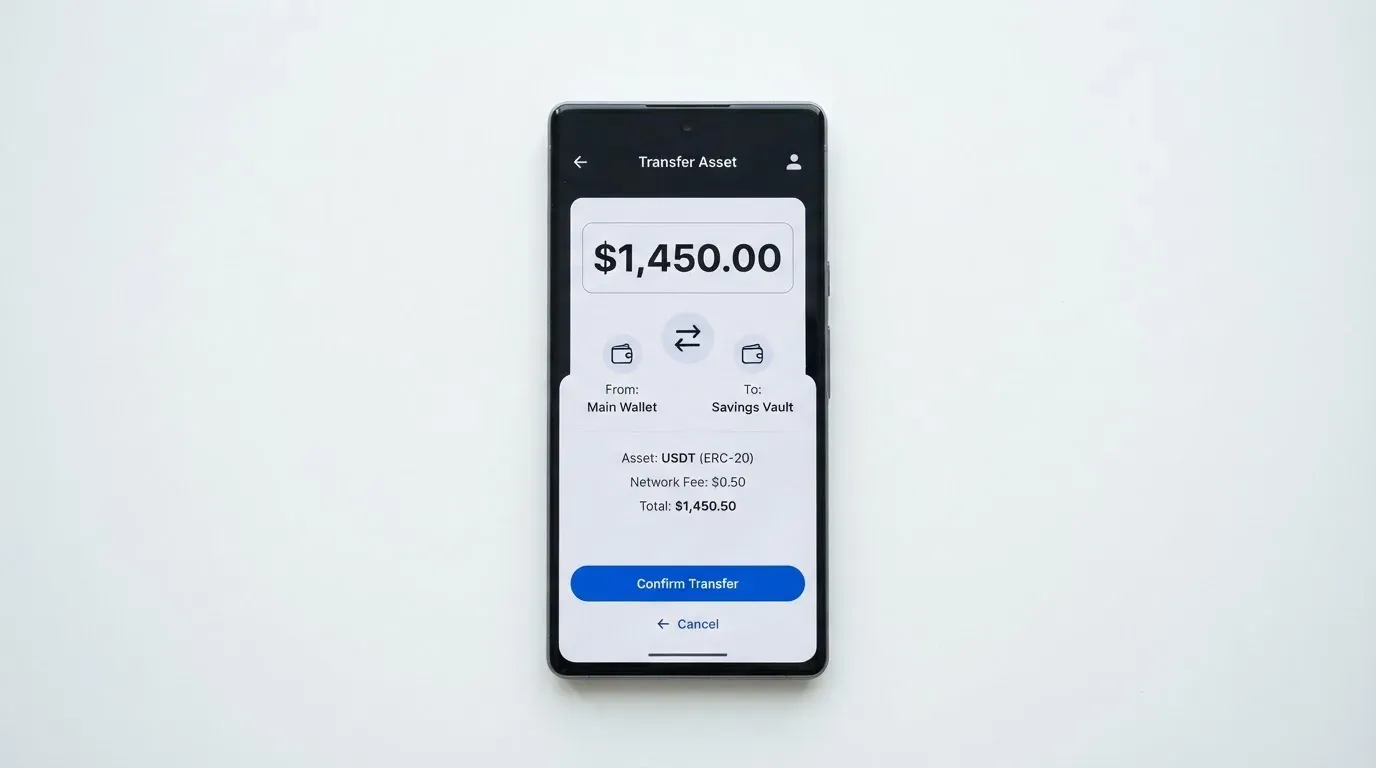
That gap is more consequential here than it looks. In this category, the network you send on decides whether the money arrives at all. Blockchain transfers are irreversible: a deposit sent on a network the provider does not support, or to an address belonging to a different network, can be lost or need manual support recovery with no guarantee. And the mechanics differ by chain in ways that bite: ERC-20 is the Ethereum token standard, and gas there is paid only in ETH, so a wallet holding USDT with no ETH cannot send it; Tron prices fees through bandwidth and energy, often burning TRX. If you are new to this, the practical consequence is that “which network do I pick” is a question with real money attached, and Apex does not publish the answer.
Two stablecoins dominate this market. Tether’s USDT and Circle’s USDC are both pegged to the US dollar, and the BIS put about 90% of stablecoin market capitalisation in these two as of July 2025. USDT has been issued on networks including Ethereum, Tron, Solana, Polygon and Avalanche; Circle listed USDC as natively supported on 38 networks as of 16 September 2026, including Ethereum, Solana, Base, Polygon PoS, Avalanche, Arbitrum and Stellar. Circle stopped supporting USDC on Tron in February 2024, so “USDC over TRC20” is not a native option. None of that tells you what Apex supports — it tells you what the question will look like once you find out.
Withdrawals are not stated. The FAQ has a Withdrawals & Transfers section, which I did not read, so I cannot tell you what moving money back out looks like or what it costs. If getting your own balance out is part of your plan, that section is the one to read before you deposit anything.
Paying with it every day
The daily picture is thin because the card is thin. It is a virtual dollar Mastercard, and the things people actually rely on day to day are not disclosed:
- Wallets. Adding the card to Apple Pay or Google Wallet is not stated. Apple Pay replaces the card number with a device-specific Device Account Number held in the Secure Element rather than on Apple’s servers, and each payment uses a one-time dynamic security code — that is how the wallet works in general, but whether this card can be added is not something the card publishes.
- ATM. Not stated, and with no physical card the question is largely moot.
- Rewards. Not stated. No cashback, no points, no tier.
- Disputes. Not stated. How a chargeback would be handled, and against whom, is not described.
- The app. The App Store listing for “Apex: Buy, Sell & Trade Crypto” shows 4.5 out of 5 across 2.3k ratings, read 21 October 2026, with Apex Web Network Ltd. as the seller. I did not obtain the Google Play listing, so I cannot tell you whether the two stores agree.
The app rating is worth a moment. 4.5 is a good number, and 2.3k ratings is a real sample, but an app rating measures the app — the exchange, the interface, the buy and sell flow — not the card. People rate the part they use daily, and the card is not it.
If you are still considering this, one everyday-use point is worth checking yourself rather than reading: take a virtual Mastercard, open a low-value online merchant or a small subscription you can cancel yourself, and see whether the authorisation goes through. Online acceptance is where prepaid and foreign-issued BINs most often fail. Merchants can look up the issuer’s identification number and see which institution and country issued the card, and some decline prepaid or foreign BINs on that basis; address verification is also mainly offered in the US, Canada and the UK and is generally unavailable for foreign-issued cards. A card issued in one country can look foreign to a shop in another. Your own test transaction is worth more than any of this.
What can go wrong
I’ll group these by how they would actually hit you.
The counterparty you cannot name. The app’s seller is Apex Web Network Ltd. The site shows an NDPR certificate — the Nigeria Data Protection Regulation — and describes Apex as a crypto exchange. The country of incorporation, the issuing bank and the licences are not stated. That means I cannot tell you which entity stands behind your balance, which regulator watches it, or which complaint route exists. It also means the usual protections do not obviously attach: if the balance is e-money rather than a bank deposit, deposit-guarantee schemes may not cover it at all, and e-money institutions are required to safeguard customer funds by segregating them or insuring them — which is a different thing from a deposit guarantee.
Nothing has gone wrong. That is the finding. I found no official incident reports involving Apex, and no card reviews for Apex Network at all. There is no Trustpilot page. Absence of complaints in a category where custody is the risk is not reassurance; it is a thin record. The category has a history: Mt. Gox (about US$350 million reported stolen, 2011–2014), Coincheck (about US$400 million, 2018), Ronin Network (US$625 million, 2022). A provider with no public track record and no named issuer is exactly where that history is least comfortable.
Programme closure. Card programmes do end. In November 2022 Visa said it had “terminated its global agreements with FTX” and the FTX US debit card programme was wound down by its issuer. WaveCrest, a Visa issuer that supplied crypto card brands, was suspended by Visa in Europe in 2018, closing all WaveCrest-issued programmes. Closures typically follow a pattern: a notice period, then loading stops, then you are asked to withdraw. One 2026 closure reported by a secondary source ended new loads on 8 July 2026 and spending on 8 August 2026 — single source, unconfirmed, and I give it to you only as the shape these events take.
Card control and account security. You can freeze, unfreeze or permanently block the card in card settings. That is the one security control the card does publish, and it is a good one to have. Custody arrangements and two-factor authentication are not stated. The site links an Asset Recovery Policy, which I did not read. If you rely on this card, treat “is 2FA on” as the first thing to check in the app, because nobody will answer that for you.
Payments that do not go through. 3-D Secure — Visa Secure on Visa, Identity Check on Mastercard — adds an identity step to online payments, and it can challenge you with a one-time code. Address verification, as noted, is largely unavailable for foreign-issued cards. Merchant category codes also play a role: MCC 7995 covers gambling, and many issuers block it by policy rather than by law, with the blocked list varying by issuer. If a payment is declined, a hold on your funds can persist for several days, typically up to seven.
Limits you cannot predict. “Limits depend on card type, verification level, and available balance.” You will find out your ceiling after you need it.
Support. A Help Center FAQ and a Contact Us page exist. Hours and languages are not stated. Given the time-zone and language spread in this category, that is a practical constraint, not a technicality.
Two further things I want to flag honestly. First, there is no news or announcement material I can point you to. Second, my inability to find reviews is itself the honest summary of this card’s public presence: there is very little to review.
What to take instead
If your problem is “I cannot get an ordinary bank card”, the honest answer is that you have more than one option, and the ones that publish their details are worth a look. The three below are the comparisons I could make from public information; note how much more there is to read here than about Apex, and treat that asymmetry itself as information.
| Card | Score | What is actually published |
|---|---|---|
| Apex | 4.2 / 10 | Issuing countries, issuer, fees and limits not stated |
| Bybit Card | 6.0 / 10 | Countries, card types, networks, currencies, validity, fees and rewards all itemised |
| MSX | 6.4 / 10 | Almost nothing published on the pages I could read; scored on the same disclosure basis |
| Young Card | 5.7 / 10 | A rewards structure is published; eligibility, card, cost and fees not stated |
Bybit Card is the most fully documented option I looked at, and the most instructive comparison. Its help centre names card regions: Argentina, AIFC (Kazakhstan), Georgia, Kazakhstan, Australia, Mexico, Brazil, Peru and Asia Pacific. The application asks for your country of residence, and if the country is unsupported Bybit says it “will register your interest”. Its cards page states that the product is not meant for European Economic Area customers and that all European Economic Area customer participation is strictly prohibited. Its fiat-service restricted list — covering deposits, withdrawals and One-Check Buy, not the card as such — includes Belarus, the Russian Federation, Serbia, China and the United States, and it says Russian users can only make RUB transactions in fiat. I found no card-specific statement about Russian or Belarusian citizens and no rule distinguishing citizenship from residence. The card currency “depends on the country of your Advanced Identity Verification”.
Bybit publishes card types and networks per region — virtual and physical, with a virtual card obtained first, no physical card in Peru, rolled out in phases — and per-region currencies: USD for AIFC, Georgia, Kazakhstan, Australia and Asia Pacific; ARS for Argentina; MXN for Mexico; BRL for Brazil; PEN or USD for Peru. Validity runs 3, 5 or 6 years depending on region. It also publishes the mechanics of spending: the card has no balance of its own, drawing instead on the Funding Account and the Flexible Easy Earn balance, fiat first, and if fiat is insufficient crypto is sold at the Bybit One-Click Sell rate plus the card’s conversion fee. Supported coins are BTC, ETH, XRP, USDT, USDC and GRAM, with a default priority of USDT, USDC, GRAM, BTC, ETH, XRP that you can reorder in the Card Dashboard.
Its rewards are also specific, and one detail there is worth borrowing as a question for any crypto card: from 5 October 2026 at 10:00 UTC, only crypto-funded transactions earn points or cashback, and fiat-funded spending does not. Tiers run Base 2.00% with a 5 USD monthly cap, Beta 2% with 50 USD, Alpha 4% with 150 USD, Apex 6% with 250 USD, Omega 8% with 400 USD, Infinite 10% with 600 USD. Points pend for four calendar days; cashback in USDT equals points × 0.002.
Two things about Bybit to weigh honestly. Its fee structure is real but layered, and the layer that will hit you depends on how you fund the card — a crypto-funded card earns rewards while a fiat-funded one does not. And its regional structure means the question you care about most may still end in “register your interest”.
Young Card publishes one thing clearly: cashback paid in YNG tokens at a rate set by Club tier — Essential 0.1%, Gold 1.8%, Platinum 3.6%, with Bronze and Silver not stated. Who can get it, what the card is, what it costs, what the fees are and how it is funded are not stated officially, so I scored it on the same disclosure basis as Apex. The difference is that it publishes a rewards rate and Apex publishes nothing.
MSX scores highest of the three at 6.4 out of 10, and I want to be careful about why, because it is not because more is known. Eligibility, the card itself, costs, fees and funding are all not stated on the pages I could read. It is a judgement call, and if you are choosing, you should not treat that number as evidence that MSX discloses more. Ask it the same questions I asked Apex.
The pattern across all four is worth naming. Where a card provider publishes its regions, its issuer, its fees and its rewards, you can decide. Where it does not, you are not choosing a product so much as accepting terms you have not been shown. That is the choice Apex is asking you to make, and it is the reason this review is as short on detail as the card is.
Who I would recommend it to
I would recommend Apex to someone in Nigeria, using the app, who wants a virtual dollar card in minutes and who treats it as a convenience instrument rather than a place to keep money. Someone who already trusts the exchange for the crypto side, who is comfortable reading the app’s own screens for fees and limits instead of a published schedule, and who would notice if their balance went quiet. Under those conditions the card does a small job quickly and cheaply in the way you would hope.
I would not recommend it as your main payment method, as a place to hold a balance you cannot afford to lose, or as your route to a dispute if a shop takes your money and does not deliver. Not because anything bad has been proven — nothing has — but because you would be relying on protections you cannot identify. If a merchant disputes a charge, you would need to know which issuer to ask; if the app stops being maintained, you would need to know which entity holds your balance. Neither is answerable from what the company publishes today. If you need to be able to answer those questions, pick a provider that has already answered them for you.
The conditions above are current as of October 28, 2026.
Frequently asked questions
What is Apex card?
Apex is a virtual Mastercard denominated in US dollars, issued inside the “Apex: Buy, Sell & Trade Crypto” app by Apex Web Network Ltd. It is created in the app after you fund your wallet or card balance, and it is issued instantly. There is no physical card mentioned, and it is not described as a bank account. What the card does not publish is as important: no issuing country, no named issuer, no fee schedule.
How does the Apex card work?
You top up in the app from a fiat wallet or from a supported crypto balance, create the card, and spend the resulting dollar balance. The card behaves like a stored-balance card rather than a debit card, so it cannot overdraw — what is left in the balance is what you can spend. Conversion between crypto and dollars happens inside the app, and the rate you see there is the one number that determines your real cost.
Is Apex a bank?
The published pages do not say, and I would not treat it as one. The app seller is Apex Web Network Ltd. and the site describes Apex as a crypto exchange with an NDPR data-protection certificate shown for Nigeria. No issuing bank is named. In this category the crypto brand is often only a programme manager in front of a licensed issuer, and here that issuer is not disclosed.
Who owns Apex?
The named company behind the app is Apex Web Network Ltd., which is the seller listed on the App Store. The site shows a Nigeria Data Protection Regulation certificate. The country of incorporation and any licences are not stated, so I cannot tell you what regulatory regime, if any, formally stands behind the balance.
Which countries can I get an Apex card in?
The FAQ and terms page I read do not list issuing countries. Starting data suggested Nigeria and select African countries, but those pages did not confirm it, so treat any country list you have seen elsewhere as unofficial. If your country is not clearly supported, ask the app directly before depositing — the support page exists, though its hours and languages are not stated.
Does Apex require KYC?
The card does not publish a document list, a proof-of-address requirement or an age rule. It does say limits depend on your verification level, which implies verification levels exist and are described only inside the app. Broadly, in this category identity checks are a legal requirement of licensed businesses rather than a product feature, so expect some form of them; expect also that failing to complete them can freeze the account.
How much does the Apex card cost?
The card does not state issuance fees, monthly servicing fees, conversion costs, foreign-exchange fees or ATM charges — all are marked as not stated on the pages I read. That is the central weakness of this card. Before you rely on it, read the conversion rate in the app at the moment you convert, since it decides your real cost more than any servicing fee will.
Can I add the Apex card to Apple Pay or Google Wallet?
Not stated. The card publishes no information about mobile wallets, so treat tap-to-pay as unavailable until you see it in the app yourself. For context on why that matters: Apple Pay replaces the card number with a device-specific number held in the Secure Element rather than on Apple’s servers, and each payment uses a one-time code — a genuine security improvement, but only if your card supports it.
Is Apex card safe?
Nothing bad has been found against it: no incident reports, no card reviews, no Trustpilot page. That is a thin record rather than a clean one, and it comes with no named issuer to look up and no published custody or two-factor-authentication arrangements. The one control the card does publish is useful — freeze, unfreeze or permanently block the card in settings — so enable that and turn on two-factor authentication yourself if it is offered.
Is the Apex card worth it?
For a Nigerian app user who wants an instant virtual dollar card and treats it as a convenience instrument, plausibly yes. For holding a balance, for a dispute route when a shop takes your money and delivers nothing, or as a primary card, no — because you cannot identify the issuer who would handle that dispute. Judge it on the app’s own screens at the moment you use it, not on what any review, including this one, can tell you.
Exchange cards put to the test – cryptocardtested
Content created by the «cryptocardtested» team