
PayPilot Review: A No-Fee Visa Card That Spends From a Euro Balance
 Available in US
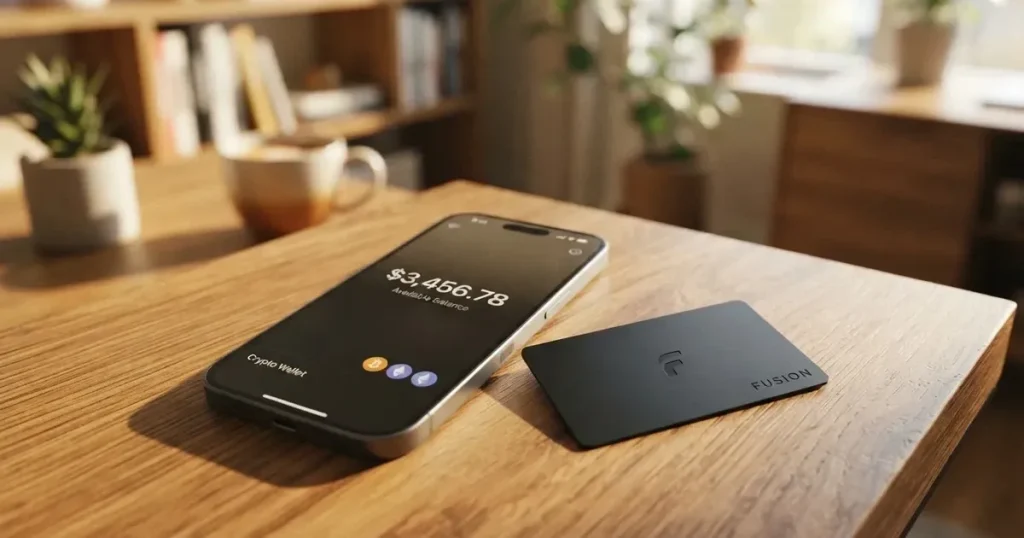
If you have been reading about crypto cards and wondering which one is worth the setup time, PayPilot is worth a proper look — but not for the reason most write-ups suggest. The card costs nothing to issue and nothing to keep, and it spends from a plain euro balance, which makes everyday use boring in the best way. The catch is not the price. It is what the public pages leave unsaid: no supported-country list, no foreign-exchange fee figure, no ATM allowance, no limit amounts. My score for it is 7.4 out of 10, and most of the missing half-point sits exactly there.
I have gone through the card’s own pages and terms and checked what is actually stated against what you will have to find out for yourself. This review is written for the person deciding whether to spend an evening on this: what it costs, what it does with your money, who it will issue to, and what could go wrong on an ordinary Tuesday.
The conditions described here are current as of October 28, 2026.
Verdict: 7.4 out of 10, strong on price and daily use, thin on disclosure
The card scores well where it is easy to score: issuance at 0 EUR, service at 0 EUR, no commission on payments from the euro balance, and a single 0.4% fee when crypto is converted to euros. For someone spending in euros and topping up with crypto, that is close to the floor for cost. Everyday use is also strong — Visa online and in stores, a virtual card usable immediately, a physical card by post, Apple Pay, Google Pay, ATM withdrawals.
Where it loses marks is silence. Availability “depends on your country of residence and local regulations” and the supported regions are not listed. The foreign-exchange fee is not stated. ATM fees and allowances are not stated. Single, daily and monthly limits exist but their values are not stated. If you are in a country where cards are hard to get, or you want to know exactly what a foreign purchase costs before you make it, that silence is the problem, not the price.
| Criterion | Mark | Why |
|---|---|---|
| Who can get it | 5 / 10 | Availability depends on country of residence and local regulations; supported regions are not disclosed |
| Cost | 9 / 10 | Issuance 0 EUR, service 0 EUR, euro-balance payments free, crypto conversion 0.4%; FX fee not stated |
| Top-up options | 6 / 10 | BTC, ETH, USDT and EUR; you can fund with crypto or euros; networks not named |
| Reliability and complaints | 8 / 10 | Issuer Walletto UAB, electronic money licence No 33 of the Bank of Lithuania, 29 March 2018; no complaints found |
| Everyday use | 9 / 10 | Visa, virtual immediately and physical by post, Apple Pay and Google Pay, ATM |
| Total | 7.4 / 10 | A cheap, simple euro-spending card with several important gaps in its public terms |
Who suits it: euro spenders who already hold some crypto and want a plain Visa to spend it from without opening another bank relationship. Who it does not suit: anyone who plans to travel heavily on it, anyone who needs a stated foreign-exchange fee before they book, and anyone in a region the card never names — because if your country is not on a list, you find out by applying.
Will they give you the card?
This is the section that decides whether anything else matters, and here the answer is short: it depends on where you live, and the card will not tell you where that is.
The official position is that availability “depends on your country of residence and local regulations”. The list of supported regions is not published. The rule is drawn by residence, not citizenship — citizenship is not mentioned at all. That distinction matters more than it sounds. If you are a citizen of a country that appears on other providers’ exclusion lists but you live legally elsewhere, the residence test is the one that counts here; the reverse is also true, and a residence in a restricted country is not cured by holding another passport. Nobody at PayPilot has published the list, so I cannot hand it to you.
A few related facts belong here so they are not a surprise later. There is one-time identity verification, your account is “verified once”, the KYC partners named are KycAid and Ondato, and — importantly — the issuer may re-verify your identity and ask for more documents at any time. The verification levels, how long they take, and the reasons a verification can be refused are not stated.
This is ordinary regulatory practice, not a red flag. Anyone who has opened a bank or exchange account in the last decade recognises it. But it does mean the timing of your first payment is not entirely in your hands, which is worth remembering if you are planning to travel on the card.
How to get it
Three steps, as the card describes them: register, verify, create the card. The verification step is a one-time “quick identity verification” you complete before the card is created.
What documents you need is not stated. Neither is whether proof of address is required, nor an age requirement — only that prepaid and debit cards in this category are generally available to adults aged 18 and up, and that some issuers set higher limits. So treat “18+” as the floor rather than the answer, and expect to be asked for identity documents and an address document, because that is what the KYC partners named on the card, KycAid and Ondato, are in the business of checking.
On the card itself: it is a Visa, for online and in-store use. It spends from a euro balance. Whether the card you get at sign-up is virtual or physical is not stated on the card page — the terms allow both. A virtual card is usable immediately. A physical card needs activation and is sent by post, and its issuance fee includes postal costs according to the issuer’s pricing page. Delivery time and delivery cost are not stated. If you need a card that works the same day, ask about the virtual one before you pay anything; the card page does not promise it automatically.
Fees: what it really costs, and where the number is missing
The pricing is unusually clean on the surface. Issuance is 0 EUR, the monthly service fee is 0 EUR, and payments taken from the euro balance carry no commission. There is one conversion fee and it is 0.4%, applied when crypto is converted into euros.
What is not on that list is the one most euro users will hit first: the foreign-exchange fee. It is not stated. The terms say exchange fees are specified in the payment account and are based on the published Visa/Mastercard rates at the time of exchange — which tells you the mechanism without telling you the number. If you buy something priced in dollars or pounds, you need to ask for that figure before you rely on the card.
| Fee or limit | What the card states |
|---|---|
| Issuance | 0 EUR |
| Monthly service fee | 0 EUR |
| Payments from the euro balance | No commission |
| Crypto-to-euro conversion | 0.4% |
| Foreign-exchange fee | Not stated |
| ATM withdrawal | Cash withdrawals possible; fee and allowance not stated |
| Single, daily and monthly limits | Exist; values not stated |
| Card tiers | Not stated — a single card, no tiers described |
Two ordinary payments, to make it concrete.
A coffee in Amsterdam priced in euros. You tap the card, the balance in euros is debited, and no commission applies — the 0.4% only ever appears if crypto is being converted into euros at that moment. If you already hold euros in the balance, this purchase has no PayPilot fee of any kind.
A hotel in Tokyo priced in yen. The card converts from your euro balance to the merchant’s currency, and the foreign-exchange fee lands here, at a value the card does not publish. The terms point to published Visa/Mastercard rates at the time of exchange, plus an exchange fee specified in the payment account. That second component is the one to ask about.
And a top-up-and-spend round trip: you send crypto, it converts at 0.4%, and then the resulting euro balance is spent with no further PayPilot fee. That is the flow the pricing is built around, and it is the reason the card suits euro spenders topping up with crypto.
One more thing the pricing section cannot tell you: single, daily and monthly limits exist. The card terms say daily, weekly and monthly maximum payment amounts are set by the issuer, and the values are not published. So there is a ceiling on what this card will do in a day, and you cannot look it up in advance.
How to top up
The funding list is short and, for once, entirely stated in the FAQ: BTC, ETH, USDT and EUR. You can top up with crypto or with euros, and the card spends from the euro balance, with crypto converted at 0.4% when that is what you loaded.
The thing to get right before your first transfer is the network. The card names the coins but not the networks they must arrive on. That matters more here than it does in most of crypto. A transfer sent on a network the provider does not support, or to an address belonging to a different network, can be lost or may need manual recovery with no guarantee — blockchain transfers are irreversible by nature, and no one can reverse them on your behalf. If you are sending USDT, for instance, know that it has been issued on networks including Ethereum, Tron, Solana, Polygon and Avalanche, and that choosing wrongly is the single most expensive mistake available to you here. Take the network list from PayPilot support in writing before you send anything.
Two other funding details are not stated: the minimum top-up, and any fee on a euro top-up. You can ask for both.
There is an off-ramp as well, and it is the reverse move: sell crypto for euros and withdraw to an IBAN, “subject to limits and compliance checks”. Two warnings attached to it. If the payment account is closed, the card becomes invalid — so the card’s life is tied to the account’s, not to your willingness to keep spending. And what happens to a remaining balance on closure is not stated.
Paying with it every day
This is the card’s strongest section, and the reason it scores 9 out of 10 for everyday use. It is a Visa, accepted online and in stores wherever Visa is. It can be linked to Apple Pay or Google Pay. It works at ATMs. You get a virtual card you can use immediately and a physical card by post when you want one.
Those mobile wallet details are not just convenience. When you add the card to a phone wallet, the card number is replaced by a device-specific number kept in the phone’s Secure Element rather than on the wallet provider’s servers, and each payment carries a one-time dynamic code. In practice that means a phone payment is harder to clone than a manual card entry.
Two things about ordinary payment life are worth knowing before you are mid-purchase.
First, the terms say a payment made with your card credentials is deemed authorised, and there is no refund unless the payee agrees to one. In other words, handing over card details authorises the spend, and reversing it depends on the other side’s goodwill. The chargeback procedure and its time frames are not stated. Second, the card can be declined if the merchant’s category is blocked or the account is restricted — and which merchant categories are blocked is not stated either. The gambling category is the one that is commonly restricted across this industry by issuer policy rather than by law, and blocked lists vary by issuer, but I can only tell you what PayPilot has said, which is nothing on this.
Other everyday details, for completeness: the iOS app is on the Apple App Store (id6751874532) and the Android app on Google Play under org.paypilot.app. I could not read the store ratings. And there are no rewards stated — no cashback, no points. If a rewards programme would have made this card worth more to you, that is a reason to look elsewhere.
What can go wrong
I looked for complaints and found none: no PayPilot-specific Trustpilot, Reddit or news complaints, and no official incidents. That is genuinely reassuring as far as it goes. The absence of complaints is also weak evidence, because a young card with few users produces few complaints whatever its quality, so I put more weight on the structure.
That structure is worth reading carefully. The card terms name Walletto UAB, company code 304686884 in Vilnius, Lithuania, as the Card Issuer, and Walletto holds electronic money institution licence No 33, issued by the Bank of Lithuania on 29 March 2018 — stated in terms dated May 2024. Behind it, the site footer says the platform is developed by Pilot Innovation Sp. z o.o., with financial services provided by Nexora Fintech Limited “where applicable”, and refers to “regulated partners” without naming licences. The issuer is not explicitly named on the marketing side.
So the practical reading is: PayPilot is a front end and programme manager, and a licensed Lithuanian e-money institution is the actual issuer behind your card. That is a normal arrangement for this category — an e-money institution in the EU may issue e-money, payment cards and wallets, but cannot lend — and it means your protection comes from a regulated payment institution rather than from a deposit guarantee scheme. Customer funds must be safeguarded, but safeguarded e-money is not the same as a bank deposit.
Security claims on the site are strong on paper: AES-256 encryption, PCI-DSS, ISO 27001, cold wallet storage, two-factor authentication, and an audit reserve. What is not stated is the custody model — whether your crypto is held by the provider or stays in a wallet you control — and that single unknown is worth asking about before you load anything large. The card terms do give you some concrete levers: you can request a block at any time, the physical card blocks after three wrong PIN attempts, and the issuer may block the card on suspicion of fraud. Those are protections against someone else using the card. They are not protections against the provider itself.
There is also the ordinary tail risk in this category: a card programme can be wound down. Visa terminated its global agreements with FTX in November 2022 and the FTX US debit card was being wound down by its issuer; WaveCrest, a Visa issuer that supplied crypto card brands, was suspended by Visa in Europe in 2018, closing all its Visa programmes. Closures typically mean a notice period, then loading and spending stop, then you are asked to withdraw what is left. That is not a prediction about PayPilot. It is the shape these things take, and it is why I would not leave an idle balance sitting in the account for months.
Support is email ([email protected]) plus a “Write to us” form, with accounts on X, Telegram, Instagram, Facebook and LinkedIn. Hours are not stated. For a card whose whole advantage is unremarkable everyday spending, support hours matter more than they would for a product with a complex interface — and an unanswered email while you are abroad is the failure mode you cannot plan around.
If you are in the EU, one more piece of context. MiCA took legal effect in June 2023; the rules on asset-referenced tokens and e-money tokens applied from 30 June 2024, and the remaining provisions including crypto-asset service provider rules from 30 December 2024. Transitional status lets providers operating under national law continue only until 1 July 2026 or until a MiCA authorisation is granted or refused, whichever comes first, and ESMA keeps a public interim register of authorised providers and white papers where you can check a firm. Note also that a card is a payment service regulated separately — so a crypto card often rests on two licences, one for the crypto side and one for the card.
What to take instead
None of these is better than PayPilot on every point; they are better on disclosure, or in countries PayPilot will not name. Scores are out of 10 on the same basis.
| PayPilot | International Visa Card | UNi Card | Whop Cards | |
|---|---|---|---|---|
| Score | 7.4 / 10 | 6.7 / 10 | 6.1 / 10 | 5.2 / 10 |
| Network | Visa | U.S.-issued Platinum Visa | Mastercard | Visa |
| Currency | Euro balance | USD | Multicurrency | Not stated |
| Card cost | Issuance and service 0 EUR | $5 virtual issuance; no maintenance | No annual fee; issuance not stated | “No extra fees”; no amounts listed |
| Fees | 0.4% crypto conversion; FX not stated | USD use free; Visa rate + 2% FX fee | No annual or foreign transaction fee; live OTC rates, “no hidden exchange fees” | Not stated |
| Funding | BTC, ETH, USDT, EUR; networks not named | USDC/USDT free at 1:1 into USD; also USD, EUR, SEPA, SWIFT, FedNow; networks not stated | Not stated | Stablecoin collateral from a linked wallet; coins not stated |
| Rewards | Not stated | No cashback stated | Spend-to-Earn up to 3% | 5% cashback at select merchants, currently Uber |
The International Visa Card is the interesting comparison because it is the only one of the four with a published exclusion list: not available to residents or legal registrants of Belarus, mainland China, North Korea, Cuba, India, Iraq, Iran, Israel, Myanmar, Nepal, Nicaragua, Russia, Syria, Turkey, Ukraine, Venezuela and Vietnam, with FATF grey-list countries reviewed case by case. Purchases are blocked in North Korea, Cuba, Iran, Russia, Syria, Ukraine and Venezuela. If knowing the blocked countries matters more to you than paying 0.4% to convert, that list is worth more than this card’s pricing. Against that: its physical card is “Coming soon”, its plans run from free to Pro at $9.00/month and Max at $19.00/month, and its foreign currency costs you the Visa rate plus 2%.
UNi Card is the one to look at if fee transparency is your priority: no annual fee, no foreign transaction fee, conversion at live OTC rates and “no hidden exchange fees”, plus spend-to-earn rewards up to 3%. Against it — the card’s availability is not stated at all, funding is not stated, and it pays from a UNi.Global account balance, which is a different model from the euro balance here.
Whop Cards score lowest, largely because so little is published: no coin or network named, no fee amounts, no card currency. It does have two things PayPilot does not — 5% cashback at select merchants, currently Uber, and a clear US footprint (31 consumer states, 41 for businesses) with its own published exclusion list.
The honest summary: if your country is on one of those published exclusion lists and you want certainty before you apply, take the provider that publishes the list even if its fees are higher. If you are a euro spender with crypto already in hand and you are willing to ask support three or four questions, PayPilot’s pricing is hard to beat.
Who I would recommend it to
I would recommend PayPilot to someone who meets four conditions: they live in a country where the card actually issues, they spend predominantly in euros, they already hold BTC, ETH, USDT or euros to load, and they are content to ask support for the FX fee, the ATM allowance, the network list and the limit values before their first trip.
I would not recommend it as your only card if you travel. The foreign-exchange fee is unpublished, ATM terms are unpublished, and a single declined authorisation can leave a hold on your funds for several days. I would not recommend it to anyone who intends to load a large balance and leave it idle, because the terms say a closed payment account invalidates the card and say nothing about what happens to the balance.
And I would not recommend it to anyone who cannot get a conventional card and needs something predictable. If a card is your fallback route to being paid or to spending at all, unstated limits and unstated FX are the two things that will hurt you, and you deserve a provider that prints them.
For everyone else, it is a plain Visa with no monthly fee, one visible conversion fee, and a euro balance that behaves like any other spending money. That is a good deal in an industry that rarely prints either number.
Frequently asked questions
What is the PayPilot card?
The PayPilot card is a Visa payment card that spends from a euro balance rather than directly from crypto. You hold BTC, ETH, USDT or EUR, top up the account, and when you pay the card converts crypto to euros at 0.4% and spends the balance. Issuance and the monthly service fee are both 0 EUR, so the card is free to open and free to keep.
How does the PayPilot card work in practice?
You load euros or crypto into the account, then pay online or in stores with Visa. Crypto is converted to a euro balance at 0.4% at that point; payments taken from the euro balance itself carry no commission. There is a virtual card usable immediately and a physical card sent by post that needs activation. You can also add the card to Apple Pay or Google Pay.
Is PayPilot a bank?
No — the card pages describe PayPilot as a platform and card programme rather than a bank. The card issuer named in the terms is Walletto UAB, a Lithuanian electronic money institution holding licence No 33 from the Bank of Lithuania, dated 29 March 2018. E-money funds must be safeguarded, but that is not the same as a bank deposit guarantee.
Which countries is PayPilot available in?
The card says availability depends on your country of residence and local regulations, and it does not publish a list of supported regions. The rule is drawn by residence; citizenship is not mentioned. Until you ask support about your specific country of residence, you are applying without knowing whether the answer is yes, and you cannot resolve that from the public pages.
Does getting a PayPilot card require KYC?
Yes. You complete a one-time “quick identity verification” before the card is created, with the card naming KycAid and Ondato as its KYC partners. Which documents are needed, whether proof of address is required, how long verification takes, and the grounds for refusal are not stated. The issuer may also re-verify your identity and request more documents at any time.
How much does the PayPilot card cost to use?
Issuance is 0 EUR, the monthly service fee is 0 EUR, payments from the euro balance have no commission, and crypto-to-euro conversion is 0.4%. The foreign-exchange fee is not stated, which is the gap to ask about before spending in another currency. ATM withdrawals are possible but the fee and allowance are not published.
What are the PayPilot card limits?
Single, daily and monthly limits exist, and the card terms say daily, weekly and monthly maximum payment amounts are set by the issuer. None of the values are published. Plan around a ceiling you have not been told about, and ask for the numbers directly before you rely on the card for a large purchase or a week abroad.
How do I top up the PayPilot card?
You can top up with BTC, ETH, USDT or EUR — the FAQ lists exactly those four — either with crypto or with euros. The networks are not specified, which is the detail to settle first: sending on an unsupported network can lose the funds, because blockchain transfers cannot be reversed. The minimum top-up amount and any fee on a euro top-up are not stated.
How do I withdraw money from PayPilot?
There is an off-ramp: sell crypto for euros and withdraw to an IBAN, subject to limits and compliance checks. Two things to know before you rely on it. If the payment account is closed, the card becomes invalid, and what happens to a remaining balance on closure is not stated. Closing an account is therefore a decision with an open ending.
Is the PayPilot card safe and worth it?
It is worth it on price for euro spenders with crypto already in hand: free to issue, free to keep, one visible 0.4% conversion fee. I found no PayPilot-specific complaints and no official incidents, and the issuer is a licensed Lithuanian e-money institution. The site claims AES-256, PCI-DSS, ISO 27001, cold storage and 2FA, but the custody model is not stated — so the honest answer on safety is that the fee side is clear and the custody side is not.
App and neobank cards put to the test – cryptocardtested
Content created by the «cryptocardtested» team