
A Solana-native Visa that spends from your stablecoin balance, with a fee page that contradicts itself more than once
 Available in US
The Solayer card is a Visa debit product that draws on a stablecoin balance held alongside a Solana wallet, with a mobile app, virtual and physical card options, and tokenised payments through Apple Pay and Google Pay. The pitch is straightforward: hold stablecoins on Solana, top up a card, spend anywhere Visa is taken. The reality, after going through the official pages, the card terms and the KYC flow, is more uneven. The fees are reasonable in places, the everyday mechanics work, but the paperwork contradicts itself on several important points: who can sign up, what the card actually costs to fund, whether you can withdraw cash, and how “non-custodial” the set-up really is.
I went into this review expecting a typical Solana-flavoured crypto card. What I found was a product where the front-end marketing is confident and the back-end documentation is patchy. The score reflects that gap. The card does its main job well enough to recommend to a narrow audience, but the rough edges are real, and they matter if you plan to rely on it.
Conditions current as of October 28, 2026.
Verdict
Solayer scores 6.2 out of 10. That places it in the middle of the crypto-card field: usable, not exciting, with enough friction around paperwork and cost disclosure that I would only point specific readers at it.
| Criterion | Mark | Notes |
|---|---|---|
| Who can get it | 7/10 | Broad country list, but the rules conflict on US citizens and a long list of European and Middle Eastern states is excluded |
| Cost | 5/10 | $20 a year membership plus shipping; the top-up fee is quoted three different ways across the official site |
| Top-up options | 5/10 | Stablecoins on Solana and other networks at the issuer’s discretion; no specific coins or minimums named |
| Reliability and complaints | 6/10 | Issuer named, the Solayer legal entity is not; documents disagree about custody |
| Everyday use | 8/10 | Virtual and physical Visa, contactless through Apple and Google Pay, ATM withdrawals up to $250 |
The card suits people who already hold stablecoins on Solana and live outside the restricted country list. If you are in India, the UAE, Turkey, the UK, most of the EU, Switzerland, China, Ukraine, Canada or Australia, you are in the eligible geography. If you are a resident or citizen of Russia, Belarus, Georgia, Serbia, Montenegro, Moldova or Ukraine, you are not, and being physically elsewhere does not change that. Several US states are also off-limits. The card terms separately state the product is “intended for those outside of the United States” and that the user attests not to be a US citizen. The two official documents disagree on the US, which is the kind of paperwork confusion that should make any US-based reader pause.
The card does not suit people who want a single, transparent fee schedule. The conversion fee, the cross-border fee and the top-up fee are all described in different ways on different Solayer pages. If you want cashback, the rate is not stated, only a points system. If you want a multi-currency wallet with EUR and GBP balances, the card is USD only.
Who they will give the card to
The eligibility rule is the first thing to understand, because it is also the first place the official paperwork contradicts itself.
Solayer maintains a list of countries whose residents and citizens are not eligible to sign up, regardless of where they currently live. That single rule covers both where you live and what passport you hold. If either of those is on the list, the application will not go through. The list includes Russia, Belarus, Georgia, Turkey, Serbia, Ukraine, Moldova, Montenegro, the United Arab Emirates and most of the European Union, plus the United Kingdom, Switzerland, Canada, Australia, India, China and a long tail of others. A third-party count put the number at 120 available and 94 restricted jurisdictions, though the official page does not break it down that way.
The restricted US states list is a separate and shorter set: Arizona, Delaware, Georgia, Idaho, Louisiana, Maryland, Montana, Nevada, New Mexico, North Dakota, Ohio, Oregon, Rhode Island, South Dakota, Vermont, Washington, Wisconsin. If you live in one of those states you are out. If you live elsewhere in the US, the country list is silent on residents, but the card terms state the product is “intended for those outside of the United States” and ask the user to confirm they are not a US citizen. The two documents conflict, and a US citizen should not assume the residency rule overrides the citizenship attestation.
A few countries worth singling out: Armenia, Kazakhstan, Azerbaijan, Uzbekistan and Kyrgyzstan are not on the published exclusion list, so they are not formally excluded, but their eligibility is not confirmed either. The official page says it does not publish a list of eligible countries. If you are in one of those, the only way to know is to try.
The application is for adults only. You must pass KYC, which the card terms describe as required without listing specific documents. The actual Sumsub identity flow I traced asks for country of residence, residential address, occupation, annual salary, an email confirmation code, a government-issued ID (passport, driver’s licence or Aadhaar card, both sides, in JPG, PNG, HEIC, WEBP or PDF up to 50MB), and a face liveness check. The review and approval window is three to five business days after the KYC package is submitted. A separate proof-of-address document, any tiered KYC levels, and the specific reasons a file can be rejected are not stated.
How to get the card
Once KYC is approved, the on-ramp is:
- Download the Solayer Pay app from the Apple App Store or Google Play.
- Complete the $20 one-time account activation fee. This covers the virtual card for the first year.
- Order a physical card if you want one. Shipping is $24.99 for US Express (2–5 business days, tracked) or $59.99 for International Express (5–11 business days, tracked, including production). Shipping is the only charge for the card itself; there is no separate card-issuance fee published.
- Wait. The address cannot be changed after the physical-card order is placed, so double-check it before submitting.
A few things I would check first. The eligibility list is not the same as the supported shipping list, and the official pages do not name which countries the physical card actually ships to. If the address you enter is in a country outside the documented eligibility scope, the order may be refused or the card may be blocked on arrival. Lost or stolen cards can be frozen in the app and a replacement ordered; the replacement fee is not stated.
The card is a Visa, issued under licence by an entity the terms call “the Issuer”, and identified in the card terms as Third National. The card is denominated in US dollars; if you spend in another currency, the transaction is converted to USD at the card-network rate before any Solayer fee is applied. There is no multi-currency balance and no option to hold the card in euros or pounds.
Fees: what it really costs
This is the section where the official paperwork disagrees with itself, and you should know that before you fund the card.

The costs at a glance:
| Item | Amount |
|---|---|
| Account activation (one-time) | $20 |
| Annual membership | $20 (covers card access and maintenance for 12 months) |
| Virtual card | Included with the $20 activation for the first year |
| Physical card | No card fee; shipping $24.99 (US) or $59.99 (international) |
| Spend in USD | $0.15 per transaction |
| Spend in non-USD | $0.10 + 1.5% (fee page) or $0.10 + 1.75% (FAQ) |
| Cross-border fee | Up to 3% on top of the above |
| ATM withdrawal (physical card) | Up to $250 per withdrawal, max 3 attempts per 24 hours; ATM/network surcharges may apply |
| Cash advance | Not available per the card terms |
| Late payment | Up to $40 |
| Returned payment | Up to $29 |
| APR | 0% currently (may be introduced later) |
| Account inactivity | Card deactivates after 6 months of no activity; reactivation requires a new card issuance |
There is no published cashback rate. The card instead runs a points system based on spending and referrals, which unlocks benefits in the broader Solayer ecosystem. The points are not the same as a percentage cashback and there is no schedule of what they convert to.
The top-up fee is the clearest example of the paperwork disagreeing. The fee page quotes 1% per top-up. The FAQ quotes 0.5%. The top-up tutorial quotes $0.10 per top-up transaction. Those three figures cannot all be right at once. I would treat the cost of loading the card as somewhere in that range and budget for the higher figure until Solayer reconciles the pages.
A few everyday examples to make the fees concrete:
- A $50 coffee in a US city on a USD-denominated card: the $0.15 transaction fee applies. Total charge $50.15.
- A €40 dinner in Berlin on the same card: Visa converts euros to dollars at the network rate, then Solayer adds $0.10 plus either 1.5% or 1.75% (depending on which page you believe) and possibly the cross-border fee of up to 3% on top. A reader who spends regularly outside the US is paying four layers of fees on a single transaction.
- A $200 ATM withdrawal on the physical card: capped at $250 per withdrawal, the card permits it, but the card terms state cash advances are not available. Those two statements are in conflict, and the practical answer is that a withdrawal may or may not work depending on the ATM. Surcharges from the ATM operator or the network are not Solayer’s, but they are yours.
Spending limits are described as “dynamic and may be modified at any time” with no published figures. Unofficial listings put the daily spending cap at $10,000, the monthly cap at $30,000 and the ATM cap at $500; those numbers come from a third-party site and predate the current card structure, so treat them as unofficial and not confirmed by the card.
Top up
Funding the card is the moment the Solana part of the product shows up. The card accepts stablecoin top-ups from a Solana wallet, with other networks added at the issuer’s discretion. The official pages do not name which stablecoins are supported, do not publish a minimum top-up and do not list fiat on-ramp options. If you want to load the card from a bank account, the public documentation does not show a way to do that directly.
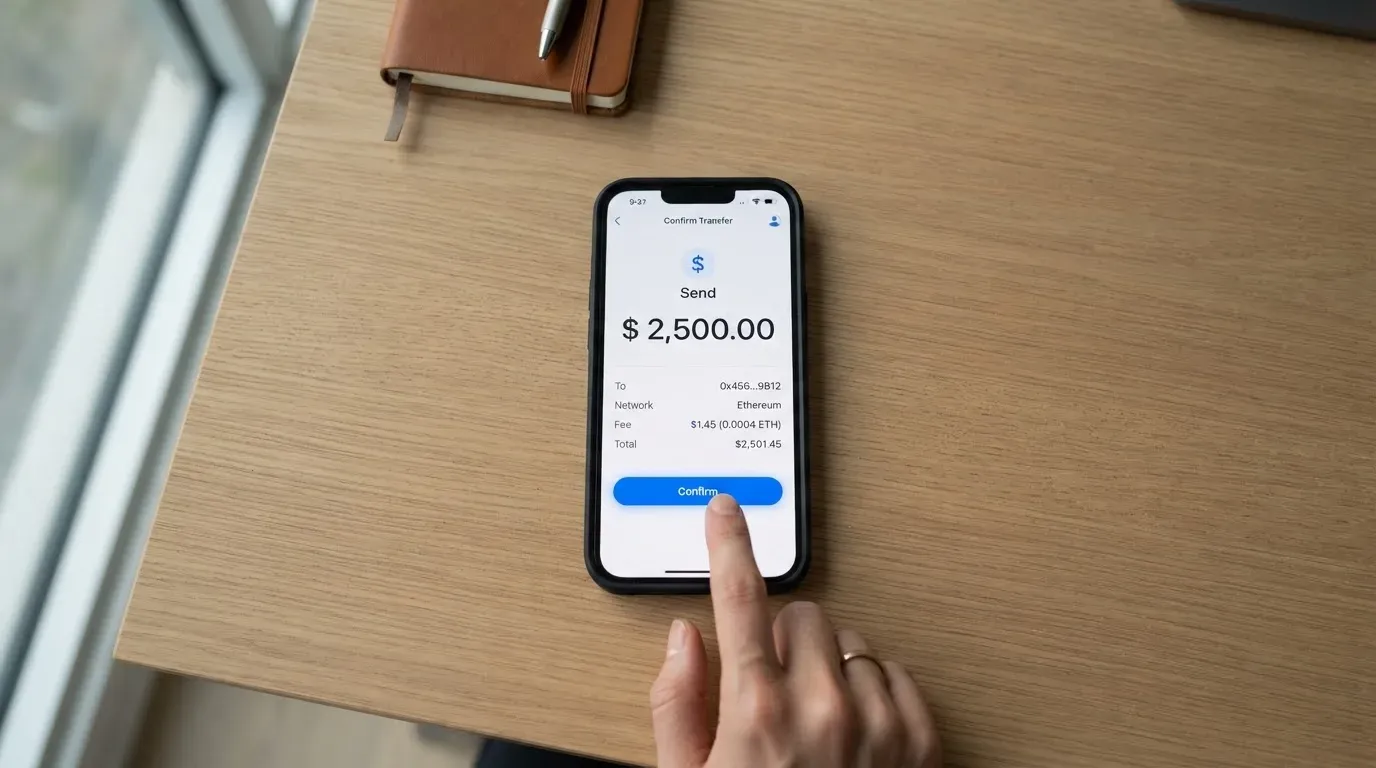
The flow inside the app is: Card tab, Deposit, approve in your connected wallet. The top-up fee is the same one the rest of the fee section disagrees about, 1% on the fee page, 0.5% on the FAQ, $0.10 on the tutorial. Whichever figure is correct, it is on top of the network gas fee charged by the blockchain for the transfer itself. On Solana that gas fee is small; on Ethereum it can swing widely.
A few practical points:
- The card balance is in USD. If you top up with USDC, the assumption is a 1:1 conversion, but the conversion rate the card uses and the spread it charges are not published.
- Multi-currency balances (EUR, GBP) are not supported.
- Withdrawing the card balance back to a wallet is not described in the public top-up page or the terms. The terms say the balance can be repaid at any time without penalty, but “repaid” is not the same as “withdrawn to your own wallet”. If you need to cash out, plan around the gap.
- The card deactivates after six months of inactivity. Reactivation is treated as a new card issuance, which carries the same $20 activation fee.
- Chargebacks resolved in your favour are credited to the Solayer Account, not refunded to your wallet.
The Solana choice has a real upside for users who already hold stablecoins there: fast settlement, low network cost, and a wallet you probably already use. For readers who hold assets on Ethereum, Base or Tron, the top-up either has to bridge first or wait for Solayer to add more networks, and neither is documented.
Paying with it every day
The card is a Visa, which means it is accepted at any merchant that takes Visa, online and offline. The mobile app adds Apple Pay and Google Pay for contactless payments through tokenised device numbers. Card controls (freeze, unfreeze, replace) are inside the Solayer Card Dashboard, which the documentation describes as instant.
The following merchant categories are restricted by the card terms: gambling-related activity, plus cash-like transactions including travellers cheques, foreign currency, money orders, wire transfers and cryptocurrency. The gambling block is common across prepaid-style cards and is applied by the issuer’s policy rather than by network rules, so the blocked list varies by card.
The mobile app is published on the Apple App Store and Google Play. A third-party site reported the App Store US rating at 5.0 from 2 ratings and Google Play at 500+ downloads as of 11 August 2026. I did not read the store pages directly. An earlier third-party report from March 2026 put the rating at 0.0, so the app’s public reception is thin and not yet reliable.
If something goes wrong with a transaction, the documented process is: try the merchant first; if the issue is unresolved or the charge is unauthorised, start a chargeback through the Solayer Account; report within no more than 60 days after the charge appears on the periodic statement; provide any extra documents the card network asks for; expect the disputed amount to remain due while the dispute is open. A chargeback resolved in your favour is credited to the Solayer Account, not to your wallet.
What can go wrong
There are five areas where I would be careful, and I will walk through each.
Issuer and corporate transparency. The card terms name the issuer as Third National. The Solayer legal entity is not stated, and the licences under which the card programme operates are not stated on the public pages. A reader who wants to know which regulator oversees the card, or which jurisdiction’s deposit guarantee (if any) applies to the stored balance, cannot find that answer from the public documentation.
Custody model. The marketing calls the card non-custodial and fully on-chain. The custody section in the documentation describes a hybrid arrangement run by a custody provider: hot wallets hold a small operational balance, cold wallets hold most assets offline, multi-signature is in use, and there are “circuit breakers” that freeze suspicious activity. Both descriptions can be partly true, but a reader who chose the card for the non-custodial claim should know that the card programme holds the balance, and that losing access to the Solayer Account is not the same as losing access to a self-custody wallet.
No insurance, no 2FA detail. Insurance on stored funds, two-factor authentication specifics and recovery procedures are not described. Standard crypto-card features such as app-based 2FA, instant freeze and spending controls are mentioned in general terms, but not specified.
Customer support. The FAQ points to a Discord server (discord.gg/solayerlabs). The card terms list [email protected] and a US phone number, +1 (734) 510 1402. Two different channels, and a reader who needs a paper trail will prefer the email.
Programme risk. The card was launched in April 2025 as the Emerald Card, renamed to Solayer Pay per a May 2026 press release, with the physical card introduced in a press release dated 14 May 2026 in Palo Alto. Earlier in 2025 a 1% cashback and 10% first-purchase offer was reported by third parties. The wider category has seen programmes shut down: Visa terminated its global agreements with FTX in November 2022, and WaveCrest was suspended by Visa in Europe in 2018, closing all WaveCrest-issued Visa programmes. A card that depends on a single issuer and a single network can be shut down the same way, and the card terms do not describe a contingency.
Public complaints. No Trustpilot page for the Solayer card and no Reddit or forum complaints turned up. Independent feedback is described by a third-party tracker as minimal. The thin public footprint is partly a function of the card being new, and partly a warning sign that there is not yet a track record to lean on.
Document conflicts. The list of conflicts is worth keeping open while you read the rest of the page:
- US eligibility: country list does not exclude US residents generally, but the card terms say the card is “intended for those outside of the United States” and require the user to attest they are not a US citizen.
- Top-up fee: 1% on the fee page, 0.5% on the FAQ, $0.10 on the tutorial.
- Non-USD spend: $0.10 + 1.5% on the fee page, $0.10 + 1.75% on the FAQ.
- Cash access: terms say cash advances are not available; the physical card page describes ATM use with a $250 cap.
- Custody: marketing says non-custodial; the custody section describes a provider-operated hybrid arrangement.
If a fee, an eligibility rule or a card feature matters to you, do not rely on the marketing. Read the specific page that governs it, and if two pages disagree, assume the more restrictive one applies.
What to take instead
Solayer is not the only card in this category, and a reader in the wrong country, with the wrong kind of stablecoin, or with a low tolerance for paperwork conflicts should look at the alternatives. I have scored each on the same scale.
TokenPocket (5.8 / 10)
TokenPocket offers a Visa debit card for a published list of European countries and territories (Germany, France, Spain, Switzerland and others), and a Mastercard debit card for Australia, Canada, Hong Kong, Japan, Taiwan, New Zealand, Singapore, South Korea and the UK, with the Americas “planned for Q2 2025”. Cards run on Arbitrum, balances are held in EUR24 and USD24, and the cards are virtual only. The main cost is a 1% fee on crypto deposits into the TP Card, which the documentation says will be refunded later through rewards or reduced transaction fees; the FX fee is not stated. There is no published cashback rate.
MetaMask Card (7.1 / 10)
The MetaMask Card is a Mastercard issued by Monovate, with Crypto Life as the card provider, available in 45 listed countries and territories (examples include Andorra, Argentina, Brazil, Canada, Mexico, Germany, France, Spain and Uruguay), with other regions on a waitlist. Proof of residency is required; US and UK sign-ups were temporarily closed. The virtual card is free with no annual or maintenance fee; the Metal card is $199 a year. The card spends directly from a connected wallet across Linea, Base, Monad and Solana, with named tokens including mUSD, wETH, EURe, GBPe, USDC and USDT (nine in total). A “minimal fee” applies per transaction; there is no MetaMask-side foreign-transaction fee, with the Mastercard rate used. Virtual cashback is 1% in mUSD, and Metal headline cashback is 3% (capped at 3% on the first $10,000 spent, then 1%).
KAST (6.1 / 10)
KAST runs on a residence-based eligibility check at KYC; the supported country list is not published and the Restricted Locations list is referenced without naming countries. The product has a real tier structure: Standard is $0 a year, Premium is $1,000 a year and Private is $10,000 a year, billed annually upfront. Up to 10 cards per user, with Visa Platinum (Standard), Visa Infinite metal (Premium) and Visa Infinite gold plated (Private) as the headline options. Balances are in USD, with stablecoin deposits converted 1:1 at 0% spread. The fees are the cleanest in this comparison: stablecoin top-up 0%, card spend in USD 0%, transaction fee 0%, Apple and Google Pay 0%, non-USD FX fee 0.5%–1.75% depending on residence, transaction country and card programme, declined transaction $0.50. Supported stablecoins are USDT, USDC, PYUSD and RLUSD on Ethereum, Solana, Polygon, Arbitrum and TRON. Cashback is paid in USD: 1.5% on the first $2,000 a month for Standard, 2% on the first $10,000 for Premium, 3% on the first $40,000 for Private, plus KAST Points for Premium and Private.
If you live in a country where Solayer is restricted, MetaMask Card is the most accessible alternative in this set. If you want cleaner fee disclosure and a tiered product, KAST is the most fully described. TokenPocket is the option for readers who are already on Arbitrum and want a virtual-only card.
Who I would recommend it to
I would recommend the Solayer card to a narrow group: people who already hold stablecoins on Solana, who live outside the restricted country list, who are comfortable with a USD-only card, and who do not need cashback at a published rate. For that reader, the card does what it claims: top up from a Solana wallet, spend anywhere Visa is taken, freeze and unfreeze in the app, top up to $10,000 a day if the unofficial limits hold. The $20 a year membership and the $0.15 USD transaction fee are reasonable, and the Apple and Google Pay integration makes the card work at a regular point-of-sale terminal.
I would not recommend the card to a reader in the United States, given the conflict between the country list and the citizenship attestation in the terms. I would not recommend it to a reader who needs to withdraw cash reliably, given the conflict between “cash advances are not available” and the $250 ATM cap. I would not recommend it to a reader who needs to know the conversion fee in advance, because the official paperwork does not agree. I would not recommend it to a reader who needs a paper trail, because the documented support channels are a Discord server and an email address.
For a reader who does not fit that narrow group, MetaMask Card and KAST are both worth a serious look before signing up. Solayer’s product is real, but the public documentation needs a second pass before I would call it reliable.
Frequently asked questions
What is the Solayer card?
The Solayer card is a Visa debit card that draws on a stablecoin balance held through the Solayer Pay app. The card is issued under Visa licence by an entity the terms call “the Issuer” and identify as Third National. It comes in virtual and physical forms, and supports Apple Pay and Google Pay for contactless payments.
How does the Solayer card work?
You complete KYC in the Solayer Pay app, pay the $20 one-time activation fee, top up the card with stablecoins from a Solana wallet, and then spend at any merchant that takes Visa. The card balance is in US dollars; non-USD spending is converted to USD at the Visa network rate before Solayer’s own fees are added.
Is Solayer a bank?
No. Solayer is a programme that markets the card, and the card is issued by Third National under a Visa licence. The Solayer legal entity and the licences under which the card programme operates are not stated on the public pages, so a reader who wants to know the regulator or the deposit guarantee scheme cannot find that answer publicly.
Who owns Solayer?
The card terms name the issuer as Third National. The Solayer legal entity is not named in the public pages I read. The card was launched in April 2025 as the Emerald Card, renamed to Solayer Pay per a May 2026 press release.
How do I get the Solayer card?
Download the Solayer Pay app from the Apple App Store or Google Play, complete the KYC flow (country of residence, address, occupation, annual salary, email confirmation, government ID and face liveness check), pay the $20 activation fee, and the virtual card is available immediately. The physical card is ordered from the app and ships for $24.99 (US Express, 2–5 business days) or $59.99 (International Express, 5–11 business days, including production). The shipping address cannot be changed after the order is placed.
Does the Solayer card require KYC?
Yes. KYC is required by the card terms. The Sumsub flow asks for country of residence, residential address, occupation, annual salary, an email code, a government-issued ID (passport, driver’s licence or Aadhaar card, both sides, up to 50MB), and a face liveness check. Review and approval takes 3–5 business days after the documents are submitted.
How do I top up the Solayer card?
In the app, open the Card tab, choose Deposit, and approve the transfer in your connected wallet. Top-ups are stablecoins, on Solana and other networks at the issuer’s discretion. The top-up fee is described three ways across the official site (1%, 0.5% or $0.10), and the minimum top-up is not stated. On top of Solayer’s fee, the underlying blockchain charges its own network fee for the transfer.
Where can I use the Solayer card?
Anywhere Visa is accepted, online and in store, plus Apple Pay and Google Pay for contactless. The card terms restrict gambling-related merchants and cash-like transactions (travellers cheques, foreign currency, money orders, wire transfers, cryptocurrency). ATM use is described on the physical-card page with a $250 per-withdrawal cap and a maximum of three attempts per rolling 24 hours, while the card terms separately say cash advances are not available.
Is the Solayer card safe?
The card uses Visa tokenisation through Apple Pay and Google Pay, an in-app card freeze, and the custody documentation describes a hybrid arrangement with hot and cold wallets and multi-signature. Insurance on stored funds, 2FA specifics and account-recovery procedures are not described in the public pages. The marketing describes the card as non-custodial, while the custody section describes a provider-operated arrangement, and the two do not fully agree.
How do I withdraw money from the Solayer card?
The public pages do not describe a way to withdraw the card balance back to a wallet. The card terms say the balance can be repaid at any time without penalty, but “repaid” is not the same as “withdrawn to your own wallet”. If you need to cash out, contact [email protected] or the in-app channel and ask for the current process before relying on the card as a store of value.
Wallet cards put to the test – cryptocardtested
Content created by the «cryptocardtested» team