
A prepaid-style Visa you fund with crypto — with a $199 entry fee and no stated network list
 Available in US

Crydit is a Visa payment card that you fund with cryptocurrency rather than from a bank account: you send crypto to the platform’s wallet, the balance converts to card spend, and you pay with a physical card with NFC or a virtual card. That is a genuinely useful shape for someone who cannot get an ordinary bank card, and the card’s own pages describe it as “Used in 210+ Countries and Regions Around the World”.
But the same pages leave a great deal unsaid, and what they do say is expensive. The issuance fee is shown as $199, the top-up fee is 1%, spending is charged at “0.8U+1.5% Per Transaction” as written on the page, and ATM withdrawals cost 2.50%. There is no annual fee, no published list of excluded countries, no stated network list for the deposits you have to make before any of this works, and no stated card currency. Add the $199 entry price and the card stops being an obvious choice for most people who simply want a way to spend crypto day to day — it becomes a serious commitment you should price carefully before you make it.
I score Crydit 5.5 out of 10 overall. The idea is sound, the card networks are the right ones, and there is real functionality here. The price and the transparency gaps are what hold it back.
The conditions described here are current as of October 28, 2026.
Verdict: 5.5 out of 10, and the split score shows why
Before the detail, here is how the card scored on each criterion I look at, with the reasoning in plain terms.
| Criterion | Mark | Why |
|---|---|---|
| Who can get it | 8 / 10 | “Used in 210+ Countries and Regions”; no exclusion list published, and unofficial sources name Cuba, Iran, North Korea, Russia, Syria and the United States as restricted |
| Cost | 2 / 10 | Issuance $199 in the table (249 in the same page’s mobile layout), annual fee 0; top-up 1%, spend 0.8U+1.5% per transaction, ATM 2.50% |
| Top-up options | 6 / 10 | Crypto to the Crydit wallet and “Transfer to Card”, with the page claiming 1,000 cryptocurrencies and 160+ fiat currencies; networks not specified |
| Reliability and complaints | 6 / 10 | CRYDIT CAPITAL LIMITED, MSO and VASP licences claimed, custody with Cobo and Ceffu; issuer country not stated, and unofficial reports describe KYC delays and slow support |
| Everyday use | 6 / 10 | Physical Visa with NFC and ATM, plus virtual cards; Apple Pay “under preparation”, Google Pay not mentioned |
Total: 5.5 / 10.
Who this suits: someone who cannot open an ordinary bank card, who already holds crypto and is comfortable treating a platform as the custodian of it, and who needs a Visa that will be accepted at ordinary merchants in more than one country. If your situation is a declined application at a bank, a country where you are not resident, or a simple need to hold and spend a stablecoin balance without an exchange account, this card is built for exactly that.
Who it does not suit: almost everyone else. If you want a cheap everyday spending card, $199 plus 1.5% on every purchase is a hard sell. If you are a self-custody person who will not hand over a seed phrase, the custodial model is disqualifying on principle. If you need Apple Pay today, it is not there. And if you are in one of the restricted countries named by third parties, the headline “210+ countries” is not for you.
Who will give you the card
Officially, Crydit says the card is “Used in 210+ Countries and Regions Around the World” and lists “Supported countries 210+”. That is the whole of the official position: there is no published exclusion list, and no rule about citizenship versus residence appears on the pages I read. In other words, the card states a reach but does not state who is inside it.
That gap matters more than it sounds. In this category, “where is the card accepted” and “who can be a customer” are two different questions, and they get confused constantly — especially in app store listings. Unofficial sources put acceptance in a different range again: a third-party review (CryptoCardHub, updated 11 August 2026) shows a map of 54 supported countries, which directly conflicts with “210+”, and names Cuba, Iran, North Korea, Russia, Syria and the United States as restricted. Take all of that as unofficial and not confirmed by Crydit.
The practical consequence is that you cannot pre-check your country from the card’s own site. If your country matters to you, the honest answer is that you have to find out through support or by starting an application, not by reading a published list.
How to get it
The signup path the card describes is three steps: choose the card, “Complete KYC certification”, then activate and deposit crypto. The site advertises “Get it done in 5 minutes” on that KYC step, while the comparison table on the same page lists “KYC Duration: 7 Business Days”. Those two statements sit uncomfortably together, and I would plan your timing around the longer one.
The card itself is a Visa. You get a physical card — the comparison table ticks “Physical Card”, “ATM” and “NFC” — and virtual cards, described as “Crydit supports Virtual Credit Cards (VCC)”. The currency the card holds and spends in is not stated on the official page.
What is missing from the official description of the KYC step is just as important as what is in it: the documents required, whether proof of address is needed, and the minimum age are not stated on the pages I read. Only a single KYC level is shown, with no explanation of what extra levels would unlock or why a check might be refused. Unofficial descriptions (CryptoCardHub, August 2026) say government ID, a selfie and, for the Mastercard programme, proof of address are involved, with Visa KYC approval in 3–5 business days — again, not confirmed by the card.
Delivery is not stated officially. Unofficial sources describe global shipping as included in the issuance fee, with a £35 replacement for a lost card and £50 on expiry.
So the practical picture: one card, one tier, one KYC step, a physical Visa plus virtual cards, and a wait you should assume is measured in days rather than minutes.
Fees: what it really costs
This is where the card earns its lowest mark, so I am putting the numbers first.

| Fee or limit | What the card states |
|---|---|
| Issuance fee | $199 in the comparison table (a second figure, 249, appears in the same page’s mobile layout) |
| Annual / management fee | 0 |
| Top-up fee | 1% |
| Spending fee | “0.8U+1.5% Per Transaction” (as written on the page) |
| FX fee | not stated officially |
| ATM withdrawal fee | 2.50%, “Instant Cash Withdrawal” offered; free allowance not stated |
| Spending limit | “Unlimited” |
| ATM and per-KYC-level limits | not stated |
Two things jump out. First, the $199 entry price is not a rounding error on a card with no annual fee — it is the dominant cost, and you pay it once whether you use the card heavily or not. Second, the card publishes two different issuance numbers on the same page ($199 in the table, 249 in the mobile layout). Unofficial sources quote $249 with no annual or inactivity fee. Whichever is right, you should assume the higher one.
The spending fee as written deserves a second look, because it is not obviously a percentage of your purchase. “0.8U+1.5% Per Transaction” appears in that form on the page. A fixed 0.8-unit component plus 1.5% is a different shape from a flat 1.5%, and the unit “U” is not defined on the page. Treat this as a figure you need to confirm for your own transactions rather than one you can plan around.
Now, three ordinary payments, and what actually applies:
- A 20-unit grocery shop. The spending fee applies. With the stated formula that is 0.8 units plus 1.5% of 20, or 0.3, so 1.1 units on top of the 20. If you are outside the card’s own currency — which is not even named — a conversion and possibly an FX component comes into it, and the FX fee is not stated officially.
- A 100-unit train ticket bought online. Same spending fee, same FX question if the merchant charges in another currency. Also worth knowing that 3-D Secure (SMS for Visa) may add a confirmation step, and that an online decline can leave a hold on your funds for several days.
- Withdrawing 100 units from an ATM. The withdrawal fee of 2.50% applies, on top of whatever the ATM operator charges. Unofficial sources describe free withdrawals at Danske Bank ATMs in Denmark and an ATM limit of £2,000 per day; both are third-party claims, not statements by the card.
Onboarding cost also includes the top-up fee of 1% every time you load, and network fees on the crypto transfer itself, which the blockchain charges and the card provider does not. Nobody has published a single all-in figure for “cost of a 100-unit purchase”, so you would have to build it yourself — and if you have to do arithmetic to find out whether a card is expensive, that is itself an answer.
On top of all of that: the card’s own page shows a single “VISA Card” column with no priced tiers, while unofficial sources describe eight VIP levels where VIP 1 requires the card fee and higher tiers depend on spending milestones. Reward rates are shown only after login, and marketing figures quoted by third parties reach up to $110,000 aggregate at VIP 8. Nothing about rewards is stated officially.
Top up: how money reaches the card
Loading the card works like this: you deposit crypto to the Crydit wallet, then use “Transfer to Card”. Under “Supports:” the page lists “1,000” cryptocurrencies, “160+” fiat currencies and “300” payment channels. Elsewhere on the same site the figures are different: “12K+ cryptocurrencies” and “150+ Fiat currencies”. Two different sets of numbers for the same claim is worth noticing, because it means the marketing figures are not pinned down.
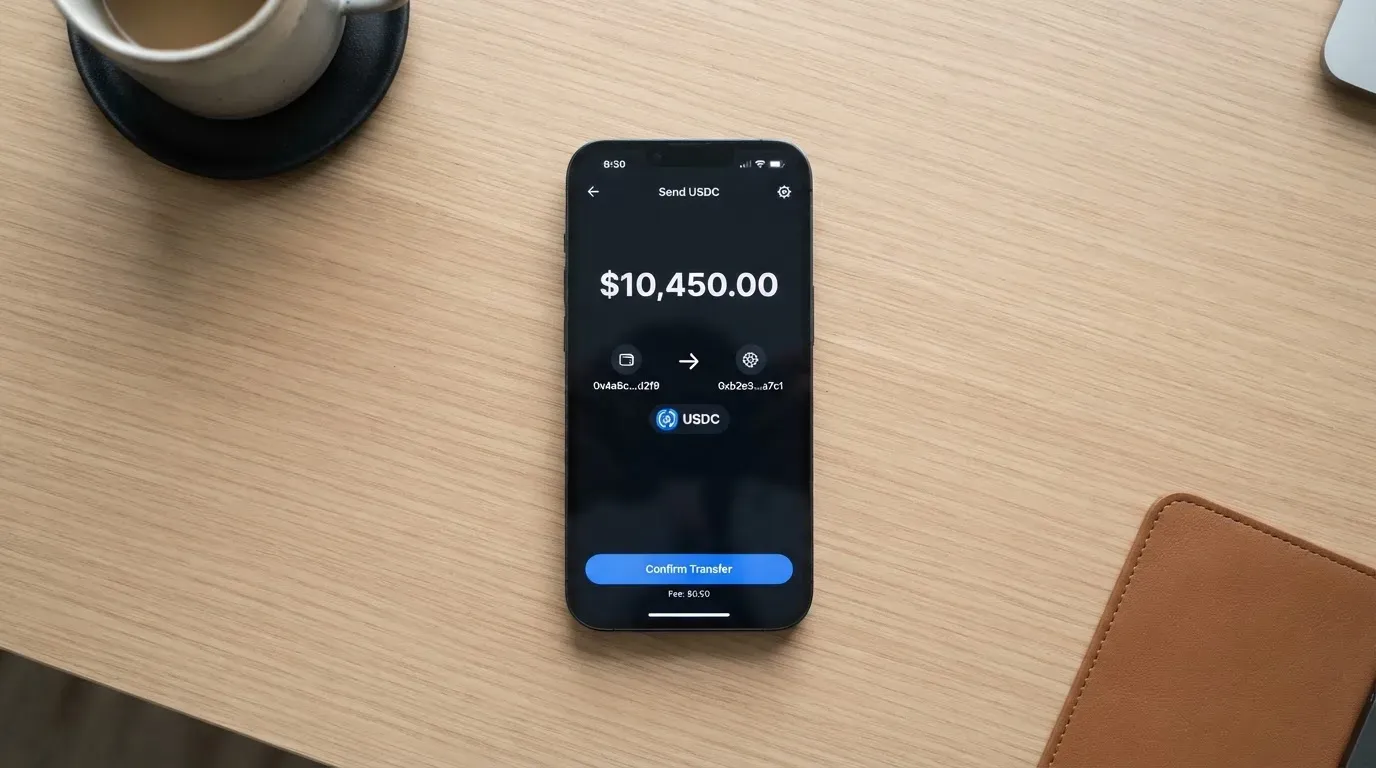
The most consequential omission on the whole page is this: networks are not listed. For a card funded by crypto, the network decides whether your deposit arrives. Crypto transfers are irreversible, so a deposit sent on a network the provider does not support, or to an address belonging to a different network, can be lost or need manual support recovery with no guarantee of success. Since the card does not publish its supported networks, you would be sending money first and finding out afterwards.
There are practical traps beyond that one. ERC-20 tokens on Ethereum charge gas in ETH, so a wallet holding USDT with no ETH cannot send it. Tron prices fees by burning TRX. Circle stopped supporting USDC on Tron in February 2024, so “USDC over TRC20” is not a native option. None of this is Crydit’s fault — it is how these networks work — but it is exactly the kind of thing that makes a first deposit go missing.
Other top-up details that are not stated: the minimum top-up amount, who pays the network fee, and any fees on fiat top-ups. Unofficial sources put the top-up fee at 1.5% and conversion at 1.5% with no FX markup, using central-bank reference rates, which differs from the official 1% top-up figure.
Withdrawals are listed as a feature with a “Withdrawal Fee: 2.50%”. How you get a balance back into crypto or into a bank account, and what happens to a remaining balance if you close the account, is not stated.
Custody is worth being blunt about: the page says assets are managed by “COBO & Ceffu”. That is custodial. Whoever holds the private keys controls the funds, and you are trusting the provider — see the risks section for why that matters.
Paying with it every day
For ordinary card use, the setup is unremarkable in the best way. It is a Visa, so it is accepted wherever Visa is accepted. The physical card has NFC for tap-to-pay, and virtual cards let you create a separate card number per merchant or per purpose. Spending limits are stated as “Unlimited”, with no ATM or per-level limits published.
Apple Pay, though, is where everyday use stops. The card’s page says “Apple Pay support is currently under preparation and will be rolled out progressively in the future”. So on a phone, in a shop, you are tapping a physical card — or typing numbers — until that rolls out. Google Pay is not mentioned at all. Blocked merchant categories are also not mentioned, which matters if you travel: gambling merchants carry a category code that many issuers block by policy rather than by law, and the blocked list varies by issuer.
Rewards are not stated officially, so I would not plan a budget around them.
The app is a thin but real signal. On the iOS App Store (Hong Kong storefront) it sits at 5.0 from 6 ratings, read on 2026-10-21, with Crydit CAPITAL LIMITED as developer. Six ratings is not a track record — it is a rounding error — and a Hong Kong storefront tells you something about where the company is anchored rather than about how the app performs. A Google Play listing is not mentioned.
For support there is a Help Center and FAQ, a contact form, [email protected], Telegram t.me/CryditAssist and X @CryditCard. The site is in English and support hours are not stated.
If your card is lost or compromised, the documented path is sound: suspend it in the app and request a replacement with identity verification. For unauthorised transactions, “Crydit’s risk control team will intervene and initiate a formal dispute process”. Two details are worth flagging: the replacement time frame is published as “within X business days” — literally a placeholder with no number — and chargeback periods are not stated.
What can go wrong
I found no official incident notices, and searches for complaints and reviews returned no Trustpilot or Reddit page for Crydit. That absence is not reassurance by itself; it also means there is no public complaint record to measure the platform against. Unofficial reporting (CryptoCardHub, August 2026) says users commonly report KYC delays and slow support responses.
The company details are partly disclosed. The footer names CRYDIT CAPITAL LIMITED, without a country on the pages I read, and the page says “Holding MSO And VASP Compliance Licenses”, with assets managed by COBO and Ceffu and the card operating “in collaboration with Danske Bank”. The issuing bank’s country is not stated. Unofficial sources name Crydit Capital Limited (Hong Kong), Crydit Inc. (BVI), ArcaneQuantix Ltd (Czech Republic) and Crydit Venture Investments Aps (Denmark), describe a Hong Kong MSO licence and a European VASP registration, and place Danske Bank behind the Mastercard programme. A Mastercard programme launch on 25 May 2024 is also a third-party claim.
Two structural risks sit underneath all of this.
Custody. Your crypto is held by the platform’s custodians, not by you. Custodial platforms have a history: Mt. Gox (about US$350 million reported stolen, 2011–2014), Coincheck (about US$400 million, 2018) and Ronin Network (US$625 million, 2022). A self-custody-linked card keeps your funds in your own wallet until the moment of payment; this one does not.
Programme closure. Card programmes get switched off. Visa terminated its global agreements with FTX on 13 November 2022 and the FTX US debit card was wound down. WaveCrest, a Visa issuer that supplied crypto card brands, was suspended by Visa in Europe in 2018, closing all WaveCrest-issued Visa programmes. The usual pattern is a notice period, then spending and loading stop, then users are asked to withdraw what is left. Because the issuer country is not stated, you cannot easily judge whether a relevant deposit-protection or e-money regime applies to your balance, and e-money funds are not the same as bank deposits.
Everyday friction deserves its own paragraph. Card numbers carry an issuer identification number of six or eight digits that merchants can look up, and a card issued in one country can look “foreign” to a shop in another — some merchants decline prepaid or foreign BINs as a result. Address verification is generally unavailable for foreign-issued cards, which causes declines. Online declines can leave holds on your funds for up to several days. None of this is Crydit-specific, but it is what a “works in 210+ countries” claim feels like from the wrong shop.
The published safeguards are reasonable: 3D Secure by SMS for Visa, instant card freeze and suspend in the app, multi-factor authentication, and 24/7 account-level risk monitoring. What is not stated is the safeguarding rules — how assets are segregated, whether they are insured, and what happens to them if the company fails. One more category fact belongs here: under 3-D Secure, liability for a fraudulent online payment can shift away from the merchant, and critics argue it can end up with you. Read your own terms when they are finally published.
What to take instead
None of these is a recommendation, and I have not used any of them. They are the closest comparable products on the same shortlist, with the same gaps in their public pages.
| Cardex | CardFlow | HyperCard | |
|---|---|---|---|
| Score | 5.6 / 10 | 4.9 / 10 | 4.7 / 10 |
| Reach | “One crypto card, 200+ countries”; no country list or exclusions; app listing is Naira-focused | Aimed at Nigeria — “Nigeria’s smartest fintech card platform”; no country list stated | No country list; app says works in “more than 176 countries” (acceptance, not eligibility) |
| Card | Debit crypto card on VERVE, Visa, Mastercard and UnionPay; physical and virtual; currency Naira per listing | Virtual USD Mastercard, created in about 3 minutes | Prepaid “HyperCard”; network not stated; balance in USD or EUR |
| Cost | not stated | “Creating a virtual card is completely free”; monthly fee not stated | not stated; app page lists no fees |
| Fees | Real-time crypto-to-fiat conversion at payment, with an “AI-Powered Conversion Rate” that scans exchange rates; no percentage stated | not stated | not stated on the pages available |
| Funding | USDT, USDC and BTC wallets; networks not stated | Bitcoin, USDT, ETH or Naira bank transfer; networks not stated | Crypto such as USDT, BTC, ETH in the app, converted to USD or EUR; networks not stated |
| Rewards | not stated | not stated | not stated |
Two comparisons stand out. Cardex scores marginally higher and offers the widest network choice, but it prices itself in Naira on its app listing and publishes no fee percentage at all. CardFlow is the cheapest to start — free virtual card, created in minutes — but it is a virtual USD Mastercard aimed at one market. Cardex and CardFlow both converge with Crydit on the same structural point: none of them publish the networks you deposit on.
For Crydit specifically, the practical alternatives are not really rival crypto cards so much as different approaches to the same problem: keeping self-custody and accepting more friction, using a regulated exchange’s own card in a jurisdiction where you qualify, or getting an ordinary bank account or prepaid card and using crypto only as the source of the money. If your reason for wanting this card is a blocked bank account, any of those three may serve you better — and none of them costs $199 to open.
Who I would recommend it to
I would recommend Crydit in a fairly narrow set of circumstances. If you cannot obtain an ordinary bank card where you live, you already hold crypto, you are prepared to let a platform hold it, and you need a Visa that works across many countries — then this does a job that few alternatives do at all, and the $199 is a one-off cost you can weigh against the convenience.
I would not recommend it to anyone who is choosing a card in the ordinary sense. The entry fee is high, the per-transaction spending charge is high, Apple Pay is not there, and the card does not publish its deposit networks, its excluded countries, its card currency, or its safeguarding arrangements. Those are not nitpicks. They are the details you would need in order to know what you are buying.
Before you commit, check these in this order:
- Ask support which networks your deposit must go on, and which stablecoins you can actually send. This is the question that matters most and the one least likely to be answered clearly.
- Get the all-in cost of one real purchase — a specific amount, at a specific merchant — in writing. The “0.8U+1.5%” formula and the two different issuance figures both need confirming.
- Confirm the replacement time frame, since the page publishes only “X business days”, and ask what happens to your balance if you close the account.
- Check whether your country is served at all, accepting that the official pages will not tell you and third-party lists conflict with each other.
- Decide whether custodial is acceptable to you before you deposit anything, because it is not reversible afterwards.
If those answers come back clean and the $199 fits your budget, the card is competent and the score of 5.5 reflects a workable product sold at an unworkable-adjacent price.
Frequently asked questions
What is Crydit card?
Crydit is a Visa payment card funded with cryptocurrency rather than a bank account. You deposit crypto to the platform’s wallet, the balance converts into card spend, and you pay with a physical card that has NFC, or with virtual cards. The company behind it is CRYDIT CAPITAL LIMITED, and custody of crypto assets is with Cobo and Ceffu. It is not a bank.
How does Crydit card work?
You top up by sending crypto to the Crydit wallet, then use “Transfer to Card” to move the value onto the card, and the card spends a converted fiat balance — the prepaid model rather than a debit link to a current account. Each purchase is charged at the stated “0.8U+1.5% Per Transaction”. One thing to understand before you start: the card does not publish which blockchain networks it supports for deposits.
Is Crydit a bank?
No. The site describes CRYDIT CAPITAL LIMITED as holding MSO and VASP compliance licences and working “in collaboration with Danske Bank”, but it does not state the issuing bank’s country or the regulatory regime protecting your balance. Treat the money as e-money or crypto held by a provider, not as a bank deposit, and do not assume deposit-guarantee protection applies.
Who owns Crydit?
The footer names CRYDIT CAPITAL LIMITED as the operating entity, without a country on the pages I read. Unofficial sources add Crydit Capital Limited in Hong Kong, Crydit Inc. in the BVI, ArcaneQuantix Ltd in the Czech Republic and Crydit Venture Investments Aps in Denmark, plus a Hong Kong MSO licence and a European VASP registration. Those are third-party claims, not confirmed by the card.
Is Crydit card available in my country?
Officially the card claims use in “210+ Countries and Regions” and lists “Supported countries 210+”, with no exclusion list published at all. A third-party review instead shows 54 supported countries and names Cuba, Iran, North Korea, Russia, Syria and the United States as restricted. Since the sources conflict and citizenship rules are not stated, the only reliable answer is to ask the company directly.
How do I get the Crydit card?
Pick the card, complete KYC, then activate and deposit crypto. The site advertises “Get it done in 5 minutes” for the KYC step but its own comparison table lists “KYC Duration: 7 Business Days”. Required documents, proof of address and minimum age are not stated officially, and delivery times are not stated either, though third parties describe global shipping included in the issuance fee.
How much does the Crydit card cost?
The comparison table shows a $199 issuance fee with 0 annual fee — though the same page’s mobile layout shows 249, and third-party sources say $249. On top of that: 1% to top up, “0.8U+1.5% Per Transaction” to spend, and 2.50% for ATM withdrawals. The FX fee is not stated officially. Budget the higher issuance figure and confirm the spending formula before you commit.
Is Crydit card safe?
The published safeguards are sensible — 3D Secure by SMS, instant card freeze, multi-factor authentication and 24/7 monitoring. But your crypto is custodial, held by Cobo and Ceffu, and the card does not state its safeguarding or insurance arrangements. I found no Trustpilot or Reddit record for Crydit, and unofficial reports describe frequent KYC delays and slow support. Treat the safety question as unresolved rather than answered.
Can I add Crydit card to Apple Wallet?
Not yet. The card’s own page says Apple Pay support is “currently under preparation and will be rolled out progressively in the future”, so there is nothing to add today and no date given. Google Pay is not mentioned at all. In the meantime you are tapping the physical card’s NFC or typing the virtual card number.
Is Crydit card worth it?
For most people, the honest answer is no: a $199 entry fee plus 1.5%-plus-a-fixed-component on every purchase is steep for a spending card with no Apple Pay. It becomes worth it when you cannot get an ordinary bank card, you already hold crypto, and you accept custodial risk — in that case it solves a problem nothing else in this category solves as directly.
Virtual cards put to the test – cryptocardtested
Content created by the «cryptocardtested» team