
Trocador card review — a privacy-leaning prepaid card you buy with crypto, with more questions than answers around cost
 Available in US
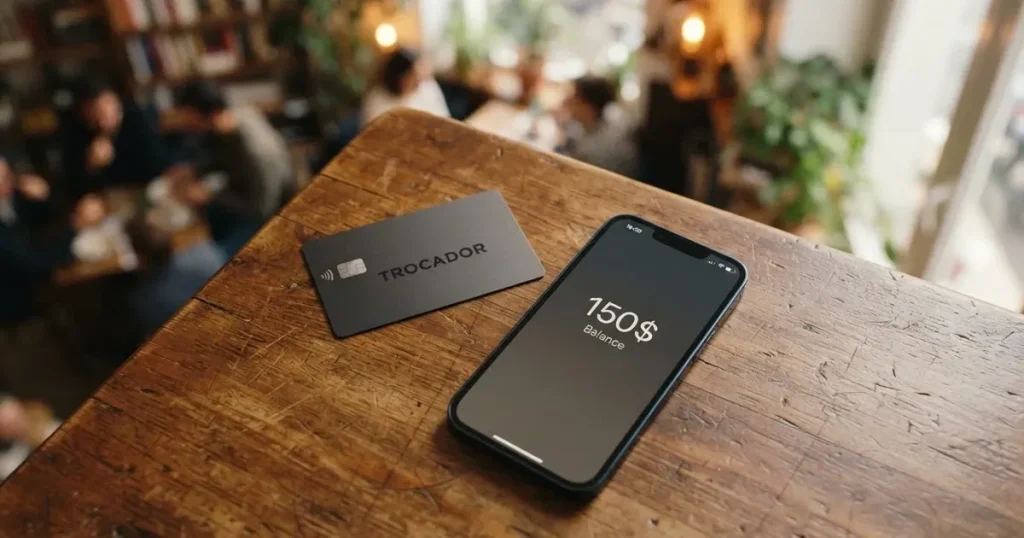
Trocador is best known as a crypto exchange aggregator — a place that compares swap rates across many smaller exchanges and routes a single trade through whichever one looks best at that moment. Sitting beside the swap service, there is also a prepaid card product: you pay with crypto, and Trocador hands you a virtual Mastercard or Visa to spend. It sounds like a tidy way to convert coins into a card without going through a traditional bank, and that is the part that interests a lot of people who cannot easily get a bank card. It is also the part where the information dries up unusually fast.
I went through what Trocador itself publishes, what partner providers say, and what independent reviewers have written, and what came out is a card that does one specific job — turning a coin balance into a payment card — with a fee structure that is largely hidden and a small stack of support complaints behind it. This review is written for someone weighing whether the product is worth using, with the assumption that you already hold crypto and want a way to spend it.
The conditions described here are current as of October 28, 2026.
Verdict
Trocador the card sits in an odd middle ground. It genuinely lets you buy a prepaid Mastercard or Visa with crypto, including coins that mainstream cards do not accept, and it works in a long list of countries. On the other hand, the official pages do not publish the things most card users check first — how much it costs, what the FX margin is, what the daily limit is — and a good portion of what is circulating about it comes from third-party sites, not from Trocador.
I would land on a score of 5.4 out of 10. That is not a strong recommendation, and it is not a warning either. It reflects a product that fits a narrow use case — turning a privacy-oriented coin balance into a one-off payment card — and falls short of being a daily driver.
How the score breaks down
| Criterion | Mark | Why it lands there |
|---|---|---|
| Who can get it | 8 / 10 | Country rules depend on the underlying provider; unofficial coverage is wide, but Reward and MyPrepaidCenter cards are US-only. |
| Cost | 3 / 10 | No official fee table; unofficial numbers point to a 3% Trocador fee on top of $2, plus separate Obsidian charges, and a 2.75% non-USD conversion fee. |
| Top-up options | 7 / 10 | Cards are bought with crypto, and the menu reportedly includes BTC, XMR, LTC, stablecoins and others via AnonPay, but the exact list is not officially confirmed. |
| Reliability and complaints | 5 / 10 | The operator is named in third-party sources (Reta Development Assets LLC); the issuing bank is not. There are user complaints about MyPrepaidCenter cards and mixed Trustpilot feedback on the wider Trocador service. |
| Everyday use | 4 / 10 | Virtual only, with Apple Pay, Google Pay and Samsung Pay support described as “usually” working. There is no ATM, no plastic, and 3DS-only merchants will refuse it. |
For a privacy-minded buyer who has crypto already and wants a prepaid card to spend it on, Trocador can be made to work. For anyone who wants a clear, public fee schedule, a named issuer, or a physical card in a wallet, it is not the right tool.
Who can actually get the Trocador card
The first thing to understand is that Trocador does not issue a card in its own name. When you go to buy a card through Trocador, you are buying a prepaid card from one of several partner providers — Reward, MyPrepaidCenter or Obsidian, according to independent sources. The country you can use the card in, the legal terms, and the price you pay are governed by whichever partner ends up issuing the card, not by Trocador itself.
What Trocador’s own pages say about eligibility is thin. The official line is that country restrictions vary by provider. Anything more specific — a list of excluded countries, age limits, residency requirements — is not stated on the card pages themselves.
Unofficial sources paint a wider picture, and it is worth knowing, even if it is not confirmed by the card issuer:
- The card is reportedly available in 164 countries and unavailable in 11.
- The Reward and MyPrepaidCenter variants appear to be US-only.
- Obsidian cards are mentioned in connection with non-US users, but the geographic fine print is not on Trocador’s own pages.
There is also no official statement on identity verification. The KYC policy is not stated on the card’s public pages, and the KYC levels (whether small purchases are allowed without documents, or whether every transaction goes through a check) are not stated either. That silence is itself a piece of information: if you are someone who needs a clearly defined onboarding flow — “send this document, wait this long, get this answer” — the Trocador card does not give you that in writing.
If you are reading this from a country where the prepaid card market is heavily regulated, treat the lack of a published country list as a yellow flag, not a green light. It is reasonable to assume that whichever provider ends up serving you will run some form of check on the destination of the payment, and the absence of a published policy does not mean no check is happening.
How to sign up and get the card
Trocador’s card is sold through the web. There is no mobile app to download for the card itself; the platform runs as a website, you pick a card value, you choose a coin, and you are given a wallet address to send the payment to. Once the payment confirms, the card details are delivered to you — usually as a number, expiry and CVC you can type into a checkout or add to a mobile wallet.
Delivery time is not stated officially. Independent reviewers describe it as fast for the simpler, US-only variants, with some friction around the cards that need an activation step. The activation process itself, including any document or address checks, is not stated on Trocador’s own pages.
What is clear is the basic shape of the flow:
- Choose a card provider (Reward, MyPrepaidCenter or Obsidian) and a fixed value.
- Pay in crypto from a supported coin.
- Receive the card details digitally.
There is no physical card, no shipping address to fill in, and no plastic to wait for. The trade-off is that the card exists only as numbers, which constrains where it can be used (more on that in the everyday-use section).
If you are an existing Trocador exchange user, the same wallet and account work for both services. If you are not, the onboarding for the card purchase itself does not appear to require a full account creation, but this is an inference, not a published rule.
What the Trocador card really costs
The cost picture is the weakest part of the card’s public information. None of the standard items — issuance fee, monthly fee, conversion fee, FX margin, ATM fee, daily and monthly limits — are stated on Trocador’s own card pages. What is circulating about cost comes from third-party sites and from forum-level write-ups, so it should be read as unofficial and not confirmed by the card itself.
Unofficial numbers that recur across sources:
- A 3% fee on the card’s nominal value charged by Trocador, plus a flat $2.
- Obsidian cards: $0.60 per purchase and a $5 monthly fee that kicks in after the second month.
- A 2.75% fee on payments made in a currency other than USD.
- No ATM, no top-up, no reload — the card is paid for up front and used until the balance runs out.
Tiers — different card products at different price points — are not stated officially. Whether there is a “premium” tier with a higher limit, a virtual-only tier, or a tiered fee schedule, the public pages do not say.
Costs at a glance (unofficial)
| Fee or limit | Amount (unofficial) |
|---|---|
| Issuance / purchase | 3% of card value + $2 |
| Obsidian per-purchase fee | $0.60 |
| Obsidian monthly fee | $5 from the third month onward |
| Non-USD conversion fee | 2.75% |
| ATM | Not stated; not available |
| Daily and monthly limits | Not stated |
| Tiers | Not stated |
| FX margin | Not stated |
Three everyday payments, what they would cost
To translate those numbers into something you can actually feel, here is what three common payments would look like if the unofficial figures hold. None of these are quotes — they are worked examples, useful for sizing the fee, not for predicting an exact charge.
A $50 supermarket shop paid in USD. You would have paid 3% + $2 = $3.50 to Trocador at the moment of purchase, plus the card value itself. If you loaded exactly $50, the fee came out of the loaded amount, leaving you with $46.50 on the card. There is no further conversion fee because the payment is in USD.
A $200 flight paid in EUR. Same 3% + $2 at purchase = $8. If the loaded value was $200, you have $192 on the card. At the airport the payment is converted from USD to EUR, and the 2.75% non-USD fee applies to whatever the converted amount is. If the conversion is roughly 1:1, you lose about $5.30 on top, for a total fee of about $13.30.
A $500 hotel booking paid in USD. Purchase fee: 3% + $2 = $17. Loaded card value: $500, balance after fee: $483. No FX fee because the payment is in USD. The larger the value, the less the flat $2 hurts as a percentage, but the 3% stays constant.
The honest summary is that the headline fee of “3% + $2” is the floor, and any non-USD payment adds a separate layer on top. Anyone optimising for low cost is going to be unhappy with that profile, and anyone optimising for privacy is going to weigh it against the alternatives and decide for themselves.
Top up options for the Trocador card
The card is not a rechargeable product in the usual sense. There is no “add $100” button after the fact. What you do is buy a card with a fixed value, and that value is what the card holds. When the balance runs out, the card is spent, and you would buy a new one.
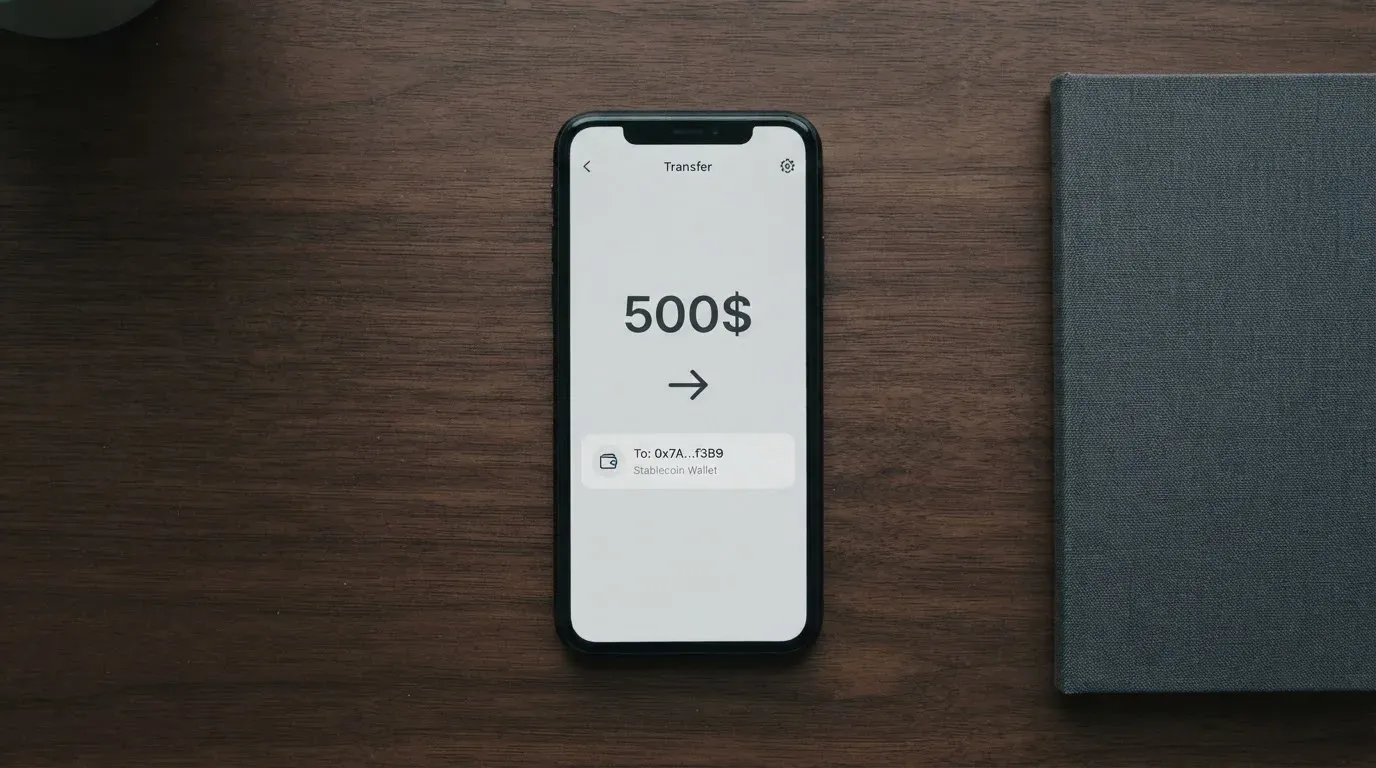
Funding the purchase is the part where the variety lives. Unofficial sources describe a wide menu, and the starting data lists BTC, XMR (Monero), LTC, stablecoins and others, with the rest routed through AnonPay. The exact coin list is not confirmed by Trocador’s public card pages, so treat the menu as a likely range, not a guarantee.
The implication is that the choice of coin matters twice. First, it affects the on-chain fee you pay to send the crypto in the first place — that is a network cost, not a Trocador cost. Second, it affects the conversion. If the card is denominated in USD and you are paying in a volatile coin, the value of the card is fixed at the moment the conversion locks, so a price move after that does not change the card balance either way.
A common point of confusion: the “top up” here is really a purchase of a new card, not a reload of an existing one. Anyone expecting a running balance they can refill from a wallet app will need to adjust that mental model.
There is no separate “withdraw” path described for the card. Whatever balance remains on the card after the last payment is, in effect, your only access to the leftover funds, because there is no ATM and no reload mechanism.
Paying with the card every day
The card is virtual. You can use the number directly at online checkouts, or you can add it to a mobile wallet. Independent reviewers describe Apple Pay, Google Pay and Samsung Pay support as “usually” working — the word “usually” is theirs, and it matters. There is no guarantee that any of the three will accept the card on a given day, and the card is not accepted at merchants that require 3-D Secure, or at merchants that refuse prepaid or gift cards outright.
This is a small set of constraints, but they bite in specific places:
- Online stores that run 3-D Secure as a hard requirement will decline the card, because the card cannot complete a 3-D Secure step-up.
- Online stores that filter prepaid and gift cards by BIN will also decline it.
- Anywhere that requires a physical swipe or insert — pay-at-the-pump fuel pumps, transit gates, supermarket self-checkout in some regions — will not work, because there is no plastic.
There is no app to manage spending. There is no rewards programme published. The dispute process, should a charge be wrong, is not stated on the public pages, which is worth knowing in advance: if a merchant double-charges you or a subscription renews without your consent, the path to a refund is not documented.
For someone whose spending is mostly online, in USD, and at merchants that do not enforce 3-D Secure, the card is workable. For anyone else, the everyday-use picture is constrained.
What can go wrong
The card sits in a part of the market where the issuer is rarely the brand the customer came for. The operator named in independent sources is Reta Development Assets LLC; the cards are delivered by Reward, MyPrepaidCenter and Obsidian; the issuing institution is not named in the third-party coverage I could read. None of this is unusual for prepaid cards bought with crypto, but it does mean that when something goes wrong, you are navigating between the brand, the operator and the issuer.
User reports compiled by independent reviewers (CryptoCardHub, August 2026) describe recurring problems with the MyPrepaidCenter variant: activation issues, billing-address validation failures, declined payments, locked access, and slow support. The Reward and Obsidian variants are less complained about, but they are also less reviewed in absolute terms.
The wider Trocador service, mostly the exchange side, has a Trustpilot score of 4.8 out of 5 across 267 reviews (read 2026-10-21). The themes in the lower-rated reviews are the kind you would expect on a crypto exchange: delayed swaps via partner exchanges (reported June-July 2026), long AML/KYC holds (reported March-May 2026), and a support tone that several users described as unhelpful (September 2026). These are exchange-side complaints, not card-side complaints, but they are the same operator.
Three structural risks are worth naming in plain terms:
- The fee structure is not published by the card itself, so you are buying on trust. If the fee changes, there is no published tariff to point to.
- The card cannot be reloaded, so any leftover balance is locked to that card until it is spent. If the card programme closes, the procedure for getting the balance back is not stated.
- The card is rejected at 3-D Secure merchants, so a payment that looked routine can fail at the last step with no obvious recourse.
On the upside, there is no dated security incident attached to the card itself in the public record I could find. There is no app to lose, no seed phrase tied to the card product, and no custody of crypto beyond the moment of purchase.
What to take instead
Trocador sits in a small group of prepaid crypto cards that work without a full bank account, and three alternatives come up most often in side-by-side reviews. None is a perfect substitute, and the right pick depends on what you actually need from the card.
Cardex
Cardex positions itself as a single crypto card that works in 200-plus countries, with no published country list or exclusions. The app store listing describes the card as Naira-focused — you can pay in Naira — and the product is a debit card on the networks VERVE, VISA, Mastercard and UnionPay, with virtual and physical variants.
The site describes a real-time crypto-to-fiat conversion at the moment of payment, with an “AI-Powered Conversion Rate” that scans global exchange rates and picks the best one when you spend. The fee percentage is not stated. Funding is in USDT, USDC and BTC, with the specific networks not stated. Rewards are not stated.
Cardex is best for someone whose day-to-day spending is in Naira or in a country where VERVE and UnionPay matter. Score: 5.6 / 10.
CardFlow
CardFlow describes itself as “Nigeria’s smartest fintech card platform,” aimed at Nigerians and global users, with no country list or exclusions. The product is a virtual USD Mastercard, created quickly. The site says creating a card is free, and the monthly fee is not stated; the wider fee schedule is not stated either.
Funding is in Bitcoin, USDT, ETH or Naira bank transfer, with the specific networks not stated. Rewards are not stated.
CardFlow is a fit for someone whose main currency is USD and who needs a quick virtual Mastercard. Score: 4.9 / 10.
HyperCard
HyperCard is a prepaid card with the network not stated on its app store page. The app store copy says the card works in “more than 176 countries” — a usage claim, not an eligibility list — and the card holds a balance in USD or EUR.
Fees and limits are not stated on the pages I could read. Funding is by depositing USDT, BTC or ETH in the app, with the network not specified, and the deposit is converted to USD or EUR on the card. Rewards are not stated.
HyperCard is the most conservative of the three on what it claims, which is itself a useful signal. Score: 4.7 / 10.
If you are choosing between these, the practical split is: Cardex for Naira-fluent spending across multiple networks, CardFlow for a fast virtual USD card, HyperCard for a quiet USD/EUR balance with fewer moving parts. Trocador still has a role if your priority is paying with privacy-oriented coins like Monero and you are willing to accept the lack of a published fee schedule.
Who I would recommend the Trocador card to
After going through the published pages and the third-party write-ups, the audience for the Trocador card is narrower than the marketing suggests. The card works best for someone who:
- Already holds crypto, including coins that mainstream cards do not accept, and wants a way to spend them.
- Values not having to go through a full bank onboarding, and accepts the silence around KYC as a feature rather than a risk.
- Is comfortable with a virtual-only card, with the possibility of a 3-D Secure decline, and with no physical fallback.
- Plans the spend in advance, because the card is paid for up front and is not rechargeable.
- Is not optimising on fee — if every basis point matters, look at a card with a published tariff.
It is not a good fit for someone who needs a physical card, who spends in non-USD currencies often, who relies on chargebacks or dispute resolution, or who wants to know exactly what they will pay before they buy.
For a privacy-minded buyer paying with Monero or a stablecoin routed through AnonPay, the card does the job. For everyone else, the gap between the marketing language and the public information is wide enough that the alternatives above will probably serve you better.
Frequently asked questions
What is the Trocador card?
The Trocador card is a prepaid Mastercard or Visa that you buy with crypto through the Trocador platform. It is virtual, has a fixed value set at purchase, and is delivered by one of several partner providers (Reward, MyPrepaidCenter or Obsidian in independent coverage).
How does the Trocador card work?
You pick a card value, pay in a supported coin, and receive the card number, expiry and CVC digitally. The card is spent at online checkouts or added to a mobile wallet. The balance is fixed; the card is not reloadable, and there is no app to manage it.
Is Trocador a bank?
No. Trocador is an exchange aggregator and card reseller. The card product is operated through partner providers, and the issuing institution is not named in the public third-party coverage I could read. The card is a prepaid product, not a bank account.
Who owns Trocador?
Independent sources name Reta Development Assets LLC as the operator. Trocador itself does not publish ownership details on the card pages, and the card product sits with partner providers, so the legal counterpart to any purchase is the partner, not necessarily Trocador.
Is the Trocador card available in my country?
Trocador’s own pages do not publish a country list. Unofficial sources describe availability in 164 countries and unavailability in 11, with the Reward and MyPrepaidCenter variants reportedly limited to the United States. For any specific country, the practical answer depends on which partner provider ends up serving you.
Does the Trocador card require KYC?
The KYC policy is not stated on the card’s official pages. Independent coverage does not describe a published identity-check process for the card itself. If identity verification matters to you, treat the silence as a question to clarify with support before purchase.
How do I add the Trocador card to Apple Wallet or Google Pay?
Independent reviewers describe Apple Pay, Google Pay and Samsung Pay support as “usually” working. The exact steps follow the standard mobile-wallet flow for adding a card number, but the outcome is not guaranteed on any given day.
Can I withdraw cash from the Trocador card?
There is no ATM access described in the public material. The card is a virtual prepaid product with no reload, so withdrawing cash at an ATM is not a feature. Any leftover balance stays on the card until it is spent.
Is the Trocador card safe?
There is no dated security incident tied to the card in the public record I could find. The risk profile is the standard one for a prepaid card bought with crypto: published fees are thin, the issuer is one of several partners, and there is no dispute process documented. Treat the card the way you would treat any prepaid instrument — useful for planned spending, not a long-term store of value.
Is the Trocador card worth it?
If your priority is converting a privacy-oriented coin balance into a payment card without a full bank onboarding, and you are comfortable with the unofficial fee profile (around 3% + $2 at purchase, plus a 2.75% non-USD conversion fee), the card can be made to work. If you need a published fee schedule, a physical card, ATM access, or a clear dispute path, the alternatives described above will serve you better.
Virtual cards put to the test – cryptocardtested
Content created by the «cryptocardtested» team