
Cheap virtual cards on four networks, with a lot left unsaid
 Available in US

Gpayvcc sells prepaid virtual cards that you pay for in cryptocurrency and use like an ordinary payment card online or in a phone wallet. The proposition is simple and, on paper, useful for anyone who cannot get a normal bank card or who would rather hold value in crypto than in a current account. On the evidence available from its public pages, it works as described at the basic level: cards are cheap, you get the details by email in minutes, and Apple Pay and Google Pay are supported. What I could not find is almost everything else — the fee schedule, the limits, the country list, the licence, the withdrawal rules, and what happens to your balance if the service disappears. My score is 6.9 out of 10, and the gap between what the site says and what a careful reader would want to know is the main reason it is not higher.
The conditions described on this page are current as of October 28, 2026.
Verdict: 6.9 out of 10, good for crypto users who want a throwaway spending card
Gpayvcc scores 6.9 / 10 overall. It is aimed at users buying prepaid virtual cards with many coins, and for that specific reader it does the basic job at a low price. It is not aimed at anyone who wants a card they can rely on for a subscription, a rent payment or anything else that must work every month.
| Criterion | Mark | Why |
|---|---|---|
| Who can get it | 8 / 10 | Country list not stated and no excluded countries listed; registration by email, name and phone number |
| Cost | 7 / 10 | Issue fee of 5 USD on most cards and 15 USD on Visa Platinum, no monthly or inactivity fee; an unofficial listing notes a high crypto-to-fiat conversion spread |
| Top-up options | 8 / 10 | USDT, BTC, TON and more; an earlier check listed USDT, BTC, ETH, BNB, Solana, TON, TRX, LTC, BCH; networks not disclosed |
| Reliability and complaints | 6 / 10 | Not a bank, cards issued by partners, no licences named; Trustpilot 4.7 from 56 reviews with 92 % five-star; an unofficial listing notes no refunds on card balances |
| Everyday use | 5 / 10 | Virtual only, details by email five minutes after payment, Apple Pay and Google Pay present, no plastic and no ATM |
The split in that table tells the story. Where Gpayvcc makes promises — cheap cards, lots of coins, fast delivery — it delivers. Where a card user needs protection — a licence, a fee schedule, a limit, a refund policy — the public pages are silent. Silence is not the same as bad, but you cannot assess risk against a blank page.
Will they give you the card?
They will not tell you that they will refuse you, which is unusual, and I am not sure it is reassuring. The country list is not stated, and there is no list of excluded countries either. In practice this means two things: there is no way to check before you spend time and money, and the service can apply its own policy changes without a published framework to compare them against.
Gpayvcc operates as a programme manager rather than a bank, relying on third-party partners to issue the cards. Whether that arrangement makes you more or less protected depends entirely on which partner holds your card programme and what licence that partner operates under, and neither is named on the pages I could read. Registration and licences are not stated.
The identity question is the other one. Signing up needs an email address, your name and a phone number, with the note that more information may be required for legal and issuer reasons. No bank account is needed. That is the light end of KYC as far as the official pages go. The verification levels themselves are not stated, and one third-party site describes level 1 as email only, with no phone, ID or selfie — that is unofficial and not confirmed by the card. Treat it as a third party’s guess rather than a promise, because the same page’s own wording leaves room for “more information may be required”.
If you are in a country under sanctions, or a national of one, the answer is decided by the issuer partner and the networks, not by Gpayvcc’s marketing. I cannot tell you which countries those are from the public pages, and you should not take an absence of published restrictions as permission.
How to get it
Three steps: sign up, choose a card, pay in crypto. The details arrive by email. That is genuinely the whole process, and there is no application form to fill in.
What you are choosing between is a range of virtual prepaid cards. The page says 28 card types across 4 networks — Visa and Mastercard among them — with a currency set per card; the Argentine Peso Card is one example of a card denominated in something other than dollars. Some cards carry a stored value and are described as reloadable, some are sold at a fixed value.
Delivery is entirely virtual. The number, expiry date, CVV and billing address are sent by email five minutes after the crypto payment confirms. There is no physical card and no shipping step, which is why the price is what it is.
The activation question that people search for has a simple answer: there is nothing to activate beyond having the details, since a virtual prepaid card works as soon as the payment lands. The details page has been reported as lagging on mobile, so give it a moment if it appears empty at first.
Fees: what it really costs
The price of the card is clear. Almost everything else about the money is not.

| Fee or limit | What the card’s own pages say |
|---|---|
| Issue fee | Virtual Visa Reloadable $200 / $5; Visa Gold $200 / $5; Visa Platinum $300 / $15; Visa Virtual Universal $100 / $5; Mastercard Reloadable Classic $100 / $5; starting price $100 |
| Monthly fee | None |
| Inactivity fee | None |
| Conversion fee | Not stated |
| Foreign exchange fee | Not stated |
| ATM fee | Not stated; virtual cards only, so there is no ATM to use |
| Top-up fee | Not stated |
| Decline fee | Not stated |
| Daily and monthly limits | Not stated; payments must be covered by balance |
| Currency | Per card; Argentine Peso Card exists; multi-currency not stated |
| Cards per person | No limit on the number of cards |
| Cashback and rewards | No cashback stated by the official site |
One third-party site lists monthly, ATM, FX, top-up and decline fees as “Free”, and in the same breath names a high crypto-to-fiat conversion spread as a con. That is unofficial and not confirmed by the card, and it should be read as a warning rather than a price list. The conversion spread is the cost you will actually meet, and it is the one number nobody publishes.
There is also a conflict in the unofficial material worth knowing about: one site lists card issuance at $200, which contradicts the official $5 issue fee for the Virtual Visa Reloadable. Again, unofficial, and the official figure is the one I would rely on.
Now three everyday payments, and which fees apply to each.
A ten-dollar online subscription. You pay in crypto to buy the card, then the subscription is covered by the card balance. What applies: the issue fee at purchase, and whatever spread sits between the crypto you sent and the fiat value credited to the card. Nothing else is published.
A twenty-euro purchase from a European shop. The same purchase in a currency your card is not denominated in. What applies: any foreign exchange conversion, which the card does not state, plus the merchant’s own handling of a foreign-issued prepaid card. Merchants can decline prepaid cards, and some decline foreign BINs. Your best guess on cost is unavailable.
Taking money out. There is no cash-out route I can find. ATM fees are not stated, but the more useful fact is that a virtual-only card has no ATM withdrawal at all, and withdrawal of the underlying balance is not stated either. If you need cash, this card does not get you there.
Top up: coins in, card balance out
Topping up starts with a deposit to your account balance, and then you buy cards from it. The accepted coins are USDT, BTC, TON and more; an earlier check of the same material listed USDT, BTC, ETH, BNB, Solana, TON, TRX, LTC and BCH. Reloadable cards can be topped up after purchase.
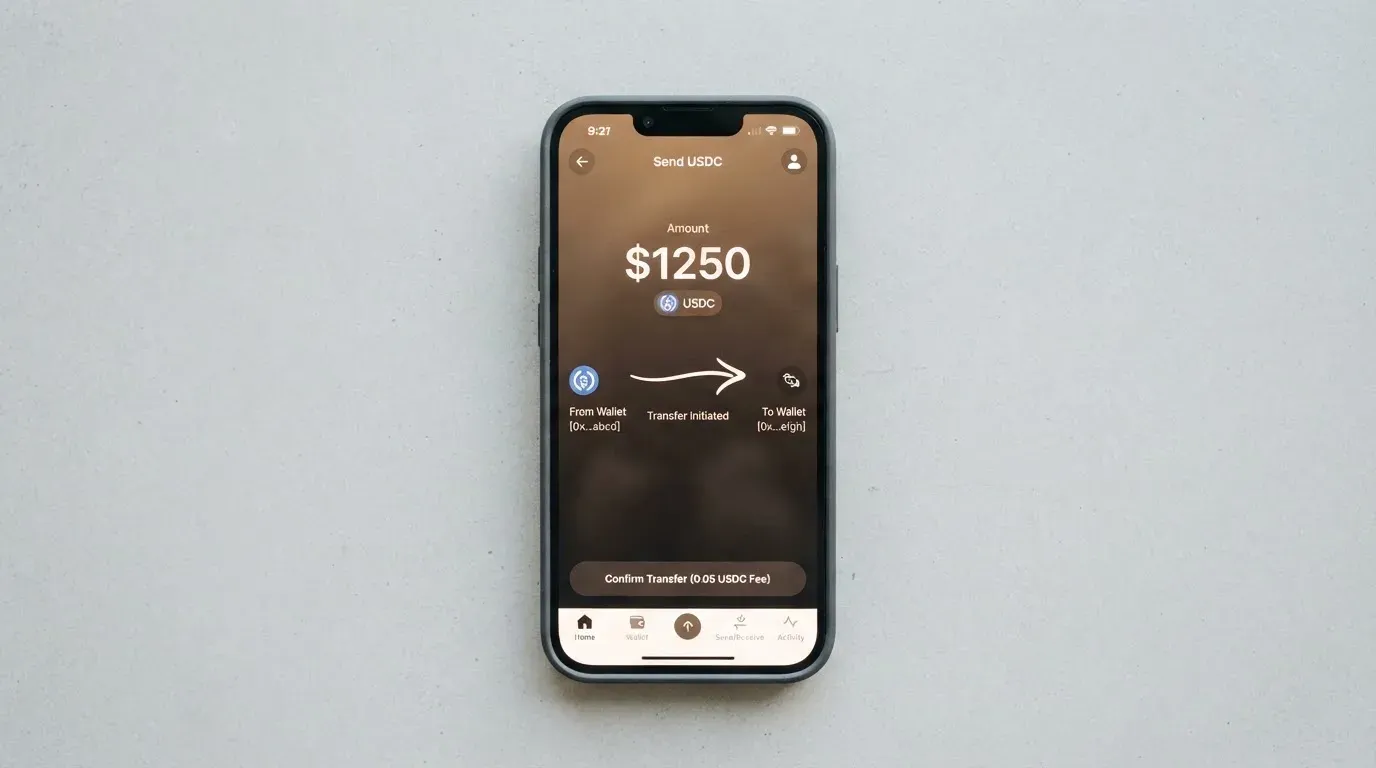
What is not disclosed is the part that costs people money: the networks. Which chain each coin should be sent on is not published, and that is the single most common way a crypto card deposit goes wrong. Send on an unsupported network or to a wallet address of another network and the transfer is irreversible — the blockchain cannot undo it, and recovery becomes a support ticket with no guarantee. On Ethereum, fees are paid in ETH, so a wallet holding USDT and no ETH cannot send at all. Tron charges through its own resource system. And note that USDC is no longer natively supported on Tron, since Circle stopped that in February 2024.
The top-up fee, the minimum deposit, and who pays the network fee are all not stated. On-chain network fees are charged by the blockchain, not by the card provider, so in practice you pay them from your own wallet.
Paying with it every day
Day to day this is a virtual card and two mobile wallets. Apple Pay and Google Pay are both supported, which matters more than it sounds: adding a virtual card to a phone wallet gives you a tokenised number stored on the device, and each payment carries a one-time code rather than your card number.
What you will not have: no plastic, no ATM, and no dedicated mobile app. That last point is not trivial. A card with no app is a card whose balance, transactions and settings live in a web page and in emails, which is exactly the arrangement that makes a lost account or a phishing page more consequential.
Blocked merchant categories are not stated. That silence has a specific commercial meaning: gambling (MCC 7995) is blocked by many issuers as policy rather than law, and the list varies by issuer, so a purchase that fails at a betting site may be the issuer rather than you. Refunds are not stated either — and a third-party listing says flatly, and unofficially, “no refunds on card balances”. Where a decline leaves a hold, the funds can sit for days, typically up to 7, before settling.
Online payments may also run through 3-D Secure, Visa’s version being Visa Secure and Mastercard’s Identity Check, where the issuer either approves the payment silently or challenges you with a code. Address verification, which compares the numeric parts of your billing address with the issuer’s records, is generally unavailable for foreign-issued cards and is a common cause of declines.
What to take instead
If the card does not fit — or if you want something to compare it against — these are the alternatives in the same category, with their own scores.
| Gpayvcc | Cardex | CardFlow | HyperCard | |
|---|---|---|---|---|
| Score | 6.9 / 10 | 5.6 / 10 | 4.9 / 10 | 4.7 / 10 |
| Card type | Virtual prepaid Visa and Mastercard, 28 types across 4 networks | Debit crypto card on VERVE, VISA, Mastercard, UnionPay; virtual and physical | Virtual USD Mastercard, about 3 minutes | Prepaid, network not stated on the App Store page |
| Cost | $5 issue on most cards, $15 on Visa Platinum | Not stated | Creating a virtual card is free | Not stated |
| Conversion | Not stated | Real-time at payment, site claims an “AI-Powered Conversion Rate” picking the best rate; no percentage stated | Not stated | Not stated |
| Top-up | USDT, BTC, TON and more | USDT, USDC, BTC | Bitcoin, USDT, ETH or Naira transfer | Crypto such as USDT, BTC, ETH in the app |
| Audience signal | Crypto users buying prepaid virtual cards with many coins | “One crypto card, 200+ countries”; App Store listing is Naira-focused | Aimed at Nigeria, “Nigerians and global users” | App Store says works in “more than 176 countries” |
| Rewards | No cashback stated | Not stated | Not stated | Not stated |
Cardex is the one to look at if conversion cost is what worries you, because it is the only one of the four that actually describes how it converts and claims to pick a rate. CardFlow’s free virtual card is attractive on price and says nothing about anything else. HyperCard’s network is not stated on its App Store page, which for a card is close to disqualifying.
One caveat on all of them: none of these pages states a country list or exclusions, so eligibility remains unverified across the category.
What can go wrong
The company tells you plainly that it is not a bank and does not issue the cards; partners do. Registration and licences are not stated, and security features are not stated. So the two questions you would normally ask about any card — who holds my money, and who is accountable if something goes wrong — have no published answer here.
Complaints are thin, which can be read two ways. Trustpilot shows 4.7 from 56 reviews, with 92 % five-star. But the page itself notes reviews with similar wording and no replies to negative ones, so the score is weaker evidence than it looks. The only visible complaint is a lag on the details page on mobile on 23 Aug 2026, which is a user report. In the other material there is one detailed complaint: a card failing repeatedly at checkout, and a slow refund that needed repeated follow-up. No official incidents are recorded.
Where complaints are this thin, the relevant history is the category’s. Custodial platforms have failed before — Mt. Gox at about US$350 million reported stolen across 2011–2014, Coincheck at about US$400 million in 2018, Ronin Network at US$625 million in 2022. Card programmes have been switched off underfoot: Visa terminated its global agreements with FTX on 13 November 2022, and WaveCrest, a Visa issuer that supplied several crypto card brands, was suspended by Visa in Europe in 2018, closing every WaveCrest-issued Visa programme. A closure usually means loading stops, then spending stops, then you are asked to withdraw what is left.
Support is reachable — live chat, WhatsApp, Telegram and [email protected] — with a target response within 24 hours, though languages are not stated. Whether a target is met is another matter.
In the EU, the framework is worth knowing. MiCA took legal effect in June 2023, with rules on e-money tokens applying from 30 June 2024 and the crypto-asset service provider rules from 30 December 2024; the transitional period runs until 1 July 2026 or until a provider is authorised or refused, whichever comes first. ESMA keeps an interim register of authorised providers that you can check. Under MiCA, a card is regulated separately from the crypto side, so a crypto card often rests on two licences. And e-money funds must be safeguarded in dedicated accounts or insured — that is not the same as a bank deposit, and a deposit guarantee scheme may not cover it.
Who I would recommend it to
I would recommend Gpayvcc to someone who already holds crypto, does not need a physical card or cash, spends in small amounts, and treats the balance as spending money rather than savings. For that person the price is genuinely low — $5 on most cards — the coin list is wide, and the mobile wallet support covers the normal way people pay online.
I would not recommend it as your only card, as a card for a subscription you cannot afford to miss, or as a place to hold money you would miss. The reasons are all the same three: no published fee schedule for conversion and FX, no published limits, and no named licence or issuing partner. Add the unofficial note about no refunds on balances and the picture is complete enough to decide on.
If you are in the EU or UK and want a regulated e-money institution with published fees, that is a different search. If you are in the US, the debit and prepaid protections you might assume apply vary, and Regulation E reversal rights for credit cards come from Regulation Z — prepaid coverage should not be assumed. And whatever you do, remember that the IRS treats digital assets as property, so each payment funded from crypto can be a separate taxable disposal; that is a matter for a professional, not for this page.
Frequently asked questions
What is the Gpayvcc card?
It is a prepaid virtual payment card sold in crypto, issued on Visa and Mastercard networks, with 28 card types across four networks according to the site’s own count. You pay for it in cryptocurrency and the card details are emailed to you. The company states it is not a bank and does not issue the cards itself; third-party issuing partners do that. Cards are virtual only — there is no plastic version and no ATM.
How does the Gpayvcc card work?
You sign up with an email address, name and phone number, choose a card, and pay in crypto. Five minutes after the payment confirms, the number, expiry date, CVV and billing address arrive by email. The card then draws on its stored balance like a prepaid card, so payments have to be covered by what is on it. Reloadable cards can be topped up later from your account balance.
Is Gpayvcc a bank, and who owns it?
No, it says so itself: it is not a bank and does not issue cards, and its issuing partners do. Who owns the company is not something the pages I read state, and neither are registration or licences. What is published is Trustpilot at 4.7 from 56 reviews with 92 % five-star — alongside a note that some reviews share similar wording and negative ones go unanswered. No official incidents are recorded.
Do I need KYC, and is it available in my country?
The signup asks for email, name and phone number, and says more information may be required for legal and issuer reasons; no bank account is needed. The verification levels are not stated. One third-party site describes level 1 as email only with no phone, ID or selfie — that is unofficial and unconfirmed. The country list is not stated and no excluded countries are published, so check eligibility yourself before paying.
What does a Gpayvcc card cost?
The issue fee is $5 on the Virtual Visa Reloadable ($200), Visa Gold ($200), Visa Virtual Universal ($100) and Mastercard Reloadable Classic ($100), and $15 on the Visa Platinum ($300), with the starting price at $100. There is no monthly fee and no inactivity fee. Conversion, foreign exchange, top-up and decline fees are all not stated, and an unofficial listing warns of a high crypto-to-fiat conversion spread.
How do I top it up, and which network do I use?
You deposit crypto to your account balance and then buy cards from it. USDT, BTC and TON are named, with an earlier check also listing ETH, BNB, Solana, TRX, LTC and BCH. The networks are not disclosed, and that is the risk: sending on the wrong chain is irreversible. On Ethereum the fee is paid in ETH, so USDT alone cannot be sent, and USDC is no longer supported on Tron.
Is the Gpayvcc card safe for my money?
The honest answer is that nobody can tell from the public pages. The company is not a bank, security features are not stated, and the issuing partner and its licence are not named. A third-party listing says unofficially that there are no refunds on card balances. Cryptographic transfers are irreversible, so if your card details are compromised the funds cannot be clawed back by the network.
Can I use it in Apple Pay and Google Pay?
Yes, both are supported, and that is the main way most people would use a card with no physical form. Adding a virtual card to a phone wallet replaces your card number with a device-specific number stored on the device, and each payment uses a one-time code. No mobile app exists, so the wallet is your main view of the card.
Where can I use it, and what gets declined?
Anywhere a virtual Visa or Mastercard is accepted online, in the sense that no country or merchant restriction is published. What is not stated is blocked categories, and merchants may refuse prepaid cards or foreign-issued ones — the issuer lookup gives away the card type and country. Address verification is generally unavailable for foreign-issued cards, gambling is blocked by many issuers as policy, and a declined payment can leave a hold for days.
Can I withdraw money or cash from a Gpayvcc card?
Not in any way the public pages describe. The cards are virtual only, so there is no ATM and no cash withdrawal; ATM fees are listed as not applicable rather than free. Withdrawal of the underlying balance is also not stated, and an unofficial listing says there are no refunds on card balances. If you need to get from crypto back to money in hand, this card is not the instrument for it.
Virtual cards put to the test – cryptocardtested
Content created by the «cryptocardtested» team