
A crypto-funded card for people who can't easily get a bank one
 Available in US
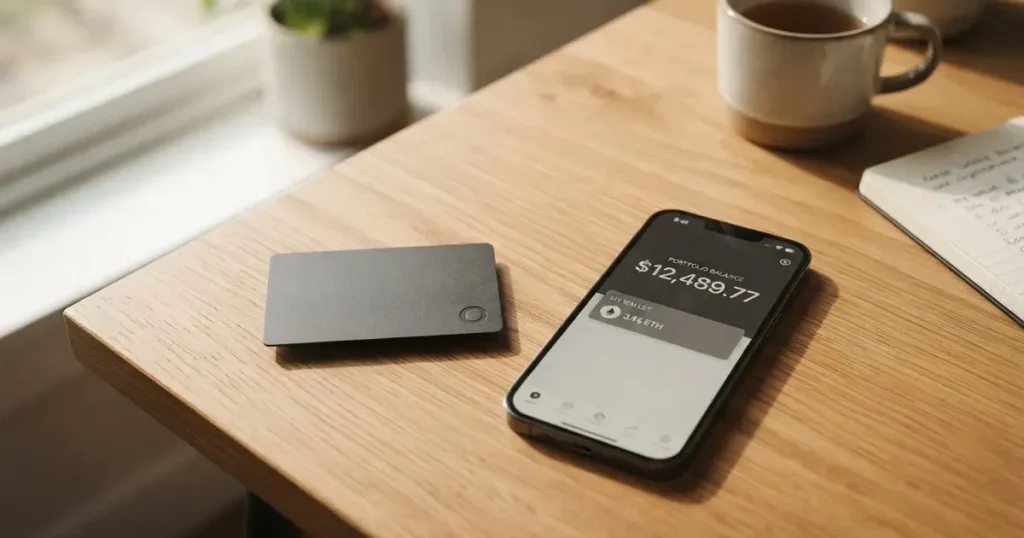
The Volet card sits in an unusual spot. It is a payment card that spends from a prepaid balance, and that balance is fed by a crypto e-wallet. In practice that means you can hold USDT, BTC, ETH or a handful of other coins, convert them into dollars or euros, and pay at shops or online with something that looks like an ordinary Mastercard or Visa. For people who have trouble getting a normal bank card, that setup is genuinely useful, but the cost of getting money onto the card and the limited transparency around the company behind it are real drawbacks. This review walks through who the card suits, what it really costs day-to-day, and where the rough edges are.
Conditions are current as of October 28, 2026.
Verdict: 6.0 out of 10
Volet earns a 6.0 out of 10. The score reflects a card that is broadly available and easy to start with, weighed against a fee structure that is heavier than the official numbers suggest once you trace crypto all the way to a point-of-sale payment, and weighed against a company that does not name the institution that actually issues the card. If you need a prepaid Mastercard or Visa that draws on a crypto balance and you live somewhere bank cards are hard to get, Volet does the job. If you are comparing it on price to mainstream fintech cards, or if you care about knowing exactly who holds your funds, there are better fits.
Here is the score broken down by the criteria I weighed:
| Criterion | Mark | Why |
|---|---|---|
| Who can get it | 8/10 | Service in 180+ countries; Global digital Mastercard in 150+ countries; regional cards for Asia-Pacific and Europe |
| Cost | 4/10 | Issuance $1–$5 by card; top-up from e-wallet 1%–2.5% + $1; fiat card top-up to wallet 3.5% |
| Top-up options | 6/10 | Card loads only from the Volet fiat wallet; crypto USDT, USDC, BTC, ETH and others are converted to USD or EUR; networks not stated |
| Reliability and complaints | 5/10 | Issuer and legal entity not named; Trustpilot 4.1/5 from 965 reviews; complaints about fees, verification limits, undelivered cards |
| Everyday use | 7/10 | Digital and plastic Mastercard and Visa; Apple Pay and Google Pay on some cards; ATM fee not officially published |
The short version: the card is well-distributed and reasonably pleasant to use, but the price of moving money in is the main thing that drags the score down, and Trustpilot reviews are the second.
Who Volet will give the card to
Volet says the service runs in 180+ countries, and the Global digital Mastercard is available in 150+ of them. On top of that there are regional card products: an Asia-Pacific plastic Mastercard, a Europe Virtual card and a Europe Plastic card on Visa or Mastercard, with USD or EUR balances. The European cards are positioned for residents of the EU plus Switzerland and Norway, with Turkey and Israel covered for the Visa version. The Asia-Pacific card is positioned for Australia, Cambodia, Japan, Malaysia, New Zealand, the Philippines, Singapore, South Korea, Thailand and Vietnam.
The page talks about region rather than residence or citizenship, so the exact rule (whether it is where you live, where your ID was issued, or where your phone number is) is not stated by Volet itself. A third-party guide lists around 29 restricted countries, including the US, the UK, Puerto Rico, Cuba, Iran, Syria and North Korea, with around 51 countries confirmed available. That list is unofficial and not confirmed by Volet, so treat it as a starting point rather than a final answer for your situation.
The practical reading is this: if you live in a country where you can use a Mastercard or Visa at a shop, there is a reasonable chance Volet has a card product that reaches you. The question is whether your country is in the supported list, and that you will need to check at sign-up, because the page is vague about it.
How to get the card
Sign-up is split into two stages. The first is opening a Volet account, which lets you hold crypto, send and receive money and use the basic wallet. The second is asking for a card, which triggers verification and gives you a card to spend with.
The basic wallet is open without KYC. You can sign up with an email and start moving small amounts in and out. To get a card, or to unlock the wallet’s full limits, you go through verification, and Volet says it usually takes only a few minutes. The page does not list the documents it asks for. Unofficial guides, including one from August 2026, mention an identity document, a selfie or liveness check, proof of address, and sometimes a source-of-funds question. The Asia-Pacific card reportedly requires proof of residential address in one of the named Asia-Pacific countries. None of this is confirmed by Volet’s own pages, so be ready to provide ID and a recent bill even though the official site does not spell that out.
Once verified, you can order one of four card products: a Global digital Mastercard in USD, an Asia-Pacific plastic Mastercard in USD, a Europe Virtual card on Visa or Mastercard in USD or EUR, and a Europe Plastic card on Visa or Mastercard in USD or EUR. The plastic cards are physical cards delivered by post to the Asia-Pacific region or to Europe, Turkey and Israel. Volet says delivery is “free or express” but does not publish the express price or a delivery window. Unofficial reporting puts replacement fees at $19.95 for the Digital card, €1 or $1 for the Europe Virtual, €5 or $5 for the Europe Plastic, and $120 for a Global Plus replacement; again, treat those numbers as unconfirmed.
Fees: what it really costs
Issuance is modest. The Digital global card costs $5, the Asia-Pacific plastic $5, the Europe Virtual €1 or $1, and the Europe Plastic €5 or $5. Volet’s FAQ says there is no monthly fee, and the official fee page does not list a recurring maintenance charge. That is the good news. The heavier numbers are in top-up and currency conversion, which is where crypto cards usually bite.

Here is the full cost picture from the official fee page:
| Fee or limit | Global digital Mastercard | Asia-Pacific plastic | Europe Virtual / Plastic |
|---|---|---|---|
| Issuance | $5 | $5 | €1 / $1 (Virtual); €5 / $5 (Plastic) |
| Monthly fee | None listed | None listed | None listed |
| Top-up from e-wallet | 2.5% + $1 | 1.5% + $1 | 1% + €1 or $1 |
| POS / FX fee | No extra fee (Mastercard rate) | No extra fee (Mastercard rate) | No POS fee |
| Crypto deposit to wallet | Free | Free | Free |
| Auto-conversion to USD/EUR | $1 for USDT/USDC; free for BTC/ETH/others | $1 for USDT/USDC; free for BTC/ETH/others | $1 for USDT/USDC; free for BTC/ETH/others |
| Fiat card top-up to wallet | 3.5% | 3.5% | 3.5% |
| ATM | Not officially published | Not officially published | Not officially published |
| Per-purchase limit | Up to $50,000 | Up to $22,000 | Not listed |
| Per-day load | Not stated | Up to $6,500 | Not listed |
To turn that into what a payment actually costs, walk through three everyday cases.
Paying a $100 online subscription from a USDT balance. You send USDT to your Volet wallet for free, then convert it to USD inside the wallet. The conversion is $1 for USDT. From the USD balance you load the card at 2.5% + $1, which is $3.50. The merchant sees a clean USD payment with no extra FX fee, because the card is in USD and Mastercard handles the rate. Your total cost consists of these two fees: $1 for conversion plus $3.50 for the card load.
Paying a €40 dinner in Berlin with a Europe card loaded from USDC. You deposit USDC for free, convert to EUR for $1, then load the Europe card at 1% + €1, which is €1.40. The merchant sees a EUR payment, no POS fee. Your total cost consists of the €1 conversion fee plus the €1.40 card load fee, which is €2.40. This is before any spread inside the crypto-to-fiat conversion, which Volet describes as “near-market” without giving a number.
Topping the wallet up with a Visa or Mastercard debit card at 3.5%, then converting to USDT. The 3.5% is the entry cost before the crypto side even begins, so if you plan to fund Volet with a bank card, expect to pay 3.5% to get fiat in, then more on top of that to convert and load. That is the cost reviewers on Trustpilot are reacting to: one February 2026 review calculated a wallet-to-card cost of up to 11% when stacking fees and conversion spread.
ATM fees are not officially published, which is a gap. Unofficial reporting puts them at €1.99 inside the region and €2.99 outside for the Europe card, $2.99 ($1.99 in Australia) for the Asia-Pacific card, $2 + 1% for Global Plus plus another 2% on non-USD, and unclear for the Digital card. None of those are confirmed, so the only honest answer is to test a small withdrawal before relying on the card for cash.
The general lesson is that Volet is cheapest if you already hold crypto and you let it sit in the wallet, and most expensive if you fund from a bank card. The conversion from crypto to fiat and the load onto the card are two separate fees, and they stack.
Top up: how to fund the card
The card is loaded from the Volet fiat e-wallet only; the card itself does not receive crypto directly. That means top-up has two steps: get money into the Volet wallet, then push it to the card.
The wallet can be funded with crypto, with a Visa or Mastercard debit or credit card, or by bank transfer (SEPA, SWIFT and local bank rails are mentioned, with SEPA from 1% and SWIFT at 1% + $25 for withdrawals). Crypto deposits are free at the network level, but you pay the blockchain’s own gas or bandwidth fee on the way in, and you choose the network you send on. Volet does not state which networks it supports on the public fee page, which is a real friction point: if you pick a network Volet does not support, the deposit can be lost because crypto transfers are irreversible.
Once crypto is in the wallet, auto-conversion to USD or EUR costs $1 for USDT and USDC and is free for BTC, ETH and the rest. From a USD or EUR balance, the load to the card is the 1%–2.5% + $1 fee from the costs table above. Fiat card top-ups to the wallet cost 3.5%, so the cheapest path is crypto in, convert in-app, then load.
A small but real detail: the minimum top-up is not stated, and SEPA and bank top-up fees are not stated either, so it is worth testing a small amount first to confirm the route is open before committing.
Paying with the card day-to-day
At a shop, the card behaves like a prepaid Mastercard or Visa. You tap, insert or hand it over, the merchant’s terminal asks Mastercard or Visa for authorisation, and the amount is deducted from your USD or EUR balance. The Global card and Asia-Pacific card are USD, the Europe cards are USD or EUR, so there is no surprise conversion in countries that use those currencies. For other currencies, Mastercard’s rate applies and Volet says there is no extra FX fee on top, which matches the rest of the market.
Mobile wallets are a partial win. The Global digital Mastercard and the Europe Spend Virtual card reportedly support Apple Pay and Google Pay, while the Asia-Pacific card and Global Plus do not, and the Europe Plastic is not advertised as supporting either. That unofficial picture is from a third-party guide and not confirmed by Volet, so check the card’s own description in the app before you assume you can tap with your phone.
There is no cashback or rewards programme. A referral programme is listed as “coming soon”, promising $2 or €2 per activated digital card and $5 or €5 per activated plastic card, but it is not live. Blocked merchant categories (gambling, adult content, crypto purchases) are not stated on the official page; the standard Mastercard rules apply.
The mobile app is on Google Play, and the iOS app is listed as “coming soon”, so iPhone users are stuck on the web for now. Store ratings are not published. Card freeze, 2FA, and spending controls are mentioned, but specific limits and how the controls work in the app are not stated.
Disputes and chargebacks are not addressed on the public pages. If something goes wrong with a payment, your path is support.volet.com, and there is no published timeframe for resolution.
What can go wrong
The most common complaint thread on Trustpilot (4.1 out of 5 from 965 reviews, read 20 October 2026) is fees. Reviewers describe fees to get euros in as “somewhat high”, and one calculated a wallet-to-card cost of up to 11% by stacking the conversion, the load fee and an exchange spread. Volet is not the only card with that profile, but it is the headline pain.
The second theme is verification and withdrawal limits. Several reviewers, including a September 2026 UK user, report that they cannot fully verify and therefore cannot withdraw. A March 2025 reviewer had a bank-statement PDF rejected for proof of address, with Volet saying the issuing partner makes that call. Because the issuing partner is not named on the public pages, you have no way to predict which documents will pass.
The third theme is operational. January 2026: transactions blocked from India without explanation. August 2026: funds sent to an old wallet address and not recovered. September 2026: cards ordered and never sent. These are individual reports, but they cluster around the same pattern: opaque decisions and slow support.
A structural risk sits underneath. Volet does not name the bank or e-money institution that actually issues the card on its public pages; the footer says only “Volet.com”, and the user agreements are published per region (“Agreement Canada”, “Agreement Costa Rica”), suggesting the contracting entity depends on where you live. That means the institution that holds your money, and the institution that issues your card, may be different companies, and the regulatory status of either is not stated on the public site. A third-party guide notes that Volet was formerly known as ADVcash, and that the card issuers “are not publicly named”. Treat that as an unofficial reading.
Security claims are standard: “multi-layer security, encryption, access controls and continuous monitoring”, and the site displays badges for PCI-DSS, GDPR, SSL and ISO. There is no published detail on whether customer funds are safeguarded in segregated accounts or covered by insurance, and 2FA, card freeze and spending controls exist but are not described in depth. Because the wallet is custodial, the usual counterparty risk applies: if the platform fails, the usual crypto-custody failure modes (Mt. Gox, Coincheck, Ronin) are the precedent.
There is one operational rule worth keeping in mind: declined authorisations can leave a hold on your balance for several days, even if the merchant later cancels the charge, so do not treat a “pending” amount as available cash.
What to take instead
Volet is not the only crypto-funded prepaid card on the market, and the alternatives are worth knowing if the fee structure or the lack of issuer transparency is a deal-breaker for you.
Cardex positions itself as a single crypto card for 200+ countries, on the Verve, Visa, Mastercard and UnionPay networks, with virtual and physical cards. Its standout claim is real-time crypto-to-fiat conversion at the point of payment, with an “AI-Powered Conversion Rate” that scans global exchanges and picks the best rate. No fee percentage is published. Cardex is in our comparison set at 5.6 out of 10, mostly because the conversion claim is hard to verify without using the card.
CardFlow is aimed primarily at Nigeria, though it says it serves “Nigerians and global users”. The product is a virtual USD Mastercard that you can create in a few minutes, free to create, with funding from Bitcoin, USDT, ETH or a Naira bank transfer. Networks and fees are not stated, and the score is 4.9 out of 10.
HyperCard is a prepaid card in USD or EUR, with crypto (USDT, BTC, ETH and others) deposited in the app and converted to the card balance. The App Store page says the card works in “more than 176 countries”, which is acceptance, not eligibility. Fees are not stated. The score is 4.7 out of 10.
None of the three publish the kind of fee table Volet does, which is itself a signal: Volet is more transparent about its pricing, even if the prices are higher than the marketing suggests. If transparency matters more than absolute cost, Volet has the edge; if price is the only thing that matters, none of these cards is a clear winner without testing them.
Who I would recommend Volet to
Volet is the right card for a fairly specific reader. If you live somewhere bank cards are hard to get, if you already hold USDT, USDC, BTC or ETH and you want to spend that balance at a regular shop or online, and if you can tolerate paying the conversion and load fees to move crypto onto a card, Volet does the job. The Global digital Mastercard reaches 150+ countries, the iOS app gap and the ATM-fee gap are real but workable, and the card is at least priced clearly.
Volet is the wrong card if you are price-sensitive, if you fund from a bank card (the 3.5% entry fee will dominate every transaction), if you need a card whose issuing bank you can name, or if you need cash access with a published ATM fee. It is also a poor fit if you want cashback, an iPhone app today, or merchant-category controls.
If you are still undecided, the most useful next step is to log in to the Volet app or web wallet, look up the card product that covers your country, and read the regional user agreement before you load any money. The agreement tells you which entity you are contracting with, which is the closest thing to a real issuer name you will find. If the agreement does not name an institution you recognise, that is a useful signal in itself.
Frequently asked questions
What is the Volet card?
The Volet card is a prepaid Mastercard or Visa issued through the Volet e-wallet. The wallet holds crypto such as USDT, USDC, BTC and ETH; the card spends a USD or EUR balance that you load from the wallet.
How does the Volet card work?
You deposit crypto into the Volet wallet, convert it to USD or EUR inside the app, and load the card from that fiat balance. At payment time the card behaves like a normal Mastercard or Visa, drawing on the loaded balance.
Is Volet a bank?
Volet does not describe itself as a bank on its public pages. It is an e-wallet and card programme, and the actual card-issuing institution is not named; the user agreement is published per region, so the contracting entity depends on where you live.
Who owns Volet?
The owner is not stated on Volet’s own pages. A third-party guide notes that Volet was previously known as ADVcash; that is not confirmed by Volet itself.
Is the Volet card available in the US or UK?
Volet’s own pages do not publish a country list; they say the service runs in 180+ countries and the Global card in 150+. A third-party guide lists the US and UK among 29 restricted countries, with around 51 confirmed available. Treat that as unofficial until you confirm at sign-up.
How do I apply for a Volet card?
Open a Volet account with an email, complete the verification step (an identity document and a proof of address are typically required, though not officially listed), and order the card that covers your region from inside the wallet.
Does the Volet card require KYC?
The basic wallet does not require KYC, but you need to verify to get a card, to remove wallet limits and to withdraw. The page says verification usually takes a few minutes; the exact documents are not listed officially.
How do I top up the Volet card?
You load the card from the Volet fiat wallet. The wallet can be funded with crypto (USDT, USDC, BTC, ETH and others), with a Visa or Mastercard at 3.5%, or by bank transfer. Crypto is converted to USD or EUR inside the wallet at $1 for USDT/USDC and free for BTC/ETH.
How do I add the Volet card to Apple Wallet or Google Pay?
Apple Pay and Google Pay are supported on some Volet cards, not all. The Digital global Mastercard and the Europe Spend Virtual reportedly support both; the Asia-Pacific and Global Plus cards do not. Check the card description inside the app before assuming tap-to-pay will work.
Is the Volet card safe?
Volet describes its security as multi-layer, with encryption, access controls and continuous monitoring, and it displays PCI-DSS, GDPR, SSL and ISO badges. The wallet is custodial, so the platform itself is the counterparty; no safeguarding or insurance detail is published.
Virtual cards put to the test – cryptocardtested
Content created by the «cryptocardtested» team