
Cheap on the surface, thin underneath: reading the KAST card's own terms before you commit
 Available in US
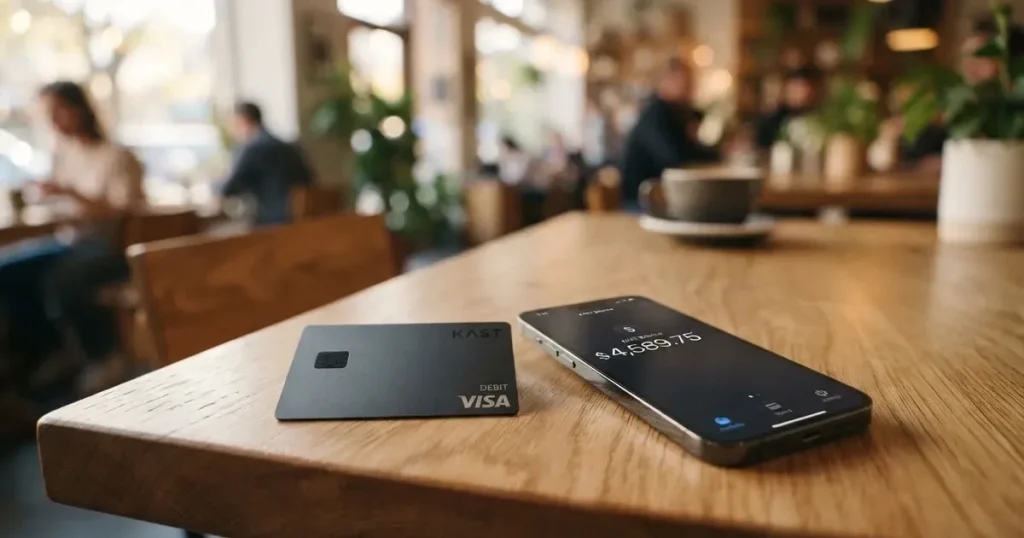
The KAST card is a Visa payment card that spends a stablecoin balance. You hold dollars on the platform, they are converted from stablecoins when you top up, and every purchase comes straight off that balance — it behaves like a prepaid card, not like credit. On paper the numbers are unusually good: the free tier costs nothing a year, spending in dollars costs nothing, and topping up with USDT or USDC costs nothing. Off the paper, the things I could not confirm are the things that would matter most to somebody in a hurry for a working card. The card’s own pages never name the bank that issues it, publish the list of countries they will onboard, or state which two of its own pages you should believe when they disagree about the ATM limit.
My score is 6.1 out of 10. That is not a verdict of “avoid” — the daily mechanics are genuinely smooth, Apple Pay and Google Pay work on both card types, and the top-up rails are the best in the set I looked at. It is a verdict of “excellent product, thin disclosure”, and for the reader who cannot wait for that disclosure to improve, the order matters: check the fees and limits first, then read the risks before you move money.
The conditions described here are current as of October 28, 2026.
| Criterion | Mark | Why |
|---|---|---|
| Who can get it | 5 / 10 | The country list appears during identity checks and is not published; Visa is accepted in 170+ countries, per the service’s own claim |
| Cost | 6 / 10 | Standard tier 0 USD a year, physical card 0 USD plus 40 USD delivery, extra virtual card 2 USD; stablecoin top-up 0%, USD spending 0%, FX 0.5%–1.75%, ATM 3 USD plus 2% |
| Top-up options | 9 / 10 | USDT, USDC, PYUSD, RLUSD; USDT and USDC on Ethereum, Solana, Polygon, Arbitrum, TRON, top-up 0% |
| Reliability and complaints | 3 / 10 | Issuer unnamed, no licence numbers, KAST Tech structure in Anjouan (Comoros); Trustpilot 2.5–2.7, complaints about frozen accounts and repeated document requests |
| Everyday use | 9 / 10 | Virtual and physical cards, Apple Pay and Google Pay, ATMs across the Visa network |
| Total | 6.1 / 10 | A very good way to spend stablecoins, attached to a company that tells you very little about itself |
This card is for you if you already hold stablecoins across several networks, you want to spend a USD balance at ordinary shops without opening a bank account, and you are comfortable treating the platform as a counterparty rather than as a bank. It is not for you if your priority is deposit insurance, a published list of the countries served, a named issuing bank, or someone picking up the phone when a payment is disputed. The audience the card is plainly built for is stablecoin holders spending USD balances across many networks — that is the person whose everyday friction this product actually removes.
Who gets the card, and who does not
The short answer: nobody can tell you the full list, because KAST does not publish it. The country list is displayed at the identity check, not on the public pages, and the card’s own words are as blunt as this: if your country is not listed there, KAST is not available there. There is a “Restricted Locations” list that the terms refer to without naming a single country, so if you are in one of those places you have no way to check from the outside — you find out during verification, and by then you have already typed in your phone number and email address.
Residence is the first gate. Citizenship is a second one, and it catches people who would not expect it. If you live in a supported country but hold identity documents from a restricted region, you may still fail verification even though your address qualifies. If you hold dual citizenship and one of the two IDs comes from a supported country, you may pass. Only your own document works — you cannot send an ID belonging to somebody else, and a VPN does not change what the check sees.
The awkward edge case: you can create an account while sitting in a country the service does not support, and the app will let you in. What you cannot do is get past verification. The account exists, the interface works, and the money path stays shut. I mention this because “I made an account and it looked fine” is not a signal that you are eligible.
Who this card suits, concretely:
- You hold USDT or USDC spread across several chains and want one dollar balance to spend from all of them.
- You have a supported country of residence and an ID from that country or from another supported one.
- You want Apple Pay or Google Pay working from a card issued off a normal bank, and you do not want to open an account at a bank to get it.
- You can afford to hold the balance with a platform whose issuer is not named, because you are not treating it as savings.
Who should look elsewhere, just as concretely:
- You want a deposit guarantee. This is not a bank deposit and nothing on the pages says it is insured as one.
- You live somewhere you cannot check against a published list — you will only learn your status during verification.
- You plan to hold a large balance for months. The inactivity fee starts after twelve months, and large transactions can be flagged for compliance review at any time.
How to get it, and what verification actually involves
You apply in the app, and there is no branch, no paperwork by post, no appointment. The sequence is: create the account, complete identity verification, then order a virtual or a physical card. Verification itself is tiered, and the tiers are what most people find surprising, because the first one gives you an app with nothing in it.
- Level 1 is account creation — phone number with a one-time code, PIN, email, country of residence. You get app access and nothing else. No cards, no sending, no receiving.
- Level 2 is a government ID — passport, national ID card or driving licence, which must still be valid — plus a selfie with a liveness check. This is the tier that unlocks moving funds and getting cards.
- Level 3 is proof of address plus enhanced checks, and citizenship is requested at this point. This unlocks USD and EUR accounts and global payouts.
- Beyond the tiers, source-of-funds documents can be asked for at any point, which is where most of the complaint traffic comes from. US residents supply a Social Security number.
- Age is the legal age where you live, so 18 in most countries.
Processing times and the official list of rejection reasons are not stated. Two things are clear enough to plan around: an expired ID is refused, and so is an unsupported or restricted country. Everything else is discretionary, and discretion is what you are really signing up for.
Cards come in three grades. Standard is Visa Platinum, Premium is Visa Infinite in metal, Private is gold-plated Visa Infinite. Other designs — Pengu, Solana, Bitcoin — exist within the tiers. You can hold up to ten cards. Your balance is denominated in USD, and stablecoin deposits convert 1:1 with a 0% spread. A physical card arrives in seven to ten business days, and on the free tier you pay 40 USD for that delivery. The list of countries it ships to and the cost of a replacement are not stated.
Fees: what a KAST payment really costs
The headline numbers are excellent and I want to give them their due, because most crypto cards cannot match them. Then I want you to notice what sits behind them. Here is the full published schedule, so you can check my arithmetic and not just take my word for it.
| Fee or limit | What the card states |
|---|---|
| Annual membership, Standard | 0 USD |
| Annual membership, Premium | 1,000 USD/year |
| Annual membership, Private | 10,000 USD/year, billed annually upfront, no monthly option |
| Physical card, Standard | 0 USD card fee plus 40 USD delivery |
| Physical card, Premium / Private | Included |
| Extra virtual card | 2 USD; in some regions 2 USD also applies to the included Standard virtual cards |
| Stablecoin top-up | 0% |
| Card spend in USD | 0% |
| Transaction fee | 0% |
| Apple Pay / Google Pay | 0% |
| Non-USD currency conversion | 0.5%–1.75%, depending on residence country, transaction country and card programme |
| Non-USD transaction under 25 USD | 0.10 USD |
| Declined transaction (insufficient balance) | 0.50 USD |
| ATM withdrawal | 3 USD flat plus 2% of the amount, plus the FX fee on non-USD |
| Inactivity fee | 1 USD/month after 12 months |
| Renewal / reactivation fees | Exist; amounts not stated |
| Card transaction limit, account deposit limit, balance limit | Stated as “Unlimited”; large transactions may be flagged for compliance, and you can set lower limits in the app |
| KAST Tag transfers | Free, maximum 10,000 USD/day and 5 per day |
The Terms say limits are set by the company and shown in the platform, and give no figures — so “unlimited” on the marketing side and “set by the company” in the terms are both true and they are not the same promise.
Now three everyday payments, so the table stops being abstract:
- Coffee at a local shop, paid in dollars. 0% on the spend, 0% on the transaction, nothing at all. If your balance is in dollars and the shop takes dollars, KAST takes no cut. This is the case the product is designed around.
- A subscription billed in euros while you sit in the US. The FX fee applies, somewhere between 0.5% and 1.75% depending on where you live, where the transaction happens and which card programme you are on. On a 12 USD monthly subscription that can be between a few cents and about 20 cents a month — annoying, not fatal, and impossible for you to predict precisely because the rate depends on three inputs.
- Taking 200 USD out of a cash machine in a country that does not use dollars. 3 USD flat, plus 2% of 200 USD, plus the FX fee. That is 3 + 4 = 7 USD before the conversion charge, on top of the spread the ATM’s own operator applies. Cash is by far the most expensive way to use this card, and it is the first thing people try.
Two of those deserve a second look. The 0.50 USD declined-transaction fee is charged when there is not enough balance — and complaint writers on Trustpilot describe being charged it repeatedly in April 2026, on a balance that had gone negative, so a single mistake can become a loop. And non-stablecoin tokens sent to the platform may be auto-converted at a fee shown in the app, which is the sort of thing that should be checked before you send the wrong asset rather than after.
Top up: the best part of the card
Topping up is where KAST is strongest, and it is the one part of this review where I have almost nothing to criticise. Stablecoin deposit is 0%, unlimited in amount, with network fees excluded — the blockchain charges you, KAST does not. You can arrive with USDT, USDC, PYUSD or RLUSD. USDT and USDC can be sent over Ethereum, Solana, Polygon, Arbitrum or TRON, and the app lists the current networks for you at the time of sending.
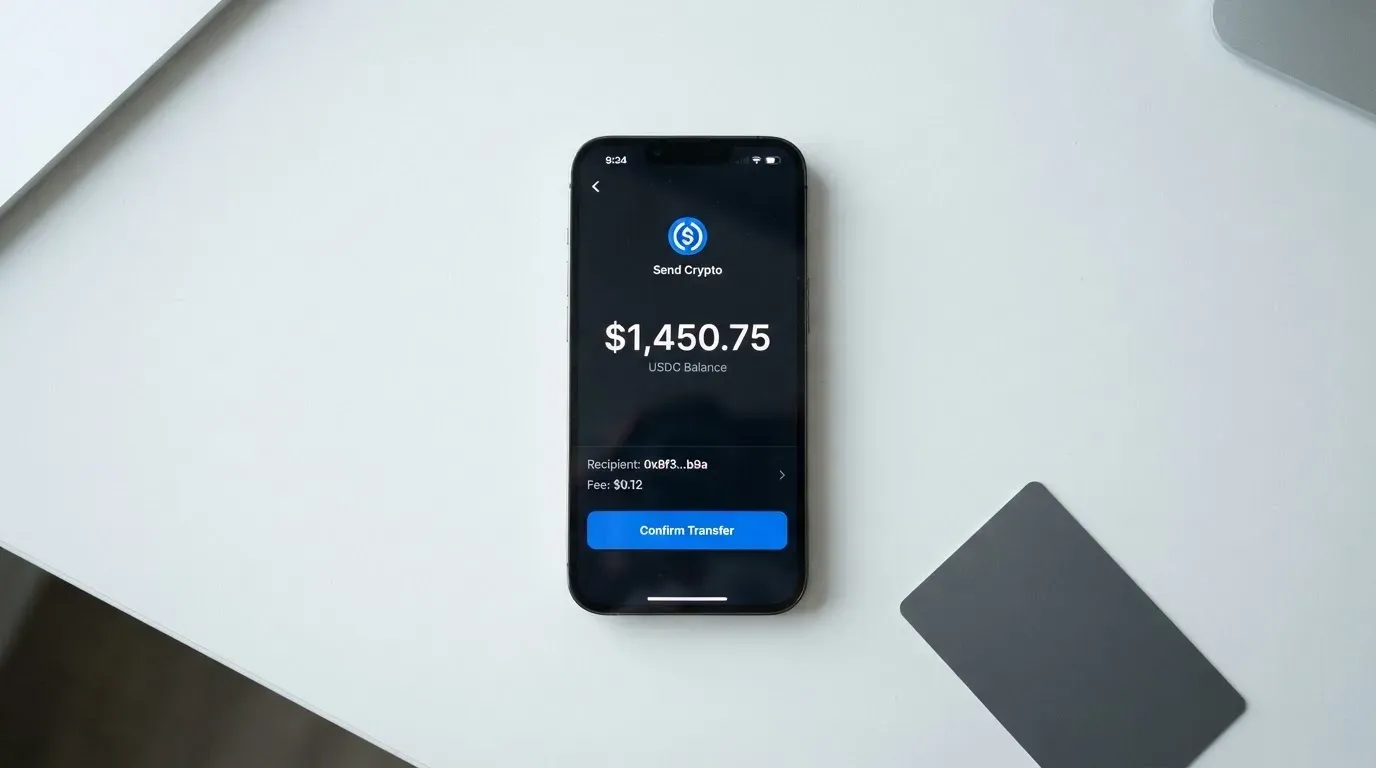
One inconsistency to know about: the Terms say the acceptable tokens are “currently USDT and USDC”, which conflicts with the app listing PYUSD and RLUSD as well. If you are planning to send a token that only the app mentions, that mismatch is exactly the kind of thing that turns into a support ticket — so check the deposit screen in the app itself rather than assuming the terms page is complete.
Bank deposits exist too, and they are where the cheapness ends: USD ACH costs 2 USD, FedWire 15 USD, SWIFT 30 USD, and EUR SEPA 0.5%. The minimum top-up is not stated. No bank account is needed for the stablecoin route, which is precisely why so many people arrive through that door.
Spending comes out of your own balance and each purchase is deducted immediately — this is not credit, and there is no statement of what you owe. Transfers inside the platform under the KAST Tag are free, capped at 10,000 USD a day and five a day.
Withdrawing back out to a stablecoin costs more than getting in, and it varies a lot by network, which is worth knowing before you pick a chain for the trip home:
| Network and token | Withdrawal fee |
|---|---|
| Solana (USDT, USDC) | 1 USD plus 0.1% |
| Arbitrum (USDC) | 0.20 USD plus 0.1% |
| Tron (USDT) | 5 USD plus 0.1% |
| Ethereum (USDT, USDC) | 6 USD plus 0.1% |
| Minimum withdrawal | 5 USD |
What happens to a leftover balance when you close the account is not stated, and that is the kind of sentence I would want to see filled in before closing anything.
One last warning that has nothing to do with KAST. Blockchain transfers are irreversible. Send to a network the provider does not support, or to an address belonging to another network, and the money can be gone or can depend on manual support recovery with no guarantee. Also worth knowing before you assume stablecoins are neutral: Circle stopped supporting USDC on Tron in February 2024, so “USDC over TRC20” is not a native option — pick the network from the deposit screen, not from memory.
Paying with it every day
Day to day, this is the part of the card that just works. You can hold a virtual card and a physical card, up to ten in total, and both work with Apple Pay and Google Pay at 0%. Samsung Pay is not stated. Wherever Visa is accepted is the whole answer to “where can I use it” — the service claims 150M+ merchants across 170+ countries, and that is the service’s own claim, not an independent count. Cash machines are the Visa network’s.
The balance shows in dollars, and USD and EUR accounts exist at the third verification level. What that means for spending is that you pay in whatever currency the shop wants, and a non-dollar payment carries the 0.5%–1.75% conversion fee.
Rewards are real but tiered, and the caps matter more than the headline:
- Standard: 1.5% cashback on the first 2,000 USD of spend a month.
- Premium: 2% on the first 10,000 USD a month.
- Private: 3% on the first 40,000 USD a month.
- KAST Points on top: none on Standard, +1% on Premium, +2% on Private, on eligible spend.
- Cashback is paid in USD when the transaction is authorised.
So if you spend 3,000 USD a month on the free tier, only the first 2,000 of it earns 1.5% — a detail that is easy to miss and easy to feel. There are also Reserve rewards on balances (8% on Standard, 10% on Premium, 12% on Private) and SOL staking paid in Points at 0.25 per SOL roughly every two days on Standard, double that on the two paid tiers. Visa Infinite benefits on Premium and Private — travel, purchase protection, lounge, eSIM — require you to register on the Visa Benefits portal first, so they are not automatic. The Reserve programme ends on 1 July 2027; I would not build a plan around it.
Two habits that will save you trouble:
- The app. The iOS app, “KAST: Global USD Account” by Troia Limited, sits at a 3.97 rating from 276 ratings in the App Store, last updated 8 October 2026 when I read it. That is a middling score, not a warning. The Google Play rating I did not read. Use the app to set your own spending limits — it is one of the few real controls you get over this card.
- Disputes. The Terms ask you to contact the company within 90 days of a transaction, and cap its liability at 500 USD. The chargeback process itself is not stated, and chargeback rights differ a lot by card type and country, so I would not assume a prepaid-style card carries the same protection as a bank debit card.
What the card cannot be used for is spelled out: weapons, controlled substances, Ponzi, pyramid and MLM schemes, counterfeit goods, Darknet or Tor purchases, adult content, and pseudo-pharmaceuticals. Gambling is not mentioned in those terms. A merchant can also place a pre-authorisation hold, and a declined authorisation can leave a hold on your funds for several days, sometimes up to seven.
What can go wrong
This is where the score drops, and I want to be specific rather than gloomy, because “it is risky” helps nobody.
Nobody will tell you who issues the card. KAST describes itself as a financial technology company, not a bank, and says cards, custody and the on- and off-ramps are provided by licensed partners. The Terms name the entity as KAST Tech, registration number 16223, incorporated in Anjouan in the Comoros, with Seychelles governing law and arbitration at the Singapore International Arbitration Centre. The app-store developer is Troia Limited. The card issuer and its BIN sponsor are described only as “one of our Partner”, unnamed. Named partners in the terms include Tazapay and BitGo; the homepage logos include Stripe, Privy, Fireblocks, Visa, Sardine and Elliptic. Logos are not licences, and no licence numbers and no regulator are named on the pages I read. The card is also offered “subject to regulatory approval”.
I am not going to tell you this is dangerous. I am telling you that you are being asked to trust a structure you cannot see, and that the people in the best position to name the parties are the ones who have not.
Accounts get frozen, and people pay for it. The official pages state no incidents, so this comes from user reports rather than from the company. On Trustpilot — about 2.5 on regional pages and 2.7 on the main page, across roughly 170 reviews when I read it on 20 October 2026 — the recurring themes in 2026 are accounts frozen or restricted soon after a deposit with the funds held, the 0.50 USD declined-transaction fee charged repeatedly until the balance went negative in April 2026, repeated document requests on self-transfers, and slow support. KAST replies to most of the negative reviews saying accounts can be restricted by security and compliance systems. The positive reviews, for balance, praise low fees and spending stablecoins without friction.
That pattern is what a restricted-account fee looks like in practice, and it is worth remembering that freezing is standard compliance behaviour, not necessarily misconduct — the frustration is in the communication and the cost, not in the freeze itself.
Held money, and no guaranteed way out. Large transactions may be flagged for compliance, limits can be changed by the company, and the Terms cap liability at 500 USD. That is a small number to have in your pocket if a dispute goes wrong.
Counterparty risk is real and general. When a provider holds your funds, you are exposed to that provider — to its solvency, to its internal controls and to hackers. The history of the industry is not encouraging: Mt. Gox (about US$350 million reported stolen, 2011–2014), Coincheck (about US$400 million, 2018) and Ronin Network (US$625 million, 2022). KAST describes itself as a stablecoin money app with custody by licensed partners, and users can set lower spend limits in the app, but two-factor authentication, card freeze and insurance are not stated on the pages I read.
Support exists, in English. There is a KAST Concierge help centre, 24/7 on all tiers, and a VIP Concierge on Private, with [email protected] appearing in company replies. Russian is not offered on the membership page — the selector is English only.
What to take instead
None of these is “better than KAST”. They are better or worse on specific axes, and the axis that matters is the one you are stuck on. I scored all three on the same basis, so you can see where they fall.
| Card | Score | Issuer visible | Cost | Who can get it |
|---|---|---|---|---|
| KAST | 6.1 / 10 | Not named | Free tier 0 USD; 40 USD physical delivery; 0.5%–1.75% FX; ATM 3 USD + 2% | Country list shown at verification, not published |
| TokenPocket | 5.8 / 10 | Not detailed here | 1% fee on crypto deposits; no other fees stated | Visa debit for a list of European countries; Mastercard debit for Australia, Canada, Hong Kong, Japan, Taiwan, New Zealand, Singapore, South Korea, UK and others |
| MetaMask | 7.1 / 10 | Monovate, with Crypto Life as card provider | Virtual free; Metal 199 USD/year | Sign-up open in 45 listed countries/territories, others on a waitlist; US and UK temporarily closed per FAQ |
| Zeal | 6.1 / 10 | Visa; Gnosis Pay programme | Fee schedule not published | Live in the EU, UK, Brazil, Colombia, Mexico, Japan, Singapore, Philippines, Indonesia, Thailand; 150+ countries for spending |
TokenPocket is the weakest of the set at 5.8, mostly on the 1% charge for depositing cryptocurrency, which the company says is refunded later through rewards or reduced transaction fees. It runs on Arbitrum, its Fiat24 cards are virtual with no physical card mentioned, and balances sit in EUR24 and USD24.
MetaMask scores highest at 7.1 and is the one I would look at first if transparency on the issuing side is what you care about — the issuer, Monovate, and the card provider, Crypto Life, are both named. The virtual card is free and instant, Metal is 199 USD a year, one card per user, and there is no foreign transaction fee. It spends directly from your connected wallet across Linea, Base, Monad and Solana, naming mUSD, wETH, EURe, GBPe, USDC and USDT. Cashback is paid in mUSD: 1% on Virtual, and on Metal a headline 3% that the fine print caps at 3% on the first 10,000 USD then 1%. The catch is eligibility — 45 listed countries and territories, a waitlist elsewhere, proof of residency required, and US and UK sign-ups temporarily closed.
Zeal matches KAST at 6.1 and is the alternative that answers a different problem. It charges no additional FX fee and converts at Visa’s wholesale rate, which is a real answer to the 0.5%–1.75% band that bothers you about KAST. It runs on Gnosis Pay accounts in EUR, USD and GBP, gives up to 4% cashback paid in GNO — with GNO held in the card Safe to qualify — and advertises up to 5% variable APY on balances. The physical card is not stated and no fee schedule is published.
And the option that is not on this list: if what you need is an ordinary bank card in your own name, a regulated bank in your own country may be slower, more paperwork and a branch visit away — but it comes with a named issuer, a deposit scheme and a complaints route that exists on paper. For anyone whose difficulty is that banks will not open an account for them, that option is genuinely closed, and it is the reader this page is for.
Who I would recommend it to
If you hold stablecoins across several networks, you have a supported residence and an ID that qualifies, and you want to spend dollars in shops and in Apple Pay today rather than after a banking relationship — this is a good card, and the 0% top-up with 0% dollar spending is not marketing, it is the schedule. The daily mechanics score 9 out of 10 for a reason.
If your first question is “who is the bank behind this”, stop here and read the risks section again, because that answer does not exist on the public pages. If your money has to be there next month regardless of what happens to the company, or if the balance is large enough that losing it would matter, the disclosure is not good enough for me to recommend it — not because I know something is wrong, but because I could not find it.
The middle path, which I like best: keep KAST for spending money you are moving anyway, and keep your long-horizon balance somewhere whose issuer, licence and safeguarding you can name. The card is good at the first job. It is not, on this evidence, built to be trusted with the second.
Frequently asked questions
What is the KAST card?
KAST is a Visa payment card that spends a stablecoin balance rather than a bank account. You top up with USDT, USDC, PYUSD or RLUSD, the deposit is converted to a USD balance at 1:1 with a 0% spread, and each purchase is deducted straight from that balance. It works like a prepaid card: no credit, no overdraft, and spending stops when the balance does.
How does the KAST card work day to day?
You order a virtual or physical card after verification, add either to Apple Pay or Google Pay at 0%, and pay anywhere Visa is accepted — the service claims 150M+ merchants in 170+ countries. Spending in dollars costs 0%, but paying in another currency carries a 0.5%–1.75% conversion fee depending on your country, the transaction country and your card programme.
Is KAST a bank, and who owns it?
No. KAST describes itself as a financial technology company, not a bank, with cards, custody and the on- and off-ramps provided by licensed partners. The Terms name the entity as KAST Tech, registration number 16223, incorporated in Anjouan, Comoros, under Seychelles governing law. The app-store developer is Troia Limited, and the card issuer is unnamed.
Can I get the KAST card where I live?
Only if your country of residence appears in the list shown during identity verification — the list is not published on the public pages. The card’s own wording: if your country is not listed there, KAST is not available there. Citizenship matters separately too: living in a supported country with only an ID from a restricted region may still fail verification.
Does the KAST card require KYC, and how long does it take?
Yes, and it is tiered. Level 1 is just account creation and gives app access with no cards; Level 2 adds a valid government ID plus a selfie and unlocks moving money and getting cards; Level 3 adds proof of address and unlocks USD and EUR accounts. Processing times are not stated, and source-of-funds documents can be requested at any point.
Is the KAST card free?
The Standard tier is 0 USD a year and spending in dollars is 0%. Premium costs 1,000 USD a year and Private 10,000 USD, both billed annually upfront with no monthly option. On the free tier the physical card has no card fee but delivery costs 40 USD, an extra virtual card is 2 USD, and an inactivity fee of 1 USD a month starts after twelve months.
How do I top up, and which networks work?
Stablecoin deposits are 0% and unlimited, though blockchain network fees are separate and not paid by KAST. USDT and USDC work over Ethereum, Solana, Polygon, Arbitrum and TRON, and the app lists the current networks when you send. Bank deposits also exist: USD ACH 2 USD, FedWire 15 USD, SWIFT 30 USD, EUR SEPA 0.5%. No bank account is needed for the crypto route.
Is the KAST card safe to use?
Safer than it looks in some ways, less reassuring in others. Apple Pay and Google Pay use tokenised numbers with one-time security codes, and you can set your own spending limits in the app. But the issuer is unnamed, no licence numbers appear on the pages I read, and Trustpilot reviews around 2.5–2.7 report accounts frozen after deposits, repeated declined-transaction fees and repeated document requests. Judge it as a spending tool, not as a place to keep money.
What are the fees and limits I am most likely to hit?
The ones that catch people are currency conversion at 0.5%–1.75% on non-dollar payments, a 0.50 USD fee each time a transaction is declined for insufficient balance, a 0.10 USD charge on non-USD transactions under 25 USD, and ATM withdrawals at 3 USD plus 2% of the amount before any FX fee. Also note the cashback caps: 1.5% only on the first 2,000 USD a month on Standard.
Is a KAST account permanent, and can I close it?
Nothing on the public pages says what happens to a leftover balance when you close an account — that is worth asking support before you close anything. What you can control yourself is deleting the account and the cards through the app, and setting lower spending limits in advance rather than waiting for an enforcement action to teach you what the defaults are.
Wallet cards put to the test – cryptocardtested
Content created by the «cryptocardtested» team