
A stablecoin-funded Visa card with a $50 card fee and a 2.99% foreign-currency charge — useful if you cannot open an ordinary bank account, expensive if you can
 Available in US
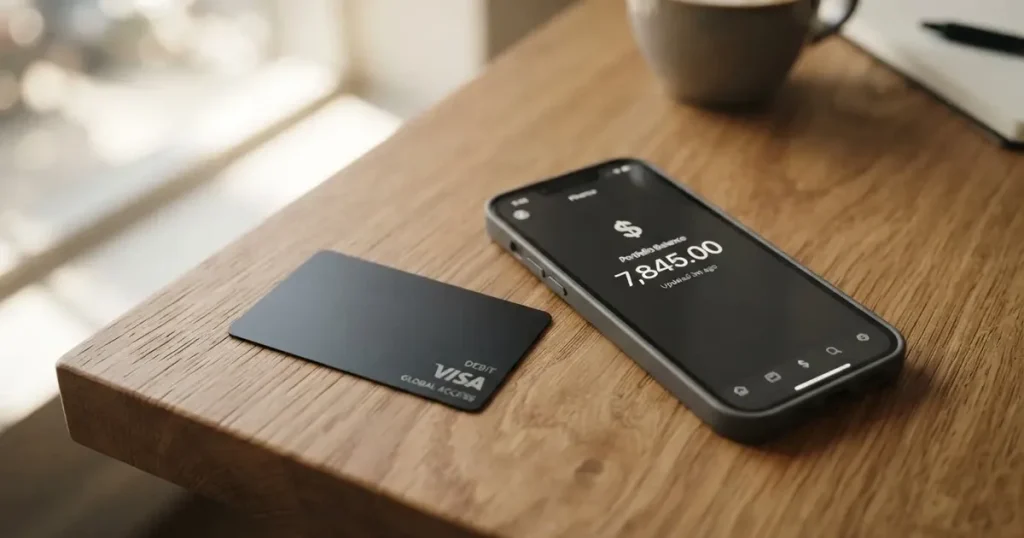
The first thing to clear up, because it decides whether the rest of this page matters to you: FV Bank is not an ordinary retail bank, and the card is not an ordinary debit card. FV Bank International Inc. is a Puerto Rico-licensed entity — it is licensed by the Office of the Commissioner of Financial Institutions (OCIF) as an International Financial Entity, licence IFE-063 — and it is a principal member of Visa, announced in October 2021. It is not FDIC-insured. It holds crypto for customers in custody, and it converts that crypto into a US-dollar balance that a Visa debit card spends from.
So the pitch is roughly: keep USDC, USDT or PYUSD with a licensed custodian, let it convert to dollars, and spend those dollars with a physical Visa card that works wherever Visa is accepted. That is a real, useful thing for someone who holds stablecoins and cannot get a normal bank account. For everyone else, the price list is severe enough that I would want a very specific reason before applying.
My score: 5.5 / 10. I have broken that down criterion by criterion below, but the shape of it matters more than the total: access is excellent (9/10), everyday use is good (7/10), top-up options are decent (6/10), reliability and complaints sit in the middle (5/10) — and cost is the killer at 1/10. A card that costs $50 to issue and $50 a year to keep, then takes 2.99% on every foreign-currency purchase, is not a cheap way to spend. It is a way to convert crypto to dollars and spend them, with the conversion priced in.
Conditions here are current as of October 28, 2026.
Score at a glance
| Criterion | Mark | Why |
|---|---|---|
| Who can get it | 9 / 10 | Account opening “available from over 100 countries”, card works wherever Visa is accepted, no country list published |
| Cost | 1 / 10 | $50 per plastic card, $50 a year card maintenance ($100 for international accounts), 2.99% currency transaction, $3.50 ATM in the USA and $5.00 outside it |
| Top-up options | 6 / 10 | USDC, USDT or PYUSD deposits converted to USD, but networks and the deposit fee are not disclosed |
| Reliability and complaints | 5 / 10 | FV Bank International Inc., OCIF licence IFE-063, Visa principal member, not FDIC-insured; Trustpilot 2.2 out of 5 from 8 reviews, 7 of them one-star |
| Everyday use | 7 / 10 | Physical Visa card, ATMs (about 1.9 million in 200+ countries), Apple Wallet; Google Pay not named, virtual card not disclosed |
| Total | 5.5 / 10 | Access and everyday spending work; the fee schedule and the complaint pattern do not |
Who this suits, and who it does not
This suits someone who already holds stablecoins, wants a US-dollar balance they can spend, and has no comfortable route to a conventional bank account. If your income arrives in crypto or in a country where opening a local account is hard, closed or slow, that is a genuine gap this card fills.
It does not suit someone who simply wants a cheap card for everyday spending. You would be paying $50 to get it and $50 a year to keep it, on top of a 2.99% charge on anything spent outside the US dollar, plus $3.50 or $5.00 per ATM withdrawal. If you already have a functioning bank card with a free replacement policy and no FX fee, this is strictly worse.
Will they give you the card?
Yes, probably. Account opening is described as “available from over 100 countries”, and the card is usable worldwide wherever Visa is accepted. Crucially, the page carries no country list at all — there is no list of excluded countries to read through and no carve-out to trip over. That is unusually open-ended, and it is the strongest thing about the offer.
Two honest caveats. First, “over 100 countries” tells you what they will accept applications from, not what every individual applicant will pass; a licensed financial entity screens applicants as part of its own compliance obligations, and the outcome for a particular passport or address is not something the marketing page can promise. Second, if a merchant or issuer somewhere declines a card because of where it was issued, that is a different matter from FV Bank refusing to open the account — see the section on spending day to day, where the issuer-country question comes up again.
Note also that this is an account, not just a card. You are opening a US-dollar bank account with a crypto custodian attached, and the card is the way you spend from it.
How to get it
Applications go through apply.fvbank.us. For the USD account the stated timeline is “as little as 24 hours” — read that as an aspiration rather than a guarantee, because the same material does not tell you how long document review actually takes in practice.
What you get: a Visa debit card on your USD account, physical, with cards also available for employees. Whether a virtual card exists is not stated on the pages I could read. If you need a virtual card for online subscriptions before plastic arrives, that is a question to ask before you apply, not after.
The physical card is ordered in the portal or app and delivered “anywhere in the world” according to FV Bank’s own blog. Neither the delivery time nor the delivery cost is stated. A replacement card costs $50, the same as the original — so a lost card is a $50 event, every time.
On identity checks: KYC is not stated on the cards page. This is worth pausing on rather than reading as “no checks”. FV Bank is a licensed bank and a digital-asset custodian, and licensed institutions are not free of anti-money-laundering obligations — verifying identity, screening sanctions lists and monitoring transactions is part of what the licence requires. What I can say is narrower and firmer: the public card pages do not describe what documents you will be asked for, or what the tiers of verification are. Do not read silence as absence; expect to prove who you are, and be suspicious of any provider that tells you otherwise. If a document request surprises you, it is a normal step, not necessarily a warning sign — but unexplained holds are a different matter, and I come back to those under risks.
Fees: what it really costs
This is where the card runs out of road. Here is the whole published schedule, and there is nothing else on the page to soften it.
| Fee or limit | Amount |
|---|---|
| Plastic card issuance | $50 per card |
| Replacement card | $50 per card |
| Annual card maintenance — domestic US accounts | $50 per card |
| Annual card maintenance — international accounts | $100 per card |
| Purchase transactions | Free |
| Foreign currency transaction | 2.99% |
| Crypto conversion fee | Not stated |
| ATM inside the USA | $3.50 |
| ATM outside the USA | $5.00 |
| ATM balance inquiry | $1.00 |
| PIN change | Free |
| Daily purchases — domestic US and international individual | $7,500 per day, 15 per day, 60 per week |
| Daily purchases — international business | $12,000 per day, 15 per day, 60 per week |
| ATM withdrawal limit | Not stated |
| Deposit fee / minimum | Not stated |
Note the gap between the two account types: $50 a year if the account is domestic US, $100 a year if it is international. An international applicant — which is most applicants — is looking at $50 for the card plus $100 a year, before a single purchase.
Three ordinary payments, and what actually happens
Let me walk through a normal week, because the fee table on its own can be read as an abstraction and the arithmetic is what will decide it for you.
A $30 coffee in your own country. You are spending outside the US or in a non-dollar currency, so the foreign currency transaction charge of 2.99% applies: roughly $0.90 on top of $30. The card purchase itself is free. So the real cost of a $30 coffee is about $30.90, and it comes out of a dollar balance you funded by converting crypto.
A $200 online subscription in USD. No currency conversion if your balance is already dollars, and purchase transactions are free, so this is $200 with nothing added. This is the case the card is genuinely good at. It is also the case that makes the annual fee defensible: $100 a year against a few hundred dollars of USD-denominated spend is a defensible exchange.
A $60 ATM withdrawal abroad. $5.00 outside the USA, plus whatever your own bank charges on the way, plus the 2.99% if the machine converts you into dollars first — about $1.79 more. Call it $6.79 before your home bank’s fee, and I have not counted that fee because it is not in FV Bank’s schedule. Withdraw cash from FV Bank and you pay more than $6 in fees to get $60.
Put those together: two coffees and a cash withdrawal in a month is roughly $8.60 of FV Bank fees before the $100 annual card maintenance, against a card that spends USD purchases for free. That is the honest shape of this card. It rewards dollar spending and punishes everything else.
How to top up
Top-up is where the crypto part actually happens, and the mechanism is simpler than it could be. You deposit USDC, USDT or PYUSD, and the amount is converted to USD at the point of deposit — automatically, into your dollar balance. So the conversion happens once, on the way in, rather than on every purchase.
There is a second route described as the Convert feature: it sells digital assets held in custody for USD. And for getting money back out, you convert custody assets to USD and transfer to a bank balance. Withdrawal fees are not stated on the cards page, and neither is the balance needed to close an account. Both of those matter more than they sound — a provider that makes it hard or expensive to leave is telling you something about how it expects to be treated.
What is genuinely not disclosed, and what I would not apply without asking: which networks are supported for each of the three stablecoins, and what the deposit fee and minimum are. This is not a pedantic point. Blockchain transfers are irreversible. If you send USDC on a network the provider does not support, or to an address belonging to a different network, the funds can be lost or need manual support recovery with no guarantee of success. Circle lists USDC as natively supported on 38 networks as of 16 September 2026, including Ethereum, Solana, Base, Polygon PoS, Avalanche, Arbitrum and Stellar; Tether describes USDT as a token built on multiple blockchains including Ethereum, Tron, Solana, Polygon and Avalanche. Two stablecoins, many networks, and a provider that does not say which ones it takes. Get that answer in writing before you move money.
One more detail worth knowing about USDT specifically: network fees are paid in the network’s own currency. On Ethereum that means ETH — a wallet holding USDT and no ETH cannot send. Circle stopped supporting USDC on Tron in February 2024, so “USDC over TRC20” is not a native option you can assume.
Paying with it every day
The card is a physical Visa debit card, and physical plastic is what sets it apart: you tap it, insert it, and it behaves like any other card in any shop that takes Visa. It is the reliable kind of everyday spending instrument, not a browser extension.
Cash access is broad: ATMs at about 1.9 million machines across more than 200 countries, at $3.50 inside the USA and $5.00 outside. Card controls live in online banking and the app — set limits, change your PIN, disable transactions. That last one is the feature I would use most: if a card goes missing, you can switch off transactions immediately rather than waiting for a $50 replacement.
Apple Wallet is supported — a blog post title from around October 2026 announces the card in Apple Wallet, and the earlier cards page says digital wallet use is possible. Apple Pay does not store your card number; it replaces it with a device-specific number held in the Secure Element, and each payment carries a one-time dynamic code. Google Pay is not named, so do not assume it works.
Three things the card pages do not tell you, which matter in the shop:
- No rewards. No cashback is stated anywhere on the pages I read.
- No virtual card disclosed, so do not plan around a disposable number for subscriptions.
- Merchant declines are possible, not predictable. A card number begins with an issuer identification number of six or eight digits that tells the merchant who issued it and from which country. When the issuer country differs from the billing address, some merchants apply extra scrutiny, and some decline prepaid or foreign-issued cards outright. That is a property of how card acceptance works, not a fault in your card — but it can happen.
Also worth knowing: a merchant category code classifies the business, and many issuers block categories such as gambling on their own cards. Nothing on the FV Bank pages lists which categories it blocks. If gambling or similar spending matters to you, ask. And a declined authorisation can leave a hold on your funds that stays for several days, occasionally up to seven.
What can go wrong
No official incident came up in my checks. What did surface was a thin but consistently negative body of user reports — which is exactly the kind of thing you weigh rather than average away.
On Trustpilot the card sits at 2.2 out of 5 from 8 reviews, read on 21 October 2026, and seven of those eight are one-star. That is a small sample, and I will not pretend eight reviews settles anything. But the themes repeat, and they are the themes that matter for a custodian holding your money: funds blocked after proof of funds was requested (August 2026), an unexpected $200 deduction after a rejected transfer (October 2025), and poor communication in January and October 2025. One reviewer in June 2025 raised the “is this really a bank” doubt directly. These are user reports on a third-party site, not confirmed findings, and I have no way to verify any individual case — but the pattern is what a reasonable person should notice.
Structurally, the picture is FV Bank International Inc., licensed by OCIF in Puerto Rico as an International Financial Entity under licence IFE-063, a principal Visa member since October 2021, and not FDIC-insured. Deposit insurance and a banking licence are different things; a licence is permission to operate, insurance is a promise to make you whole, and this is the first without the second.
The broader category context matters here too. Custody always carries counterparty and hack risk, and the record of custodial platforms includes Mt. Gox (about US$350 million reported stolen, 2011–2014), Coincheck (about US$400 million, 2018) and the Ronin Network bridge (US$625 million, 2022). Transfers are irreversible: a stolen key has no built-in recovery, because the network cannot freeze or return funds. And stablecoins are not censorship-proof either — Tether says it disables tokens in wallets on the OFAC sanctions list and has frozen funds tied to illicit activity.
Practical safeguards you should expect from any provider and should check FV Bank against: two-factor authentication in the app, instant card freeze, spending limits, and 3-D Secure confirmation for online payments. FV Bank’s card controls cover limits, PIN and disabling transactions. What is not stated on the pages I read is the dispute process, the chargeback route, or whether this specific card falls under the US protections that govern debit cards or prepaid cards — and those differ, so I would not assume either.
One more structural fact about this market, since it bears on how any of these programmes can end: Visa and Mastercard do not issue crypto cards themselves. They license issuers, and they can suspend a programme. Visa terminated its global agreements with FTX on 13 November 2022 and the FTX US debit card was wound down. WaveCrest, a card issuer that supplied crypto card brands, was suspended by Visa in Europe in 2018 and all its Visa programmes closed. Closures typically run as a notice period, then spending and loading stop, then users are asked to withdraw remaining balances. That is not a prediction about FV Bank. It is the shape the exit takes when it comes.
The company’s own record is a reasonable one, which I want to record too: Visa debit and corporate expense cards launched at Money20/20 USA in October 2024, a Stablecoin Invoicing product around June 2026, a fee agreement effective 13 August 2026, and the card added to Apple Wallet around October 2026. This is a company still shipping.
What to take instead
If your problem is “no usable ordinary card”, there are three other approaches in this category, and each solves a different piece of the problem. I have scored them the same way, out of 10.
| Alternative | Score | Card | Cost profile |
|---|---|---|---|
| International Visa Card | 6.7 / 10 | US-issued Platinum Visa, virtual; physical “coming soon” | $5 one-time issuance, no maintenance fee; plans Classic free, Pro $9.00/month, Max $19.00/month; USD use free; foreign currency “Visa exchange rate + 2% FX fee”; deposits of any kind free |
| UNi Card | 6.1 / 10 | Multicurrency, Mastercard network, spends from the UNi.Global balance; physical or virtual not stated | No annual fee, no foreign transaction fee; converted at “live OTC rates”, “no hidden exchange fees”; Spend-to-Earn rewards up to 3% |
| Whop Cards | 5.2 / 10 | Visa, works wherever Visa is accepted online and in stores; physical or virtual not stated, card currency not stated | Page says “No extra fees” with no amounts listed; 5% cashback at select merchants, currently Uber |
International Visa Card is the closest to FV Bank on mechanics and the cheapest on fees, with one catch that matters: the card is virtual, and the physical version is listed as “coming soon”. Its eligibility is also far more prescriptive than FV Bank’s. It is not available to residents or legal registrants of Belarus, mainland China, North Korea, Cuba, India, Iraq, Iran, Israel, Myanmar, Nepal, Nicaragua, Russia, Syria, Turkey, Ukraine, Venezuela or Vietnam, with FATF grey-list countries reviewed case by case with compliance approval — and purchases are blocked in North Korea, Cuba, Iran, Russia, Syria, Ukraine and Venezuela. The rule is by residence or registration, not citizenship. You can fund it with USDC or USDT at 1:1, plus USD, EUR, SEPA, SWIFT and FedNow. If you are in a listed country, this door is closed where FV Bank’s page leaves it open.
UNi Card is the cheapest to hold — no annual fee and no foreign transaction fee, which beats FV Bank’s $100 a year plus 2.99% outright — and it pays up to 3% back. Against that: its eligibility is not stated, its funding routes are not stated, and whether you get plastic is not stated. It converts at live over-the-counter rates, which is a fair description, but I would want to know where those rates come from.
Whop Cards spends from a Whop balance rather than from your crypto directly, and the backing is stablecoin collateral linked to a connected wallet, with the coins and networks not stated. Consumer access covers 31 US states and businesses 41; unsupported consumer countries include Belarus, mainland China, Cuba, Hong Kong, India, Iran, Iraq, Israel, Myanmar, Nepal, Nicaragua, North Korea, Russia, Syria, Turkey, Ukraine, Venezuela and Vietnam, with Russia and Belarus also unsupported for corporate accounts — and whether the test is citizenship or residence is not stated. Its 5% cashback at select merchants is the best reward on offer here, but the payout currency and conditions are not stated either.
The pattern across all three: everyone publishes fewer numbers than you would like, and everyone has a catch. FV Bank’s catch is price. The others’ catches are eligibility lists and virtual-only cards.
Who I would recommend it to
I would recommend FV Bank to a person who has stablecoins already, receives money in crypto or in a difficult jurisdiction, cannot open a straightforward bank account, and intends to spend mainly in US dollars — subscriptions, services, US suppliers — and who treats the card as a bridge rather than as a primary card. At $100 a year for an international account, the fee pays for itself only if you are moving a few hundred dollars of USD spending through it a month. Ask them which networks each stablecoin is accepted on and what the deposit fee is before you transfer anything.
I would not recommend it to anyone who already has a working bank card, purely as a second card, because the issuance and maintenance fees buy nothing extra there. Nor would I recommend it to someone planning to travel and withdraw cash, since $3.50 to $5.00 per withdrawal plus 2.99% on conversion is a poor exchange rate by any standard.
And I would want more from it before recommending it as a primary card: the deposit fee, the supported networks, the withdrawal fees, and the dispute process are all absent from the public pages. My 5.5 is not a verdict on a bad company. It is a verdict on a card that is easy to get and awkward to justify on price, backed by a licensed entity with a short, very negative, very small complaint history.
Frequently asked questions
What is FV Bank card?
FV Bank is a US-dollar account with a Visa debit card attached, run by FV Bank International Inc. It is licensed by Puerto Rico’s Office of the Commissioner of Financial Institutions as an International Financial Entity, licence IFE-063, and it is a Visa principal member. You fund the account in dollars, typically by depositing USDC, USDT or PYUSD which convert to USD at deposit, then spend with the card wherever Visa is accepted. It is a bank and digital-asset custodian, not FDIC-insured.
Is FV Bank a real bank?
It is a licensed entity, but not the kind of bank most people picture. FV Bank International Inc. holds an International Financial Entity licence from OCIF in Puerto Rico under number IFE-063, and it acts as a digital-asset custodian. What it is not is FDIC-insured, so your balance does not carry US deposit insurance. Treat it as a licensed financial business you trust with your money, not as a retail bank with a government guarantee behind it.
Who can apply for the card?
Account opening is described as available from over 100 countries, and the card works worldwide wherever Visa is accepted, with no country list published. That is more open than most alternatives in this category, several of which name excluded countries explicitly. It describes who may apply, not who will pass: a licensed institution still screens applicants for its own compliance reasons, so an individual application can still be declined.
How do I get the card, and how long does it take?
You apply through apply.fvbank.us and open a USD account, which the site puts at “as little as 24 hours”. You receive a Visa debit card on that account, physical, with cards also available for employees; whether a virtual card exists is not stated. Physical cards are ordered in the portal or app and delivered “anywhere in the world” per FV Bank’s blog, but neither delivery time nor delivery cost is stated, and a replacement costs $50.
Does the card require KYC?
The public cards page does not say, and what documents you will be asked for is not described there. As a licensed bank and custodian, FV Bank is subject to anti-money-laundering obligations, so expect identity verification and sanctions screening as part of applying — silence on the page is not evidence they are skipped. In the EU, customer due diligence normally covers name, address, date of birth, nationality, ID documents, a sanctions check and a politically-exposed-person check, and accounts can be frozen pending documents if due diligence cannot be completed.
What does it cost to use the card?
The plastic card costs $50 to issue and $50 a year to maintain on a domestic US account, or $100 a year on an international account, with a $50 replacement. Purchases in dollars are free, but foreign currency transactions cost 2.99%. Cash is $3.50 per ATM inside the USA, $5.00 outside it, plus $1.00 for a balance inquiry. The crypto conversion fee is not stated, and neither is the ATM daily limit.
How do I top up, and which networks work?
You deposit USDC, USDT or PYUSD and the amount converts to USD automatically at deposit; the Convert feature also sells digital assets held in custody for USD. Withdrawing means converting custody assets to USD and transferring to a bank balance. Networks and the deposit fee are not disclosed, and that gap matters — transfers are irreversible, so sending on an unsupported network can lose the funds or need manual recovery with no guarantee.
Can I add it to Apple Wallet and use it in stores?
Apple Wallet support was announced around October 2026, and the card works in stores anywhere Visa is accepted, since it is a physical Visa debit card. Apple Pay stores a device-specific token in the Secure Element rather than your card number, with a one-time code per payment. Google Pay is not named on the pages I read, so assume nothing there, and expect no cashback — no rewards are stated.
Is FV Bank card safe, and what about the reviews?
There is a licence and a real card programme, but the deposit is not FDIC-insured, so no deposit guarantee stands behind the balance. Trustpilot shows 2.2 out of 5 from 8 reviews, seven of them one-star, with reports of blocked funds after proof-of-requests, a $200 deduction after a rejected transfer, and poor communication — user reports on a third-party site, not verified findings. Treat the pattern as a warning to ask questions, not as a verdict.
Is FV Bank card worth it?
Only in a fairly narrow case: you already hold stablecoins, cannot open an ordinary bank account, and plan to spend mostly in US dollars through subscriptions and services. At $50 to issue plus $100 a year for an international account, plus 2.99% on foreign-currency spend, an existing bank card is cheaper for anyone who has one. Cash withdrawals are the worst-value use of this card at $3.50 to $5.00 a time.
App and neobank cards put to the test – cryptocardtested
Content created by the «cryptocardtested» team