
Stella lets you spend crypto through a Visa card, but the published story and the user reports are not the same story
 Available in US

Stella sells itself as a Visa you can top up from a crypto balance, then spend in shops, online and through mobile wallets including Alipay and WeChat Pay. The pitch is simple, and on paper the card does what it says: you deposit crypto, it shows up as a balance, and the card draws on that balance at the point of sale. The reality, when you start to look at the small print and at what users are reporting, is more uneven. Fees are not published anywhere I could find, the card-issuing bank is not named, the company behind the product sits in the British Virgin Islands, and at least one user has described funds being frozen and not returned after providing proof of a transfer. The card still has real strengths, particularly on the funding side, but the gap between the official pages and what third parties report is large enough that I would not walk into this product with my eyes closed.
Conditions are current as of October 28, 2026.
This review reflects conditions as of October 2026. Where the official site does not say something, I have said so plainly rather than fill the gap with guesswork. Where I rely on third-party reporting, I have marked it as unofficial and not confirmed by the card itself.
Verdict: 6.5 out of 10
The score comes from weighing five criteria against what the official pages disclose and what users report. Stella scores well on top-up options and on everyday use, and reasonably on access. It loses marks on cost (because the fees are not published) and on reliability (because the issuer is unnamed, the licence is not stated, and complaints include at least one account freeze with funds not returned).
The table below breaks the score down by criterion.
| Criterion | Score | Why |
|---|---|---|
| Who can get it | 7 / 10 | Official pages do not list supported countries; unofficial sources say 57 supported and 49 restricted, including the US, UK, Singapore and India on one side and Russia, Belarus, Ukraine, Iran, Iraq, Syria, North Korea, Cuba, Venezuela and South Africa on the other |
| Cost | 5 / 10 | Fees are not disclosed on the official site; unofficial sources describe no annual fee, zero deposit fee (gas only) and a virtual card whose pay-as-you-go price one user reported as USD 30, with the physical card free only after a USD 20,000 top-up |
| Top-up options | 9 / 10 | Unofficial sources list BTC, ETH, USDT and USDC across six networks (Ethereum, TRON, BNB Smart Chain, Polygon, Arbitrum One, Optimism); the official site confirms that depositing crypto automatically tops up the card |
| Reliability and complaints | 4 / 10 | Operator is Stella Global Services Limited (BVI); the issuing bank is not named and no licence is cited; user reports include account freezes and funds not returned; Trustpilot shows 3.2 out of 5 from a single rating, too small to judge |
| Everyday use | 9 / 10 | Virtual and physical Visa; ATM withdrawals; Google Pay, Alipay and WeChat Pay confirmed officially, Apple Pay listed by third parties; works at the wider Visa acceptance network |
The audience this card is built for is the crypto holder who wants a Visa they can use in everyday places, including in Asia where Alipay and WeChat Pay dominate. If you want a published fee schedule, a named issuer, and a regulator you can point to, this is not the card for you.
Who will they give you the card
The official site does not list the countries where Stella is available. It does say two things that matter. First, the user agreement bars anyone subject to economic sanctions programmes, which rules out the usual list of sanctioned countries and any individual on a sanctions list. Second, the company says it routes US and European users through affiliates, which is a common way of handling the licensing gap when a BVI company wants to serve regulated markets.
Third-party reporting, which I am treating as unofficial and not confirmed by the card, says the card is available in 57 countries, including the United States, the United Kingdom, Singapore and India, and restricted in 49, including Russia, Belarus, Ukraine, Iran, Iraq, Syria, North Korea, Cuba, Venezuela and South Africa. The list is said to have been last confirmed in Stella documentation dated 6 September 2024, which means it has had two years to drift.
If your country is on the restricted list you will not be able to sign up, and if your country changes its stance the picture can change without much notice. The practical advice is to check the supported-country list on the day you intend to apply, not on the day you read this review.
The user agreement also sets the basic eligibility floor. You need to be at least 18. You will be asked for your name, address, date of birth, tax identification number, government-issued ID and bank details. The agreement also lets Stella ask for biometric data, which in practice means a selfie or a liveness check during sign-up.
How to get it
Sign-up is positioned as a quick e-KYC process with immediate card usage after approval. The verification flow asks for the standard identifying information, and unofficial sources say it typically takes one to two business days, with many applications auto-approved in minutes.
The card comes in two forms: a virtual card and a physical card, both on the Visa network. The official site says the card works at more than 40 million Visa merchants worldwide. Unofficial sources describe it as a Visa credit card denominated in US dollars, with a starting credit limit of zero that rises as you lock in crypto collateral, which is a different shape from the prepaid-style model the official wording implies. The official site is silent on whether the card functions as a credit product or a prepaid one, which is one of the questions I would want answered before treating either description as definitive.
Delivery times for the physical card are not stated on the official pages. Unofficial sources say the physical card is free after a USD 20,000 top-up and otherwise carries a delivery fee. If the physical card is what you want, the cost-benefit calculation is the one thing the official site does not help you with.
The official site does not publish KYC tiers, in the sense of different verification levels unlocking different limits. Unofficial sources do not fill that gap either, which leaves a single sign-up path that grants whatever default limits apply.
Fees: what it really costs
The honest summary is that the official pages do not publish a fee schedule at all. The user agreement says fees are “described under this User Agreement and/or on the App”, which means the prices are inside the application rather than in the marketing or the website. That is a deliberate choice, and it is one I would push back on if I were choosing where to put my money.

The table below summarises what is and is not known. Where the official site is silent, I have used the unofficial figures and marked them as such.
| Fee or limit | Official position | Unofficial position |
|---|---|---|
| Issuance (virtual) | Not stated | Pay-as-you-go fee shown only in app; one user complaint cites USD 30 |
| Issuance (physical) | Not stated | Free after a USD 20,000 top-up, otherwise a delivery fee |
| Monthly or annual fee | Not stated | None |
| Crypto deposit fee | Not stated | 0% (network gas only) |
| Conversion fee | Not stated | At interbank rates shown in-app, not itemised |
| Foreign-exchange (FX) fee | Not stated | Not itemised |
| ATM fee | Not stated | Limits: USD 2,000 daily, USD 10,000 monthly, 3 withdrawals per day, 30 per month; per-transaction fees shown in-app only |
| Daily spending limit | “Top-up limits can be set by risk preference” | USD 100,000 for regular accounts |
| Base currency | Not stated | USD only |
Working through a few everyday scenarios helps show what the lack of published numbers means in practice.
Buying lunch in your home currency. If your balance is in USDT and you pay a café in USD, the only fees in play are the ones the card charges on a domestic USD transaction, and the only published answer is “shown in the app”. There is no published FX fee because no FX is involved.
Buying lunch abroad. If you are sitting in a European capital paying in euros from a USD balance, you face two layers of cost: the conversion spread between USDT and the euro (which the official site does not itemise but which unofficial sources describe as interbank), plus any FX fee the card adds. Neither number is published. The app will tell you, but only after you have signed up and gone through KYC.
Withdrawing cash from an ATM overseas. Unofficial sources cap you at USD 2,000 per day and USD 10,000 per month, with up to three withdrawals per day and 30 per month. The fee per withdrawal is not published; the ATM operator will charge its own fee, and the card may add its own. You will not know the combined cost until you are standing at the machine.
The structural point is that “0% deposit fee, you only pay gas” is the one fee claim that the unofficial sources do back up, and even there, gas is not zero: it varies by network and by congestion. A USDT transfer on TRON typically costs a fraction of a cent, an ERC-20 transfer on Ethereum can cost several dollars at busy times, and a mistake such as sending USDT to a USDC address can be lost entirely.
How to top up Stella
The funding flow is the strongest part of the product. The official description is short: deposit crypto into your account and the card balance is topped up automatically from an in-app custodial wallet. The card therefore behaves as a prepaid-style card: the balance must be there before you spend.
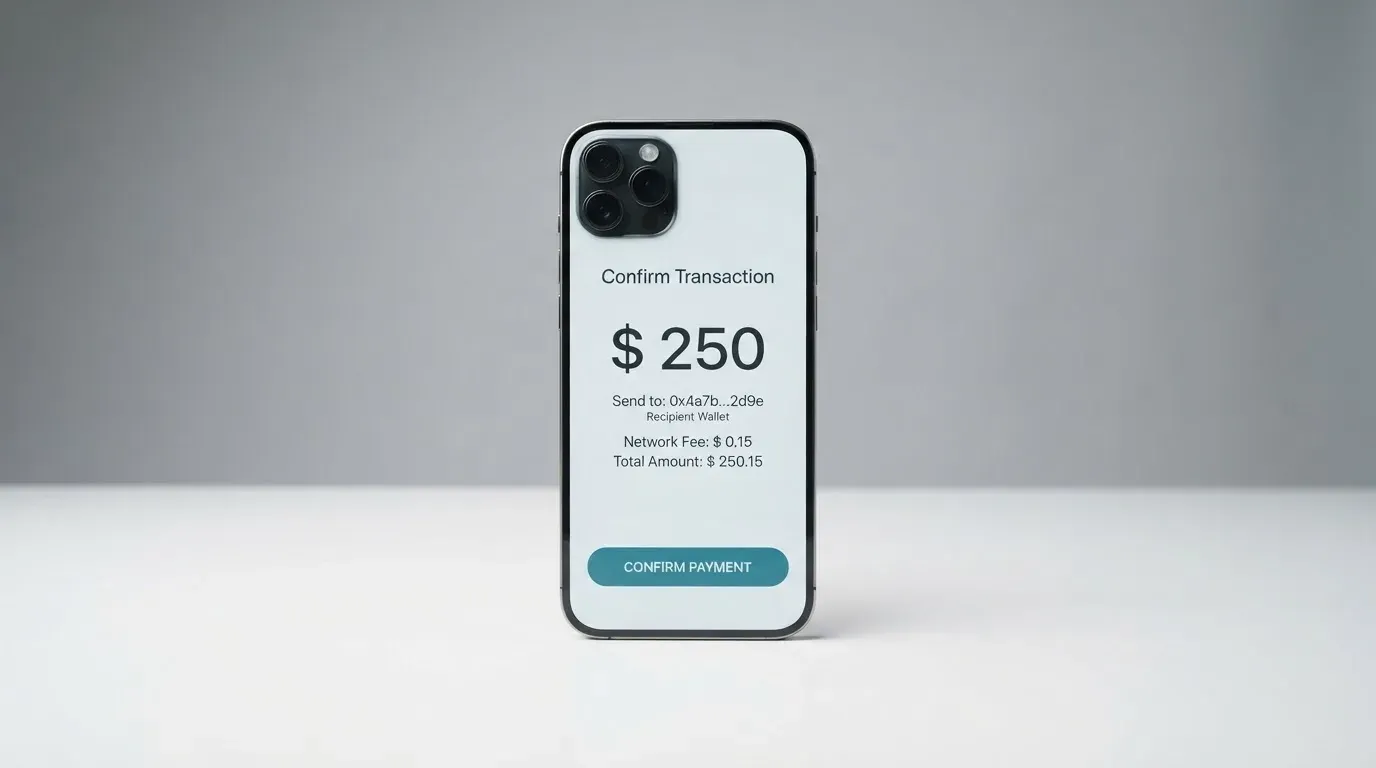
Third-party sources list the supported coins as BTC, ETH, USDT and USDC, and the supported networks as ERC-20 (Ethereum), TRON, BNB Smart Chain, Polygon, Arbitrum One and Optimism. That is six networks for the two stablecoins, which is a generous set by the standards of the category, where it is common to support only one or two.
The deposit fee is reported as 0% on the card side, with the user paying the network’s own gas. That is the standard shape of crypto-on-ramps for cards: the card issuer does not charge you to receive funds, but the underlying blockchain charges the sender a transaction fee in its native token. On Ethereum that fee is paid in ETH, which is the gotcha to keep in mind: a wallet that holds USDT but no ETH cannot actually move the USDT.
The risk to manage on the funding side is the network. Stablecoin transfers are irreversible, and a deposit sent on a network Stella does not support, or sent to an address belonging to the wrong network, can be lost. Circle also stopped supporting USDC on Tron in February 2024, so USDC on TRC-20 is not a native option even where Tron is supported by the issuer; USDT on TRC-20 is the route most people use on that network.
The withdrawal side, when you want to move crypto back out of the platform after closing the account, is governed by a clause that lets the company transfer your digital assets out within a reasonable period after you have paid what you owe, unless a legal bar applies. Unofficial sources put the withdrawal fee at USD 1 and upward, with the exact amount shown in the app.
Paying with it every day
The card links to Google Pay, Alipay and WeChat Pay officially, which is a notable choice: most crypto cards stop at Apple Pay and Google Pay, and supporting Alipay and WeChat Pay opens up everyday spending across China and the wider region. Unofficial sources add Apple Pay to the list. The card works at any retailer that accepts Visa, and the official site cites more than 40 million merchants.
There is no cashback on the main card according to the official pages; the “Earn” product is a separate yield feature, not a card-spending rebate. Unofficial sources back that up on the main card and add a referral programme that pays up to 40% of card fees, which is worth knowing about if you intend to recommend the card to others.
The application is available on iOS, Android and as a Telegram Mini App according to unofficial sources, which cite an App Store rating of 5.0 from five ratings; that is a tiny sample and I would treat it as a placeholder rather than evidence. The official cards page shows a Google Play button, which is at least a confirmation that the Android app is real.
Disputes go to [email protected]. If the dispute is with a partner rather than with the card itself, the user agreement says you settle it directly with the partner. The user agreement also names the courts of the Republic of Seychelles and Seychelles law as the venue and the governing law, which is the kind of clause to read before you put a meaningful balance on the card. The agreement does not state a time frame for raising a dispute, which is itself a small warning sign; a card programme that publishes response windows is usually a card programme that has thought about this.
What can go wrong
A few of the risks are generic to custodial crypto products, and a few are specific to Stella as described in the company’s own terms and in third-party user reports.
The issuer question. Stella is operated by Stella Global Services Limited, a company incorporated in the British Virgin Islands. The card is issued by an unnamed licensed “Partner Issuer”, and the licences under which the company and the issuer operate are not stated on the official pages. The Apple App Store developer entry is shown as Flashwire Inc, which appears to be a starting-data point rather than a confirmed operating entity. None of this is illegal, and many crypto cards sit in similar structures, but it does mean the regulator you would take a complaint to is not obvious from the public pages.
Account freezes and unrecovered funds. The official site does not publish incident reports. Third-party reporting from August 2026, again unofficial, includes an App Store complaint in which a user describes an account freeze and funds not being returned even after the user provided proof of a transfer. Themes that recur in user reports include the cost of the virtual card, occasional failed transactions and the same freeze-and-no-return pattern. Trustpilot shows 3.2 out of 5 from a single rating, which is not a large enough sample to draw a strong conclusion from, and I would weight it as “one data point, not a verdict”.
Custody. The user agreement describes the in-app wallet as holding “custodial assets held by us for your benefit”, pooled in omnibus accounts with title remaining with the user. That is the standard custodial shape. It means you are exposed to the operator’s solvency and to the operator’s security, in the same way that a customer of a centralised exchange is. The 2011 to 2014 Mt. Gox episode, the 2018 Coincheck hack and the 2022 Ronin Network attack are reminders of how exposed that position can be.
Two-factor authentication and the ability to freeze the card from inside the app are not stated on the official pages, and the Telegram channel at t.me/CS_StellaPay is listed as the main support route alongside a Help Center, a Contact Us page and, according to unofficial sources, Zendesk tickets. There is no live chat and no published support hours. The language selector shows only English; Russian is not offered, which is relevant given how often Russian-language users appear in the search queries for crypto cards.
Sanctions. The user agreement bars users subject to economic sanctions programmes, and stablecoin issuers including Tether say they disable tokens in wallets on the OFAC sanctions list and have frozen funds tied to illicit activity. In other words, “I hold my own keys” is not a defence if a stablecoin issuer decides to freeze at the token level.
Programme closure. Card programmes can be wound down. The category has examples: Visa terminated its global agreements with FTX in November 2022, and WaveCrest was suspended in Europe in 2018. When a programme closes, the usual pattern is a notice period, then spending stops, then you are asked to withdraw any remaining balance within a window. The 7-day hold that an authorisation can leave on a prepaid balance is a reminder that even a closure notice does not move the money back to you instantly.
What to take instead
If the things that worry you about Stella are the unpublished fees, the unnamed issuer, or the limited dispute pathway, three alternatives sit at a similar price point and are worth a look.
| Card | Score | Who can get it | Card and currency | Cost and fees | Funding | Rewards |
|---|---|---|---|---|---|---|
| Stella | 6.5 / 10 | Available in 57 countries per unofficial sources; restricted in 49 incl. Russia, Belarus, Ukraine, Iran, Iraq, Syria, North Korea, Cuba, Venezuela, South Africa | Virtual and physical Visa | No published fee schedule; unofficial: no annual fee, 0% deposit, virtual card reported at USD 30, physical free after USD 20,000 top-up | BTC, ETH, USDT, USDC across six networks (unofficial) | No cashback on the main card |
| International Visa Card | 6.7 / 10 | Excludes residents of Belarus, mainland China, North Korea, Cuba, India, Iraq, Iran, Israel, Myanmar, Nepal, Nicaragua, Russia, Syria, Turkey, Ukraine, Venezuela, Vietnam; purchases blocked in North Korea, Cuba, Iran, Russia, Syria, Ukraine, Venezuela | US-issued Platinum Visa, virtual only; pays in USD; physical “coming soon” | Virtual card USD 5 one-time; plans Classic free, Pro USD 9 / month, Max USD 19 / month; no FX fee in USD; foreign-currency fee “Visa rate + 2%” | USDC, USDT free at 1:1; also USD, EUR, SEPA, SWIFT, FedNow | No cashback stated |
| UNi Card | 6.1 / 10 | Countries not stated | Multicurrency card on Mastercard; spends from the UNi.Global balance | No annual fee, no foreign transaction fee; assets converted at live OTC rates | Not stated | Spend-to-Earn rewards up to 3% |
| Whop Cards | 5.2 / 10 | Consumers in 31 US states; businesses in 41 states; unsupported countries include Belarus, China, Cuba, Hong Kong, India, Iran, Iraq, Israel, Myanmar, Nepal, Nicaragua, North Korea, Russia, Syria, Turkey, Ukraine, Venezuela, Vietnam | Visa; virtual or physical and currency not stated | “No extra fees”; no amounts listed | Whop balance backed by stablecoin collateral from a linked wallet; coins and networks not stated | 5% cashback at select merchants, currently Uber |
A few notes on how the alternatives compare in practice. International Visa Card wins on transparency: it publishes its fees and uses a US-issued Platinum Visa, but its country list is restrictive in some of the same places Stella is restrictive, and the physical card is still “coming soon”. UNi Card is the one to look at if multicurrency spending without a foreign-transaction fee is your priority; the rewards line is also the most generous of the four, but the country list and the funding list are not stated. Whop Cards is a closer fit if you are US-based, want to issue cards to team members and care about merchant-specific cashback, but the funding and fee details are thin on the public pages.
Who I would recommend it to
Stella is a reasonable pick if you are a crypto holder who already has BTC, ETH, USDT or USDC in a wallet, you want a Visa that handles Alipay and WeChat Pay alongside Google Pay, and you are comfortable evaluating the cost in-app because the published fee schedule is essentially empty. The funding side is genuinely strong by the standards of the category, and the everyday-use side covers most of what a Visa needs to cover.
Stella is not the card to choose if you need a fee table to compare against competitors before you sign up, if you want a regulator you can name, if a large stable balance is going to sit on the card, or if you are in one of the restricted countries. The combination of an unnamed issuer, an unnamed regulator, an unscheduled fee structure, an unresolved user report of an account freeze, and a dispute venue in Seychelles means the risk sits with the cardholder more than with most bank-backed prepaid products.
A short checklist before you commit. Read the fee screen inside the app, on the day you intend to top up, and treat that as your real price list. Send a small test top-up on the network you intend to use, and only send the rest once the test is settled. Avoid leaving a balance larger than you are willing to lose, in the same way you would with any custodial product. Keep your own records of transactions and transfer IDs, because the user reports of frozen accounts and unrecovered funds all turned on what each side could prove. And if you are in a restricted country, do not try to route around it; the card blocks sanctioned users at the agreement level, and getting caught on the wrong side of a sanctions clause is not the kind of problem an FAQ can solve.
Frequently asked questions
What is the Stella card?
Stella is a Visa card linked to an in-app custodial wallet. You deposit crypto and the card balance is topped up automatically; you then spend that balance wherever Visa is accepted, including in mobile wallets. The operator is Stella Global Services Limited in the British Virgin Islands, and the card is issued by an unnamed licensed partner.
How does the Stella card work?
You create an account, pass KYC, get a virtual card immediately and a physical card by post if you order one. You send crypto from your own wallet to the deposit address the app gives you, on one of the supported networks, and the card balance updates when the transfer confirms. At the till, the card draws on that balance, and the conversion from your deposit asset to the merchant’s currency happens inside the app.
Is Stella a bank?
No. Stella describes itself as a card programme, not a bank. The funds you hold in the in-app wallet are custodial balances, not deposit accounts, and they would not be covered by a deposit guarantee scheme in the way a bank account would be.
Who owns Stella?
The operator is Stella Global Services Limited, incorporated in the British Virgin Islands. The Apple App Store developer entry shows Flashwire Inc, which appears to be a starting data point rather than a confirmed operating entity. The card is issued by a licensed partner whose name is not on the public pages.
Is the Stella card available in my country?
The official site does not list supported countries. Unofficial sources say 57 countries are supported, including the US, UK, Singapore and India, and 49 are restricted, including Russia, Belarus, Ukraine, Iran, Iraq, Syria, North Korea, Cuba, Venezuela and South Africa. The list was last confirmed in September 2024 and is worth re-checking on the day you apply.
Does the Stella card require KYC?
Yes. The user agreement sets out the standard identifying information, including name, address, date of birth, tax ID, government-issued ID and bank details, and allows the company to request biometric data. The application flow is described as a quick e-KYC process with immediate card usage after approval.
How do I top up the Stella card?
You send BTC, ETH, USDT or USDC, per unofficial sources, to the deposit address shown in the app, on one of the supported networks: Ethereum (ERC-20), TRON, BNB Smart Chain, Polygon, Arbitrum One or Optimism. The card balance is topped up automatically when the transfer confirms, and you pay the network gas rather than a deposit fee.
Is the Stella card free?
The official pages do not publish a fee schedule. Unofficial sources say there is no annual fee and no deposit fee, that the physical card is free after a USD 20,000 top-up, and that the virtual card carries a pay-as-you-go application fee shown only in-app; one user complaint cites USD 30. The only number the unofficial sources treat as firm is 0% on deposits, and even there you still pay network gas.
Where can I use the Stella card?
Anywhere Visa is taken, which the official site puts at more than 40 million merchants worldwide. The card also links to Google Pay, Alipay and WeChat Pay officially, and Apple Pay is listed by third-party sources. ATM withdrawals are supported, within limits described in the app.
Is the Stella card safe?
It is as safe as the operator running it and the partner issuing it, neither of which is fully identified on the public pages. The wallet is custodial and pooled, so the user carries the counterparty and hack risk that comes with any custodial product; user reports include an account freeze with funds not returned. Treat the balance as a small, working balance rather than a long-term store of value.
App and neobank cards put to the test – cryptocardtested
Content created by the «cryptocardtested» team