
A crypto card built offshore, priced in the hundreds, and short on the basics
 Available in US
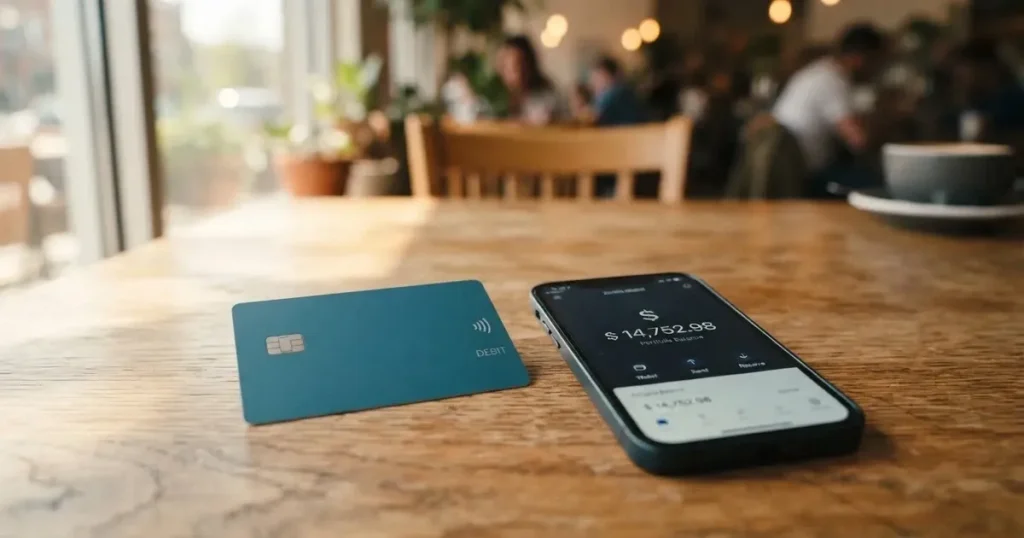
I spent time going through Ultimo’s official pages, the fees section, the sign-up flow, and the user reports that have been filed about it so far. The picture that came together is not a comfortable one. Ultimo is a crypto-funded Visa Platinum debit card, issued through an offshore bank that the company does not name, and most of the practical details a cardholder would normally want to know (the country list, the issuance fee, the ATM cost, the cashback rules) are either not stated on the card’s own site or are only available in third-party write-ups. The headline number to keep in mind: 3.7 out of 10. I’ll explain how I got there, but the short answer is that the card has very wide crypto top-up support and a quick virtual card, and that’s about where the good news ends.
The conditions described in this review are current as of October 28, 2026.
Verdict
The total comes out to 3.7 out of 10. I weight that across the five areas that matter when you choose a crypto card: who can get it, what it costs, the top-up options, reliability and complaints, and how it works day to day.
| Criterion | Mark | Reason |
|---|---|---|
| Who can get it | 4 / 10 | Ultimo does not publish a country list; an older Ultimo Pay card is reported blocked in the EU and UK; Russia and Belarus are not addressed |
| Cost | 1 / 10 | Card-level fees are not on the official page; the exchange rate is 1.5% “all-in” and unofficial sources put the setup cost between $450 and $600 |
| Top-up options | 9 / 10 | BTC, ETH, SOL and USDT are supported on nine networks, from Bitcoin and Ethereum to BNB Chain, Tron, Polygon, Arbitrum, Base and Avalanche |
| Reliability and complaints | 1 / 10 | The brand is listed as “founded in 2026”, the issuing country and bank are not named, and a Trustpilot user reports funds and cards locked after a move to ultimox.io |
| Everyday use | 6 / 10 | Visa Platinum, with a physical card delivered in 10–15 banking days and a virtual card in minutes; Apple Pay and Google Pay are reportedly not supported |
Ultimo is, in practice, a card for experienced users who are comfortable with offshore crypto platforms, understand that customer support and dispute resolution are not guaranteed, and have a way to absorb the setup cost in case the product disappears. If you want a card you can plug into Apple Pay, a card that publishes its fees, or a card with a transparent regulator behind it, this is not it. The 3.7 reflects the gap between the very good multi-chain top-up story and everything else.
Who Ultimo will give the card to
The honest answer to “can I get this card?” is: I cannot tell you from the official site. The Ultimo pages do not list supported countries, do not say whether citizenship or residence is the criterion, and do not name the bank that issues the card. I will say this as plainly as I can: not stated. You would have to start the application to find out where it actually takes you.
Two things can still be said. The first is that the older Ultimo Pay Platinum card is reported (in third-party reviews, not on Ultimo’s own site) to have been blocked in the European Union and the United Kingdom, with reviewers attributing the block to sanctions pressure. The second is that neither Russia nor Belarus is mentioned anywhere on the card’s pages; there is no statement that residents or citizens of those countries are accepted, and there is no statement that they are not. If you live somewhere where ordinary banking is hard to access, this is precisely the question Ultimo leaves you to answer by trying.
Because the official pages do not give you a list, you are effectively trusting Ultimo to tell you, during the application, whether your country is supported. That is a different posture from cards that publish an explicit list and let you check before you hand over a document.
How to sign up
Signing up starts with the web app at app.ultimox.io. Ultimo says an identity check is required both to open an account and before any withdrawal goes out, but the site does not specify which documents are asked for, which proof of address is accepted, or how many KYC tiers exist. Unofficial reports from a card-comparison site say that email, phone number and an identity document are required, and that proof of address and a selfie are not. I cannot confirm that from Ultimo’s own pages, so treat it as the experience one reviewer described, not a company promise.
After the account is open, a virtual card is “ready in minutes”. A physical Visa Platinum is delivered in 10–15 banking days, with no published list of delivery countries, no stated delivery fee and no stated replacement fee. Card currency is not stated either, which matters because the FX behaviour of a card depends on the currency the issuer attaches to it.
In practical terms, then, the sign-up flow is: account, identity check, virtual card now, physical card later, and a long list of details you only find out by getting partway through. For a reader who values predictability, that is the wrong order. You normally want to know the country list, the fee and the currency before you upload a passport.
What Ultimo really costs (fees)
The single biggest issue with this card is that the cost is hard to pin down. The card page does not list issuance, monthly, ATM or FX fees. The “Fees” section on the site covers exchange fees only, and the rest has to be pieced together from third-party write-ups, which I am giving you as unofficial and not confirmed by Ultimo.
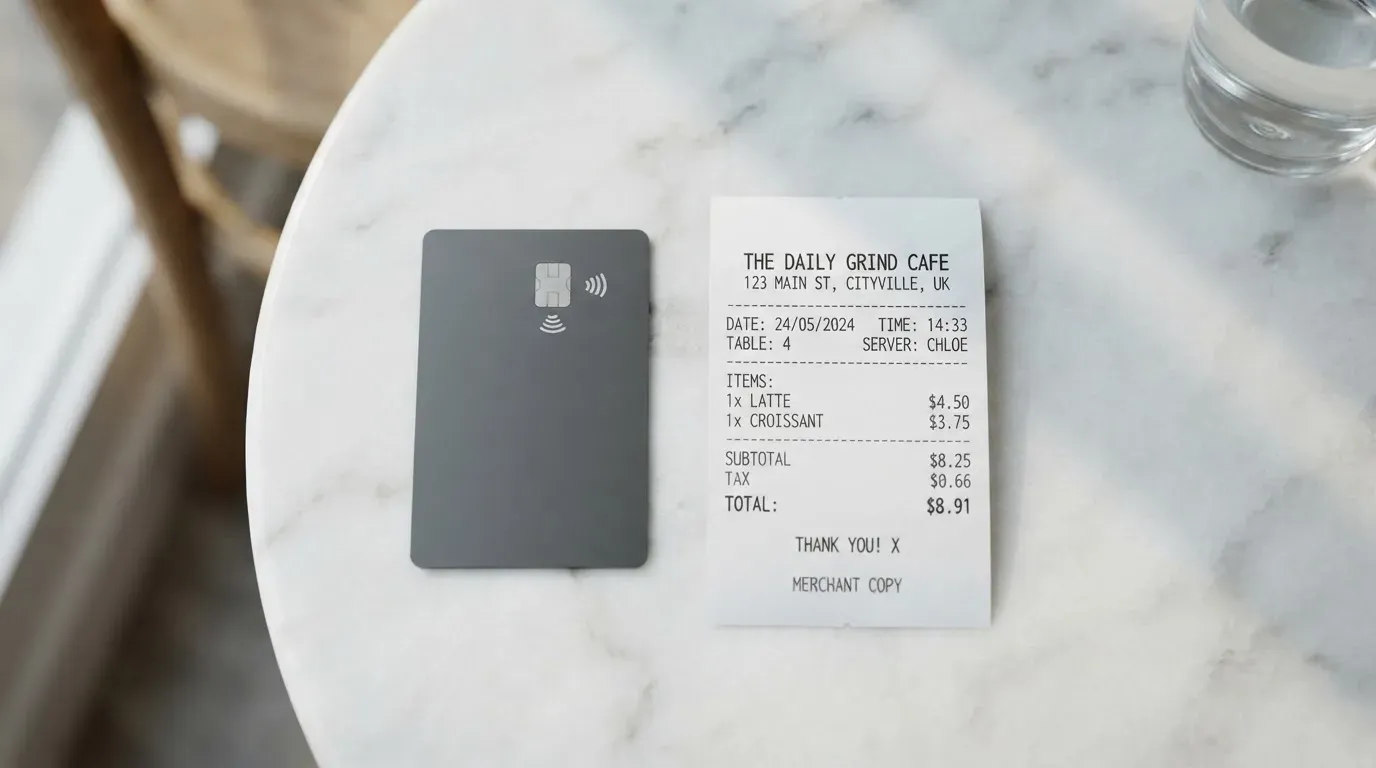
The official number that does exist: buy and sell at 1.5% “all-in, shown up front”, and spot trading at 0.05% maker and 0.10% taker. That is the conversion layer between your crypto and whatever balance the card spends from. The card-specific fees (FX, ATM, monthly maintenance) are not stated.
| Fee or limit | Value | Source |
|---|---|---|
| Buy and sell spread | 1.5% all-in | Official |
| Spot trading | 0.05% maker / 0.10% taker | Official |
| Card issuance | $450 (one unofficial source); $550–$600 (another report) | Unofficial |
| Setup total | $600 ($450 card + $150 deposit) | Unofficial |
| Monthly fee | Free | Unofficial |
| FX fee on card spend | Not stated; one unofficial source says free; a Trustpilot user cites 3% crypto-to-fiat plus 0.75% per card transaction | Mixed unofficial |
| ATM fee | 0.1% (unofficial), with no stated cap | Unofficial |
| Daily / monthly spend and ATM limits | “Unlimited” | Unofficial |
To make this concrete, here are three everyday payments and the fees that would apply, working only from the figures above:
- A $40 supermarket purchase in your home currency, paid with a balance already converted from USDT. You would pay the 1.5% that was already charged when you converted the USDT into the card balance; no further FX.
- A $40 supermarket purchase abroad, paid in a foreign currency. The conversion to the card’s spending currency is where the FX fee bites. The official figure is not stated. If the unofficial “free” figure is right, the only cost is the 1.5% already paid at top-up time.
- A $100 ATM withdrawal. Unofficial: 0.1% with no cap, which on $100 is ten cents. That part of the cost is genuinely low, but you are still exposed to whatever your ATM operator charges on top, and to the 1.5% if the card balance had to be topped up from crypto for the withdrawal.
The honest read on costs: the 1.5% spread is the only number Ultimo puts on the table itself, and the rest of the picture is reconstructed from one comparison site and one user review. For a card that costs, on the unofficial numbers, several hundred dollars to set up, the absence of a published fee schedule is itself a cost, because you are buying something whose final price is partly a guess.
Top up
This is where Ultimo is genuinely strong, and it is the reason the “top-up options” criterion in the verdict gets a 9. The card pulls from your Ultimo balance, and the platform supports BTC, ETH, SOL and USDT “and more” across nine networks: Bitcoin, Ethereum, Solana, BNB Chain, Tron, Polygon, Arbitrum, Base and Avalanche. If your crypto is sitting on any of those chains, you can in principle move it across without going through a third-party exchange first.
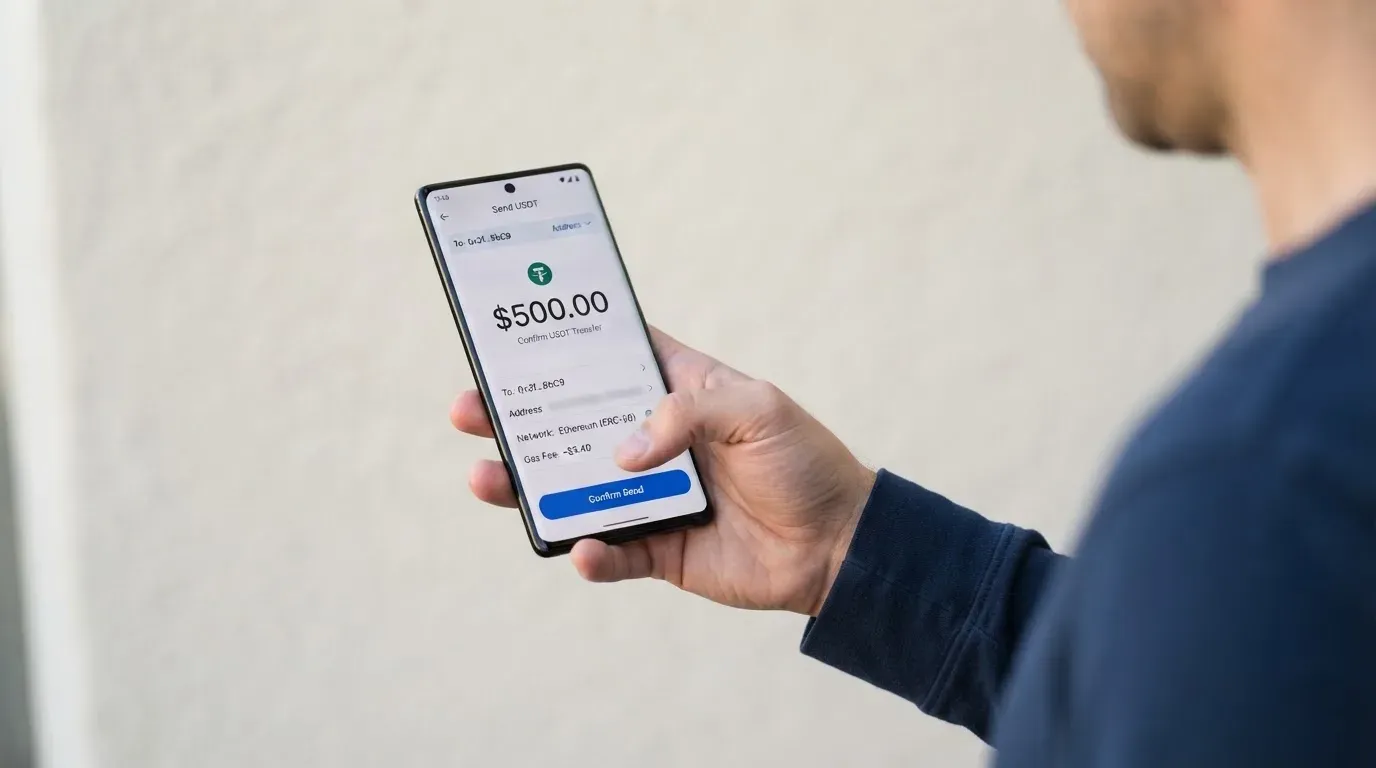
The fee side of top-ups is the usual mix. On-chain network fees (gas on Ethereum, bandwidth and energy on Tron, and so on) are charged by the blockchain itself, not by Ultimo, and you pay them regardless of which card you use. Unofficial: top-up itself is free, but one Trustpilot user reports 1% for an immediate USD transfer and zero for a 72-hour transfer. The 72-hour option is the kind of number that should make you think twice: a free transfer that takes three days is only useful if you plan ahead.
There are two things to watch. The first is the network choice: if you send USDT on a chain Ultimo does not list, the transfer either will not credit or will need manual support, and blockchain transfers are irreversible. The second is that Ultimo’s own pages do not describe the top-up flow step by step; the practical instructions live in the app, and you only see them once you are logged in.
A small note on Tron and USDC. USDC was never natively issued on Tron; Circle ended support for USDC on Tron in February 2024, so a “USDC on TRC20” deposit is not a native option. Tether’s USDT, by contrast, is issued on Tron, Ethereum, Solana and others. If you intend to use Tron, USDT is the realistic asset, not USDC.
Paying with Ultimo every day
The card itself is a Visa Platinum debit, and the marketing line is that you can spend it “wherever Visa is accepted”, which is functionally anywhere a Visa is taken. The physical card is delivered 10–15 banking days after ordering; the virtual card arrives “in minutes” once the account is in good standing. In a real-world sense, then, the card behaves like most crypto cards: you fund a balance, you tap or insert the card, the network routes the payment, and Ultimo handles the conversion in the background.
The everyday-use story loses points in three places. Unofficial: Apple Pay and Google Pay are not supported. If tokenised mobile wallets are how you usually pay, this is a real downgrade. Unofficial: there is no cashback or rewards programme listed at all, which by 2026 is unusual in this category. The dispute process is not stated on the card’s pages either, so I cannot tell you what happens if a charge goes wrong, how long you would wait, or whether chargeback rights are spelled out.
The web app lives at app.ultimox.io; there are no published app store listings or ratings I could check, and “not stated” applies to the mobile experience as a whole. The card runs as a Visa Platinum, which means you can expect 3-D Secure prompts on online checkouts (a one-time code or biometric challenge), and standard merchant acceptance. AVS (Address Verification Service) is generally unavailable for foreign-issued cards, so some US and UK merchants may decline a transaction because the BIN lookup flags the card as overseas. That is a category problem, not a Ultimo-specific one, but it is the kind of friction you feel.
What can go wrong
The risks here are not hypothetical; they are written into the public record already.
The single most important thing I came across is a Trustpilot review from August 2026, after the brand moved to ultimox.io, reporting that “cards and funds are locked”. Trustpilot’s overall score for the card is 3.2 out of 5, drawn from a single review, and that one review is a one-star account of cards and funds being locked after the move. The full picture is small in volume but the direction is bad: a cardholder who paid the setup cost, and cannot currently spend or withdraw. There is also a user report on the older Ultimo Pay card that the card stopped working in the EU and UK while the $600 fee was still charged, and that support was unreachable and the account could not be deleted. No official incident announcement has been published.
The corporate structure is also thin. Ultimo is listed as a brand “founded in 2026” on the site; the country of registration is not stated; the issuing bank is described as “an offshore bank” without a name; no licences are listed on the card pages. Unofficial write-ups point to a starting-company name (Silver Capital Financial s.r.o.) and a Laos-based issuer (JDB) that is described as having been “removed from the partnership”. Infrastructure partners are listed (BitMEX, Bitget, Deribit, Cobo, Simplex), and unofficial sources name custody providers (BitGo, Shiftmarket, Fireblocks). The custody model is not stated on the card’s own pages, and the Security page is linked but does not, in what I could see, describe how customer funds are held.
Support is chat and email at [email protected], advertised as 24/7 (“any time — day or night”). Whether support actually responds in practice is a different question, and it is the same question the user reports above raised.
The pattern to take seriously: a new brand, an offshore issuer that has changed at least once, a $450–$600 setup cost, no licences published, a domain move with locked funds reported, and a user account where deletion was reportedly impossible. None of these on their own is fatal; in combination, they describe exactly the kind of counterparty risk that has historically taken crypto card programmes off the map.
What to take instead
If the thing you like about Ultimo is multi-chain crypto top-up, but the $450+ setup cost and the locked-funds reports put you off, there are cards in the same category that score better in this review and cost less to try.
Young Card
Young Card scores 5.7 out of 10. Like Ultimo, it does not publish a country list or card costs officially, and the card details are not stated on its public pages. Where it differs is on rewards: cashback is paid in YNG tokens, and the rate depends on the Club tier. Essential holders get 0.1% back, Gold 1.8%, Platinum 3.6%; Bronze and Silver are not stated. If rewards are part of why you want a crypto card, Young Card is structured around them in a way Ultimo is not.
MSX
MSX scores 6.4 out of 10, the highest of the three alternatives here. The public pages I could read do not state supported countries, card details, cost, fees or funding options clearly, so the score is based on what the card does and does not say. The higher score reflects that the gap between “what the card offers” and “what is published” is narrower than for Ultimo, even if the gap is not zero. If you want a card where the comparison is more about features than about hidden unknowns, MSX is worth a closer look.
Bybit Card
Bybit Card scores 6.0 out of 10 and is the most transparent of the three. The card has a published country list, named issuance fees per region, a published FX fee, and a tiered cashback structure. Supported regions for the card include Argentina, AIFC (Kazakhstan), Georgia, Kazakhstan, Australia, Mexico, Brazil, Peru and the wider Asia Pacific region; the card’s fiat currency depends on the country of your Advanced Identity Verification. The cards page says the product is not meant for European Economic Area customers, and EEA participation is prohibited. Bybit’s fiat-service restricted list (which is not the same as the card list) includes Belarus, the Russian Federation, Serbia, China and the United States, with a note that “Russian users can only make RUB transaction in Fiat”. For card-specific eligibility, the application asks for country of residence and will register your interest if the country is not currently supported.
The card has no balance of its own; it draws on the Funding Account and Flexible Easy Earn balance, fiat first, with crypto sold at the One-Click Sell rate plus a crypto conversion fee (0.9% in most regions, 0.5% in Argentina, not supported in Peru). FX fees on top of the network rate are 2% in Australia, Asia Pacific, Georgia and Mexico; 2% “International Fee” in Kazakhstan (AIFC) on purchases outside Kazakhstan even in USD; 7% in Argentina; 1.5% in Brazil; 1% in Peru. Cashback tiers run from Base 2% to Infinite 10%, with monthly caps, and from 5 October 2026 only crypto-funded transactions earn points; fiat-funded spending does not. New users get 10% back up to 110 USDT in the first 30 days.
The Bybit Card is not a perfect substitute either, especially if you are EEA-based, and the fee structure has plenty of moving parts. It is, however, a card that publishes its fees, names its countries, and has been operating long enough to be reviewed in detail. That alone is a step up from Ultimo’s current public posture.
Who I would recommend Ultimo to
I would not recommend Ultimo to a first-time crypto card user, to anyone whose primary need is a card that works in Apple Pay or Google Pay, or to anyone who needs a published fee schedule, an EU or UK issuer they can name, or a chargeback process that is described somewhere. The 3.7 out of 10 reflects that the top-up support is genuinely wide and the virtual card is genuinely quick, and that the rest of the card (cost, transparency, regulatory footprint, complaint history) does not yet match the better-known options in the same category.
If you are an experienced user who is comfortable with offshore platforms, accepts that customer support and dispute resolution are limited, has a plan in place for the possibility of a programme change, and is paying in a stablecoin you are happy to convert at a 1.5% spread, then Ultimo can function as a tool. If that is not you, Bybit Card, MSX and Young Card are better places to start.
Frequently asked questions
What is the Ultimo card?
Ultimo is a crypto-funded Visa Platinum debit card. The card pulls from an Ultimo balance that you top up with crypto, and the marketing claim is that you can spend it anywhere Visa is accepted. The card’s own pages do not say which countries are supported or what the card costs to issue, and the issuing bank is described only as an offshore bank without a name.
How does the Ultimo card work?
You open an account at app.ultimox.io, complete an identity check, get a virtual card within minutes, and (optionally) order a physical card delivered in 10–15 banking days. You fund the Ultimo balance with crypto on one of the supported networks, and the card spends from that balance. Conversion from crypto to spendable balance carries a 1.5% spread as the only fee Ultimo itself publishes.
Is Ultimo a bank?
No, not on the basis of the public information. Ultimo describes itself as a brand, lists infrastructure partners (BitMEX, Bitget, Deribit, Cobo, Simplex), and says the physical card is “issued through an offshore bank” that is not named. No banking or e-money licence is published on the card’s pages, and the registration country is not stated either.
Who owns Ultimo?
The brand “Ultimo” is listed on the site as founded in 2026. The country of registration, the parent company, and the issuing bank are not stated on the official pages. Unofficial write-ups name Silver Capital Financial s.r.o. as the starting data and a Laos-based bank (JDB) that is described as having been removed from the partnership. Treat the corporate picture as not confirmed by Ultimo.
Is the Ultimo card available in my country?
The card’s own pages do not publish a country list, so I cannot tell you from the site. Unofficial reports say the older Ultimo Pay Platinum card is blocked in the European Union and the United Kingdom, with reviewers attributing the block to sanctions. Russia and Belarus are not mentioned either way. In practice, you find out by starting the application.
Does the Ultimo card require KYC?
Yes. Ultimo says an identity check is required to open an account and again before any withdrawal, and the support pages mention email confirmation plus a one-time code for withdrawals. Unofficial: email, phone and an identity document are required, and proof of address and a selfie are not. The site does not list the documents it asks for or the KYC tiers that exist.
How do I top up the Ultimo card?
You send crypto to your Ultimo balance on one of the supported networks: Bitcoin, Ethereum, Solana, BNB Chain, Tron, Polygon, Arbitrum, Base or Avalanche. Supported assets are BTC, ETH, SOL and USDT “and more”. On-chain network fees are charged by the blockchain, not by Ultimo. Unofficial: top-up is free, with one Trustpilot user reporting 1% for an immediate USD transfer and 0% for a 72-hour transfer.
How much does the Ultimo card cost?
The official pages do not list card-level fees. The exchange spread is 1.5% all-in, and spot trading is 0.05% maker / 0.10% taker. Unofficial: $450 to issue the card, $600 total setup ($450 card + $150 deposit), no monthly fee, 0.1% on ATM withdrawals, daily and monthly spend and ATM limits listed as unlimited. FX on card spend is not stated officially; one unofficial source says free, and a Trustpilot user cites 3% crypto-to-fiat plus 0.75% per transaction.
Can I add the Ultimo card to Apple Pay or Google Pay?
Unofficial reports say no. Neither wallet is listed as supported on the card’s public pages, and I did not see an official statement confirming tokenisation support. If mobile-wallet tap-to-pay is part of how you usually pay, this is a real gap.
Is the Ultimo card safe?
The honest answer is that the public information does not let me tell you it is. The card’s own pages do not describe the custody model, do not name the issuing bank, and do not publish licences. A Trustpilot user reported in August 2026 that cards and funds were locked after the brand moved to ultimox.io, and an earlier user report on the older Ultimo Pay card described the card stopping in the EU and UK, the $600 fee still being charged, support being unreachable, and the account not being deletable. For a card that costs several hundred dollars to set up, that record is the answer to the safety question.
Exchange cards put to the test – cryptocardtested
Content created by the «cryptocardtested» team