
MaaarPay card, step by step
 Available in US

The MaaarPay card sits in a corner of the crypto card market that most mainstream cards do not reach. It advertises availability in 150-plus countries, hands out a virtual Visa inside the app within minutes, and lets you load it with USDT, USDC or other supported crypto. The headline numbers are friendly, but the fine print is thin: the conversion and crypto fees are only partly published, the physical card and ATM access are marked “Coming soon”, and a meaningful slice of the everyday cost is hidden in a 2% foreign-exchange fee and a 3% cross-border fee. The conditions are current as of 2026-10-22.
Conditions are current as of October 28, 2026.
This review walks through what MaaarPay actually offers, who can get it, what it costs in real payments, and where the gaps are. I score it 6.7 out of 10. The short version: it is a reasonable fit for someone who already lives in stablecoins and wants a digital Visa without a bank account. It is a poor fit for anyone who needs a physical card, ATM access, transparent pricing or a card that they can fund with cash.
Verdict
MaaarPay earns 6.7 out of 10. The breakdown below shows where it picks up marks and where it loses them. The audience that fits best is the crypto-native user who funds a digital Visa with USDT or USDC. If that is you, the experience is straightforward and the geographic reach is genuinely wide. If you want a physical card to tap at a shop, to pull cash at an ATM, or to compare flat fees across a published tariff, you will be frustrated.
| Criterion | Mark | Why |
|---|---|---|
| Who can get it | 8 / 10 | Available in 150+ countries; US citizens excluded and OFAC sanctions apply, but the full list of supported countries is not published |
| Cost | 4 / 10 | FX fee up to 2%, cross-border fee up to 3%, late and returned payment fees published, but crypto conversion and card-issuance fees are not disclosed |
| Top-up options | 8 / 10 | USDT, USDC and other supported crypto (BTC also listed on the home page); card collateral held as stablecoins on Ethereum, Polygon, Optimism and Arbitrum |
| Reliability and complaints | 8 / 10 | Operated by MAAAR PAY FZCO in DMCC, Dubai (license DMCC-981512), with cards issued by Third National under a Visa licence; no public complaints found |
| Everyday use | 6 / 10 | Digital card issued instantly, Apple Pay and Google Pay supported, freeze in app; physical card and ATM withdrawals marked “Coming soon” |
| Total | 6.7 / 10 | A digital-first card for stablecoin users who do not need cash or a physical card today |
Who it suits: a crypto-native user who already keeps a balance in USDT or USDC, lives outside the US, does not need to pull cash from an ATM, and is comfortable that the published fee schedule is incomplete. Who it does not suit: anyone in the United States, anyone who needs a physical card or ATM access right now, anyone who wants full tariff transparency before signing up, and anyone whose main use is gambling or buying more crypto (those merchant categories are restricted).
Will they give you the card
Eligibility for MaaarPay is unusually wide for a Visa-issued product. The company says the card is “available in 150+ countries”, but it does not publish the list. If you are reading this from a country you have never seen mentioned in a crypto card FAQ, that is normal: the brand is targeting breadth and the public pages do not spell out every market individually.
The two exclusions that are spelled out matter. First, the terms require you to confirm that you are “not a United States citizen”. Second, the terms refer to OFAC sanctions, which means that even within the 150-plus country claim, anyone on a sanctions list, or resident in a fully sanctioned country, will be turned away. Citizenship and residence are not distinguished on the public pages, so the rule is read in practice as a citizenship check at minimum.
A few things the card does not tell you, and that I want to flag here because they shape your real experience: which countries exactly are inside the 150, what level of identity document is needed, whether a proof of address is required, and whether there is a minimum age above 18. The card’s public pages simply do not say. The terms point to a separate “AML & KYC Policy” page, but the policy itself was not available to read.
For most readers the practical question is: “Will they give it to me where I live?” The honest answer is “probably, unless you are a US citizen or on a sanctions list, but you will only know for sure by starting the sign-up and going through the identity check”. The sign-up includes a “secure identity verification” step. What that step demands is the kind of detail the public pages do not disclose. If you are in a country with strict data protection rules and want to know in advance what data is collected and stored, you will not find that on the marketing site.
If you need a card that is open to US citizens, or that publishes a full country list with its eligibility rules in writing, MaaarPay is not the right choice. If you live outside the US, are not a US citizen, and you are happy to learn the exact requirements during the application itself, the card is one of the more geographically inclusive options on the market.
How to get it
The sign-up path is short. You download the app, create an account, go through “secure identity verification”, and a digital card is issued inside the app. That card is a Visa. Cards are issued by “third-party licensed institutions”; one of them is Third National, operating under a Visa licence. Foreign transactions are converted to USD by the card association before they reach the issuer.
A few things shape how this feels in practice. The digital card is available immediately after verification, which is the main reason the everyday-use score is not lower. A physical card is on the roadmap but is marked “(Coming soon)”, so if you want plastic to swipe or tap at a shop, you cannot get one today. Until the physical card is live, the practical way to pay in store is to add the digital card to Apple Pay or Google Pay and tap your phone.
The identity verification step is the part that most often delays a card. The card’s pages say it happens; they do not say what documents, what proof of address, what age minimum, or what tier of KYC you will go through. The sign-up flow itself is the only place this is fully visible. If your country issues national ID cards and you have a recent utility bill, this is normally a short process. If you are in a country where documents are harder to obtain, expect it to take longer.
Once verification is done, the card sits in the app. You can freeze and unfreeze it any time, which is the most useful single feature in the early days of using a new card: while you are still learning whether a merchant accepts it, leaving it frozen in the wallet until the moment you pay is a sensible default. The “Card details” view gives you the virtual card number, expiry and CVV for online checkout, and the same details can be tokenised into Apple Pay or Google Pay for contactless use.
The digital-first model is the right design for a crypto card in 2026. Most online checkouts work fine with virtual card details, and contactless in-store payments work fine through the phone wallet. The only thing the design does not yet cover is the old-fashioned “hand over the plastic” situation, and that is a temporary gap rather than a permanent one.
Fees: what it really costs
This is the section the score card is harshest about, and rightly so. The published tariff on MaaarPay’s pages is partial: a few headline numbers are clear, others are simply not stated, and the most important cost for a crypto card, the conversion fee, is in the not-stated bucket.
| Fee or limit | What it is | Value |
|---|---|---|
| Card issuance | Cost of issuing the card | Not stated |
| Monthly fee | Recurring fee | Not stated |
| Crypto conversion | Cost to convert crypto to card balance | Not stated |
| Foreign exchange fee | Non-USD currency conversion | Up to 2% |
| Cross-border fee | Cross-border transaction | Up to 3% |
| ATM withdrawal | Cash withdrawal | Not stated (physical card “Coming soon”) |
| Late payment | Paying late | Up to $40 |
| Returned payment | Payment that bounces | Up to $29 (terms section 6 lists $00.00, conflicting) |
| Interest | APR on carried balance | 0% for now |
| Daily/monthly limits | Spend caps | Not stated (issuer may cap by type, number and dollar amount) |
The two numbers you will actually feel in everyday use are the foreign-exchange fee of up to 2% and the cross-border fee of up to 3%. They can stack: a payment made in a currency other than USD, from a merchant in a country different from the issuer, can in theory hit you with both. That is the worst-case published scenario; in practice the issuer routes through USD anyway, so the 2% FX fee is the one you will see most often.
Three everyday payments show how this lands.
A coffee in euros when your card is funded with USDT. You pay €4.50. MaaarPay’s conversion fee on the crypto side is not published, so the only visible cost is the FX fee of up to 2% on the euro-to-USD conversion that the card association performs. On €4.50 that is up to about 9 US cents, which is small enough to ignore. The hidden cost is the crypto-to-fiat conversion rate applied inside the wallet, and that is the part the tariff does not disclose.
A flight booking of $800 paid in USD from a US airline site. The card is funded with USDC. The merchant is in the same currency the card settles in, so the FX fee does not apply. The cross-border fee is a question of where the merchant is billed versus where the issuer is; the issuer is Third National, and how that interacts with the merchant’s country is the part you cannot predict from the published tariff. The best case is that neither the 2% nor the 3% fee applies and you only see the unstated crypto conversion cost. The worst case is a 3% hit on a non-trivial amount, so $24.
A cash withdrawal in Thailand once the physical card is live. The card is currently marked “Coming soon” for ATM access, and “cash advances and balance transfers are not available” in the terms, so this is a future-state example rather than a present-day one. When the ATM feature goes live, the fee for using it is not published, and the foreign-exchange fee of up to 2% will apply on top because Thai baht is not USD.
The most important practical point is that the conversion fee, which is the single most important cost for a crypto card, is not in the tariff. You will see a rate inside the app when you top up, but the headline percentage is not on the website, and it is not the same number for every currency pair. If you fund in USDT and spend in USD, the spread is usually small. If you fund in BTC and spend in USD, the spread is the visible cost of being paid in USD for an asset that just moved.
For dispute handling, the card’s published terms put a 60-day window on reporting a problem after the transaction posts, require you to try to resolve the issue with the merchant first, and route unresolved disputes to a Chargeback in the account. Arbitration is through the American Arbitration Association, and class actions are waived. This is normal for a US-routed card programme and not something to be alarmed by, but it is worth knowing before you sign up.
Top up: how to load the card
Top-up is the strongest part of the product. The wallet accepts USDT, USDC and other supported crypto, and the home page also lists BTC. The card’s collateral is held as stablecoins on Ethereum, Polygon, Optimism and Arbitrum. Those are four of the most widely used EVM-compatible networks, which means most stablecoin users already have a way to send to at least one of them.
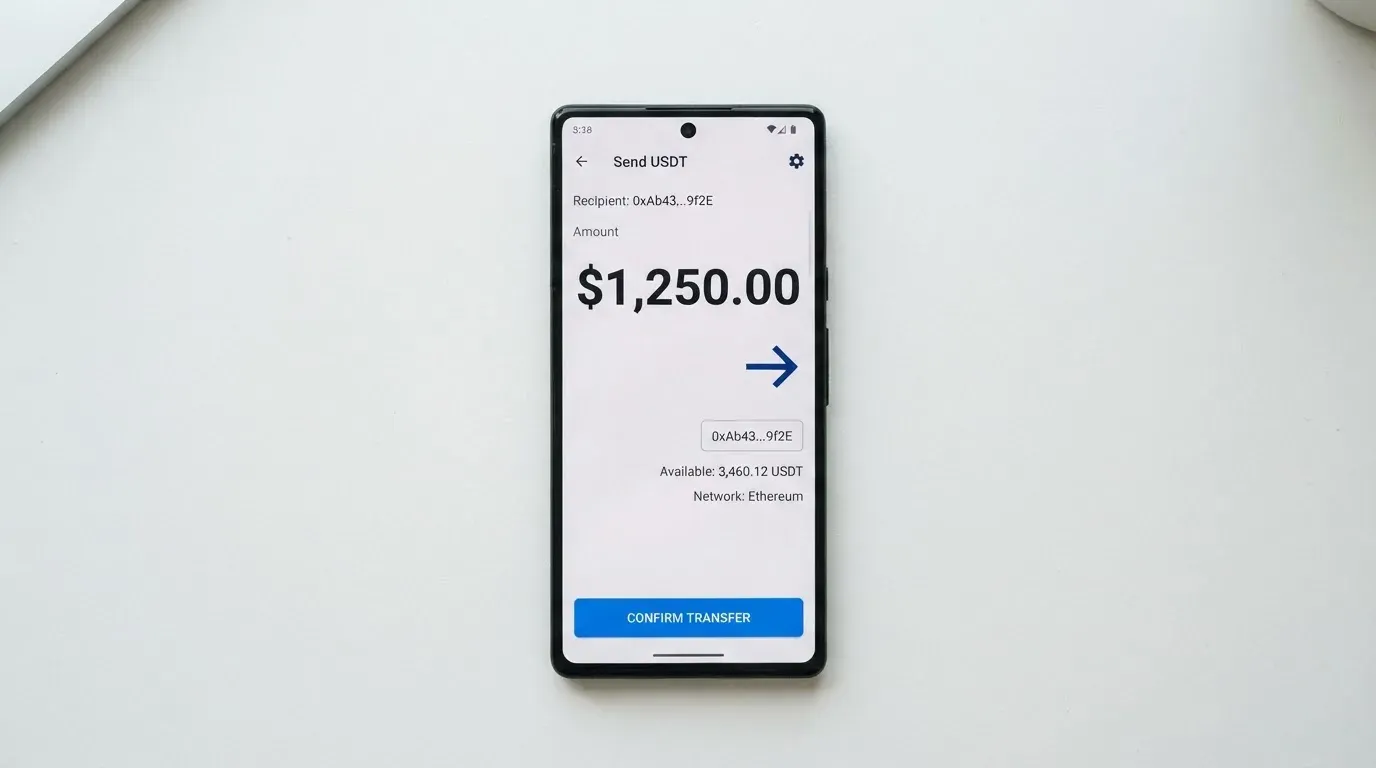
What the public pages do not tell you is the full list of supported networks, the deposit instructions for each one, the minimum top-up amount, and any fees charged on top-up. The card points to a help-centre article called “Deposit crypto” for the practical steps. Two things follow from this. First, you will need to read the help-centre article before you send any funds, because sending on the wrong network is the most common way to lose money in this category and blockchain transfers are irreversible. Second, the gas fee for the transfer is paid on the network itself, not by MaaarPay: if you are sending USDT on Ethereum, you need a small amount of ETH in the sending wallet to pay gas.
On the withdrawal side, the wallet supports sending crypto back out to an external wallet, with a linked help article covering the steps. Withdrawal fees were not read. The terms also say the issuer may suspend or cancel the account “with or without cause”, and the treatment of any remaining balance on closure is not stated. That is the kind of clause that matters in a worst-case scenario, so keep in mind that the rules around an involuntary closure are not on your side.
A few practical patterns help. If you keep a balance in USDT or USDC on Ethereum or one of the supported L2s, top-up is a single transfer to a deposit address, a wait for the network to confirm, and the balance appears in the wallet. If you keep BTC, the home page lists it but the actual on-ramp into the card is less obvious from the public pages, and you should expect an extra conversion step somewhere. If you keep your funds on an exchange, the exchange’s own withdrawal network settings are the first thing to check, because sending USDT on Tron when the card only supports USDT on Ethereum is a very easy mistake to make.
Circle stopped supporting USDC on Tron in February 2024, which is worth knowing if you see “USDC over TRC20” advertised anywhere. Tether’s USDT is still issued on multiple networks including Tron, but the card specifies the networks it accepts, and you must match those exactly. A deposit sent on a network the card does not support, or to an address of another network, can be lost or require manual support recovery with no guarantee.
Paying with it every day
For digital and contactless payments, the card is functional. The digital card is available in the app as soon as verification is complete, and it can be added to Apple Pay or Google Pay so that the phone becomes the way to pay in store. Online checkout works with the virtual card number, expiry and CVV, and the wallet handles the conversion from your crypto balance at the moment of payment.
Two things are restricted at the card level. The terms block cash-like transactions, which include money orders, crypto purchases and gambling. So this is not the card to use at a crypto exchange, at a betting site, or to buy a money order, and the issuer enforces this rather than leaving it to the merchant. If those categories are how you spend, the card is the wrong fit.
The 3-D Secure flow is the issuer’s standard for online card payments, and for tokenised mobile wallets the Device Account Number replaces the card number in the Secure Element, with a one-time dynamic security code for each transaction. The issuer can restrict a tokenised number (for example, block it on magnetic-stripe use or website use), which is a useful feature if your phone is lost or stolen. The freeze and unfreeze toggle in the app is the simplest version of this.
A few caveats worth knowing. Merchants can decline prepaid or foreign-issued BINs because the BIN lookup reveals the card type and issuer country; for a card issued in a different country than the merchant, this can be a real source of failed checkouts. Address Verification Service, which compares the billing address you typed with the issuer’s records, is mainly offered in the US, Canada and the UK, and is generally unavailable for foreign-issued cards, which is another reason an online checkout might fail. Declined authorisations can leave a temporary hold on the balance that lingers for several days, typically up to seven.
Disputes go through the merchant first, then a Chargeback in the account. The 60-day window starts from the date the transaction posts, not from the date you first noticed the problem. Chargebacks are a real protection, but they are not instant, and the recovery rate depends on the merchant’s response. Prepaid cards have a more uneven coverage under US reversal rights than credit cards, and that is worth keeping in mind: Regulation E covers debit, Regulation Z covers credit, and prepaid-card coverage varies and should not be assumed.
Rewards are not mentioned in the published material. There is no cashback line on the home page and no points structure in the terms. If a programme is introduced later, it would be a separate announcement, but for the purposes of this review, treat the card as one that does not pay you back for spending.
What can go wrong
The honest answer to “what can go wrong” with MaaarPay has three layers: the things the card says, the things the category is known for, and the things the public pages do not say.
On the first layer, the card is operated by MAAAR PAY FZCO, registered in DMCC, Dubai, under licence DMCC-981512 and registration number DMCC202616. A subsidiary, MAAAR CIRCLE PAYMENTS LTD., is incorporated in British Columbia, Canada (BC1585437). The company describes itself as a “technology service provider and does not provide banking or money transmission services”, and the issuer is named as Third National, operating under a Visa licence. For Nigerian users, the local partner named is BANEX MICROFINANCE BANK LIMITED. There are no public reports of complaints.
On the second layer, the category has a real history. Custodial platforms have failed: Mt. Gox in 2011-2014, Coincheck in 2018, Ronin Network in 2022. Even when a card programme is solvent, the network can withdraw support: Visa terminated its global agreements with FTX in November 2022, and WaveCrest, which had supplied crypto card brands in Europe, was suspended by Visa in 2018 and shut its programmes down. Stablecoins have also shown they can depeg: TerraUSD in May 2022, and USDC temporarily in March 2023 during the US banking crisis. The card programme itself is small and new enough that a programme-level shutdown is a real risk worth keeping in mind, even if the company itself is in good standing.
On the third layer, the public pages do not say several things that matter. The published “advanced security protections” do not specify whether 2FA is enabled, whether funds are safeguarded in segregated accounts, and what the issuer’s policies are on suspicious activity. The support channels listed are a Help Center, FAQ, Contact Us page, the email [email protected], the Telegram channel t.me/Maaarpay_official, and the Reddit community r/maaarpay. Languages and hours are not stated; the FAQ shows “Eng”, which is a hint that English is the primary support language. The card’s terms reserve the right for the issuer to suspend or cancel the account “with or without cause”, which is a one-sided clause worth flagging.
The practical implication is that you should treat MaaarPay as you would treat any other crypto card programme: load only what you plan to spend in the near term, keep your own records of top-ups and transactions, and do not store on the card a balance that you cannot afford to lose access to. The freeze and unfreeze toggle, the tokenised mobile wallet, and the digital card details are useful safety features, but they do not change the fact that the underlying wallet is custodial and the card programme is dependent on a third-party issuer that can be cut off by the network.
What to take instead
If the gaps in MaaarPay’s offering are the things that matter most to you, the alternatives below come from a directly comparable set: each is a crypto-funded card with a published review. The trade-offs are different, and the best fit depends on which gap you are trying to close.
Cardex. Score: 5.6 out of 10. Available in 200-plus countries, which is broader than MaaarPay’s 150-plus claim, but with no published country list or exclusions. The card runs on VERVE, Visa, Mastercard and UnionPay, with both virtual and physical cards; the App Store listing positions the card around paying in Nigerian Naira, so it is a strong fit for users in Nigeria and a weaker fit for users in countries where the Naira denomination is inconvenient. The headline feature is an “AI-Powered Conversion Rate” that scans global exchange rates at the moment of payment and picks the best one. No fee percentage is published, which is the same transparency gap as MaaarPay but in a different place. If you want the broadest geographic reach and are happy to trust a non-published conversion rate, Cardex is worth a look.
CardFlow. Score: 4.9 out of 10. Aimed at Nigeria (“Nigeria’s smartest fintech card platform”), with messaging that extends to “Nigerians and global users”. The card is a virtual USD Mastercard created in 3 minutes, with no monthly fee according to the FAQ. Funding accepts Bitcoin, USDT, ETH or Naira bank transfer, which is a different mix from MaaarPay’s stablecoin-first design. Fees are not stated beyond the free creation line. If you are in Nigeria or send money to Nigeria frequently, and you want a virtual USD card you can spin up in minutes, CardFlow is a reasonable alternative. If you are outside the Nigerian corridor, the brand’s positioning is less obviously for you.
HyperCard. Score: 4.7 out of 10. The official pages do not publish a country list; the App Store page says the card is accepted in “more than 176 countries”, which is an acceptance figure rather than an eligibility figure. The card is a prepaid “HyperCard” with a balance held in USD or EUR. The App Store page does not list fees. Funding accepts USDT, BTC and ETH in the app, which is converted to USD or EUR on the card. If your main concern is being able to choose between a USD balance and a EUR balance, HyperCard is one of the few options in this set that offers that choice clearly; MaaarPay settles in USD only.
A few patterns are worth pulling out. None of the four cards in this set, MaaarPay included, publishes a complete fee schedule. Each one has at least one major cost that is either not stated or stated only inside the app. Each one is custodial in the sense that the issuer holds the programme and the network can withdraw support. Each one is restricted in some merchant categories. The differences are in geography (Cardex wider, CardFlow narrower), card type (MaaarPay virtual-only for now, the others physical too), and balance currency (MaaarPay USD, HyperCard USD or EUR, Cardex and CardFlow Naira/USD). The right pick depends on which of those differences matters most to you.
Who I would recommend it to
I would recommend MaaarPay to the reader who keeps a balance in USDT or USDC, lives outside the US, and wants a digital Visa they can use online or through Apple Pay or Google Pay. The top-up path is short, the geographic reach is genuinely wide, and the digital card is available the moment verification finishes. The freeze and unfreeze toggle, the tokenised mobile wallet, and the no-interest-for-now pricing on the credit side all make this a usable everyday card for the audience it is built for.
I would not recommend it to the reader who needs a physical card today, who needs to pull cash from an ATM today, who needs a complete published fee schedule before signing up, or who needs to spend in restricted categories like crypto purchases or gambling. I would also not recommend it to a US citizen, because the terms require you to confirm you are not one.
If you do go ahead, the practical advice is short. Read the “Deposit crypto” help-centre article before you send any funds, and make sure you are using a network the card supports. Fund the card with USDT or USDC rather than BTC if you want the tightest spread. Keep only what you plan to spend in the near term on the card, and treat the balance as you would treat any other custodial balance. Use the freeze toggle by default until you know which merchants accept the card reliably. And if a transaction goes wrong, contact the merchant first, then start a Chargeback in the account within 60 days of the transaction posting.
The score of 6.7 out of 10 is the result of a strong top-up story and a wide geographic reach, pulled down by an incomplete fee schedule and a digital-only product. The card is not the best crypto card on the market, and it is not the worst. For the user it was built for, it does the job.
Frequently asked questions
What is the MaaarPay card?
The MaaarPay card is a Visa payment card that is funded from a crypto wallet. The wallet accepts USDT, USDC and other supported crypto (BTC is also listed on the home page), and the digital card is issued inside the app. Cards are issued under a Visa licence by a third-party licensed institution; the issuer is Third National.
How does the MaaarPay card work?
You load crypto into the wallet, the wallet converts it to a card balance, and the card spends that balance at merchants. Foreign-currency transactions are converted to USD by the card association. The digital card can be added to Apple Pay or Google Pay for contactless payments.
Is MaaarPay a bank?
No. MAAAR PAY FZCO, the operator, describes itself as a “technology service provider and does not provide banking or money transmission services”. Cards are issued by a separate licensed institution under a Visa licence.
Who owns MaaarPay?
MaaarPay is operated by MAAAR PAY FZCO, registered in DMCC, Dubai, under licence DMCC-981512 and registration number DMCC202616. A subsidiary, MAAAR CIRCLE PAYMENTS LTD., is incorporated in British Columbia, Canada (BC1585437).
Is the MaaarPay card available in my country?
The card says it is available in 150-plus countries, but the public pages do not publish the list. The two exclusions that are spelled out are US citizens and OFAC-sanctioned persons. The only reliable way to confirm your country is to start the sign-up.
How do I get a MaaarPay card?
Download the app, create an account, complete the “secure identity verification” step, and the digital card is issued inside the app. The physical card is marked “Coming soon” and is not available yet.
Does the MaaarPay card require KYC?
Yes. The sign-up includes a “secure identity verification” step, and the terms point to a separate “AML & KYC Policy” page. The public pages do not list the specific documents, the proof of address, or the age minimum required.
How do I top up the MaaarPay card?
You send supported crypto (USDT, USDC and others, with BTC also listed on the home page) to a deposit address from your external wallet. The card’s collateral is held in stablecoins on Ethereum, Polygon, Optimism and Arbitrum. The “Deposit crypto” help-centre article has the network-specific steps.
Is the MaaarPay card free?
The published tariff is partial. Card issuance, monthly fee, crypto conversion fee, and ATM fee are not stated. Foreign-exchange fee is up to 2%, cross-border fee is up to 3%, late payment up to $40, returned payment up to $29, and interest is 0% APR for now. Treat the cost as “partly free, partly not stated” until you check the rate inside the app.
Is the MaaarPay card safe?
The card is operated by a Dubai-registered company with a published DMCC licence and a Canadian subsidiary, and the issuer is identified as a Visa-licensed institution. There are no public reports of complaints. As with any custodial crypto product, the risks are the standard ones: counterparty failure, programme shutdown by the network, and the absence of a deposit guarantee on the card balance.
Virtual cards put to the test – cryptocardtested
Content created by the «cryptocardtested» team