
A dollar stablecoin card that only exists in a phone wallet
 Available in US
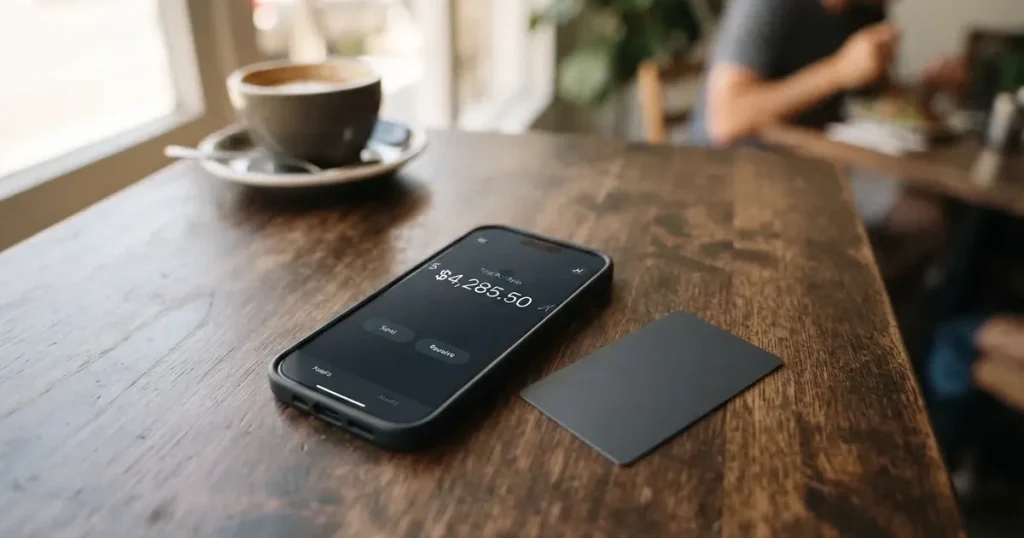
Phantom Cash turns a balance you already hold into something you can tap for coffee. The balance sits in a Cash account, the card spends it, and the card itself is virtual — you add it to Apple Wallet or Google Wallet and use your phone. There is no plastic in the post. For anyone in the United States who keeps dollar stablecoins in Phantom and wants to spend them at an ordinary till, the idea is straightforward and the execution is simple. The catch is that almost everything you’d want to check before signing up is not on the card’s public pages, and one piece of news is: the card is being replaced as Phantom moves to a new issuer.
I gave it 5.3 out of 10. That is not a verdict on Phantom as a wallet, which I am not reviewing here. It is a verdict on one narrow product — a virtual prepaid Visa debit, US-only, without New York — described by a company that publishes almost no numbers about it.
The conditions described here are current as of October 28, 2026.
The score in detail
| Criterion | Mark | Why |
|---|---|---|
| Who can get it | 4 / 10 | United States only, excluding New York, by place of residence |
| Cost | 7 / 10 | The card says only that “fees may apply” and points to its Cardholder Agreement. Unofficial sources describe no issuance, replacement or inactivity fee, free cash loads, and 1% + $0.30 on an international transaction |
| Top-up options | 4 / 10 | The card spends the CASH balance. You can fund Cash through Apple Pay, Google Pay, a debit card or a bank, and withdraw to a bank or to a Solana wallet. Direct funding with crypto is not named |
| Reliability and complaints | 6 / 10 | Lead Bank issues, Bridge Ventures LLC manages the programme, Stripe processes. The virtual card is being replaced because the issuer is changing, with no dates given. I found no complaints |
| Everyday use | 5 / 10 | Virtual Visa only, for Apple Wallet and Google Wallet. Unofficial: no ATM withdrawals |
| Total | 5.3 / 10 |
The pattern in that table is the whole review in miniature. Who can get it is narrow and plainly stated, so it scores reasonably. Cost is narrow in the good way — a page that says nothing about fees is not promising anything, and the unofficial picture is favourable. Top-up options are narrow in the frustrating way: the card spends a balance you can fill from ordinary payment rails, not from the crypto you actually hold, and nothing on the pages names a direct crypto top-up. Reliability sits in the middle because the structure is real, regulated and named, but a reissue is under way with no schedule attached. Everyday use is a virtual card, which is genuinely limiting: if your phone is dead, so is your money.
Who this suits: a US resident outside New York who already holds dollar stablecoins in Phantom and spends mostly in dollars, mostly online or at contactless tills, and who does not need cash from an ATM. Who it does not suit: anyone outside the United States, anyone in New York State, anyone who needs physical plastic, anyone who needs ATM cash, and — given how little is published — anyone whose decision to use a card depends on reading a fee schedule first.
Will they give you the card?
United States only, excluding New York, and the test is where you live, not where you hold citizenship.
That is the whole eligibility statement the card makes. It is worth sitting with, because it excludes most of the people who might read a review like this one. If you are in London, Lagos, Lisbon, Warsaw or Bogotá, this card is not a candidate at any stage of your search, and the answer will not change by trying. If you are in the US but in New York State — New York City, Buffalo, Albany, anywhere in the state — the answer is the same.
The distinction between residence and citizenship matters more than it might look. Crypto card issuers screen on both: sanctions lists and issuer risk policy are usually applied to citizenship and country of birth as well as to your address. This card’s public page tells you about residence. It does not tell you what it does with a citizenship. So if you live in an eligible state and hold a passport from somewhere else, you have a question the published material cannot answer for you, and you would need to ask it before you rely on this.
How to get it
Identity verification through Link is required for the virtual card. The marketing page phrases it differently: it says verification is handled by Stripe for bank transfers, direct deposit and debit card funding. Those are two descriptions of the same requirement arriving from two pages.
Beyond that, the sequence the card describes is short:
- Fund your Cash balance.
- Complete identity verification.
- Receive your virtual card.
- Add it to Apple Wallet or Google Wallet.
Applicants must be 18 or over. Proof of address is not stated. Delivery timing is not stated, though that is a slightly odd gap when the artefact is virtual and instant — the card does not say when you get it, or what happens if verification fails, and it does not say how many verification attempts you get.
One clarification worth having, because it comes up in every search on this product: you do not need KYC to use Phantom or Phantom Cash in general. Verification is required for bank transfers, direct deposit and the debit card. If you already have a Phantom account, that is a separate thing from the card approval, and the difference is deliberate.
The card itself is a virtual prepaid Visa debit. It works wherever Visa is accepted. No physical card is stated to exist. The currency is not stated; USD is implied by the CASH stablecoin the account runs on, but “implied” is not the same as “stated”, and if you travel, that gap is where surprises live.
Fees: what it really costs
Here is the honest position: the card publishes one sentence on cost — “Fees may apply” — and refers you to a Cardholder Agreement it does not reproduce. Issuance fee, monthly fee, conversion fee, FX fee, ATM fee, daily limit, monthly limit: all not stated. There is no tier structure either; it is a single card on a single Cash account, with no tiers mentioned at all.

What fills that table below is unofficial material from a third-party card-details page, last verified in late September 2026, partly carried forward from an older dataset. I am passing it on because it is what a reader will otherwise find, not because the card confirms it. Treat every line marked unofficial as a claim to verify.
| Item | What the card says | Unofficial figure |
|---|---|---|
| Card issuance | not stated | No issuance fee |
| Replacement | not stated | No replacement fee |
| Inactivity | not stated | No inactivity fee |
| Cash loads | not stated | Free |
| Purchase in the US | not stated | Free |
| International transaction | not stated | 1% + $0.30 per transaction |
| ATM withdrawal | not stated | Not available |
| Daily spending limit | not stated | $2,000 by default, up to $5,000 on request |
| Monthly spending limit | not stated | Not disclosed |
| Stablecoin trades | described as fee-free | Fee-free |
So what does an ordinary day cost? Three cases, and notice how different they look.
A coffee in the US, paid by tapping your phone. On the unofficial figures, nothing at the card level — a US purchase is free — and the CASH balance simply moves down by the price.
The same coffee in a foreign country. Here the unofficial 1% + $0.30 international fee is the whole cost, and it is the number that decides whether this card is a travel tool or not. On a $4 coffee that is roughly $0.34. On a $40 dinner it is roughly $0.70. It is not a travel card; it is a domestic spending card with a foreign surcharge.
A cash withdrawal. There isn’t one. Unocially, ATM withdrawals are listed as not available, and the ATM fee is not disclosed, which is consistent with there being nothing to disclose. If cash is part of your week, this card is not the tool.
The category point underneath all of this: a deposit you make on-chain is charged a network fee by the blockchain, not by the card provider. That is true of every card in this category and it is worth holding in mind whenever a crypto card advertises a free top-up. The chain fee is separate and it is real.
Top up the card
The card spends the Cash account balance — the CASH balance — and the Cash account is funded through Apple Pay, Google Pay, a debit card or a bank account, depending on your region. Withdrawals go to a bank account in the US or to a Solana wallet.
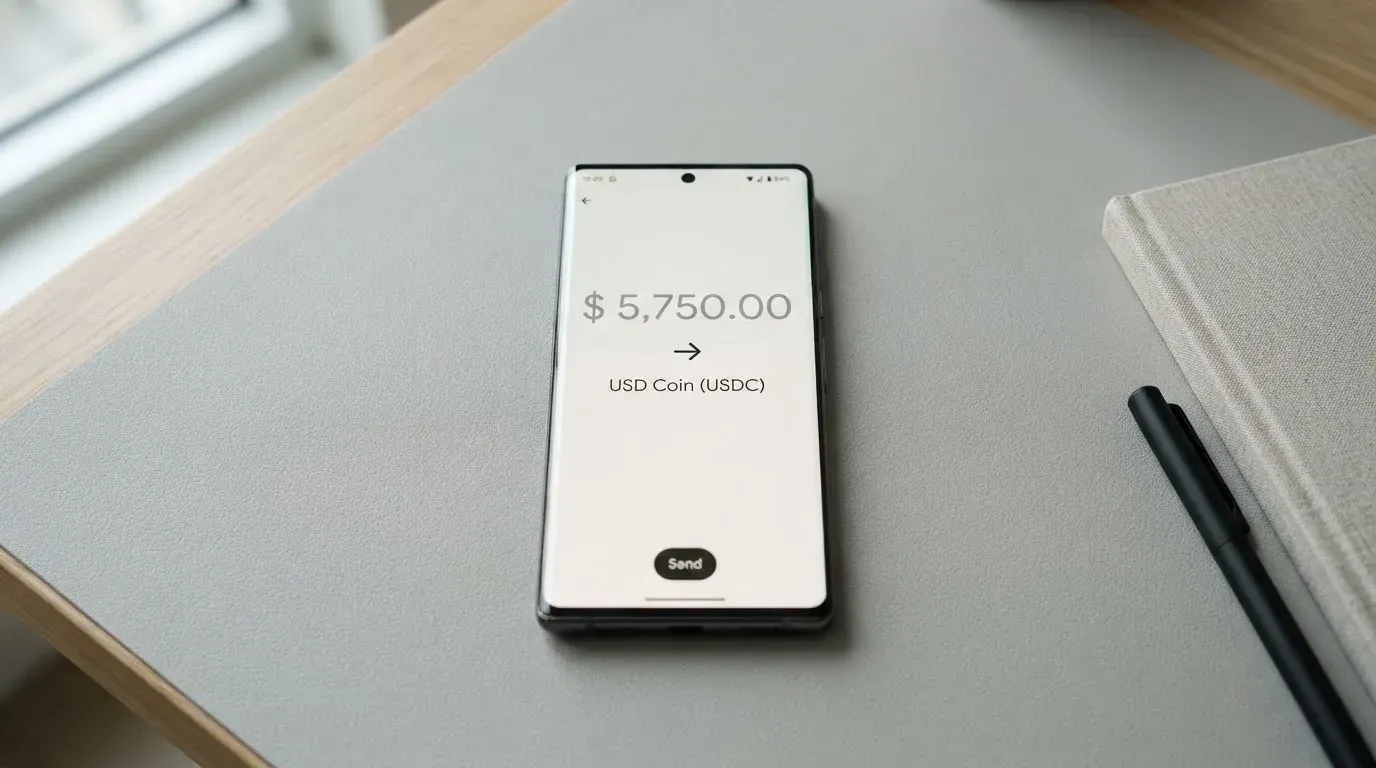
Here is the part that will decide whether this card works for you, and the card does not address it: direct funding with crypto is not named anywhere in the pages I read. You fund from payment rails. Crypto trades are described as fee-free. So if your intent is “I hold stablecoins, therefore I can spend them”, the mechanism between those two states is the question to ask, and the honest answer is that the published material does not fill it in.
If you do hold dollars in a bank account, the picture is plain and unexciting: you move money from a familiar place to an account, and you spend from there. That works. It also means this is not obviously a way to put crypto to work; it may be a way to hold crypto while spending dollars, which is a different and less interesting proposition.
| Top-up route | How it works | Fees |
|---|---|---|
| Apple Pay | Region-dependent; one of the four named funding routes | not stated |
| Google Pay | Region-dependent; one of the four named funding routes | not stated |
| Debit card | Region-dependent; identity verification described as handled by Stripe | not stated |
| Bank account | Region-dependent; withdrawals also run back this way in the US | not stated |
| Direct crypto | Not named on the pages read | not stated |
Minimums are not stated either, and neither are fees or minimums on the withdrawal side. Closure behaviour is also unstated: if you close your Cash account, what happens to a balance sitting in it? The pages do not say, and that is worth asking before you commit funds to it.
Paying with it every day
Add it to Apple Wallet or Google Wallet, and that is the card. Restricted categories are not stated, which is interesting in itself — for this category of card, blocked categories are usually a stated policy, and the usual suspects are gambling (MCC 7995) and, increasingly, the large platforms that decline prepaid and foreign-issued BINs. The card says nothing.
Everyday mechanics you can rely on, because they come from the card networks and the phone rather than from Phantom:
- A tap-to-pay payment replaces your card number with a device-specific number stored in the phone’s Secure Element, never on the vendor’s servers, and each payment carries a one-time code.
- Online payments go through 3-D Secure, which for Visa is Visa Secure: the issuer either approves frictionlessly or challenges you with a one-time code or a biometric check.
- The issuer can restrict the mobile copy of the card — for example, block it on websites, on phones, or on magnetic stripe, while leaving contactless working.
That last one is the day-to-day hazard. A virtual card that works only in the phone wallet can be selectively disabled by the issuer, and you learn about it at the till.
Disputes: Stripe handles card disputes for debit card transactions. The process and the time frames are not stated. In the US, debit card reversal rights come from Regulation E; prepaid coverage varies and should not be assumed to be the same as a bank’s.
Rewards: no cashback is stated. Holding CASH is described as earning passive income without lock-ups, but no rate is given. I would not build anything around “passive income” without a number in front of me.
The app is the Phantom mobile app. Platforms and store ratings are not stated on these pages. Support is a Help Center with a “Start a chat” option; languages and hours are not stated.
What can go wrong
Four things, and they are not equal in weight.
The card is being replaced. The Help Center carries an official incident notice: “Your virtual Phantom debit card is being replaced as we move to a new card issuer.” Users are told to add the replacement to Apple or Google Wallet. No dates are given for the switch, for when the old card stops working, or for what happens to a balance in flight at the moment of the handover. A card reissue is ordinary housekeeping. A reissue with no published schedule, on a product with no published fees or limits, is the single most important thing to know about Phantom Cash today.
Nobody holds your money in the ordinary sense. Phantom is the platform provider and says plainly that it is “not a bank”. Lead Bank issues the card under a Visa licence, Bridge Ventures LLC is the programme manager, and Stripe processes transactions and disputes — with Stripe’s role changing as the new issuer comes in. That chain is normal for a card like this and it is reassuring to see named institutions rather than a mystery. But the balance is secured on-chain as CASH, and Phantom says it does not store KYC information. Understand which piece you are trusting before you put real money in it.
Fees and limits may not be what you were told. Everything above marked unofficial came from a third-party page. If your spending depends on a $2,000 daily limit actually being $2,000, confirm it in the app.
A stablecoin is not a dollar. Stablecoins aim to hold their value against a fiat currency, and despite the name they are not necessarily stable: TerraUSD collapsed in May 2022 and USDC temporarily lost its peg in March 2023 during the US banking crisis. Transfers are typically irreversible, so a deposit sent on a network the provider does not support can be lost, or need manual recovery with no guarantee. Tether also says it disables tokens tied to OFAC-listed wallets, so these balances are not censorship-proof either.
On the other side of that ledger, and this is genuinely good news: my searches for complaints turned up no Phantom-specific complaints about this card — nothing on Trustpilot, nothing on Reddit, no user reports found. For a product in this category that is unusually quiet. Absence of complaints is not evidence of quality; it may equally reflect how young and how small the user base is.
What to take instead
Three cards I looked at, all of which publish more than Phantom Cash does. All three also fail to help you if you are in the United States outside Phantom, which is the point of the comparison.
| Card | Score | Who it is for | Card and cost | Funding and rewards |
|---|---|---|---|---|
| Phantom Cash | 5.3 / 10 | US residents outside New York | Virtual prepaid Visa; fees not published | Apple Pay, Google Pay, debit card, bank; no cashback stated |
| MetaMask | 7.1 / 10 | 45 listed countries/territories, others on a waitlist | Mastercard; virtual card free, metal $199/year | Spends from the connected wallet across Linea, Base, Monad, Solana; 1% cashback on Virtual, 3% headline on Metal with a footnote limiting 3% to the first $10,000 |
| KAST | 6.1 / 10 | Residence-based list shown at KYC | Virtual and physical, Visa tiers; Standard $0, Premium $1,000/year, Private $10,000/year | USDT, USDC, PYUSD, RLUSD on several networks; 1.5% / 2% / 3% cashback by tier |
| TokenPocket | 5.8 / 10 | A list of European countries and territories; other regions from Q2 2025 | Visa debit in Europe, Mastercard debit in Asia-Pacific and elsewhere; runs on Arbitrum | Crypto deposits from the TokenPocket wallet; 1% deposit fee refunded later via rewards |
MetaMask is the one that beats Phantom Cash on almost every published measure. It has a published price list (virtual free, metal $199/year), a named transaction-fee position (“no additional MetaMask fees”, no foreign transaction fee, Mastercard’s rate), named networks and tokens, and real cashback. Its catch is eligibility: sign-up is open in 45 listed countries and territories, and US and UK sign-ups are temporarily closed per its FAQ. It also asks for proof of residency and says ineligible regions limit sign-ups but not spending — a distinction worth reading twice.
KAST publishes more about money than either. Stablecoin top-up 0%, card spend in USD 0%, transaction fee 0%, a non-USD FX fee of 0.5%–1.75% depending on where you live and which card programme you are on, $0.10 for non-USD transactions under $25, $0.50 for a declined transaction. Cashback is tiered: 1.5% on the first $2,000 a month, 2% on the first $10,000, 3% on the first $40,000. Its eligibility is the least transparent of the three — the country list is not published, only a reference to a Restricted Locations list, and it warns that living in a supported country while holding an ID from a restricted region may still make you ineligible. A VPN does not bypass it.
TokenPocket sits closest to Phantom Cash on score. It charges 1% on a crypto deposit, which it says is refunded later through rewards or reduced transaction fees, plus possible inter-institution settlement costs, and it has an NFT creation fee partly covered by the provider where the user pays “a small portion”. Its geography is the widest of the three, but its Americas availability is described as planned rather than live.
Where all of them sit on the same axis: none of them is a bank, all of them depend on an issuer holding a network licence, and all of them can be switched off by that issuer. Visa and Mastercard do not issue crypto cards to consumers — they license issuers and can suspend a programme. In November 2022 Visa terminated its global agreements with FTX and the FTX US debit card was wound down. In 2018 Visa suspended WaveCrest in Europe, closing every WaveCrest-issued programme in the region. If you want to know what a closure looks like, those are the two to read about; nobody announced them as features.
Who I would recommend it to
I would recommend Phantom Cash to a specific person, and I would not recommend it to everyone else.
I would recommend it to someone who lives in the United States outside New York, keeps dollar stablecoins in Phantom already, spends in dollars, taps their phone for everything, has never needed an ATM, and is comfortable with a financial product that publishes almost nothing about itself. For that person the card does a small, legible job: it turns a balance into spending, at what unofficial sources say is no cost, with an issuer and a programme manager both named.
I would not recommend it if any of these are true: you need cash; you want a card that arrives in the post; you are outside the US; you are in New York State; you want to know what a euro transaction costs before you make it; or you want to read a fee table and a limit schedule, because they are not there.
And I would hold a thought over the reissue. Not because a change of issuer is suspicious — it is normal, and Stripe’s role is expected to change with it. But the combination of a reissue, no dates, no published fees, no published limits, and a daily spending cap that exists only on a third-party site is thin. If I were holding real money here, I would keep it to an amount I could lose without changing my week, and I would ask the Help Center chat — which does exist — what happens to a balance at the moment the issuer switches, and what the limits are, before I added anything substantial.
Frequently asked questions
What is Phantom Cash card?
It is a virtual prepaid Visa debit card that spends the balance of a Cash account inside Phantom, a balance denominated in the CASH stablecoin. The card exists only in a phone wallet — Apple Wallet or Google Wallet — and works wherever Visa is accepted. There is no physical card, no plastic posted to you, and no cash withdrawal. It is a way to spend a balance you hold, not a bank account.
How does Phantom Cash card work?
You fund the Cash account, complete identity verification, receive a virtual card, and add it to Apple Wallet or Google Wallet. From then on a tap at a contactless till spends the Cash balance, and online payments follow the usual 3-D Secure checks. The balance is secured on-chain as CASH, while Phantom says it stores no KYC information and handles none of it.
Is Phantom Cash a bank?
No, and Phantom says so itself — it is the platform provider and “not a bank”. The card is issued by Lead Bank under a Visa licence, with Bridge Ventures LLC as programme manager and Stripe processing transactions and disputes, though Stripe’s role changes as the new issuer comes in. That naming is reassuring, but it means your money sits in a stablecoin balance, not in a bank deposit.
Who can get Phantom Cash card?
United States residents only, and New York State is excluded. The test is residence, not citizenship, and the card’s pages say nothing about how citizenship is treated — which matters if you live in an eligible state and hold a passport from elsewhere. Applicants must be 18 or over, and no minimum age or higher limit is described beyond that.
How do I get Phantom Cash card?
The steps are: fund your Cash balance, complete identity verification through Link, receive the virtual card, add it to Apple and Google Wallet. The marketing page describes verification as handled by Stripe for bank transfers, direct deposit and debit card funding. Delivery timing is not stated, nor are the reasons a verification might be rejected or how many attempts you get.
Does Phantom Cash card require KYC?
Not for Phantom or Phantom Cash in general — that is a distinction the card makes explicitly. Verification is required for the three things that touch the banking system: bank transfers, direct deposit and the debit card. So if you only use the wallet, you do not go through it; if you want the card, you do.
What are the fees on a Phantom Cash card?
Officially, the card says only that “fees may apply” and points to a Cardholder Agreement it does not reproduce. Issuance, monthly, conversion, FX and ATM fees are all unstated, as are limits. Unofficial third-party figures from late September 2026 describe no issuance, replacement or inactivity fee, free cash loads, free US purchases, and 1% + $0.30 per international transaction.
Can I use a Phantom Cash card at an ATM?
No, according to the unofficial card-details material, which lists ATM withdrawals as not available and the ATM fee as undisclosed. The card itself does not address ATMs at all. If you need physical cash during the week, that settles the question: this is not the card for you, and no physical version is stated to exist.
How do I top up Phantom Cash card?
The Cash account is funded through Apple Pay, Google Pay, a debit card or a bank account, depending on your region, and withdrawals run to a US bank account or to a Solana wallet. Direct funding with crypto is not named on the pages I read, which is the detail to press on if your reason for wanting the card is that you hold stablecoins. Fees and minimums are not stated.
Is Phantom Cash card safe and worth it?
Safe is the wrong question; understand what it is instead. The balance is a stablecoin, which can and has de-pegged, transfers are typically irreversible, and a card issuer can suspend a programme — Visa did exactly that with FTX in November 2022 and WaveCrest in Europe in 2018. On the positive side, I found no complaints specific to this card anywhere. Worth it for a US user spending dollars daily; doubtful otherwise.
Wallet cards put to the test – cryptocardtested
Content created by the «cryptocardtested» team