
A crypto card with an IBAN and a 5.6 score — here's who Brighty actually works for
 Available in US
Brighty is a financial technology company, not a bank, and it sells a virtual card you load with crypto and an IBAN account in euros. If you live in the EEA and want a card that draws on a Bitcoin, Ethereum or USDC balance, plus a place to receive a salary, the proposition is genuinely interesting. If you are outside the EEA, or you need a physical card, or you care about transparent dispute handling, the picture narrows fast. I went through the card’s own pages, the help center, third-party coverage and Trustpilot to see what the product actually delivers, and below is what I found, section by section.
The conditions described here are current as of October 28, 2026. Card programmes change, and the EU’s MiCA transitional period runs until July 2026, so re-check the details that matter to you before you apply.
Verdict
I give Brighty 5.6 out of 10. The card does a few things well — incoming crypto is free, the in-app FX rate is competitive, and you get an IBAN in addition to a virtual card. It loses marks on the things that hurt in practice: the EEA-only framing that contradicts the app’s own expansion, a vague partner-issuer setup, a Trustpilot profile that is held up by account-closure complaints, and a rewards story that the card’s own page does not actually publish. If you are an EEA resident who wants a crypto IBAN and a virtual Mastercard to spend from a USDC or BTC balance, Brighty fits. If you are a Russian national in Montenegro or Andorra, or you need a physical card, or you want a clearly stated cashback scheme and dispute process, look at the alternatives in the “what to take instead” section.

| Criterion | Mark | Why it scored that way |
|---|---|---|
| Who can get it | 5 / 10 | Card page says EEA only; app has been extended to Montenegro and Andorra, with a nationality block for Russian residents of those two countries; full country list not on official pages |
| Cost | 7 / 10 | Virtual card issued for EUR 2.99, no monthly card service fee, in-app FX is 0.6% / 0.5% / 0.4% above a free monthly allowance on the One, Plus and Pro plans; SEPA and Faster Payments fees are reasonable |
| Top-up options | 7 / 10 | Bitcoin, Ethereum and USDC accepted in app, incoming crypto is free on every plan, plus an IBAN; outgoing crypto supported on a wide set of networks |
| Reliability and complaints | 4 / 10 | Issuing partners are not named on the official site, the third-party press points to UAB Monavate; Trustpilot sits at 3.2 from 78 reviews with account closures and unpaid referral bonuses as recurring themes |
| Everyday use | 5 / 10 | Virtual Mastercard that is accepted online wherever Mastercard is taken; Apple Pay is unavailable for Mastercard cards, available for Visa; Google Pay works for Mastercard |
Who they will give the card to
The card’s own page is marked “EEA only”, which sounds clean and tidy until you notice the app has also been opened up to Montenegro and Andorra. The wording on the help article is a careful one: availability “may vary by jurisdiction” and “due to regulatory restrictions, we are unable to onboard Russian nationals residing in Montenegro and Andorra.” The rule is by residence first, and there is an additional nationality check that bites Russian citizens in those two specific countries. A full official list of supported countries does not exist in the pages I read; third-party coverage puts the working list at 36 countries including the EU, EEA, Switzerland, Montenegro, Andorra, San Marino, Monaco and Moldova, but treat that as unofficial and unconfirmed by Brighty.
What this means for you, in practice, is that the headline “EEA only” is narrower than the actual footprint, and the actual footprint is narrower than the third-party count. If you are a US resident, a UK resident after Brexit, or a resident of most of Asia, the picture is bleak. If you live in an EU member state, Iceland, Liechtenstein or Norway, you are inside the EEA and inside the easy case. If you are in Switzerland, Montenegro, Andorra, San Marino, Monaco or Moldova, you are probably fine unless you are Russian in the two expanded countries.
Two things are worth flagging up front. First, Brighty is a financial technology company, not a bank, so what it offers is an e-money account and a card issued through a licensed partner rather than a full banking relationship. The official pages do not name the issuing bank, and the third-party press points to a Lithuanian electronic money institution called UAB Monavate, but that is not confirmed on Brighty’s own site. Second, because the product sits in e-money rather than deposit-taking banking, the safeguards you get are the e-money kind: segregated funds, no deposit guarantee scheme coverage. That is normal for the category, but it is worth knowing before you park a salary in the IBAN.
How to get it
Sign-up runs in the app, and identity verification is handled by Sumsub, which the help center names. The flow is a standard one: clear photos of an ID showing your full name, date of birth, place of birth and citizenship, plus a proof of address that is a utility bill, a bank statement PDF or an official registration confirmation, no older than three months. Screenshots are not accepted, blank fields are grounds for rejection, and a document that does not match the address you signed up with is grounds for rejection. There is a fallback path: you can email [email protected] if verification stalls.
What the help center does not state publicly is the level structure of the verification, the processing time, or what a “rejected” decision looks like on the inside. That is not unusual for a regulated product, but it does mean you do not get a published service-level commitment.
On the card itself, you choose between a Virtual Card and a Physical Card inside the app. The page does not publish delivery times, replacement costs or the list of countries that get a physical card shipped, and the third-party coverage is the place where the practical reality surfaces: physical Mastercard orders are, as of August 2026, not being fulfilled at all, with the help center saying they “will not be fulfilled.” If you need plastic in your wallet, that is a meaningful gap, and it is worth treating the physical card as effectively unavailable until Brighty itself starts shipping them again.
The card currency is not stated on the official pages. The third-party coverage lists fiat balances in EUR, USD, GBP and AED, and crypto balances in USDC, EURC, BTC, ETH, ADA, XTZ, TON and SOL, but treat that list as unofficial. What is clear is that you can hold a euro balance and a USDC balance side by side, and the card spends from whichever one you fund.
What it really costs
The headline cost story is simple and worth getting right. A virtual card costs EUR 2.99 to issue, and there is no monthly card service fee. You can issue up to ten cards a month. The physical card price is not published, and given that physical orders are not being fulfilled, the published price is academic for now.
The other side of cost is what the card charges you when you actually use it, and that is where the plan structure starts to matter. Brighty runs three plans: One, Plus and Pro. The plan prices are not on the official page I read, and the third-party coverage puts them at free for One, EUR 9 per month for Plus and EUR 18 per month for Pro. Treat those numbers as unofficial.
Where the official pages do publish numbers is in the limits and the in-app FX. On the One, Plus and Pro plans respectively:
- Cards included: 1, 2, 3.
- Card purchase limit, daily / monthly: EUR 50,000 / 75,000 / 100,000.
- Outgoing fiat, daily / monthly: EUR 30,000 / 250,000 / 500,000.
- Free FX allowance per month: EUR 0 / 2,000 / 5,000.
- FX above the allowance: 0.6% / 0.5% / 0.4%.
- SEPA / Faster Payments out: EUR 3 plus 0.3% on One, with a EUR 10 minimum, and EUR 0.5 plus 0.3% on Plus and Pro.
- SWIFT out: 0.9%, with a EUR 50 minimum on One and Plus, and a EUR 30 minimum on Pro.
- Maximum fiat account balance: EUR 100,000 / 250,000 / 500,000.
The plan names and limits come from a help article dated 15 September 2026, and the FX percentages are also the ones the card charges in-app when you convert between currencies.
| Fee or limit | One | Plus | Pro |
|---|---|---|---|
| Virtual card issuance | EUR 2.99 | EUR 2.99 | EUR 2.99 |
| Monthly card service | Free | Free | Free |
| Cards included | 1 | 2 | 3 |
| Free FX allowance per month | None | EUR 2,000 | EUR 5,000 |
| FX above allowance | 0.6% | 0.5% | 0.4% |
| SEPA / Faster Payments out | EUR 3 + 0.3% (min EUR 10) | EUR 0.5 + 0.3% | EUR 0.5 + 0.3% |
| SWIFT out | 0.9% (min EUR 50) | 0.9% (min EUR 50) | 0.9% (min EUR 30) |
| Card purchase limit, daily | EUR 50,000 | EUR 75,000 | EUR 100,000 |
| Card purchase limit, monthly | EUR 75,000 | EUR 100,000 (per published tier table) | EUR 100,000 |
| Outgoing fiat, daily | EUR 30,000 | EUR 30,000 | EUR 30,000 |
| Outgoing fiat, monthly | EUR 250,000 | EUR 250,000 | EUR 500,000 |
| Maximum fiat balance | EUR 100,000 | EUR 250,000 | EUR 500,000 |
| Incoming crypto | Free, unlimited | Free, unlimited | Free, unlimited |
| Incoming SEPA | 0.3% (min EUR 10) | 0.3% (min EUR 10) | 0.3% (min EUR 10) |
| Incoming SWIFT | 0.7% (min EUR 50) | 0.7% (min EUR 50) | 0.7% (min EUR 50) |
To make those numbers less abstract, walk through three everyday situations.
You spend EUR 25 on a coffee in Berlin with a euro balance. The card charges the merchant in euros, the balance is already in euros, and there is no conversion. The fee is the merchant’s acquiring fee, which is not on your invoice. The only Brighty charge is the EUR 2.99 you paid for the card itself, and nothing per transaction.
You spend USD 40 on a streaming service while travelling in the US, paid from a euro balance. The card converts the USD 40 to euros at the in-app rate. On the One plan there is no free FX allowance, so the conversion carries 0.6%. On Plus, the first EUR 2,000 of monthly conversions are free, and the rate above that is 0.5%. On Pro, the first EUR 5,000 are free, and the rate above that is 0.4%. On a USD 40 transaction, the difference between One and Pro is roughly ten cents, but on USD 10,000 of monthly conversions the difference is meaningful.
You take EUR 200 out of an ATM. ATM fees are not stated on the official pages, and the third-party coverage points to legacy Visa rates of EUR 3.50 in the EEA and EUR 3.50 plus 3.5% outside, and Pro-tier Visa rates of EUR 3 in the EEA and EUR 3 plus 3% outside. The third-party coverage also notes that the Mastercard has no dependable ATM feature right now. The official page says the card is “accepted at ATMs worldwide” but does not publish the per-withdrawal fee or any monthly allowance, so the practical answer is that ATM withdrawals are not a clean feature of this card.
The FX fee for paying in a foreign currency, separate from the in-app conversion rate, is not stated on the pages I read. That is a real gap, and if you spend abroad regularly, the safest reading is that the in-app rate already incorporates any foreign-currency margin and that there is no second layer on top.
Top up: how to fund the card
The funding menu is one of the card’s stronger points. You can hold Bitcoin, Ethereum and USDC in the app, plus a euro fiat balance, plus an IBAN. Incoming crypto is free on every plan and unlimited per month, so the only cost on the way in is the network fee, which the blockchain charges, not Brighty.
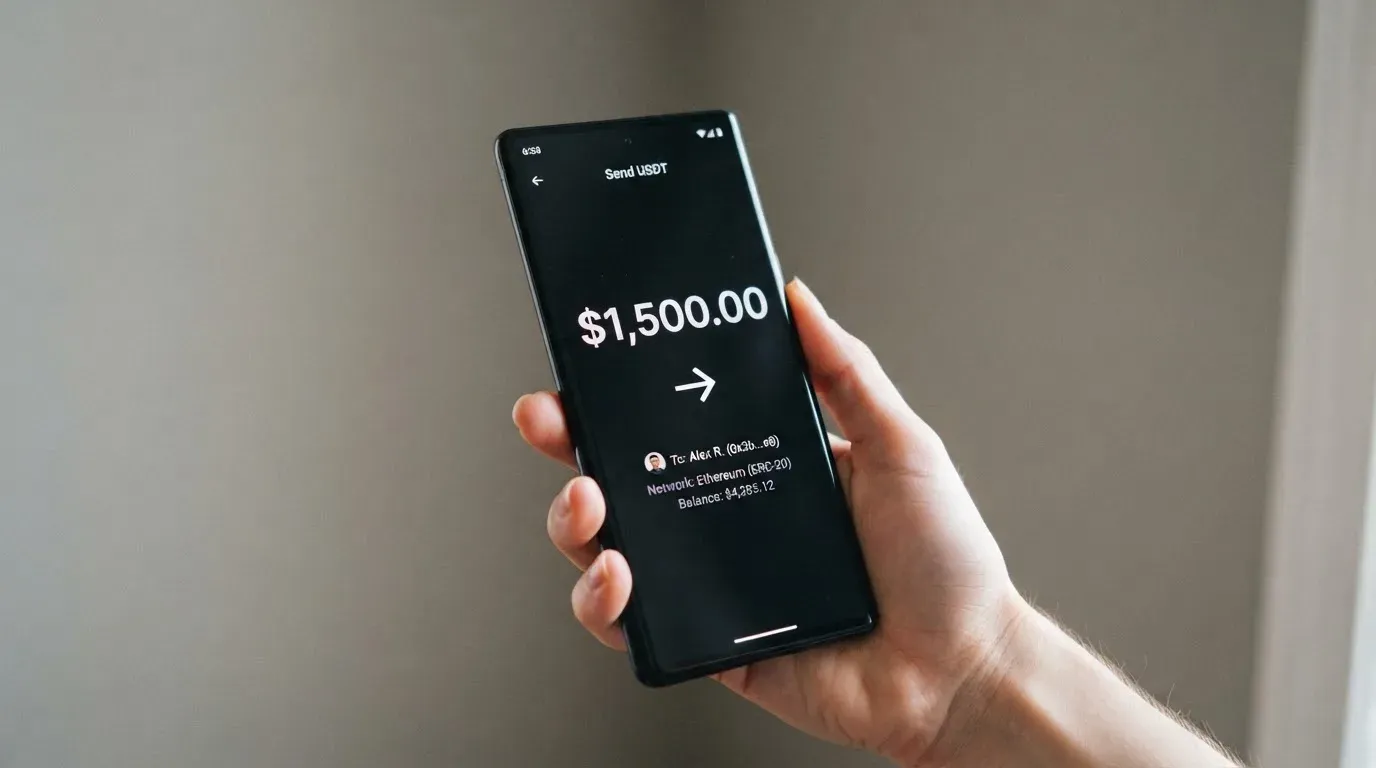
On the way out, the card supports an unusually long list of networks. The official fees list shows: ERC20 (Ethereum) at EUR 3, TRC20 (Tron) at EUR 3, BTC at EUR 20, Cardano at EUR 1, Tezos at EUR 1, Islamic Coin (HAQQ) at EUR 1, TON at EUR 3, Arbitrum at EUR 3, Solana at EUR 3, Polygon at EUR 3 and BEP20 at EUR 3. The networks covered are Ethereum, Tron, Bitcoin, Cardano, Tezos, Islamic Coin, TON, Arbitrum, Solana, Polygon and BEP20. There is no monthly cap on outgoing crypto, and the per-transaction cost is the same on all three plans.
For fiat, the menu is a normal European one. Incoming SEPA costs 0.3% with a EUR 10 minimum, incoming Faster Payments costs 0.3% with a EUR 10 minimum, incoming SWIFT costs 0.7% with a EUR 50 minimum, and the monthly incoming fiat cap is EUR 100,000. The card top-up fee and the minimum top-up amount are not stated on the official pages I read, so I cannot quote them. What is implied is that moving from your euro balance to the card balance is a free internal step, since the card spends the fiat balance directly.
The IBAN is the piece that makes Brighty more than a card. A euro IBAN means you can have a salary paid in, receive SEPA transfers from friends or clients, and pay rent or contractors from the same account that holds your crypto. That combination, an IBAN plus a crypto balance plus a card, is the core proposition, and the funding side delivers it cleanly.
Two practical cautions, though. The first is the network discipline point. Crypto transfers are irreversible, so if you send USDC on a network the app does not support, or to an address of a different network, the funds can be lost or need manual support recovery. The help center has articles on “Wrong Network and Unsupported Cryptocurrency” and “Refund Policy for Unsupported Crypto Deposits”, which is the kind of article that exists because the problem exists. The second is the closure rule. If you close your account yourself, the official wording is that it is “scheduled for permanent deletion within 30 days”. What happens to the remaining balance is not stated, so the right move before closing is to withdraw everything first.
Paying with it every day
The card is a virtual Mastercard on the official pricing article, accepted wherever Mastercard is taken online. The published everyday-use story is “keep earning on your crypto while using it”, which is the kind of sentence that signals a yield or rewards feature but does not actually state one. The rate and the payout are not published on the NPC page.
The third-party coverage is where the rewards story appears: a base 0.5% cashback in USDC on all tiers, with selected categories offering 1.25% to 1.75%, monthly caps of 20 / 60 / 100 USDC on the One, Plus and Pro plans, paid the next month into a Reward Box, and reversed if the underlying purchase is refunded or charged back. None of that is on Brighty’s own pages, so treat the cashback story as unofficial and unconfirmed by the card.
On mobile wallets, the situation is the kind of split that catches people out. As of 26 May 2026, Apple Pay is unavailable for Mastercard cards because of “technical updates”, and available for Visa. Google Pay works for Mastercard. The NPC page mentions Apple Pay and Google Pay on the Montenegro and Andorra blog post, but it does not separate the two by card scheme, so the practical reading is: if you have a virtual Mastercard, you have Google Pay; if you want Apple Pay, you need a Visa. The virtual card the app actually issues is the one whose wallet support applies.
A few everyday details that the help center does not spell out clearly: blocked merchant categories, the dispute process, and chargeback handling. The help center has articles on refunds for unsupported crypto deposits and on wrong-network deposits, and nothing I saw described a cardholder dispute or chargeback flow. The third-party coverage also says no dispute or chargeback process is described, which is consistent with what I read. For a card whose central pitch is a salary-style IBAN plus a Mastercard, the absence of a published dispute process is a real gap, and it is the kind of gap you only feel when something goes wrong.
On the app side, the App Store listing for the Turkish storefront that I read on 20 October 2026 was “Brighty: Crypto Card & IBAN” at 4.9 from 9 ratings, which is a very small sample. I could not find a Google Play rating. That makes the app review signal thin rather than negative.
What can go wrong
The most consistent thread in the user feedback I found is account closure. Trustpilot sits at 3.2 out of 5 from 78 reviews, and the recurring themes are accounts closed without a clear explanation, referral bonuses not paid out and instant transfers that take hours. The company’s responses cite policy and regulation as the reason for closures, and suspected referral abuse for the unpaid bonuses. There is praise in there too, mostly around cashback, but the pattern of closure complaints is the kind of thing that matters when you are thinking about parking a salary in the IBAN.
The official offboarding language, where it is published, lists the standard regulated-finance reasons: suspected fraud, unclear source of funds, partner-provider concerns, and PEP or sanctions status. Those are legitimate reasons to close an account, but the gap between “we closed your account under policy” and “we will tell you what triggered it” is the gap that generates the complaints.
The company side of the picture is short on the official site. Brighty says it is a financial technology company, not a bank, that accounts, cards, custody and the on- and off-ramp are provided through licensed partners, and that licence numbers are not on the pages I read. The 2024 press coverage describes Brighty as based in Switzerland and holding crypto-exchange and digital-asset custodian licences, but that is from a third-party press release, not from Brighty’s own site, so treat it as unconfirmed.
On the security side, the official FAQ says Brighty keeps user funds in segregated accounts that are “specially secured”, works with penetration testers, and lets you freeze or terminate a card in the app. Freeze is temporary; termination cannot be reversed. Two-factor authentication is not mentioned on the page I read, which is unusual for a crypto product in 2026. There is no mention of insurance, no mention of a backup or recovery process, and no published proof of reserves. Custody is by Brighty, not self-custody, so the funds are in the company’s hands rather than yours.
On support, the published channels are email at [email protected] and the help center at help.brighty.app, available in English, French, Italian, Lithuanian, Polish, Romanian, Serbian and Spanish. Russian is not on that list, which is worth noting if it is your working language. There is no phone, no live chat, and no published support hours. The third-party coverage of the historic 2024 Apple Pay change is consistent with what the help center now says.
The MiCA context matters here. MiCA’s transitional grandfathering period for crypto-asset service providers runs until 1 July 2026, after which providers either have a MiCA authorisation or they stop. The card is currently inside that window, and the card’s own pages do not name the licence status of the partners. That is a normal gap in published information, but it is the kind of thing you want to be able to look up on the ESMA register before you commit a salary.
What to take instead
The three alternatives below are useful comparison points, and they each solve a different version of the problem. None of them is a like-for-like replacement, so pick the one that matches what you actually need.
International Visa Card, score 6.7 out of 10. A US-issued Platinum Visa card that pays in USD, with a $5 one-time issuance fee and no maintenance fee. Plans are Classic (free), Pro at $9 per month and Max at $19 per month, with card use in USD free on every plan. Foreign-currency spending is converted at the Visa exchange rate plus a 2% FX fee. Deposits of any kind are free, and you fund a USD account with USDC or USDT at 1:1, plus USD, EUR, SEPA, SWIFT and FedNow. There is no published cashback. The big difference is geography: the account and the card are not available to residents or legal registrants of Belarus, mainland China, North Korea, Cuba, India, Iraq, Iran, Israel, Myanmar, Nepal, Nicaragua, Russia, Syria, Turkey, Ukraine, Venezuela or Vietnam, and purchases are blocked in North Korea, Cuba, Iran, Russia, Syria, Ukraine and Venezuela. If you are a US-facing user who needs a USD balance and a Visa, this is the cleaner choice; if you need a euro IBAN, it is not.
UNi Card, score 6.1 out of 10. A multicurrency card on the Mastercard network that spends from a UNi.Global account balance, with no annual fee and no foreign transaction fee. Assets are converted at “live OTC (Over-the-Counter) rates” and the card’s marketing claims “no hidden exchange fees”. Spend-to-Earn rewards go up to 3%. The headline trade-off is that the public information is thin: physical or virtual type, issuance fee, the funding menu and the country list are not stated. If you are comfortable with less published detail and the multicurrency Mastercard story is what you want, UNi is a reasonable name to know; if you need a published cost table, it is not.
Whop Cards, score 5.2 out of 10. A Visa card for consumers in 31 US states and businesses in 41 US states, with a long list of unsupported countries including Belarus, mainland China, Cuba, Hong Kong, India, Iran, Iraq, Israel, Myanmar, Nepal, Nicaragua, North Korea, Russia, Syria, Turkey, Ukraine, Venezuela and Vietnam. The card is marketed as having “no extra fees”, and the rewards story is 5% cashback at selected merchants (currently Uber, with more planned), though the payout currency and conditions are not stated. The card spends from a Whop balance backed by stablecoin collateral from a linked wallet. If you are in a supported US state and you spend at the listed merchants, the cashback rate is genuinely competitive; if you are anywhere else, the card is not available.
| Alternative | Score | Network | Headline strength | Headline trade-off |
|---|---|---|---|---|
| International Visa Card | 6.7 | Visa (US-issued, USD) | USD account funded by USDC/USDT, no maintenance fee | Long list of unsupported residence countries |
| UNi Card | 6.1 | Mastercard (multicurrency) | No annual fee, no FX fee, up to 3% rewards | Thin published detail on funding, fees and country list |
| Whop Cards | 5.2 | Visa (US-state-based) | 5% cashback at selected merchants, no published extra fees | Available in 31 US states only |
Who I would recommend it to
I would recommend Brighty to a fairly specific person: an EEA resident with a euro salary and a crypto balance, who wants one app for both, who is comfortable with a virtual card, and who is not relying on a published dispute process for a problematic merchant. If you are a freelancer with mixed crypto and euro income, a contractor in a regulated EU jurisdiction, or an EU resident who travels inside the EEA and wants an IBAN plus a USDC balance, the card fits.
I would not recommend it to a US or UK resident, who will not pass eligibility, or to a Russian national resident in Montenegro or Andorra, who is blocked by the additional nationality rule. I would not recommend it to anyone who needs a physical card, since Mastercard physical orders are not being fulfilled. I would not recommend it to anyone whose primary need is a published cashback scheme, because the rewards story is not on the official page, or to anyone who weighs the dispute process heavily, because there is no published one.
The deeper reason for caution is the combination of custodial funds, an unnamed issuing partner, an account-closure pattern on Trustpilot, and an absence of a MiCA authorisation statement on the pages I read. None of those is disqualifying on its own, and they are all common in the category, but they stack. The card does what it says, the costs are reasonable inside the EEA, and the funding menu is strong. The questions to ask yourself are whether you are comfortable with the published gaps, and whether your use case is inside the supported footprint.
Frequently asked questions
What is Brighty card?
Brighty is a financial technology company that issues a virtual Mastercard and a euro IBAN account, and lets you fund both with Bitcoin, Ethereum, USDC and other listed cryptocurrencies. The card spends from a euro or crypto balance in the app, and the company itself describes itself as a fintech rather than a bank, with cards, custody and the on- and off-ramp provided through licensed partners.
Is Brighty a bank?
No. Brighty is a financial technology company, not a bank. What it offers is an e-money account and a card issued through a licensed partner, not a full banking relationship, which means your funds sit in segregated e-money accounts rather than under a deposit guarantee scheme.
How does Brighty card work?
You sign up in the app, complete identity verification through Sumsub, receive a euro IBAN and a virtual card, and fund the account with crypto, SEPA, Faster Payments or SWIFT. When you pay, the card converts the balance to the merchant’s currency at the in-app rate, with a free monthly allowance on Plus and Pro and a 0.6%, 0.5% or 0.4% margin above it.
Who owns Brighty?
The company describes itself as a Swiss-based fintech that holds crypto-exchange and digital-asset custodian licences, per 2024 press coverage; the company structure and any licence numbers are not published on Brighty’s own pages, so I would treat the press description as unofficial until the company states it on its own site.
Is Brighty card available in my country?
The official card page says “EEA only”, and the help center extends the app to Montenegro and Andorra while blocking Russian nationals resident in those two countries. A full official country list is not published, and third-party coverage lists 36 countries; if you are outside the EEA and outside the expanded list, you will not pass eligibility.
How do I get the Brighty card?
Sign up in the Brighty app, complete Sumsub verification with a clear photo ID and a proof of address no older than three months, and the app issues a virtual Mastercard for EUR 2.99. Physical cards are listed as an option in the app but, as of August 2026, Mastercard physical orders are not being fulfilled.
Does Brighty card require KYC?
Yes. Verification runs in-app at sign-up through Sumsub, and the published requirements are a clear photo of an ID showing your full name, date of birth, place of birth and citizenship, plus a utility bill, bank statement PDF or official registration confirmation no older than three months; screenshots are rejected and blank fields are grounds for rejection.
How do I top up Brighty card?
You can top up with Bitcoin, Ethereum, USDC and other listed crypto, with incoming crypto free on all plans, or with SEPA, Faster Payments or SWIFT into your euro IBAN. Incoming SEPA and Faster Payments cost 0.3% with a EUR 10 minimum, incoming SWIFT costs 0.7% with a EUR 50 minimum, and incoming fiat is capped at EUR 100,000 per month.
Can I add Brighty card to Apple Wallet?
Only if you have a Visa card. As of 26 May 2026, Apple Pay is unavailable for Brighty’s Mastercard cards because of technical updates, while Google Pay works for Mastercard. The published everyday-use story on the NPC page does not separate the two, so the practical rule is: Apple Pay needs Visa, Google Pay works with Mastercard.
Is Brighty card safe?
Funds are held in segregated accounts by Brighty, the company works with penetration testers, and you can freeze or terminate the card in the app. The published safety story does not include insurance, proof of reserves, two-factor authentication or a partner licence number, and the Trustpilot profile carries a clear account-closure pattern, so the honest answer is: safer than a hot wallet, less transparent than a regulated bank.
App and neobank cards put to the test – cryptocardtested
Content created by the «cryptocardtested» team