
What the ZAR card really does with your dollars, and where it stops working
 Available in US
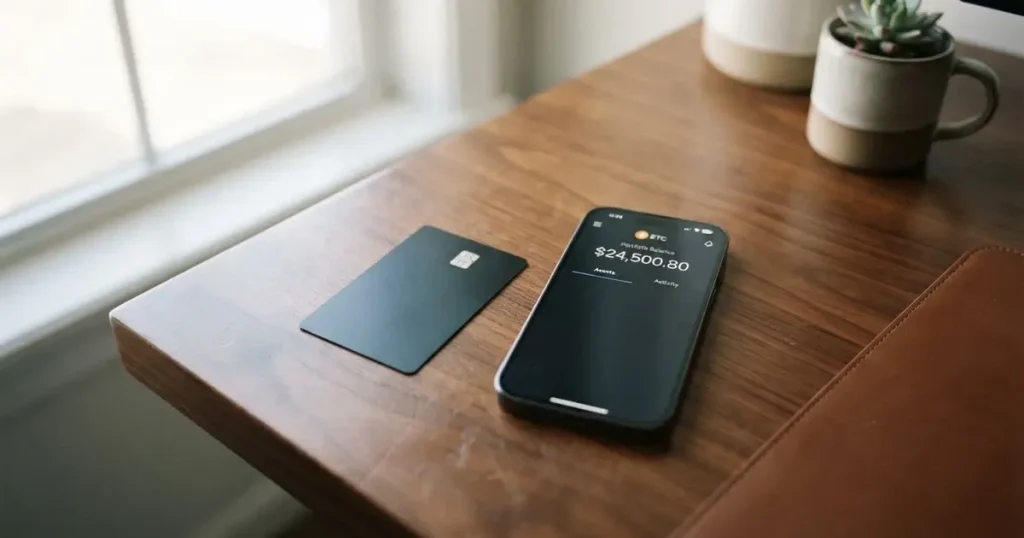
The ZAR card is one of those products that looks, from the outside, like a normal bank card and behaves like something else. You keep dollars as USDC, a stablecoin, in a wallet, and you spend from that balance through a virtual Visa card number in USD. Apple Pay works. ATM withdrawals are advertised. The catch is not hidden exactly — it is just that the interesting parts sit in the terms rather than on the front page: only USDC on Solana goes in, the physical card does not exist yet, the card issuer is never named, and the app’s rating on the UK App Store is 3.9 out of 5 from 44 ratings. None of that makes the card bad. It makes it narrow.
I scored it 7.3 out of 10. That is a good card with a specific job, not a general answer to “I need a way to spend crypto”. Here is who it suits and who it does not.
- It suits you if you already hold dollars as USDC on the Solana network, you mostly spend in USD or in places that take USD, you can pass a passport check, and you want a card number in your pocket within an hour or so of applying rather than a plastic one in the post.
- It does not suit you if you spend mainly in euros, pounds or local currency and care about the exchange rate; if you are in one of the excluded locations; if you want a physical card, cashback, Google Pay or a clearly named issuing bank; or if you are putting your savings in and expecting ordinary bank protections.
- It is worth a second look if the alternative in your country is nothing at all — no bank account, no card, no way to receive a salary. Against that, the ordinary fee and reliability complaints that dog every other card are simply not present, because there is almost nothing to complain about yet.
Conditions described here are current as of October 28, 2026.
The score, criterion by criterion
The marks come out of ten, and the total is what I actually think of the card.
| Criterion | Mark | Why |
|---|---|---|
| Who can get it | 8 / 10 | Site says “100+ countries”, the App Store listing says 110+ countries, with no list; Russia, Belarus, Iran, Iraq, China, Japan, Vietnam and Venezuela named as excluded |
| Cost | 9 / 10 | Account opening and virtual cards are free, and there are “No foreign fees”; the plastic card is paid for, priced by country, and the monthly fee is not disclosed |
| Top-up options | 5 / 10 | Right now only USDC on Solana is accepted, other stablecoins get converted to USDC, plus a bank transfer |
| Reliability and complaints | 7 / 10 | Golden Age Dev Lab Pte Ltd in Singapore, dollars from Circle, banking by SSB (Member FDIC); the card issuer is not named, and no complaints surfaced — but the app sits at 3.9 out of 5 |
| Everyday use | 6 / 10 | Virtual Visa in USD, Apple Pay supported, ATMs advertised; the physical card is “coming soon” and Google Pay is not mentioned |
Total: 7.3 / 10.
The highest mark is cost, and it is the one worth trusting. Zero to open, zero to hold a virtual card, no foreign transaction surcharge — for a card aimed at people who cannot easily get a normal one, that is genuinely unusual. The weakest mark is top-ups, and it is the one that will decide whether the card works for you at all, because a single accepted coin on a single network is a narrow door.
Who will they give you the card
Eligibility is generous on paper. The website says “100+ countries” and the App Store listing says 110+, which is a claim about coverage rather than a list you can check against, and no country list is published either way. The terms are where the real shape appears: ZAR may refuse service in certain locations, and Russia and Belarus are explicitly named alongside Iran, Iraq, China, Japan, Vietnam and Venezuela — the list is stated as non-exhaustive, which means it is not the whole set of places you will be refused. You must be 18 or older and not under sanctions.
The thing I could not find is the basis for eligibility: whether it turns on your citizenship, your country of residence, or both. The card’s public pages do not say. That matters more than it sounds, because sanctions screening and issuer risk policy are commonly applied to citizenship and country of birth as well as to where you live — so a resident of an allowed country holding a passport from a restricted one may be treated differently from a citizen of an allowed country living elsewhere. If your situation is anywhere near those listed countries, this is the question to put to support in writing before you send any documents, not after.
How to get it
The route is the ordinary one: register in the app, complete identity verification, and the virtual card is issued. Both iOS and Android are available.
Verification is real, not decorative. KYC/AML checks are required for bank connectivity and card services, and Plaid handles identity verification — that is the same service many mainstream banking apps use to connect a bank account. Passports and driver’s licences are both accepted. Politically exposed persons are screened as part of the process. There is only one KYC level that the card describes, and neither the levels nor the processing time are stated, so I would not plan around a same-day approval. Proof of address is not stated either — which may mean it is not required at this stage, or may simply mean nobody has written it down.
Once you are through, what you get is a virtual Visa card in USD, with a physical version marked “coming soon”. Delivery times for the plastic are not stated, for the same reason. I would plan on living with the virtual card. The App Store listing for the UK, which I read on 21 October 2026, gives the app 3.9 out of 5 from 44 ratings; I did not read the Google Play rating, so treat Android sentiment as unknown rather than good.
One more thing to know before you sign up: the account can be suspended for fraud, for legal requirements, or for a breach of the terms. That is standard wording, but on a self-custodial wallet product it means the person who controls your money is not you.
Fees: what it really costs
The cost side is where this card looks best on paper, and where I would still ask questions at the counter. Here is everything the card’s own pages say, and — just as usefully — what they leave out.

| Item | What ZAR says |
|---|---|
| Opening an account | Free |
| Virtual card issuance | Free |
| Physical card | Paid; the price depends on the country |
| Monthly fee | Not stated |
| Foreign transaction fee | “No foreign fees” |
| Conversion fee | Not stated; fees are shown before you confirm |
| ATM withdrawal | “Withdraw dollars as local currency from ATMs worldwide”; fee and allowance not stated |
| Card currency | USD |
| Daily transaction limit | Set on registration, depending on currency, payment method and the KYC/AML assessment; no amounts published |
| Monthly limit | Not stated |
| Tiers | Not stated |
Three ordinary payments, with what actually applies:
A lunch in a New York café. You are spending USD from a USD-denominated card, so there is no currency conversion in the transaction at all. “No foreign fees” is irrelevant here — the fee was designed for the case you are *not* in.
A $40 lunch in Lisbon. Here “No foreign fees” does the work, and this is the case it was written for. What you get is whatever Visa’s rate is on the day; the card publishes no conversion rate of its own and no conversion fee, so the rate you receive is the network’s, not a guaranteed figure. Budget for the Visa spread.
Withdrawing $100 from a Madrid ATM. The App Store promises dollars converted to local currency at ATMs worldwide. The fee is not stated and the allowance is not stated, so you cannot tell in advance what this costs or how much you may take out. If cash matters to you, ask first.
The one thing that is genuinely clear and genuinely useful: fee changes are announced a week ahead, and you always see the fee before you confirm. That is better than most cards in this category. What is missing is the number itself — a monthly fee that exists but is not published is a monthly fee you cannot budget for.
How to top it up
This is the narrowest part of the card, and it is where I would slow down and read carefully.
According to the terms, the only thing currently accepted is USDC on the Solana network. Other stablecoins such as USDT may be accepted, but they are converted into USDC. The website also lists a bank transfer and cash at a merchant as ways to add money. So there are two doors — crypto and fiat — and only one of them is narrow.
The consequences of “one coin, one network” are worth spelling out, because they are the errors people actually make:
- Sending USDC over the wrong network can lose the funds. This is stated plainly in the terms, and it is the single most common way people lose money with cards like this. Blockchain transfers are irreversible: the network cannot freeze or return them, and a deposit sent to an address belonging to a different network may need manual support recovery, with no guarantee of the outcome.
- Sending USDT may work but will be converted to USDC, which means a conversion happening somewhere that is not described to you.
- On-chain network fees are charged by the blockchain, not by ZAR — and on some networks you cannot even send without holding the network’s own token. On Ethereum, for instance, fees are paid only in ETH, so a wallet holding USDT and nothing else cannot move it. Solana does not have that particular trap.
Bank transfers are the calmer route, but the cost varies by method and the card does not publish a table; you will see the fee before you confirm. The stablecoin minimum and the network fee are not stated.
If you are closing the account, note the order of operations: it can be closed at any time, but all funds must be withdrawn first, and withdrawal fees are not stated.
Paying with it every day
Day to day, the card behaves like a prepaid card in dollars. That is a real mental model: it draws on a stored balance rather than on a bank account, so it cannot overdraw, and if the balance is empty, that is the end of it.
What works:
- Apple Pay tap-to-pay, per the App Store listing, with Tap to Pay also listed on the site. Apple Pay replaces the card number with a device-specific number held in the Secure Element, and each payment uses a one-time code — so tokenising is a genuine upgrade in safety over typing your card number into a site.
- Online payments with 3-D Secure — the issuer assesses the risk and either approves silently or challenges you with a code or a biometric prompt.
- ATM withdrawals worldwide. See the Fees section for details on how this works.
What is not established:
- Google Pay is not mentioned anywhere I could find, which for an Android user means the mobile-wallet experience is unconfirmed.
- Blocked merchant categories are not stated. This is worth asking about if gambling is relevant to you: the gambling category code is MCC 7995, many issuers block it by policy rather than law, and the blocked list varies by issuer. ZAR does not publish one.
- Rewards are not stated. There is no cashback mentioned, so assume none.
- Disputes. The terms route smart contract, oracle, API, backend and account-access disputes to an automated in-app resolution process, and waive litigation and arbitration for exactly those. Everything else goes to the courts of Singapore. The card chargeback process is not stated — and that is the one you would want if a shop takes your money and never delivers.
Two things that bite prepaid and foreign-BIN cards specifically, and that you cannot check in advance: merchants may decline a prepaid or foreign-issued card because the BIN lookup reveals the card type and issuing country; and Address Verification Service, which compares the numeric parts of the billing address you type against issuer records, is mostly a US, Canada and UK offering and is generally unavailable on foreign-issued cards, which causes declines. A declined authorisation can also leave a hold on your funds for several days.
What can go wrong
The name of the company, and what it is not. ZAR is operated by Golden Age Dev Lab Pte Ltd, under Singapore law and Singapore courts. It describes itself as “a fintech company, not a bank”. The terms state that ZAR is not a money services business, and no licence numbers are published. The dollars are USDC issued by Circle; the banking is done by SSB, a Member FDIC. The card issuer is not named — and that is the company whose rules, limits and dispute handling will govern a payment you make with the card.
Where your money sits. The terms call the wallet software self-custodial and say plainly, “We do not custody or control your funds”. The footer says customer funds are held at SSB in custodial accounts, FDIC-insured up to $250,000 per depositor — and, in the same breath, that this does not protect you against ZAR’s failure. Both statements are true and they describe different pots of money: crypto in your own wallet is yours, and the fiat sitting behind your card is not the same thing as a bank deposit you can claim. When you hold both, you are trusting two different counterparties. The App Store adds the phrase “Bank-Grade Security”; take that as marketing, because it is not a standard anyone enforces on you.
Irreversibility. Crypto transfers cannot be undone. A stolen private key has no recovery mechanism — the network cannot freeze or return anything — and a seed phrase, typically 12 to 24 words, is the whole of your ownership. Anyone who obtains it can restore the wallet and spend it.
Counterparty history in the category. This is not a claim about ZAR; it is the context you are entering. Custodial platforms have failed before: Mt. Gox (about US$350 million reported stolen, 2011–2014), Coincheck (about US$400 million, 2018), Ronin Network (US$625 million, 2022). Card programmes themselves have been switched off: Visa terminated its global agreements with FTX on 13 November 2022 and the FTX US debit card was wound down by its issuer; WaveCrest, a Visa issuer that supplied crypto card brands, was suspended by Visa in Europe in 2018, closing every WaveCrest-issued Visa programme. Closures follow a pattern — notice, then spending and loading stop, then you are asked to withdraw what is left.
No track record, in either direction. I found no official incidents and no ZAR reviews at all, and no Trustpilot page. That is genuinely good news — there is no complaint pile to read — and it is also thin evidence, because a young product with a small user base can look clean for reasons that have nothing to do with quality. I would not treat the absence of complaints as proof of anything.
Regulatory direction. In the EU, MiCA took legal effect in June 2023; its stablecoin rules applied from 30 June 2024 and the crypto-asset service provider rules from 30 December 2024. Under it, e-money tokens may be issued only by a credit institution or an electronic money institution, and the transitional period for existing providers runs only until 1 July 2026 or until they are authorised or refused. ESMA keeps a public register of authorised providers, white papers and non-compliant entities — worth checking a provider against. In the US, FinCEN treats administrators and exchangers of convertible virtual currency as money transmitters, while ordinary users buying goods are not.
Stablecoins are stablecoins, not dollars. About 90% of stablecoin market capitalisation sits in USDT and USDC, and Circle says USDC is redeemable 1:1 with 100% backing in cash and equivalents, mostly in an SEC-registered government money market fund, with monthly reserve attestations. That is a strong setup. It is also not a guarantee: TerraUSD collapsed in May 2022, USDC lost its peg briefly in March 2023 during the US banking crisis, and stablecoins are not censorship-proof — Tether says it disables tokens in wallets on the OFAC sanctions list and has frozen funds tied to illicit activity.
Tax. I am not giving tax advice, but you should know this exists before you are surprised. In the US the IRS treats digital assets as property, so exchanging them for goods, services or dollars generally produces a taxable gain or loss, measured in local currency at fair market value on the date of the transaction — which means each card payment funded from crypto may be a separate disposal. If a year of spending counts as a year of disposals, ask a professional in your own jurisdiction.
Where to complain. Support is [email protected] and [email protected]. Disputes about smart contracts, oracles, APIs, backends or account access go to automated in-app resolution with litigation and arbitration waived; other matters go to Singapore courts.
What to take instead
ZAR is not alone in this category, and the comparison is more interesting than the marketing suggests. All three alternatives below are also cards where the crypto brand is often just the front end.
| ZAR | International Visa Card | UNi Card | Whop Cards | |
|---|---|---|---|---|
| Score | 7.3 / 10 | 6.7 / 10 | 6.1 / 10 | 5.2 / 10 |
| Network and currency | Visa, virtual, USD | U.S.-issued Platinum Visa, virtual, USD | Mastercard, multicurrency | Visa |
| Physical card | “Coming soon” | “Coming soon” | Not stated | Not stated |
| Opening / holding | Free | $5 one-time, no maintenance fee | No annual fee | “No extra fees”, amounts not listed |
| Plans | None stated | Classic free, Pro $9.00/month, Max $19.00/month | Not stated | Not stated |
| Foreign currency | “No foreign fees” | Visa exchange rate + 2% FX fee | No foreign transaction fee | Not stated |
| Funding | USDC on Solana, bank transfer | USDC/USDT free at 1:1, plus USD, EUR, SEPA, SWIFT, FedNow | Not stated | Whop balance backed by stablecoin collateral |
| Rewards | Not stated | No cashback stated | Spend-to-Earn up to 3% | 5% cashback at select merchants, currently Uber |
International Visa Card is the closest rival and, for many people, the better buy. Its virtual card costs $5 once with no maintenance fee, though the paid tiers — Pro at $9.00/month and Max at $19.00/month — are worth avoiding unless you know you need them. It charges 2% on foreign currency on top of the Visa rate, which is a real cost ZAR does not charge you. Its restriction list is much longer and much more specific: no account or card for residents or legal registrants of Belarus, mainland China, North Korea, Cuba, India, Iraq, Iran, Israel, Myanmar, Nepal, Nicaragua, Russia, Syria, Turkey, Ukraine, Venezuela or Vietnam, with FATF grey-list countries reviewed case by case, and purchases blocked in North Korea, Cuba, Iran, Russia, Syria, Ukraine and Venezuela. Note that this is by residence or registration — citizenship is not mentioned.
UNi Card is the simplest of the three to understand: a multicurrency Mastercard spending from the UNi.Global account balance, with no annual fee, no foreign transaction fee, assets converted at live over-the-counter rates with no hidden exchange fees, and up to 3% spend-to-earn. Its weakness is silence — who can get one, what it costs to issue, and how you fund it are all not stated on the pages I read.
Whop Cards pay the best cashback, 5% at select merchants currently including Uber, but they are aimed at a US audience: consumers in 31 states, businesses in 41, with a long unsupported-country list. The Visa type, card currency and whether virtual or physical are not stated, and spending draws on a Whop balance whose backing is described as stablecoin collateral from a linked wallet — with the coins and networks unstated.
| Pros | Cons |
|---|---|
| Free to open, free virtual card, no monthly fee disclosed | No monthly fee disclosed — you cannot budget what is not published |
| No foreign transaction fee | Only USDC on Solana accepted; other stablecoins get converted |
| Apple Pay and Tap to Pay supported | No physical card yet; Google Pay not mentioned |
| ATM withdrawals worldwide, USD card | ATM fee and allowance not stated |
| Fees shown before confirmation, changes announced a week ahead | Conversion fee and daily/monthly limits not published |
| Registered in Singapore, banking with SSB (Member FDIC), USDC issued by Circle | Card issuer never named |
| No complaints, no Trustpilot page — but also no track record | App Store rating 3.9 out of 5 from 44 ratings |
| No blocked categories, rewards or chargeback process published | Eligibility basis — citizenship or residence — not stated |
Who I would recommend it to
I would recommend ZAR to someone who has dollars in USDC on Solana and a genuine reason not to be able to open an ordinary bank account. That person gets something most banks will not give them: a working Visa number, free, with Apple Pay, that spends USDC. The fee structure is better than anything else in this comparison, and the company is identifiable, registered and reachable.
I would steer you elsewhere if your money is in USDT rather than USDC, if your spending is in a local currency rather than dollars, if you are in or hold a passport from one of the excluded locations, if you want cashback, if you need a physical card this year, or if you want to know who issued your card. In each of those cases the International Visa Card or UNi Card will answer the question more clearly — at the price of a 2% foreign-currency fee, or a longer eligibility list.
And I would hold back slightly on recommending it with your savings. Seven and three is a good card, not a bank. The virtual card is genuinely free and the “no foreign fees” promise is real, but you should fund it the way you would fund any financial product you have been using for a year, not the one you read about last week. Send it a small amount first. Learn the top-up flow, learn how a decline feels, learn what the support answers look like. Then decide.
Frequently asked questions
What is the ZAR card?
ZAR is a virtual Visa card that spends a balance you hold in dollars. You load it with USDC — currently only on the Solana network — and the card draws down that balance like a prepaid card would. The account and virtual card are free, the card is denominated in USD, and Apple Pay is supported. A physical card is listed as “coming soon”.
How does ZAR card work?
You register, pass identity checks, and receive a virtual Visa number in the app. Crypto arrives, converts to a spendable dollar balance, and the card draws on that balance at each payment — so it cannot overdraw, and an empty balance means no spending. Fiat can also be added by bank transfer or cash at a merchant, and Apple Pay tokenises the card number into a device-specific one.
Is ZAR a bank?
No. ZAR describes itself as “a fintech company, not a bank”, and its terms state that ZAR is not a money services business, with no licence numbers published. The company behind it is Golden Age Dev Lab Pte Ltd in Singapore, the dollars are USDC issued by Circle, and banking is provided by SSB, a Member FDIC. The bank that actually issues the card is not named.
Who owns ZAR?
ZAR is operated by Golden Age Dev Lab Pte Ltd, a company registered in Singapore and governed by Singapore law, with disputes other than the automated categories going to the courts of Singapore. It describes its wallet software as self-custodial and says it does not custody or control your funds, while customer fiat funds sit at SSB in custodial accounts.
Is ZAR card available in my country?
The website says “100+ countries” and the App Store listing says 110+, with no country list published. The terms name Russia and Belarus explicitly, alongside Iran, Iraq, China, Japan, Vietnam and Venezuela, and say the list is not exhaustive. You must be 18 or over and not under sanctions. Whether the test is your citizenship or your residence is not stated — ask support if it matters for you.
Does ZAR card require KYC?
Yes. KYC/AML checks are required for bank connectivity and card services, and Plaid handles identity verification. Passports and driver’s licences are accepted, politically exposed persons are screened, and one single KYC level is described with no processing time published. Proof of address is not stated either way. Accounts can be suspended for fraud, legal requirements or a breach of the terms.
How do I top up the ZAR card?
Currently with USDC on the Solana network — that is the only accepted option in the terms. Other stablecoins such as USDT may be accepted but are converted to USDC. The website also lists bank transfer and cash at a merchant. Sending on the wrong network can lose the funds outright, because blockchain transfers are irreversible. You will always see the fee before you confirm.
What are ZAR card’s fees?
Opening the account and the virtual card are free, and there are “No foreign fees”. The physical card is paid for, with the price depending on the country. Not stated anywhere: the monthly fee, the conversion fee, ATM fees and allowances, and the daily and monthly limits. Fees are shown before you confirm, and any fee change is announced a week ahead.
Can I use the ZAR card in my Apple Wallet?
Yes — tap-to-pay with Apple Pay is supported, according to the App Store listing, and Tap to Pay is also listed on the website. When you add the card, Apple replaces the number with a device-specific one held in the Secure Element and each payment uses a one-time code, so it is safer than typing the number into websites. Google Pay is not mentioned at all.
Is the ZAR card safe?
Parts of it are safe, and one part needs care. Self-custodial storage means a stolen seed phrase or a wrong-network transfer is unrecoverable, which is a real risk you carry. What sits behind the card is not the same: customer fiat funds are held at SSB in accounts FDIC-insured up to $250,000 per depositor, which the card itself notes does not protect you against ZAR failing. No complaints have surfaced, but a short history is not a safety record.
App and neobank cards put to the test – cryptocardtested
Content created by the «cryptocardtested» team