
A cheap card for spending USDT, with fees that scale with how much you leave in it
 Available in US
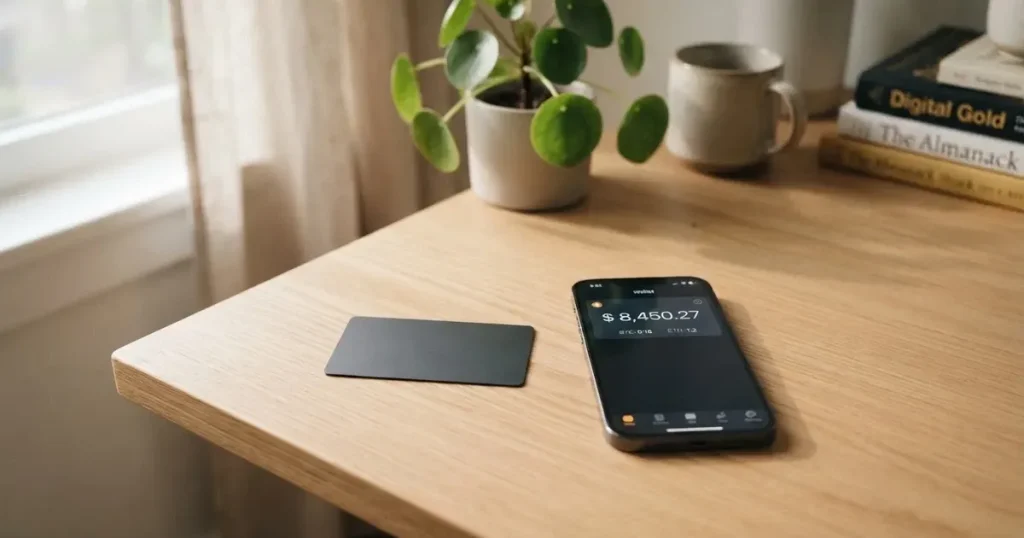
The Pionex card is not a bank account with a crypto screen bolted on. It is a prepaid payment card that draws on a USDT balance you load yourself, run by an exchange that is best known for its trading bots. That single sentence explains most of what follows: there is no annual fee, no monthly fee, no card issuance fee listed in either fee schedule — and a fairly narrow set of things it can actually do.
I scored it 4.8 out of 10. Not because it is a bad product in places, but because the card is still virtual-only, funds it in exactly one asset, and the platform behind it cancelled the cards of inactive users in batches between August and September 2026. That last part matters more than any fee on this page, and I will come back to it in full.
Who it suits: you already hold USDT on Pionex and want to spend it without selling to fiat first. Who it does not: anyone who needs a physical card in the post this month, anyone who needs to be paid into it, anyone who wants to withdraw at an ATM, and anyone whose country is on the restricted list. More on all of that below.
The conditions on this page are current as of October 28, 2026.
| Criterion | Mark | Why |
|---|---|---|
| Who can get it | 6 / 10 | Card type follows your KYC country, not your citizenship, and no country list is published; restricted regions are excluded entirely, and third-party sites disagree about EU availability |
| Cost | 6 / 10 | Annual fee and inactivity fee are both zero on both networks, Visa charges 1% per transaction with free fiat conversion, Mastercard charges “up to 3.5%”, and neither fee schedule lists an issuance fee |
| Top-up options | 4 / 10 | USDT only, from your main Pionex account or an external wallet; no networks named, no fiat top-up, no IBAN |
| Reliability and complaints | 3 / 10 | No issuer bank is named, inactive cards were cancelled in batches in August–September 2026, and Trustpilot shows 2.5 out of 5 for the exchange on frozen withdrawals |
| Everyday use | 4 / 10 | Only virtual cards are issued at the moment, Apple Pay and Google Pay are supported, the physical Visa is rolling out in phases, and Mastercard has no ATM at all |
| Total | 4.8 / 10 | A working spend tool for an existing USDT balance, on a platform that has shown it will switch products off |
Will they give you the card?
Yes, if your KYC country is one Pionex serves and you pass the level of verification the application demands. But you cannot work out from public pages exactly which country you are in that group, and the rule is not the one most people expect.
The card you receive depends on the country or region of your completed KYC, shown to you on the application page. The list of those countries is not published. Critically, this is the KYC country, not your citizenship — two people with the same passport can be routed to different cards based on where they verified. If you are in one of Pionex’s restricted regions, you cannot apply at all.
Two specific rules have changed recently. Since 14 August 2026, new Visa applications from Belarus have stopped; applicants verified in Belarus are offered a Mastercard instead. There is no Russia-specific application rule, which is not the same as Russia being open — but the payment side is restricted regardless, because payments are declined at merchants registered in or operating from Afghanistan, Venezuela, Russia, Myanmar, Ukraine, North Korea, Iran and Belarus. If you are inside one of those countries, a card that works is not the question; a card that spends is.
On availability outside the card’s own pages: third-party country pages say the card is not available in some EU countries, while the Pionex terms of service list France, the Netherlands and Spain as restricted jurisdictions — which conflicts with France and Spain appearing in the spend list above. The same third-party sources list the card as available in the UAE, South Africa, Malaysia, Nigeria and Australia, and not open in the US and Canada. None of that is confirmed by Pionex’s own card documentation, so treat it as a pointer to where to look rather than as a promise. The honest position is that availability varies, the public information is inconsistent, and the only reliable answer is what the application page shows you after KYC.
How to get it
The process is short on paper, and the gate is verification rather than paperwork. You need KYC Level 2 completed, plus account assets above a threshold that the application page shows you — an eligibility condition, not a fee. Your cardholder name can be up to 25 characters. You get one card network per user, so this is a single decision. Age is not stated.
The route through the app is Wallet, then Card, then Apply Now, then your cardholder details, then confirm. Review usually completes within an hour. One detail that catches people out: a Visa application needs an address; a Mastercard application does not. What KYC Levels 1 and 2 individually unlock, and what specific reasons get a card application rejected, are not stated.
What you actually get is a virtual card, on Visa in most regions or on Mastercard where Visa is not open. The card holds USDT, with billing at USD to USDT 1:1. Mastercard is virtual-only and valid for 2 years; Visa is valid for 5 years. The physical card is described as being rolled out in phases, and right now only virtual cards are issued. Delivery countries, delivery time, delivery cost and replacement cost are not stated — which means if you lose the virtual card and need a new one, you are reading a help article that does not tell you what that costs.
One unofficial detail worth knowing because it is confusing: a tested card came back as a virtual Mastercard even though the application screen had shown Visa artwork. The exact card you are assigned follows your account and region. What you see at the application stage may not be what arrives.
Fees: what a Pionex payment really costs
There is no annual fee and no inactivity fee on either network. Neither fee schedule lists a card issuance fee. That is the good news, and it is genuinely good — you can hold one of these without paying to keep it.

The cost lives in the transaction, and it differs sharply between the two networks. Visa charges 1% per transaction, and converting fiat to crypto is free at USD to USDT 1:1. Small payments of 5 USD or less are free once per month, then 0.2 USDT each. A failed payment costs 0.5 USDT after the first free one. Mastercard charges “up to 3.5%”, which is a ceiling rather than a stated rate, and it converts non-USD at its own rate with no separate FX markup listed — a phrase that means the rate is doing the work and the markup is inside it.
| Fee or limit | Visa | Mastercard |
|---|---|---|
| Annual fee | Free | Free |
| Inactivity fee | Free | Free |
| Issuance fee | Not listed in the fee schedule | Not listed in the fee schedule |
| Transaction fee | 1% | Up to 3.5% |
| Fiat-to-crypto conversion | Free, USD/USDT 1:1 | Not listed |
| Payments of 5 USD or less | First per month free, then 0.2 USDT | Not stated |
| Failed payment | 0.5 USDT after the first free one | Not stated |
| Non-USD currency handling | Local USD transactions carry the 1% fee | Converts at its own rate, no separate FX markup listed |
| ATM withdrawal | 2% on the physical card, not adjustable | No ATM |
| Per-transaction limit | 10,000 USDT | 20,000 USD |
| Daily limit | 10,000 USDT | 20,000 USD |
| Monthly limit | 50,000 USDT | 100,000 USD |
Now three everyday payments, so the percentages stop being abstract.
A 30 USD subscription on Visa costs 30 USDT plus 1%, so 0.30 USDT on top — about 30.30 USDT. Nothing about it feels expensive, which is exactly why the 1% goes unnoticed until you run real volume through it.
The same 30 USD subscription on Mastercard could cost up to 3.5%, which is up to 1.05 USDT. Whether you pay that depends on how the rate resolves, and nobody publishes a table showing you what the 3.5% is made of. Budget the ceiling, not the average.
A 1,200 USD purchase on Visa costs 12 USDT in fees alone, plus whatever the merchant’s local currency does to the rate. That single transaction sits comfortably inside the 10,000 USDT per-transaction and daily default, but 1,200 USD twice in a day is under the limit, and 1,200 USD fifty times in a month is not — you would hit the 50,000 USDT monthly cap and need the temporary increase, which is itself conditional.
There is one more thing the card does to your balance that no fee schedule mentions: the balance earns APY automatically and this cannot be turned off. If you load USDT you were not planning to spend, it sits there earning. Fine, as long as you know that the default is on.
On limits, Visa’s temporary raise takes you to 80,000 USDT per transaction and 500,000 USDT daily and monthly for 14 days, but only if your card balance is at least 16,000 USDT, and you then wait 30 days before reapplying. Mastercard has no increase at all: 20,000 USD per transaction and daily, 100,000 USD monthly. There is one tier and no paid plans — the limit raise is the only upgrade in the product.
Top up: the one-way street that is the whole design
Everything enters as USDT. Two routes: an internal transfer from your main Pionex account to the separate card account, or a USDT deposit from an external wallet. There is no fiat top-up, no IBAN, no bank transfer in. Networks are not named, and no deposit fee or minimum top-up is stated on either the Visa fee schedule or the Mastercard article; network fees on an external deposit are also not stated.
That last point is where transfers quietly go wrong. On a blockchain, a deposit sent to an address belonging to a network the provider does not support can be lost or need manual support recovery with no guarantee. Stablecoins exist on many chains — USDT has been issued on Ethereum, Tron, Solana, Polygon and Avalanche among others — and picking wrong here is not a fee, it is a support ticket. ERC-20 transfers also need ETH for gas: a wallet holding USDT with no ETH cannot send. Circle stopped supporting USDC on Tron in February 2024, so if you plan to arrive with USDC over TRC20, that is not a native option. And because Tether disables tokens in wallets on sanctions lists and has frozen funds tied to illicit activity, stablecoins are not censorship-proof in either direction.
The way back out is the reverse, and it has one rule worth memorising: the card cannot send crypto on-chain or to a bank card. Funds go back to your Primary Account first — in the app, Wallet, then Card, then Deposit, then Transfer; on web, Card, then Personal Card, then Transfer with From set to the Card Account — and you withdraw as normal from there. Security verification may be requested on the way. The transfer-back fee is not stated.
Two restrictions bite here. Reward-type balances, specifically Growth Fund principal and Futures Bonus, cannot be moved to the card at all. And an unpaid negative balance restricts your crypto withdrawals until it is repaid — which a third-party report describes as a negative card balance pausing withdrawals, unverified, so the mechanism is official and that particular account-level behaviour is not.
If you close the card or let it go inactive, the balance stays in the card account and moves out by that same transfer guide. Deleting and reapplying goes through a form, not an automatic process. Fee for that transfer: not stated.
Paying with it every day
The card lives inside the Pionex app under Wallet, then Card, and on the web as well. Platforms and store ratings are not stated, so I cannot tell you whether Android or iOS users have the better experience.
Apple Pay and Google Pay both work for contactless payments. Samsung Pay does not. Since only virtual cards are issued right now, in practice your everyday path is: load USDT, add the virtual card to your phone’s wallet, and tap. That works well and it is the reason a lot of people keep a card like this despite the caveats.
The headline incentive is 1% cashback on local-currency purchases and on general USD purchases, with 0% on listed excluded merchant-category and country combinations and 0% on ATM withdrawals. Cashback is credited in real time and no cap is mentioned. The separate 5% APY on your USDT card balance is credited hourly. Between the two, holding a balance pays you whether or not you spend it — and, again, you cannot switch the APY off.
Restricted-merchant notices exist for both networks, though the detail behind them is not spelled out and the gambling merchant-category treatment is not stated. If something is declined, the merchant-category code is the place to look: it is a four-digit classification assigned when a business starts accepting cards, and issuers block specific codes by policy rather than by law, with the blocked list varying by issuer.
Refunds are slow and that is structural, not a Pionex choice. Refund clearing generally takes 3 to 30 days and is released automatically; support cannot release it early. Pre-authorization holds are released within 7 business days after the merchant finalises. VAT refunds take about 3 to 5 business days, sometimes a few weeks. A refunded transaction fee comes back only where the transaction shows “Payment Reversal” status — so a partial refund may leave your fee spent.
The dispute path is the part to read twice. A Visa dispute costs 50 USDT per case, paid regardless of outcome. Arbitration costs 600 USDT, and only if you lose. You also need at least 650 USDT available in your main account as a temporary deposit. For a 40 USD transaction, that setup costs more than the transaction. If a payment failed but you were still charged, the route is to ask the merchant for a refund and then give support the ARN.
For context on why any of this can happen at all: a card number starts with a six- or eight-digit issuer identification number that tells merchants which institution and country issued it, and some merchants apply extra scrutiny when that country differs from the billing address. Some also decline prepaid or foreign-issued cards outright. Address verification is mostly unavailable for foreign-issued cards, which is a common source of declines. Declined authorisations can also leave a hold on your funds for days.
What can go wrong
Start with the one I would weigh heaviest, because it is not a fee and it is not a rule — it is a decision that was already taken.
Pionex cancelled the cards of inactive and rarely used users in batches between August and September 2026, some of them without notice. According to the platform’s own communications, the cancellation is irreversible, you cannot reapply, and the balance stays in the card account. There is also a “Pionex Mastercard Temporary Maintenance Notification” article in the help centre. A card product that can be switched off in batches, on the platform’s own initiative, is a different proposition from a card product where only you can close your own account.
The second is who is actually behind it. The issuer bank is not named anywhere in Pionex’s public card material. For some Mastercards, help articles refer to a “Dogpay channel (BIN 5371)” and note that those cards cannot pay merchants in South Africa. Pionex’s company registration and licences are not stated. Third-party sources in October 2026 also could not name an issuer bank or a licence. That is not a scandal — plenty of programmes are run under licence without the front page naming the bank — but it means you cannot verify the chain of responsibility from Pionex’s pages alone.
Third, the balance sits with the custodian. Funds are held in a card account inside your Pionex exchange account, not in a wallet you control, and this carries counterparty risk that is not hypothetical: Mt. Gox (about US$350 million reported stolen, 2011–2014), Coincheck (about US$400 million, 2018) and the Ronin Network (US$625 million, 2022) are the reference points for anyone holding funds with someone else. Blockchain transfers are typically irreversible and a stolen key has no recovery path.
Fourth, the controls are good but they are not complete. You can freeze and unfreeze instantly in the app under More, then Freeze. A risk-control freeze can only be lifted by customer support. Security Authentication is required to view card details and at checkout. Payment SMS codes can be switched to in-app authorization. But freezing does not cancel merchant subscriptions — so if you froze because you think the card is compromised, any recurring charge you set up before the freeze keeps running until you cancel it at the merchant. Insurance or safeguarding arrangements, and the two-factor specifics, are not stated.
Fifth, the complaints. Trustpilot shows Pionex (the exchange, not the card) at 2.5 out of 5 from about 600 reviews, 124 of them in the last 12 months, read on 20 October 2026. The themes: frozen withdrawals and trading after profits, where the company’s replies point to a risk team; account closure with a refund scheduled 2 months out; and a card charged for a transaction the merchant declined, with no refund. Coin Bureau listed 2.3 out of 5 in August 2025 with withdrawal complaints. Users also report frozen withdrawals, an account closure with a refund delayed 2 months, and a Visa dispute where Pionex asked for extensive purchase history — that one is not card-specific. Support is named only as “Pionex Customer Support”, with no chat address, email or hours listed in the card articles, though the help centre is published in six languages: English, German, Russian, Spanish, Simplified Chinese and Traditional Chinese.
And a category-level risk that applies to any card of this shape: Visa and Mastercard do not issue crypto cards to consumers themselves — they license issuers and can suspend a programme. Visa terminated its global agreements with FTX on 13 November 2022 and the FTX US debit card was wound down. WaveCrest, a Visa issuer that supplied crypto card brands, was suspended by Visa in Europe in 2018, closing all its Visa programmes. Programme closures typically mean a notice period, then spending and loading stop, then users are asked to withdraw remaining balances.
What to take instead
None of the alternatives below publish the basics clearly enough for me to score their fees honestly, and I would rather say that than guess. What I can give you is where each one is stronger on the thing that made me score Pionex’s reliability at 3.
| Option | Score | What it says about itself | Where it looks stronger than Pionex |
|---|---|---|---|
| Pionex | 4.8 / 10 | This review | — |
| Young Card | 5.7 / 10 | Eligibility, fees, card type and funding are not stated officially; cashback is paid in YNG tokens at 0.1% Essential, 1.8% Gold, 3.6% Platinum by club tier | Published reward tiers, though denominated in a platform token |
| MSX | 6.4 / 10 | Eligibility, card, fees and funding are not stated on any official page I could read | A higher score, but from a card with no public documentation — treat the gap as a question to ask, not a quality signal |
| Bybit Card | 6.0 / 10 | Virtual and physical, region-by-region networks and currencies, tiered cashback up to 10%, published fee schedules | The most transparent fee and reward documentation of the four, and physical cards are live in most of its regions |
Bybit is the one I would actually look at first if a physical card in your hand matters. It publishes per-region networks and currencies: Argentina Mastercard prepaid, Mastercard credit card for AIFC, Georgia, Kazakhstan, Australia and Mexico, Visa prepaid for Brazil and Peru, Visa credit for Asia Pacific. Validity runs three years in several regions, six in Argentina, five in Brazil, Mexico and Peru. Virtual card issuance is free in all regions until further notice, the cards page states auto interest and no annual fees, and physical issuance runs from none in Brazil and Mexico up to 29.99 USD in Australia. Conversion fees are 0.9% over the One-Click Sell rate in most regions, 0.5% in Argentina, with FX fees from 1% in Brazil and Peru up to 7% in Argentina.
Its rules are also firmer and worth reading as a model: the card is not meant for European Economic Area customers and EEA participation is strictly prohibited; the application asks for country of residence, and unsupported countries get a registered-interest response rather than a card; the card currency depends on the country of your Advanced Identity Verification; and the card has no balance of its own — it draws on the Funding Account, spending fiat first and selling crypto only when fiat runs out, with a coin priority list you can reorder in the dashboard. One detail that tells you what kind of company you are dealing with: since 5 October 2026, only crypto-funded transactions earn points or cashback, and fiat-funded spending does not.
What Bybit costs you is less clarity on the geographic side for the countries Pionex’s spend list touches — its restricted list for fiat services names Belarus, the Russian Federation, Serbia, China and the United States, with Russian users able to make only RUB transactions in fiat, though that is the fiat-service list and not the card itself. No card-specific statement on Russian or Belarusian citizens was found, and no citizenship-versus-residence rule is published.
Who I would recommend it to
You, if all four of these are true. You already hold USDT on Pionex. You spend in small-to-medium amounts, mostly by phone. You are verified in a region Pionex serves, and you checked the application page rather than trusting a third-party country list. And you accept that this is a virtual card today, on a custodial balance, from a platform with a documented history of cancelling inactive cards in batches and a 2.5-out-of-5 review score on the exchange itself.
Even then, keep the balance you do not need for the week off the card. Load, spend, unload. The transfer back is free of published charges and takes one step in the app, and it keeps the number that matters — how much a platform decision can cost you — small.
I would steer you elsewhere if you need cash, a physical card, a Mastercard rather than a Visa, more than 20,000 USD a day, a fiat top-up, a card that can be topped up by SEPA or card-to-card, or any provider that will tell you its issuer bank. And if you are in France, the Netherlands or Spain, the terms of service list you as restricted while France and Spain appear in the spend list — go and ask Pionex directly before you build any plan around it.
The single number I would hold on to: 4.8 out of 10. Not because spending USDT is a bad idea, but because the fee is small and the dependencies are large.
Frequently asked questions
What is the Pionex card?
It is a prepaid Visa or Mastercard that draws on USDT you have loaded into a separate card account. You cannot pay in with fiat, and you cannot send crypto from the card — it spends, and you move funds back to your main account afterwards. The card type follows the country of your completed KYC, not your citizenship.
Is Pionex a bank?
Not as far as its card pages tell you, and the public material does not settle it. The issuing bank is not named; some Mastercard help articles refer to a “Dogpay channel (BIN 5371)”. Pionex’s company registration and licences are not stated. Treat Pionex as an exchange that administers a card programme, not as a bank.
Does the Pionex card require KYC?
Yes, KYC Level 2, plus account assets above a threshold the application page displays. Reviews usually complete within an hour. A Visa application also asks for an address; a Mastercard application does not. What the lower KYC levels unlock, and why a specific application is refused, is not stated.
How do I top up the Pionex card?
Two ways: transfer USDT from your main Pionex account to the card account, or deposit USDT from an external wallet. There is no fiat top-up and no IBAN. Networks are not named, so pick the chain carefully — a deposit to an unsupported network can be lost or need manual support recovery with no guarantee.
Is the Pionex card free?
There is no annual fee and no inactivity fee on either network, and neither fee schedule lists an issuance fee. Spending is what costs: 1% per transaction on Visa, “up to 3.5%” on Mastercard, plus 0.2 USDT on small payments of 5 USD or less after the first free one each month, and 0.5 USDT for a failed payment after the first free one.
Can I use the Pionex card in the United States?
Not according to the third-party country sources, which list the US and Canada as not open. Pionex’s own card pages do not publish a country list. Separately, payments are declined at merchants registered in or operating from Afghanistan, Venezuela, Russia, Myanmar, Ukraine, North Korea, Iran and Belarus.
Does the Pionex card work in Apple Wallet?
Apple Pay and Google Pay are both supported for contactless payments; Samsung Pay is not. Since only virtual cards are issued right now, adding the card to your phone’s wallet is the main way most people will use it. The physical Visa is being rolled out in phases, with delivery countries, time and cost not stated.
Is the Pionex card safe?
It is custodial: the USDT sits in a card account inside your exchange account, so you carry counterparty risk the same as any balance held on an exchange. You do get instant freeze and unfreeze in the app and security authentication on card details and checkout — but a freeze does not cancel merchant subscriptions, and a risk-control freeze can only be lifted by support.
Is the Pionex card worth it?
Worth it if your spending is USDT-denominated anyway and you load and unload in small amounts. Not worth it if you need a physical card today, an ATM, more than 20,000 USD a day, or a provider willing to name its issuing bank. The inactive-card cancellations between August and September 2026 are the reason I would keep only what I am spending that week on it.
Why was my Pionex card cancelled?
The most likely explanation, based on the platform’s own communication, is that the card was inactive or rarely used. Pionex cancelled such cards in batches between August and September 2026, some without notice, and the process is described as irreversible with no route to reapply. The balance stays in the card account and moves back to your Primary Account by the same transfer guide you would use normally.
Exchange cards put to the test – cryptocardtested
Content created by the «cryptocardtested» team