
A dollar card on a crypto balance, with the gaps in the small print
 Available in US
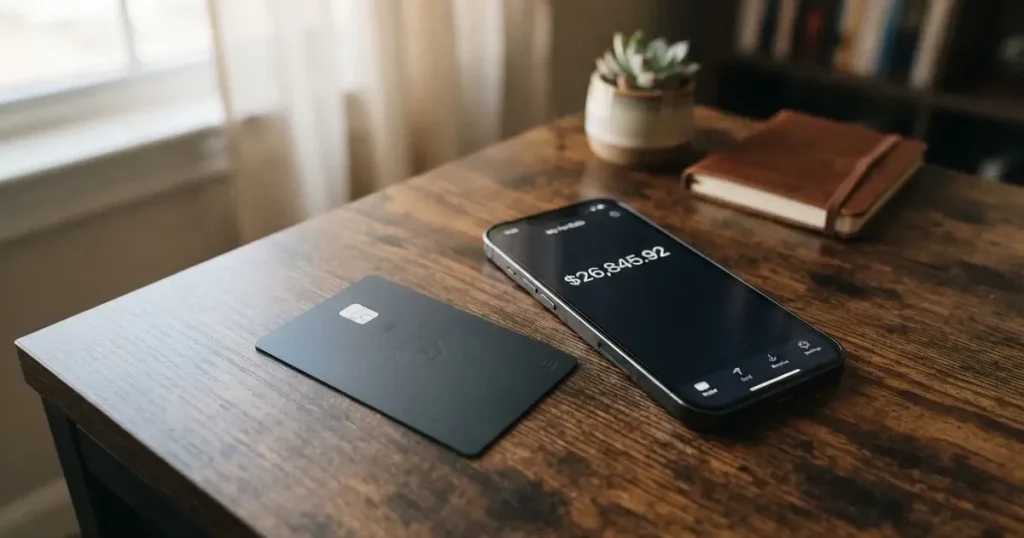
Plasma One is a Visa card that spends a dollar balance you load yourself, wrapped in an app that also lets you hold and lock the crypto token XPL. That combination is the whole pitch in one line, and it explains both the appeal and the frustration. On one side you get a card that works in shops, in Apple Pay and on Google Pay, pays cashback in XPL, and — on the highest tier — will not charge you the fee Visa normally takes on currency conversion. On the other side, the card is offered by a company that describes itself as a financial technology company and explicitly not a bank, and a good deal of what you would want to know before signing up is not published anywhere I could read.
I gave it 7.1 out of 10. That is a good score, not a great one, and it is worth being precise about why. The product does the basic job well and its costs are unusually transparent. What holds it back is not a defect in the card; it is the gaps around it — no published country list on the pages I could read, no published ATM terms, no published spending limits, no published delivery information for the physical card, and a tier system whose prices live in a help centre rather than on the front page. Those gaps matter most to exactly the people most likely to be drawn to a card like this: people who do not have an ordinary bank card, or who want a dollar balance they control outside a traditional bank’s system.
The conditions described here are current as of October 28, 2026.
| Criterion | Mark | Why |
|---|---|---|
| Who can get it | 7 / 10 | Residence decides everything, and the supported countries are not published; the terms restrict a long list including Belarus, India, Israel, China, Russia, Turkey, Ukraine and Vietnam, plus Cuba, Iran, North Korea |
| Cost | 8 / 10 | Lite with a card costs nothing and the card “does not charge any additional fees”; FX outside USD is up to 1%, cross-border is 0%; Core and Platinum are paid or require locking XPL |
| Top-up options | 7 / 10 | Local currency in, dollars out, plus unofficial reports of USDT, USDC and USDG on listed networks and USD, EUR, GBP, MXN, BRL, COP accounts, with withdrawal to a bank or wallet |
| Reliability and complaints | 6 / 10 | Emitted by Rain, a Visa member, with services through Bridge; Plasma is not a bank; collateral on the card can be liquidated after non-payment; Trustpilot shows 3.4–3.5 from just two reviews, one complaining about changed terms |
| Everyday use | 7 / 10 | Virtual and physical Visa, Apple Pay and Google Pay; unofficial reports suggest the physical card may be Platinum-only and say nothing about cash withdrawals |
That 6 in the reliability column is doing a lot of work, and it is not a judgement about reliability I can make from outside. It is a discount for how little is verifiable. Two Trustpilot reviews cannot tell you whether a service is good or bad; they can only tell you that nobody has written much in public. The single negative review says the terms and the arbitration body changed after the reviewer raised problems, and that advertised Platinum benefits were not in the published tier. Whatever the reason, that is exactly the kind of finding you want to see before you lock up tokens for twelve months, not after.
Who this suits, plainly. Someone who already holds dollars or dollar-pegged stablecoins, who is comfortable with an app that converts and settles, and who values a virtual card in their wallet over physical plastic. Someone who spends mostly in USD or is happy paying up to the stated 1% on foreign currency. Someone who wants cashback in a token rather than in dollars and does not mind the token’s price moving against them. And someone who reads tier terms closely, because the differences between the three tiers are large and the price of the upper two is not on the public pages.
Who it does not suit. Anyone in a restricted or unlisted country who would have to guess. Anyone who needs cash from ATMs and cannot find published terms — the terms say ATM withdrawals earn no rewards and that Spending Credit cannot be applied to them, but the fee and allowance are not stated. Anyone who wants deposit protection: the card’s stablecoin balances are not bank deposits and are not covered by the FSCS or FDIC, and Plasma says so itself. And anyone planning to close an account while XPL is locked, because locked XPL cannot be unlocked early and the account cannot be closed while a lock is active. That last one is not a small print detail. It is a twelve-month commitment with no exit, and it is the single most important thing to read before you deposit.
Will they give you the card?
Short answer: it depends on where you live, and the card’s own public pages do not tell you the list.
Plasma’s site states that “Geographic, regulatory, and other eligibility limits apply, and are subject to change” without enumerating them. Account services are residence-based, and different Bridge entities serve US residents, EEA residents and everyone else. So your address, not your nationality, is the first gate.
What the terms do publish is a restricted-jurisdictions appendix. It says that users “located in or connected to” certain places may be restricted, and that the list is not exhaustive. The named jurisdictions are Afghanistan, Belarus, Bosnia and Herzegovina, Central African Republic, China (Mainland), DR Congo, Guinea, Guinea-Bissau, Haiti, India, Iraq, Israel, Libya, Mali, Myanmar, Nepal, Nicaragua, Russia, Somalia, South Sudan, Sudan, Syria, Turkey, Ukraine (outside the Crimea, Donetsk, Luhansk, Kherson and Zaporizhzhia carve-out), Venezuela, Vietnam, Yemen and Zimbabwe, plus Cuba, Iran and North Korea. The language used is “located in or ordinarily resident in”. I saw no citizenship rule in those terms — but the international card terms separately ask you to attest that you are not a US citizen, so citizenship does enter the picture at the attestation stage even where residence is what selects the servicing entity.
Then there are the numbers floating around on third-party sites, and I would treat them all as unofficial. One says available in 188 countries with seven restricted; another lists only the United States; a third says 150+ countries excluding the US. They disagree with each other, and two of them name Russia and Belarus among those who may still qualify with proof of residence in a supported country — which directly contradicts the card’s own appendix, where both appear. When official terms and aggregators conflict, believe the terms. So: expect the supported-country list to be narrower than the headlines imply, expect an invite in at least some cases, and expect US availability to be partial rather than nationwide.
One structural detail worth knowing, because it explains some of the confusion in reviews: a card’s first six or eight digits identify the issuing institution and country, and merchants can look them up. A card issued in one country can therefore look “foreign” to a shop in another, and some merchants decline prepaid or foreign-issued cards on that basis alone. If a payment of yours is refused in a country where the card is officially accepted, this is often why.
How to get it
The signup pitch is speed: “Get a card you can add to your wallet in minutes”. In practice there is identity verification, you must be 18 or over, you may open one Card Account per person, and you cannot be under US, UK or EU sanctions.
That is the whole of the official description. The card does not publish its verification levels, how long each takes, or why an application gets rejected — so if you are refused you will probably get a refusal rather than a reason.
Third-party reporting, unofficial and not confirmed by the card, describes the usual shape of this kind of flow: legal name, date of birth, government ID, residence and address, a liveness video, and proof of address in some countries, with automated checks typically completing in up to five minutes and a human review on request. Take that as a rough expectation, not a promise.
The card itself comes in two forms, virtual and physical, on Visa, “issued by Rain, a Visa Principal Member”, accepted in 180+ countries, with a USD account — the site’s own words for it are “Add local currency. Get dollars”. One thing you should know before you pay for anything: the terms say cards are activated through the Plasma One app, and that replacement cards may come with new numbers. So do not treat the card number as something permanent.
The physical card is where the uncertainty is thickest. Delivery countries, time and cost are not stated in the terms I read, and third-party reporting says — unofficial, not confirmed by the card — that the physical card is available on Platinum only and that the Core physical card is not confirmed as live. If the plastic matters to you, that is the first thing to ask support, in writing, before you commit to a tier.
Fees: what it really costs
The headline is unusually clean: “Plasma One does not charge any additional fees”. The catch is in what follows it. Partner fees are shown in the app before you confirm a transaction, and Cash Out “may carry processing fees and minimums” that are not specified. The Foreign Exchange number and the tier prices are where the real money is.

| Fee or limit | What the card states | What third parties say (unofficial) |
|---|---|---|
| Card cost | Lite is $0 for the card; tiers are Lite, Core, Platinum with fee levels of standard, reduced, none added; tier prices not stated on public pages | Core $199/year or a lock of 20,000 XPL for 12 months; Platinum a lock of 100,000 XPL for 12 months, with the Help Center calling it a launch rate rising to 150,000 XPL. Sources differ on the Core price |
| Monthly fee | Not stated | Bleap reports an annual fee of $0–$120/year, or an XPL lock |
| Conversion | “Plasma One does not charge any additional fees”; partner fees shown in app before confirming | Plasma’s own FX markup reported as 1% (Lite), 0.5% (Core), 0% (Platinum), with roughly 1% Visa network FX possibly applying on top |
| Foreign exchange | Up to 1% for non-USD, 0% cross-border, 0% APR on purchases; Platinum covers the Visa FX fee | Bleap reports about 2% FX fee on non-USD spend |
| ATM | Not stated. ATM withdrawals earn no Rewards and Spending Credit cannot be applied to them | Fees, withdrawals and limits not published for any tier; Bleap says a virtual-only Lite cannot be used at ATMs |
| Spending limits | Not stated as dollar amounts. Plasma sets limits based on collateral and can change them, including down to $0, at any time; cash-like transactions may be restricted | Daily limits adjustable in the app, effective within about a minute, with no universal maximum published |
| On-ramp and off-ramp | Cash Out may carry processing fees and minimums, amounts not specified | USD ACH on-ramp $1.00 / $0.50 / $0.50 by tier, wire $15 / $15 / $10; USD ACH off-ramp 0.75% / 0.35% / 0.10% plus an ACH fee. New York residents reportedly cannot use fiat rails |
Take three ordinary payments and see what survives.
A coffee in your own currency on Lite. The card says up to 1% on non-USD and 0% cross-border, and third-party reporting puts Lite’s own markup at 1% with roughly 1% of Visa network FX possibly on top. If both apply, that is a small pile-up on a small bill — the percentage hurts more than the absolute amount, which is why a 1%-plus fee on a $4 coffee is a poor trade and the same fee on a monthly subscription is not.
A subscription paid in USD. This is the clean case, and it is why the card exists. 0% cross-border, 0% APR on purchases, no added fees. You get cashback in XPL on top, at 2% base on Lite, 3% base or 5% AI on Core, and 4% base or 10% AI on Platinum, with up to USD 600/year flight cashback at the top tier. Read those rates as tier-dependent and changeable, because the card says they are.
Cash from an ATM, anywhere, any tier. Here the card is close to silent: no fee, no allowance, no number. You get two things you can verify — no Rewards, no Spending Credit — and one hard caveat from unofficial sources that a virtual-only Lite may not work at ATMs at all. If cash is part of your week, treat this as an open question and ask before you rely on it.
A note on what you are actually buying when you pay a tier. Core and Platinum are not sold as flat prices alone. Core unlocks through an annual USD subscription or a twelve-month XPL lock; Platinum only through an XPL lock. The help centre’s launch rate applies to the first thirty days, after which the amount is set in the Help Center — so the number in front of you today may not be the number you lock at. And a lock is not a purchase: it cannot be broken early, and while it runs the account cannot be closed. If the token price falls during those twelve months, you have bought a tier at yesterday’s valuation. That is the risk the tier prices do not mention.
How to top it up
Top-up is the part Plasma explains best, and it is also where the practical detail lives in the app rather than on the page. The flow is: add local currency, receive dollars, spend the dollars. Withdrawals go to a bank or a wallet through in-app off-ramps where available, and the rails depend on your region. USDT is mentioned for transfers, though the networks are not stated on the pages I read.
The cost story is consistent: top-up fees and minimums are not stated, the card “does not charge any additional fees”, and partner fees on some currency-exchange and bank-withdrawal transactions appear in the app before you confirm. Cash Out “may carry processing fees and minimums”. So the rule of thumb is simple and unglamorous — read the confirmation screen, every time, because that is where your actual cost is disclosed.
Third-party detail, unofficial and not confirmed by the card: deposits in USDT, USDC and USDG on listed networks usually land within five minutes; fiat virtual accounts in USD, EUR, GBP, MXN, BRL and COP are converted to USDT; and New York residents cannot use the fiat rails. If your money comes from a bank account in one of those six currencies, that is a materially better route than buying a stablecoin yourself first.
Two things to be careful about, both of them general to this kind of card rather than specific to Plasma. The first is the network. Blockchain transfers are irreversible, so a deposit sent on a network the provider does not support, or to an address belonging to a different network, can be lost entirely — recovery is a manual support request with no guarantee. The second is that on chains like Ethereum, fees are paid in ETH, so a wallet holding USDT and no ETH cannot send. On Tron, fees work differently, burning TRX through bandwidth and energy. Before your first transfer, confirm in the app which network your asset must go on.
One design point worth internalising before you fund anything: a pre-loaded balance card cannot overdraw, because the balance you loaded is all the balance there is. That is reassuring in one direction and unforgiving in the other. There is no credit line to absorb a mistake, and if your collateral is liquidated after non-payment, the loss is real.
Paying with it every day
Day to day, this is a competent card. Virtual and physical Visa, Apple Pay on iPhone and Google Pay on Android, with availability depending on region, and the card accepted in 180+ countries. The apps exist for iOS and Android — though the site publishes no store ratings, and I found none on 20 October 2026, so “good app” is an impression I cannot verify for you.
The rewards are the reason to stay. Cashback arrives in XPL, not in dollars, which is the trade you are making: a token that can move against you in exchange for a percentage. The rate depends on your tier — 2% base on Lite; 3% base and 5% AI on Core; 4% base, 10% AI and up to USD 600/year flight cashback on Platinum — and the card states plainly that rates vary by tier and may change.
Apple Pay is worth using rather than digging out the card. It replaces the card number with a device-specific number stored in the phone’s Secure Element, never on Apple’s servers, and every payment carries a one-time dynamic code. The issuer can still restrict the tokenised number — blocking it for online, contactless or magnetic-stripe use — so if one channel stops working, check the app before assuming the card is dead.
When something goes wrong, the card says its team helps dispute unauthorised charges and issues a replacement card. One deadline matters: a disputed charge must be reported within 60 days after it posts to your statement. In the US, debit reversal rights come from Regulation E; prepaid-card coverage varies and should not be assumed, so treat that 60-day window as the hard edge rather than the expectation. A declined payment can also leave a hold on your funds for several days, typically up to seven, which is worth knowing before you try a second card in the same shop.
Online payments will usually involve 3-D Secure, branded Visa Secure — an extra identity check on the card, sometimes frictionless, sometimes a one-time code or a biometric prompt. And a warning about US merchants specifically: address verification compares the numeric parts of the billing address you type against issuer records, and it is largely unavailable for foreign-issued cards. That produces declines that have nothing to do with your balance.
What can go wrong
Start with the structural risks, because they are the ones you cannot fix later.
Plasma describes itself as a financial technology company and says plainly that it is “not a regulated financial institution, bank”. The card is issued by Rain, a Visa Principal Member, and the account services are powered by Bridge. So you are dealing with a card programme managed by a non-bank on top of an issuer — a structure that works, and that plenty of people use happily, but it is not the same as the balance sitting in a deposit-taking bank.
The money side deserves precision. Per the card’s own FAQ, you hold custody — Plasma does not custody assets. The card is described as a collateral-backed account, and the card states that collateral can be liquidated after non-payment. That is the sentence to sit with: if you overextend against your collateral and do not make it right, the collateral is gone. Combined with a tier lock you cannot exit early, the position is that both your funds and your locked tokens carry a time commitment with a penalty for breaking it.
Deposits are also not bank deposits. The card states that stablecoin balances are not covered by the FSCS or FDIC. In Europe, an electronic money institution must safeguard customer funds by segregating them or insuring them — but safeguarded funds are not bank deposits and may not fall under a deposit guarantee scheme. That distinction is worth keeping in your head whenever a card page uses reassuring language.
On security, the card names its compliance posture — “PCI DSS v4.0.1 Level 1 Service Provider – SAQ D” — and offers instant card freeze and account lock in the app, which are the right tools. Support is “available 24/7” at [email protected], with the level depending on your tier: standard, priority or VIP. The site language selector shows English only, which is worth noting if you are comfortable in another language and would rather not rely on it.
On history: I found no official record of incidents involving this card. That is a genuinely good sign, and it is also a short record. The public complaint picture is thin — Trustpilot shows roughly 3.4–3.5 out of 5 from two reviews only, and the company has not invited reviews. The critical review says the terms and the arbitration body changed after the reviewer flagged issues, and that advertised Platinum benefits are not in the current published tier. The positive review from July 2026 praises the cashback, low fees and virtual card but notes there was no physical card yet and that it was a private beta with an access key. I found no Reddit threads and no store-rating data. Two reviews is not a track record; it is a sample of two.
Two timing facts, so you can place the current terms. They took effect on 26 February 2026, naming Third National in the defined terms and Rain in a footnote. And an Android Core promotion of six months free ended on 21 July 2026 — so if you have read a review offering that, it is out of date.
Finally, the category risks that apply to any card of this type, and they are not hypothetical. Visa terminated its global agreements with FTX on 13 November 2022 and the US debit programme was wound down by its issuer. WaveCrest, a card issuer that supplied several crypto card brands, was suspended by Visa in Europe in 2018, closing all of its Visa programmes. Programme closures tend to follow a pattern: a notice period, then loading and spending stop, then you are asked to withdraw what is left. On closing the account, the issuer may suspend or cancel at any time, withdrawing your collateral does not end outstanding obligations, and Spending Credit is not cash — it is forfeited if the account closes.
What to take instead
Three alternatives, none of them clearly better, each strong somewhere Plasma is weak.
MetaMask Card — also 7.1 / 10. Sign-up is open in 45 listed countries and territories, with proof of residency required; other regions join a waitlist, and US and UK sign-ups are temporarily closed. It is a Mastercard, virtual first and instant, with a metal version you can pre-order after approval. The virtual card is free with no annual or maintenance fee; metal is $199/year. It spends directly from your connected wallet on Linea, Base, Monad or Solana, holds mUSD, wETH, EURe, GBPe, USDC and USDT, and has no foreign transaction fee — the Mastercard rate applies. Cashback is paid in mUSD: 1% on virtual, and on metal a headline 3% that the footnote caps at the first $10,000 spent, then 1%. The one real caveat: Solana-only wallets cannot withdraw credit.
KAST — 6.1 / 10. Its residency rule is stated more clearly than most: if your country is not listed at KYC, KAST is not available there. The list itself is not published, and a Restricted Locations list is referenced without naming countries. Note also that living in a supported country while holding an ID from a restricted region can still make you ineligible. Pricing is the honest part: Standard is 0 USD a year, Premium 1,000 USD, Private 10,000 USD, billed annually upfront; extra virtual cards are 2 USD; the Standard physical card is 0 USD plus 40 USD delivery; there is a 1 USD/month inactivity fee after twelve months. Fees: stablecoin top-up 0%, USD spend 0%, non-USD FX 0.5%–1.75% depending on country, non-USD transactions under 25 USD cost 0.10 USD, and a declined transaction costs 0.50 USD. Cashback in USD is 1.5% on the first 2,000 USD/month (Standard), 2% on the first 10,000 (Premium), 3% on the first 40,000 (Private). One internal inconsistency to know about: the app lists USDT, USDC, PYUSD and RLUSD, while the Terms say acceptable tokens are “currently USDT and USDC”.
TokenPocket — 5.8 / 10. A Mastercard or Visa debit card depending on where you are, running on Arbitrum, with balances in EUR24 and USD24 and virtual Fiat24 cards. One 1% fee on crypto deposits, refunded later through rewards or reduced transaction fees, and otherwise “no additional fees”. Region coverage is split between a list of European countries and a separate Asia-Pacific set, with the Americas described as planned. Its own tier list, cashback and fee handling are less developed than either card above, which is why it scores lower.
| Plasma One | MetaMask Card | KAST | TokenPocket | |
|---|---|---|---|---|
| Score | 7.1 / 10 | 7.1 / 10 | 6.1 / 10 | 5.8 / 10 |
| Network | Visa | Mastercard | Visa | Visa / Mastercard |
| Entry price | $0 on Lite | Free virtual, $199/year metal | $0 Standard | Not stated beyond the NFT creation fee |
| Rewards | 2% base on Lite, in XPL | 1% virtual, up to 3% metal, in mUSD | 1.5%–3% USD cashback on capped monthly spend | None stated; deposit fee refunded via rewards |
| Foreign exchange | Up to 1%, 0% cross-border | No FX fee, Mastercard rate | 0.5%–1.75% | Not stated |
| Where it is strongest | Dollars in, card out, XPL cashback | Free virtual card, wallet-native spending | Published annual tiers, cashback in dollars | Low headline fees, Arbitrum support |
The pattern worth noticing: the cards that score lowest are not worse products, they are less complete ones. And the card that beats Plasma on transparency is not obviously better on trust — KAST publishes its fees precisely because its model is straightforward, whereas Plasma publishes little for reasons nobody outside the company can fully explain.
Who I would recommend it to
I would recommend Plasma One to someone who already has dollars or dollar-pegged stablecoins, who wants a Visa virtual card in their wallet within minutes rather than a plastic card in the post, and who is deliberately choosing to hold XPL and get paid in it. If your spending is mostly in USD, the economics here are close to free and the cashback is real. If you spend abroad a lot, budget the 1% and consider whether the tier that covers the FX fee is worth a twelve-month token lock for someone in your position — for a lot of people the answer is yes, because the lock is the price of the best fee structure available.
I would not recommend it as your only card, and I would not recommend it to anyone who needs to know their ATM fee, their delivery time, their spending ceiling or their exact tier price before they commit. The information exists — mostly in the app, in the Help Center, and in the support inbox — but it does not exist in one place, and a card you cannot price from the public terms is a card you are taking on someone else’s word. Ask support the four questions that matter: what my total tier cost is for my country, what my ATM fee and allowance are, how long physical delivery takes and where it ships, and what happens to my lock if I close the account. Then read the answers before you transfer anything.
The honest summary is that this is a competently built, reasonably priced card with thin documentation and a tier system whose real cost is locked in a token. For the person I described first — dollars in, card out, comfortable with that trade — it works. For everyone else, the questions are worth more than the card.
Frequently asked questions
What is Plasma One?
Plasma One is a Visa payment card, virtual and physical, that spends a dollar balance you load yourself, issued by Rain, a Visa Principal Member. Around it sits an app for holding and locking the crypto token XPL, and cashback is paid in XPL rather than dollars. Three tiers exist: Lite, Core and Platinum. Plasma describes itself as a financial technology company and states it is not a bank.
How does the Plasma One card work?
You add local currency, receive dollars into a USD account, and spend that balance. Because it works like a prepaid card rather than a debit card, it draws on a stored balance and cannot overdraw. Cashback in XPL accrues on purchases, with rates set by tier. You can add the card to Apple Pay or Google Pay and withdraw to a bank or wallet through in-app off-ramps.
Is Plasma One a bank, and who is behind it?
No. Plasma calls itself a financial technology company and explicitly “not a regulated financial institution, bank”. The card is issued by Rain, a Visa Principal Member, and account services are powered by Bridge, with different Bridge entities serving US residents, EEA residents and others by residence. Your collateral backing the card can be liquidated after non-payment.
Who can get a Plasma One card?
Eligibility turns on residence, and the supported-country list is not published on the public pages I could read. The Terms of Service appendix names restricted jurisdictions including Belarus, India, Israel, China (Mainland), Russia, Turkey, Ukraine and Vietnam, plus Cuba, Iran and North Korea, and says the list is not exhaustive. Age 18+, one account per person, and no US citizen attestation in the international terms.
What does Plasma One cost?
Lite costs $0 for the card, and the card states it “does not charge any additional fees”, though partner fees are shown in the app before you confirm and Cash Out may carry processing fees and minimums. Foreign exchange is up to 1% on non-USD with 0% cross-border and 0% APR on purchases. Core and Platinum require an annual subscription or a twelve-month XPL lock; those prices are not on the public pages.
How do I top up the Plasma One card?
Officially: add local currency and receive dollars, with withdrawal to a bank or wallet through in-app off-ramps where available. Third-party reporting, not confirmed by the card, describes USDT, USDC and USDG deposits on listed networks and fiat accounts in USD, EUR, GBP, MXN, BRL and COP. Check the network before sending — transfers are irreversible, and the wrong one can be lost.
Can I use Plasma One at ATMs and how much can I spend?
ATM terms are not published. The card does state that ATM withdrawals earn no Rewards and that Spending Credit cannot be applied to them, and unofficial sources suggest a virtual-only Lite may not work at ATMs at all. Spending limits are set by Plasma based on collateral and can be changed or reduced to $0 at any time, with no dollar maximums published.
Is the Plasma One card safe, and is my money protected?
The card describes self-custody — you hold the keys — and offers instant card freeze and account lock in the app, plus a stated PCI DSS v4.0.1 Level 1 Service Provider – SAQ D posture. But stablecoin balances are not bank deposits and are not covered by the FSCS or FDIC, and Plasma is not a bank. Treat the balance as your own responsibility, including the collateral-liquidation risk.
What happens if I want to close my account?
The issuer may suspend or cancel the account at any time. Withdrawing collateral does not end outstanding obligations, and Spending Credit is not cash — it is forfeited if the account closes. Critically, locked XPL cannot be unlocked early and the account cannot be closed while a lock is active, so a twelve-month tier lock is a real commitment with no early exit.
Is the Plasma One card worth it?
For someone already holding dollars or dollar-pegged stablecoins who wants a virtual Visa quickly and is comfortable holding XPL, the costs are close to free and cashback is a genuine addition. It is harder to recommend to anyone who needs published ATM terms, published spending limits, published delivery details or a clear tier price — and impossible to recommend if you need cash regularly or want deposit protection.
Wallet cards put to the test – cryptocardtested
Content created by the «cryptocardtested» team