
Renegade, checked honestly: a euro IBAN and a virtual card, sold by a company that says it is not a bank
 Available in US

Renegade promises something that is genuinely hard to get: a euro IBAN and a payment card in one app, paid for from a crypto balance, with no plastic to wait for. That promise is real in the sense that the product exists and can be downloaded today. What I could not find is the layer of paperwork that usually sits under it. The company says in its own terms that it is “NOT a bank” and does not yet provide regulated services, and will apply for licences first. There is no list of countries you can open the account from. There is no physical card. And the entire public complaint record on Trustpilot is one review, one star, from a user who says the roadmap was promised and not delivered.
My score is 4.1 / 10. That is not a score for a scam — I found no evidence of that. It is a score for a product that is early, thinly documented, and priced in a way that quietly assumes you will pay monthly whether or not you use it.
The conditions described on this page are current as of October 28, 2026
Score: 4.1 / 10
| Criterion | Mark | Why |
|---|---|---|
| Who can get it | 5 / 10 | No country list published; the euro virtual IBAN is limited to customers in the European Economic Area |
| Cost | 4 / 10 | Monthly: Pioneer 9.90 EUR, Voyager 19.90 EUR, Vanguard 29.90 EUR; crypto/fiat exchange 1.6 %, “No other fees are collected by Renegade” |
| Top-up options | 5 / 10 | Crypto via vIBAN through Striga and an IBAN account; coins and networks not named on the card page |
| Reliability and complaints | 3 / 10 | No licences, company “NOT a bank”, issuer named inconsistently; Trustpilot 3.2 on one review: promised features not delivered, no refund |
| Everyday use | 3 / 10 | Virtual card only, “No plastic”; Google Pay appears only in a site testimonial, Apple Pay and cash withdrawals not disclosed |
Total: 4.1 / 10.
Who this suits, in plain terms: someone living in the European Economic Area who needs a euro IBAN and is comfortable paying a monthly subscription for an account that behaves like a prepaid card, and who treats the balance as money they are willing to lose rather than money they are saving. Who it does not suit: anyone who wants a card in a physical piece of plastic, anyone outside the EEA hoping the euro IBAN will work anyway, anyone who needs published spending limits, and anyone whose budget cannot absorb 9.90 to 29.90 EUR a month for something they may use twice.
I want to be careful about one thing before you read the rest. The absence of information here is not evidence of wrongdoing, and I am not saying the product is unsafe. I am saying that when I checked the public pages and terms, the questions a new customer would most want answered were simply not answered in public. That difference matters, and it is the main reason the score sits where it does.
Will they give you the card
The short answer is: probably, if you are in the European Economic Area and your verification passes, but the card’s own pages will not tell you whether your country is one of the accepted ones.
There is no supported-country list and no excluded-country list on the card page. That absence is itself the answer: you cannot pre-check your own eligibility anywhere public. What the terms do say is narrower and more specific — only customers in the European Economic Area can use the virtual IBAN for euro deposits and withdrawals (terms 1.2). So the euro IBAN, which is the part of this product that is actually distinctive, has a defined boundary. The card itself is described more loosely.
That split matters if you are outside the EEA. You might still be able to download the app and complete verification, but the euro account underneath the card is not yours to use, and the feature the product is built around is off the table. If you are inside the EEA, the wording tells you less than you would like, because it does not enumerate which member states or which other EEA countries are actually onboarded at the moment you are reading.
There is a second eligibility dimension the card does not publish, and it is not a country: who passes. Renegade runs identity verification through a secure in-app chat, described as taking only a few minutes. What the public pages do not state is which documents are required, whether proof of address is required, what age threshold applies, or whether verification levels differ between users. I could not find any of that, so I am telling you once, plainly, and not repeating it: for this card, the sign-up page does not say what you will need to prove, and if that matters to you, ask in the app before you commit money.
One more piece of context for anyone checking the BIN later. A card number starts with six or eight digits that identify the issuing institution, and the rest identifies the account. Merchants can look up that prefix and see which institution and country issued the card, and some will apply extra scrutiny if the issuer country differs from your billing address. A card issued from Portugal by a programme managed from Portugal, for a customer billing in another EEA country, can look mildly foreign to an unfamiliar shop. That is a property of how card lookups work everywhere, not something wrong with this card, but it is worth knowing before your first payment is declined.
How to get it
The sign-up flow is short by design, and that is the main thing in its favour.
You download the app, enter personal information and verify identity through a secure in-app chat. The card states that this “only takes a few minutes”. When you are through it, a virtual card is issued instantly in the app, under the slogan “No plastic. No waiting.” There is no physical card and no delivery process to wait for, which means the whole product lives or dies on whether the virtual card works where you shop.
One wording detail deserves a pause. The page says “VISA integration”. That is not a network statement in the ordinary sense — it does not tell you plainly which network the card runs on, and “integration” can mean several different things, including a wallet integration rather than a card network. The terms elsewhere name a card service provider and an unnamed licensed issuer, which suggests a real card programme sits behind the app, but the public wording is softer than I would like. If the specific network matters to you — and for some merchants and some apps it does — you would need to confirm it inside the app or from support.
The card currency is not stated. There is a euro IBAN account, so euro is clearly loadable, but “which currency does the card bill in” is a different question, and a difference of a few percent can matter if you travel or buy in dollars. I found no published answer.
So the practical sequence is: download, verify in chat, receive a virtual card number, and check the in-app settings for the billing currency and the network before you rely on it anywhere important. That last step is not something the card tells you to do. I am telling you to do it.
Fees: what it really costs
The headline is that there are three monthly tiers and one conversion fee, and the card insists there is not much else. Here is what is actually published, including the places where the answer is silence.

| Fee or limit | What the card publishes |
|---|---|
| Monthly fee | Pioneer 9.90 EUR, Voyager 19.90 EUR, Vanguard 29.90 EUR |
| Monthly fee if paid in RNG | Pioneer 4,90, Voyager 14,90, Vanguard 24,90 |
| Issuance fee | Not stated |
| Crypto/fiat exchange | 1.6 % |
| Other fees | “No other fees are collected by Renegade” |
| FX fee | Not stated |
| ATM / cash withdrawal | Not stated |
| Spending limits | No figures published; Voyager “Higher limits”, Vanguard “maximum limits” |
| Card currency | Not stated (a euro IBAN account exists) |
| Future fee changes | New fees announced with at least 30 days’ notice |
Read that table twice, because the sentence “No other fees are collected by Renegade” is doing a lot of work in a product that moves money across blockchains. It is plausible and probably accurate as written — providers usually do not charge for holding or for loading — but it is a claim about Renegade’s own charges. It says nothing about what you pay outside Renegade.
That outside cost is the network fee. When you send crypto, the blockchain itself charges a transaction fee, and that fee is set by the network and its current conditions, not by the card. This is the single largest number the card never mentions, and it is the one that catches people out: a transfer can cost a meaningful fraction of a small deposit, and the cost is not something the card can tell you in advance because it depends on which network and how busy it is.
Then there are the two fees that exist but are not quantified. The foreign-exchange fee is “not stated”, which in practice means that if you spend outside the card’s billing currency, something may be charged on top of the network’s own rate. And cash withdrawal is “not stated” — there is no published ATM fee, no published number of free withdrawals, no published daily total. If you plan to live on ATM withdrawals, this is the card to skip, because you would be budgeting from nothing.
The monthly fee is also the thing most likely to catch you out, because it is charged whether or not you spend. If you open an account for a trip, or to have a euro IBAN for one invoice, and then stop, the subscription keeps running. The terms say you may terminate at any time free of charge, and that is the good news; the bad news is that “at any time” still means the current month’s fee has already been incurred.
The tiers themselves:
- Pioneer — 9.90 EUR per month, 2 benefits, instant virtual card, 3 % rewards in RNG with a listed monthly reward cap of 2,500 EUR.
- Voyager — 19.90 EUR per month, 3 benefits, higher limits, reward cap listed as 25,00 EUR.
- Vanguard — 29.90 EUR per month, 5 benefits, maximum limits, priority support, reward cap listed as 35****,000 EUR.
I am reproducing that last figure exactly as the page shows it, including its garbled middle section, because I did not want to guess at a number for you. It is very likely a typo on the card’s side — plausibly 35,000 EUR — but “plausibly” is not the same as “published”, and if the cap on your rewards is material to why you would choose the top tier, that is a question for support.
Now three everyday payments, and which fees actually bite.
A small card payment in euro, on Pioneer. The 1.6 % conversion fee applies if the money reaches the balance as crypto. The network fee you already paid on the way in does not care how much you spend. Nothing else is published, so nothing else should appear.
A 200 EUR online purchase billed in dollars. This is where the missing FX fee line stops being theoretical. If the card bills in euro and the shop charges in dollars, the conversion cost sits between the network’s rate and the network’s rate plus whatever Renegade charges — and the card does not tell you what that is. You are buying an unknown spread on a transaction twenty times larger than the coffee.
Paying a subscription you will pay again next month. Here the 1.6 % is small and the monthly fee is not. A 9.90 EUR subscription for a card you use for one recurring charge is a poor trade. The higher tiers cost multiples of that for the same conversion rate, so the reason to move up is limits and support, not price.
Top up: how the money gets in
Top-up is where this product is either interesting or frustrating, and the honest answer is that the card’s public pages do not let me tell you which.
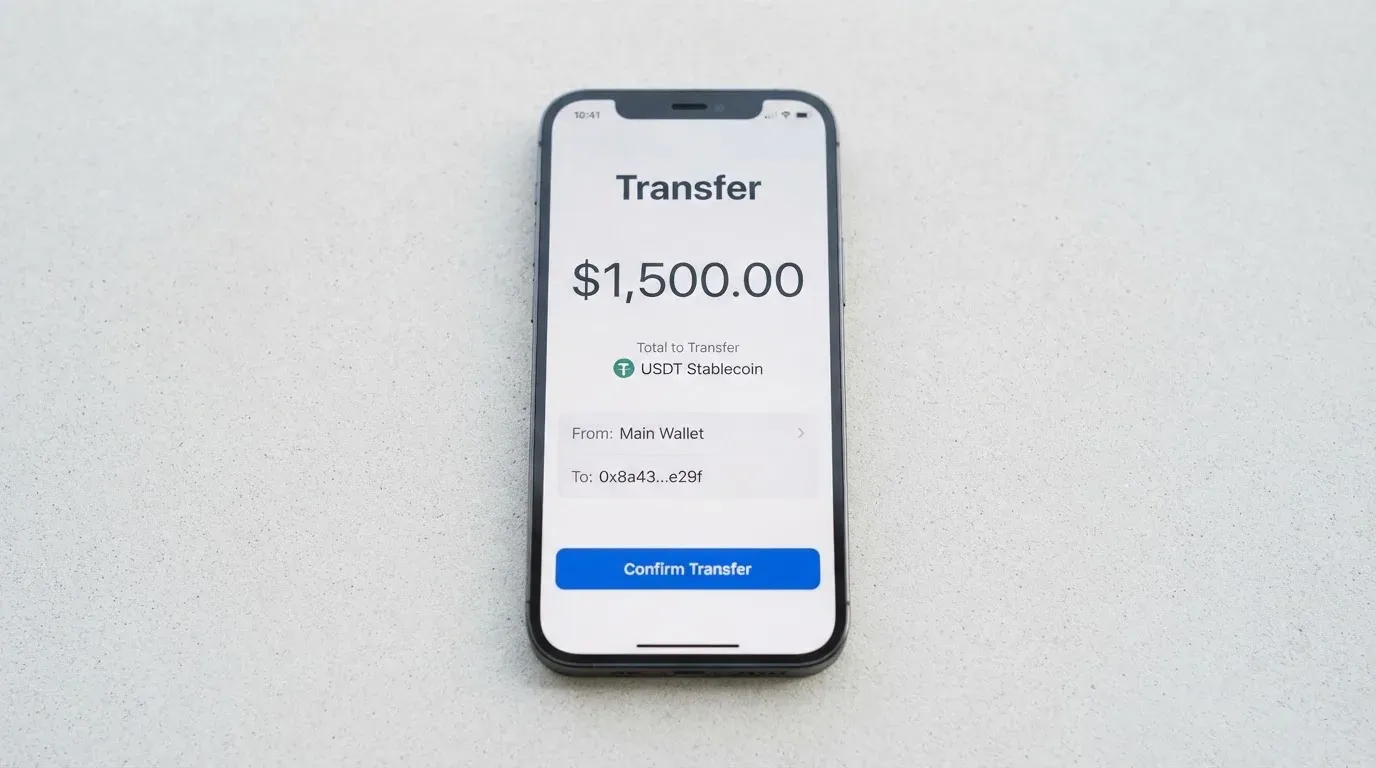
The published routes are a crypto vIBAN through Striga and an IBAN account. Coins and networks are not listed on the card page. An earlier check described a non-custodial wallet with USDC, BTC and ETH — that is the shape of the product, but it is not the current published specification, and you should treat the current page as the authority and the earlier description as history.
This is the single largest practical gap I found, and it is worth being blunt about why. Choosing the wrong network for a stablecoin deposit is one of the most common ways people lose money in this category, and the reason is structural: blockchain transfers are irreversible. If you send on a network the provider does not support, or to an address belonging to a different network, the funds can simply be gone, or recoverable only through a manual support process with no guarantee. A provider that does not publish which networks it accepts is asking you to supply that information yourself.
If you do top up with stablecoins, a few category facts that bear on the choice. USDC and USDT are the two dominant dollar-pegged tokens, and the BIS put about 90 % of stablecoin market capitalisation in them in July 2025. Circle says USDC is redeemable 1:1 for USD and fully backed by cash and cash equivalents, and lists it as natively supported on 38 networks as of 16 September 2026, including Ethereum, Solana, Base, Polygon PoS, Avalanche, Arbitrum and Stellar. USDT has been issued on networks including Ethereum, Tron, Solana, Polygon and Avalanche. Circle stopped supporting USDC on Tron in February 2024, so “USDC over TRC20” is not a native option. Stablecoins can and do depeg — TerraUSD collapsed in May 2022, USDC briefly lost its peg in March 2023 — so a dollar balance in a token is not the same as dollars in an account. And on Ethereum specifically, fees are paid in ETH, so a wallet holding USDT with no ETH cannot send.
None of that is a reason to avoid the product. It is a reason to insist on an answer about supported networks before you transfer.
Nothing is stated about deposit fees, minimum deposits, or who pays network fees. And on the way out: euro withdrawals go through the virtual IBAN, with no other terms published. The one genuinely reassuring line in this section is the account-closure rule — you may terminate at any time free of charge, Renegade may close with two months’ notice, and accounts inactive for over six months may be closed. That last one deserves attention: if you open this and forget about it, six months of silence can close it.
Paying with it every day
Day to day, this is a prepaid virtual card with a euro account behind it, and that framing explains both its strengths and its edges.
The strength is that it cannot overdraw. In the pre-loaded balance model, you convert or top up a fiat or stablecoin-denominated balance first and the card spends only that balance. There is no credit line, no interest, and no bill arriving later. For someone who wants a spending boundary rather than a spending limit, that is genuinely useful.
The wallet story, though, is thin in the public material. Apple Pay is not mentioned at all. Google Pay appears only in a testimonial on the site, where a user writes that the card was added to Google Pay — a single user’s account of their own setup, not a product statement. Blocked merchant categories are not stated either, which matters more than it sounds: gambling, for instance, sits under a merchant category code that many issuers block by policy rather than by law, and the blocked list differs from issuer to issuer. You will not find out what this card blocks from the public pages.
Rewards: 3 % on all three tiers, paid in RNG coin, which the page calls cashback. Two cautions. First, the reward is denominated in the card’s own token, so its value depends on a market you did not choose to enter, and it is not a fixed 3 % of your spending in money. Second, the monthly caps are listed, and one of those caps is printed in a garbled form — see the fee section above.
The app itself: on iOS the App Store listing is “Renegade” by Renegade GmbH, with no rating displayed, described as “hasn’t received enough ratings” when I looked on 2026-10-21. On Google Play the package is net.myrenegade.main and the rating was not readable. Neither of those is damning — new apps routinely have no ratings — but neither gives you the social proof you might look for.
If a payment goes wrong, the terms give you a path: complaints go to Customer Support, formally in writing, and there is an EU online dispute resolution platform referenced in the terms. What is not mentioned is chargebacks in the card’s own materials. That is a real omission to weigh, because a chargeback is a refund ordered by the issuer, with reason codes for fraud, duplicate billing or goods not received. Under EU rules the seller is liable for faulty goods, so your route in that case is the seller and the dispute platform, not a card chargeback. In the US the position differs again: reversal rights come from Regulation E for debit cards and Regulation Z for credit cards, and prepaid-card coverage varies and should not be assumed.
Support is live chat in the app 24/7, plus a contact form and [email protected]. Customer Support operates in German and English per the terms.
What can go wrong
Nothing here suggests fraud. What I found instead is thin documentation, an unlicensed structure, and a single very unhappy customer. Both of the first two are things you can manage if you know about them.
The licence question. Renegade states it is “NOT a bank” and does not yet provide regulated services, and will apply for licences first. In the EU, an electronic money institution can issue e-money, payment cards and wallets but cannot lend, and must safeguard customer funds in dedicated accounts or by insurance — and those safeguarded funds are not bank deposits and are not covered by a deposit guarantee scheme. A crypto card typically depends on two separate licences: one for the crypto side under MiCA, and one for the payment side under e-money and payments law. The card’s own structure shows the split: the company markets it, a partner provides the IBAN, and a third party is named as card service provider. I found no licences held.
That is where the entity naming gets confusing, and you should read it carefully. The operating company is MYRENEGADE, UNIPESSOAL LDA in Lisbon, Portugal (company no. 517780801). The app developer on the App Store is Renegade GmbH. The partner for the vIBAN is Striga Technology OÜ in Tallinn, Estonia. The terms name Zypto as the card service provider in one section, and in another describe an unnamed licensed card issuer on Striga infrastructure. A licensed issuer is named in the documents but not identified by name. If you are deciding whether to trust this with money, that gap is the thing to raise, and I would want a straight answer before I did.
For context on why programme structure matters: Visa and Mastercard do not issue crypto cards themselves; they license issuers and can suspend a programme. In November 2022 Visa said it had “terminated our global agreements with FTX” and the FTX US debit card programme was wound down. WaveCrest, a Visa issuer that supplied crypto card brands, was suspended by Visa in Europe in 2018, closing all its Visa programmes. Closures follow a pattern — a notice period, then loading and spending stop, then users are asked to withdraw remaining balances. I found a 2026 closure reported by a secondary source where new loads ended 8 July 2026 and spending stopped 8 August 2026; that is a single unconfirmed source and I am flagging it as such, not asserting it.
The complaint. Trustpilot shows 3.2 with a single review, one star, as I read it on 2026-10-21. One review is not a track record in either direction, but the content is worth reading as a warning rather than as noise. The reviewer, on 7 April 2026, says roadmap items promised for Q1 2026 — the app, the crypto wallet, the card — were not delivered, and that support refused a refund, describing it as a “startup investment”. That phrase is the thing to sit with: if a product is described to you as an investment in a pre-licence company, then a delay is not a service failure, it is the business model. Ask yourself honestly whether that is a business you want your money sitting in.
The official record is clean by contrast: I found no official incidents. That is worth something, and it is not the same as a company having an uneventful future.
Where the money sits. The site says “user-interface only” and says Striga helps keep money “in a safe manner”, but custody is not clearly addressed in the terms. Multi-factor authentication is mentioned (terms 9.1). The word “interface” implies the crypto stays with you; the terms do not clearly confirm it. If it is genuinely non-custodial, then key loss, phishing and clipboard malware that swaps a copied address are entirely your problem, and crypto transfers are irreversible with no built-in recovery. If it is custodial, then you carry the counterparty and hack risk that comes with that — the category’s record includes Mt. Gox (about US$350 million reported stolen, 2011–2014), Coincheck (about US$400 million, 2018) and Ronin Network (US$625 million, 2022). The site language and the terms are not clear enough for me to tell you which one you are in. That is a question to ask, and it is more important than the monthly fee.
The smaller traps. A declined authorisation can leave a hold on funds for several days, typically up to 7. Some merchants decline prepaid or foreign-issued cards because a BIN lookup reveals the type and issuer country. Address verification is mainly offered in the US, Canada and the UK and is generally unavailable for foreign-issued cards, which can cause declines. None of these are Renegade-specific, but they all land on a virtual card from Portugal with a euro account.
And a note on timing: the sponsored article on btc-echo.de, published 30 January 2024 and updated 31 July 2025, described a euro IBAN plus Visa debit card app as live with an IBAN waitlist and crypto features still being integrated, and mentioned Founder cards limited to 555 with up to 9 % rewards and Carbon/Black NFT cards at 5 % and 3 % in RNG. That is a paid placement, and it is from a period when the IBAN was still a waitlist. It is a useful marker of where the product was, not evidence of where it is.
What to take instead
If the euro IBAN is the thing you actually need, these are the alternatives I looked at, with the same scepticism applied. Each score is out of 10.
| Alternative | Score | Card and fees | Who it is for |
|---|---|---|---|
| Renegade | 4.1 | Virtual only; 9.90–29.90 EUR monthly; 1.6 % crypto/fiat | EEA residents wanting a euro IBAN with a virtual card |
| International Visa Card | 6.7 | U.S.-issued Platinum Visa, virtual, pays in USD; issuance $5 one-time, no maintenance fee; Classic free, Pro $9.00/month, Max $19.00/month; card use in USD free on all plans; foreign currency at “Visa exchange rate + 2% FX fee”; deposits of any kind free | Residents or registrants outside the excluded list, spending mainly in dollars |
| UNi Card | 6.1 | Multicurrency Mastercard network, spends from the UNi.Global balance; “No annual fee or foreign transaction fee”; converted at “live OTC rates”, “No hidden exchange fees”; up to 3 % spend-to-earn rewards | Someone who wants a multicurrency card and prioritises no FX fee |
| Whop Cards | 5.2 | Visa, works anywhere Visa is accepted; page says “No extra fees”, no amounts listed; spends from a Whop balance, pending balance usable on arrival; 5 % cashback at select merchants, currently Uber | US consumers in the listed 31 states and businesses in 41 states |
International Visa Card is the one that scores highest, and the reason is disclosure. It publishes who cannot use it: residents and legal registrants of Belarus, mainland China, North Korea, Cuba, India, Iraq, Iran, Israel, Myanmar, Nepal, Nicaragua, Russia, Syria, Turkey, Ukraine, Venezuela and Vietnam, with FATF grey-list countries reviewed case by case, and purchases blocked in North Korea, Cuba, Iran, Russia, Syria, Ukraine and Venezuela. Notably, the rule is by residence or registration — citizenship is not mentioned. It also publishes its price: $5 one-time for the virtual card, no maintenance fee, and free card use in dollars on every plan, with a clearly stated 2 % fee on top of the Visa exchange rate for foreign currency. You can fund it with USDC or USDT into the USD account free at 1:1, and also with USD, EUR, SEPA, SWIFT and FedNow. Two things to weigh against that: no cashback is stated, and the physical card is “Coming soon”, so it is virtual too. But you know what you are paying for, which is more than you can say here.
UNi Card is the most interesting answer if foreign-exchange cost is your main worry. It publishes “No annual fee or foreign transaction fee” and says assets convert at live OTC rates with “No hidden exchange fees”, on a multicurrency Mastercard network spending from the UNi.Global balance, with up to 3 % spend-to-earn rewards. What it does not publish is who can get it, how you fund it, or whether the card is physical or virtual. The transparency ranking is good and the coverage ranking is not.
Whop Cards work anywhere Visa is accepted and spend from a Whop balance, with a pending balance usable as soon as a payment arrives — useful if you get paid in that ecosystem. The 5 % cashback at select merchants is currently Uber, with more planned, and neither the payout currency nor the conditions are stated. Its eligibility is US-focused and well specified for consumers: 31 states listed by name, from Alabama through Wyoming, with businesses in 41 states, and unsupported consumer countries matching the usual pattern including Belarus, mainland China, Cuba, Hong Kong, India, Iran, Iraq, Israel, Myanmar, Nepal, Nicaragua, North Korea, Russia, Syria, Turkey, Ukraine, Venezuela and Vietnam. Whether the rule is citizenship or residence is not stated. Fees are “No extra fees” with no amounts published at all, which is a phrase I would treat as “ask”.
Across all four, one pattern is worth naming: every option here is virtual-only or virtual-first. If the reason you want a card is something physical in your hand, none of these solves it today, and you are really looking at a conventional bank or e-money account.
Who I would recommend it to
I would recommend Renegade to a specific person, and I would tell everyone else to wait.
The specific person: you live in the European Economic Area, you need a euro IBAN for a reason you can name — a supplier who pays in euro, a landlord, a saved payment method — and you are planning to use the account rather than just hold it. You are comfortable that this is a young company with no licences yet, that your balance is a stored balance rather than banked money, and that the rewards are denominated in its own token. You will check the supported networks before your first transfer, because they are not published. And you will set a calendar reminder, because an account inactive for over six months can be closed.
Everyone else, I would point elsewhere. If you are outside the EEA, the euro IBAN is not yours and the flagship feature is off the table. If you need a physical card, this has none. If you need published spending limits, published FX fees or published ATM fees, this publishes none of them. If you are putting savings in rather than spending money, an account that says it is not a bank, is not yet regulated, and may be closed after six months of inactivity is the wrong instrument — and the guarantee schemes people assume apply simply do not.
What would change my mind, and what I would watch: whether Renegade obtains its licences, whether it publishes a supported-country list and its accepted networks, whether the weekly/monthly reward caps are printed correctly, and whether the issuer named in section 11 of the terms is ever named in public. Those are the specific things to check, and all four are free to check.
Frequently asked questions
What is the Renegade card?
The Renegade card is a virtual payment card offered inside an app, paired with a euro IBAN account, so you can hold euro and spend it without any plastic. The card page says “No plastic. No waiting.” and the virtual card is issued instantly after in-app identity verification. It is aimed at people who want a euro-denominated account they can pay from, funded either by crypto or by IBAN transfer. It is not a bank account and the company states it is not a bank.
Is Renegade a bank?
No. Renegade states in its own terms that it is “NOT a bank” and does not yet provide regulated services, and that it will apply for licences first. The operating company is MYRENEGADE, UNIPESSOAL LDA in Lisbon, Portugal. Even a licensed e-money institution’s safeguarded funds are not bank deposits and would not be covered by a deposit guarantee scheme. I found no licences held, so treat any balance as money you could lose.
Who owns Renegade?
The company behind the app is MYRENEGADE, UNIPESSOAL LDA, company no. 517780801, registered in Lisbon, Portugal. The App Store lists the developer as Renegade GmbH. The IBAN partner is Striga Technology OÜ of Tallinn, Estonia, and the terms name Zypto as card service provider in one section while another refers to an unnamed licensed issuer. So the ownership chain is public; the card issuer is not.
Is the Renegade card available in my country?
The card page publishes no list of supported or excluded countries, so you cannot check eligibility in advance. What the terms do say is that only customers in the European Economic Area can use the virtual IBAN for euro deposits and withdrawals. Outside the EEA, do not assume the euro account is available to you — the card’s main feature depends on it.
How do I apply for the Renegade card?
You download the app, enter personal information and verify identity through a secure in-app chat, which the card says “only takes a few minutes”. The virtual card then appears instantly in the app. Which documents are needed, whether proof of address is required, and what age applies are not stated on the public pages. Have your identity documents ready anyway, and expect a chat rather than a form.
Does the Renegade card require KYC?
Yes. Identity verification is built into the sign-up flow, which is standard for regulated partners: EU due diligence covers name, address, date of birth, nationality, identity documents, sanctions screening and politically-exposed-person status, and if it cannot be completed the relationship cannot proceed. That is why accounts get frozen pending documents rather than closed outright. Nationality is screened separately from residence, so your passport’s country of birth can matter independently of where you live.
How much does the Renegade card cost?
Monthly fees are 9.90 EUR for Pioneer, 19.90 EUR for Voyager and 29.90 EUR for Vanguard, or 4,90, 14,90 and 24,90 if paid in RNG. The crypto/fiat exchange fee is 1.6 %, and the card says “No other fees are collected by Renegade”. But the FX fee, ATM fees, issuance fee and any deposit fee are not stated, and blockchain network fees are charged by the network, not by Renegade.
Is the Renegade card free?
No. The cheapest tier is Pioneer at 9.90 EUR per month, discounted to 4,90 if you pay in the card’s own token. There is no free tier. The card says new fees come with at least 30 days’ notice, and you can terminate at any time free of charge — but the current month’s fee is already spent by then. Consider a month you use it heavily and a month you use it not at all; the fee is the same both times.
How do I top up the Renegade card?
Published routes are a crypto vIBAN through Striga and an IBAN account. The coins and networks accepted are not listed on the current card page, and an earlier check described a non-custodial wallet with USDC, BTC and ETH. Because blockchain transfers are irreversible, sending on an unsupported network can mean losing the funds, so confirm the accepted network in the app or with support before your first transfer. Deposit fees and minimums are not stated.
Is the Renegade card safe, and is it worth it?
Worth it only if you need a euro IBAN and will actually use the account, and only with a balance you could afford to lose. The company is unlicensed by its own account, custody is not clearly addressed in the terms, and the single Trustpilot review (3.2, one review) reports undelivered roadmap items and a refused refund. Support is 24/7 live chat in the app. If you want published fees, limits and an inclusive country list, the alternatives in the comparison section above disclose considerably more.
App and neobank cards put to the test – cryptocardtested
Content created by the «cryptocardtested» team