
A physical Visa from a crypto wallet, with the important details left out
 Available in US
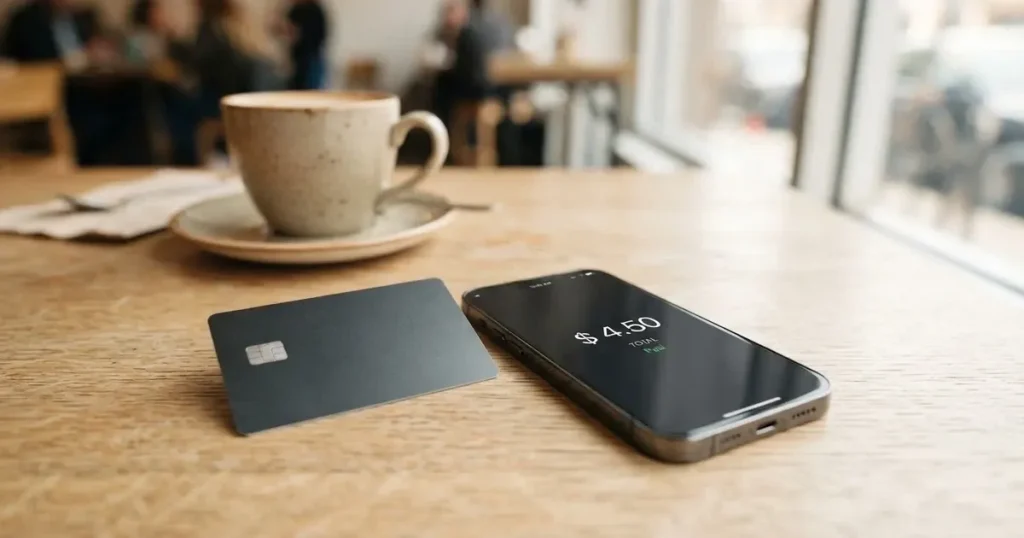
SkyDAO promises the thing a lot of crypto users want and few can explain clearly: a physical Visa card you order in an app, load from a crypto wallet, and then use in an ordinary shop, at a card terminal, or in Apple Pay and Google Pay. On the everyday-use side of the ledger, it delivers the parts that matter — a physical Visa, mobile wallets, ATM withdrawals, and a multichain top-up route from the wallet to the card.
What it does not do is tell you the things you would need in order to decide. I went through the pages that could be read, and the country list, the issuing company, the licence, the fees, the limits, the top-up coins and networks, and the withdrawal procedure are all simply not stated. That is not a nitpick. Those are the details that decide whether a card works in your life, and their absence is why this review lands where it does.
My score is 5.3 out of 10. If you already hold crypto, want a physical Visa with ATM access, and can tolerate finding out the terms by testing them, this card is worth a look. If you need to know your monthly cost before you start, or you live somewhere the card may not be available and cannot confirm that from the card’s own pages, there are better-documented choices.
The conditions described here are current as of October 28, 2026.
The score, criterion by criterion
| Criterion | Mark | Why |
|---|---|---|
| Who can get it | 5 / 10 | The pages that could be read do not name the countries served; starting data says worldwide except 49 restricted countries, not confirmed here |
| Cost | 5 / 10 | Issuance, fees and servicing are not disclosed |
| Top-up options | 5 / 10 | Wallet-to-card transfer, multichain; neither coins nor networks are named |
| Reliability and complaints | 4 / 10 | SKYDAO TRUST LTD is named as the App Store seller, but country of registration, issuer and licences are not stated; no complaints or reviews found, and too few App Store ratings for a score |
| Everyday use | 8 / 10 | A physical Visa ordered in the app, Apple Pay and Google Pay, ATM withdrawals; the virtual card is not disclosed |
| Total | 5.3 / 10 | A strong everyday feature set sitting on top of an undisclosed operational picture |
Everyday use is the one place the card genuinely stands out, and that 8 is worth reading carefully rather than as flattery. It means the visible, testable part of the product — order a card in the app, pay with it, hold it against a phone, pull cash — works in a way the paperwork does not explain.
Will they give you the card?
Honestly: I cannot tell you from what SkyDAO publishes, and that is the answer, not a dodge.
The pages that could be read do not name the countries where the card is issued or accepted, and they do not name the countries whose residents are refused. There is starting data suggesting a worldwide service outside 49 restricted countries, but I could not confirm that here, so I will not pass it on as fact. What that leaves you with is the wrong kind of uncertainty: not “you are outside the service area”, but “nobody has published where the boundary is.”
For anyone who has trouble getting an ordinary bank card — which is the situation this review is written from — that is a specific and expensive kind of gap. The countries where people most often need an alternative to a bank card are not always the countries a card programme is willing to write to, because the same sanctions and compliance rules that push you toward a crypto card also shape who the issuer will accept. The rules are applied by residence or registration in most of this industry, and citizenship is a separate question again, because screening often runs on citizenship and country of birth as well as on the address on your documents.
What I would want before you spend anything on the hope of it:
- Whether your country of residence is served, in the card’s own words
- Whether your citizenship is treated separately from your address
- Which legal entity issues the card, and under which country’s licence
- What happens to your balance if the app stops working or the programme ends
That last one is not alarmist. Card programmes in this space do close. WaveCrest, a Visa issuer that supplied crypto card brands, was suspended by Visa in Europe in 2018 and all its Visa programmes were shut. When a programme winds down, the pattern is a notice period, then spending and loading stop, then users are asked to withdraw what is left. Visa itself said in November 2022 that it had terminated its global agreements with FTX, and the FTX US debit card programme was wound down by its issuer.
The company behind the app is named in one place: the App Store seller is SKYDAO TRUST LTD, and the developer name is SkydaoTrust. The site mentions Hong Kong for regional access, the United States for global standards, and “License” without naming a licence. The registered country, the issuer, and the licence names are not stated. The help centre at skydao.zendesk.com is closed.
How to get it
The stated route is short and straightforward:
- Download the SkyDAO app.
- Complete identity verification in the app.
- Apply for a physical card online.
- Once the order is placed, the card is shipped to your specified address.
The card is a Visa linked to the SkyDAO wallet, and value moves from the wallet to the card. The currency the card is denominated in is not stated, which is the first hint that some things only become clear at the point of use.
Two things the process leaves open. The documents required for identity verification are not stated — not whether a passport is enough, not whether a selfie is needed, not whether a proof of address is required. And the verification levels are not stated: some providers run a light check that lets you browse and then demand documents before the first transfer, others make the full check a condition of the card. You will find out by applying.
The physical card is ordered online in the app. The delivery time and the delivery cost are not stated. For a person outside the main markets that is not a detail to shrug at: if the card takes three weeks to arrive, or costs money to send, that changes whether the card is usable at all.
Fees: what it really costs
This is the section where I have the least to tell you, and I want to be direct about why rather than dress it up. The card’s public pages do not state the issuance cost, the fee schedule, or the currency the card holds. What they do say, in the App Store text, is that a “VIP service” for high-value users offers priority access, dedicated support and higher limits — a developer claim, with no tiers, prices or conditions attached.

| Fee or limit | What the card states |
|---|---|
| Card issuance | not stated |
| Monthly or servicing fee | not stated |
| Conversion fee (crypto to card balance) | not stated |
| Foreign exchange fee | not stated |
| ATM withdrawal fee | ATM withdrawals available; fees and allowance not stated |
| Daily limits | not stated; App Store text only mentions “higher limits” on the VIP service |
| Monthly limits | not stated; same VIP mention |
| Card currency | not stated |
Let me walk you through three ordinary payments and what I can and cannot say about each, because that is the part most reviews skip and the part you will actually feel.
A coffee in your own country. If the card holds a balance and you pay in that balance’s own currency, in the simplest version of the setup you would expect no conversion and no foreign exchange fee. But SkyDAO does not name the currency, so I cannot tell you that this case is fee-free — only that this is the case where fees are least likely to bite. The hidden cost here would be the card’s own monthly or servicing charge, and that is not stated either.
A subscription in a currency that is not your own. Here two separate charges can apply: the conversion rate the card uses when your balance is converted, and a foreign exchange fee on top. Neither is stated. This is also where the “multichain” part of the story matters in reverse — if your balance came from an asset that had to be converted to reach the card, the conversion happened before the payment, not at it, and you would have seen it at the top-up step.
A cash withdrawal at an ATM. Withdrawals are available. What I cannot tell you is what it costs, how much is included, whether there is a daily cap, and whether the ATM operator’s own surcharge applies on top. Card-network ATM fees are commonly separate from the issuer’s, and a foreign ATM adds a third layer. Get the fee schedule in writing before you rely on this.
There is one more fee that is not the card’s at all but will still land in your balance: on-chain network fees for your own deposit are charged by the blockchain, not by the card provider. That is the category norm, not a SkyDAO detail, and it means a top-up can cost more or less depending on which network you choose.
The honest summary is that SkyDAO’s cost section is empty, and an empty cost section is itself a cost — it pushes you into testing with your own money to find out.
How to top up
The funding route is the same as the payment route, and this is the part of the design that makes sense: transfer from the wallet to the card, multichain. The App Store text describes a unified account holding both fiat and digital assets, so the wallet and the balance are meant to be one place rather than two systems you shuttle value between.
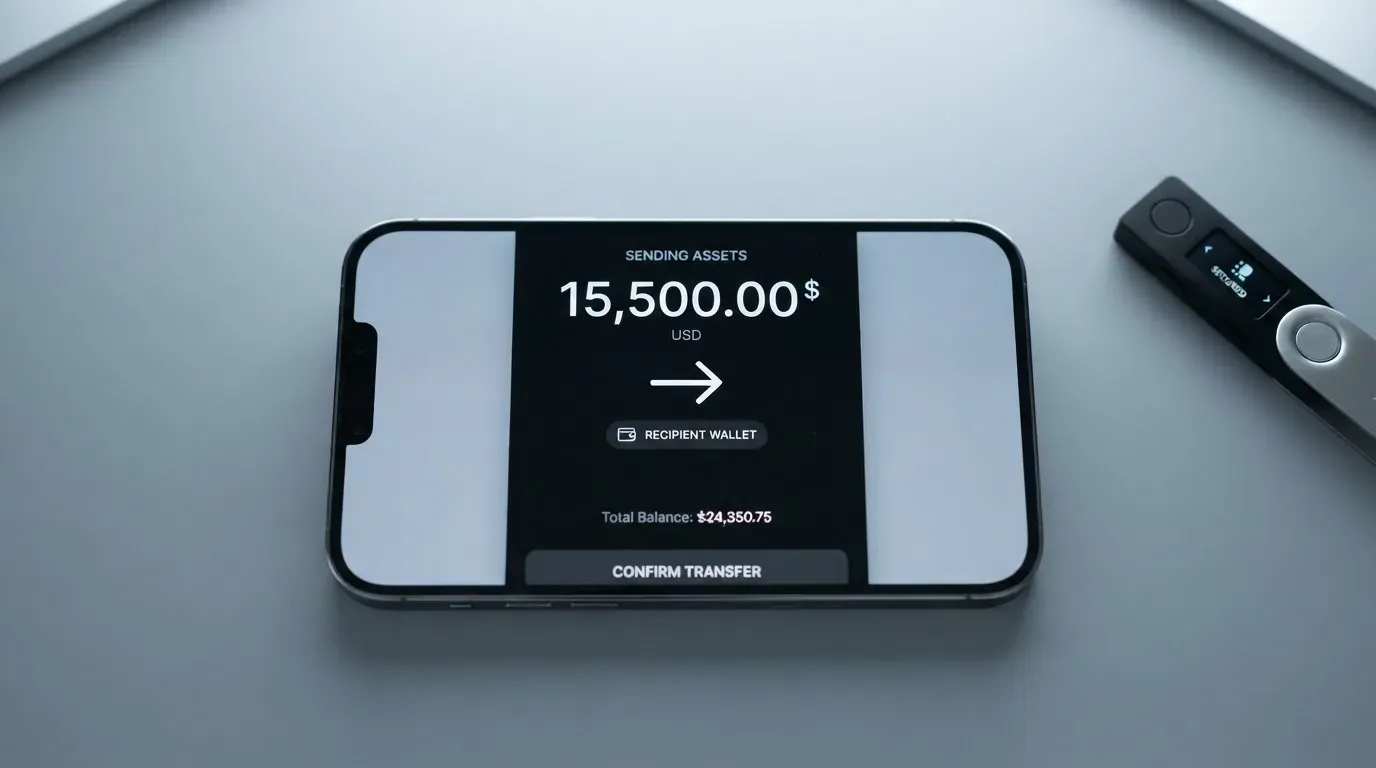
What is not stated: which coins, which networks, the fees, the minimums, and the withdrawal procedure. “Multichain” without a network list is a promise of flexibility with no map attached.
That matters more than it sounds. Blockchain transfers are irreversible. A deposit sent on a network the card provider does not support, or to an address belonging to a different network, can simply be lost, or need manual support recovery with no guarantee of success. If you are holding Tether’s USDT, the networks it has been issued on include Ethereum, Tron, Solana, Polygon and Avalanche. If you are holding Circle’s USDC, Circle listed it as natively supported on 38 networks as of 16 September 2026, including Ethereum, Solana, Base, Polygon PoS, Avalanche, Arbitrum and Stellar — and Circle stopped supporting USDC on Tron in February 2024, so “USDC over TRC20” is not a native option.
There is a second trap in the coin choice. On Ethereum, fees are gas paid only in ETH, so a wallet holding USDT and nothing else cannot send. On Tron, fees are paid through bandwidth and energy resources, often burning TRX. In other words, you may need a small amount of a second coin you did not plan on buying before you can move the first one.
And one more: if you are planning to use stablecoins generally, read the peg rather than the name. Tether’s USDT and Circle’s USDC are US-dollar-pegged, and the BIS put about 90% of stablecoin market capitalisation in these two as of July 2025. Circle says USDC is redeemable 1:1 for USD and fully backed by cash and cash equivalents, mostly in an SEC-registered government money market fund, with monthly reserve attestations. Stablecoins are not immune from losing their peg, though: TerraUSD collapsed in May 2022, and USDC temporarily lost its peg in March 2023 during the US banking crisis.
Because SkyDAO names neither coins nor networks, I cannot tell you which of these issues you will meet in practice. You should assume you will meet them and check the network against the app before your first transfer, not after.
Paying with it every day
This is where the card earns its best mark, and I want to be fair about that.
- A physical Visa card, ordered in the app
- Apple Pay and Google Pay supported
- ATM withdrawals available
- Value moves from the wallet to the card
- A unified account for fiat and digital assets
- App for iPhone and iPad, free, rated 18+, version 2.4.8 from 10 October
- App available in English plus Bengali, French, German, Hindi, Indonesian, Italian, Japanese, Korean, Portuguese, Russian, Simplified Chinese, Spanish, Thai, Traditional Chinese, Ukrainian and Vietnamese
Apple Pay is worth a moment of explanation, because it is not simply handing your card number to Apple. When you add a card to Apple Pay, the card number is replaced with a device-specific Device Account Number stored in the Secure Element on the device, never on Apple’s servers, and each payment carries a one-time dynamic security code. That is a genuine reduction in exposure relative to typing numbers into websites, and it is the single best argument for using the mobile wallet rather than the plastic whenever a terminal accepts it.
Not stated: the virtual card, blocked merchant categories, rewards, and any dispute process. If your routine depends on a virtual card for online subscriptions, assume nothing about it. If you travel and care about gambling or other restricted categories, note that many issuers block them by policy rather than by law, and the list varies by issuer — but SkyDAO does not publish one.
Two things about merchant acceptance are worth knowing generally, because they explain the payments that fail for reasons that have nothing to do with you. A payment card number starts with an issuer identification number of 6 or 8 digits, and merchants can look it up to see which institution and country issued the card, applying extra scrutiny if the issuer country differs from the billing address. Some merchants decline prepaid or foreign-issued cards precisely because that lookup reveals the card type and issuer country. So if a card works everywhere for your neighbour and is refused in one shop for you, the BIN country may be the whole story.
Address verification is the other one. AVS compares numeric parts of the billing address you type — street number, ZIP — with issuer records; it is mainly offered in the US, Canada and the UK and is generally unavailable for foreign-issued cards, which can cause declines. If you shop across several countries, expect the odd refusal and do not read it as a sign of anything.
Finally, a declined authorisation can leave a hold on your funds that stays for several days, typically up to 7. That is standard, not a SkyDAO quirk, and it is the reason a failed hotel booking can quietly reduce your available balance for a week.
On support and disputes, the honest position is thin. “Dedicated support” is offered for VIP only, as a developer claim; support channels and hours are not stated; and the help centre is closed. The dispute procedure is not stated at all. That last point deserves weight. A chargeback is a refund ordered by the card issuer to settle a dispute, with reason codes such as fraud, duplicate billing or goods not received. In the US, debit card reversal rights come from Regulation E and credit card rights from Regulation Z, and prepaid-card coverage varies and should not be assumed. If your card behaves like a prepaid card drawing on a stored balance — which most crypto cards do — assume less protection, not more, until the issuer tells you otherwise.
What can go wrong
Beyond the fees, the country list and the missing terms, there are four things I would weigh before you rely on this card.
Nobody has heard of it, or nobody has written about it. I found no Trustpilot page for SkyDAO itself, no Reddit threads, and no official incidents. That cuts both ways, and it is worth being honest about both halves: absence of complaints is not evidence of good service, it is mostly absence of users. The one Trustpilot page I did see belonged to a similarly named business and had two one-star reviews; it is unclear whether it is the same company, so I did not use it. In the App Store, the listing reads “This app hasn’t received enough ratings or reviews to display an overview” — in other words, there are too few ratings for a public score. With no reviews to draw on, you have no crowd-sourced answer to “is it safe”, and you will be the source.
Custody, and who holds your keys. Most crypto cards behave like prepaid cards: crypto is converted and loaded as a balance, and the card spends only that balance, which is why the card cannot overdraw. But the balance sits with the provider until you spend it. With a custodial wallet the provider holds the credentials, so you must trust the provider completely. Custodial platforms have a real record of failure — Mt. Gox (about US$350 million reported stolen across 2011-2014), Coincheck (about US$400 million in 2018), and Ronin Network (US$625 million in 2022). A card that draws on a wallet you control is the safer shape; a card that draws on an account the operator controls carries counterparty risk, and the developer claims encryption and multi-layer risk controls without detail I could verify.
Compliance, sanctions and your citizenship. Identity verification is not a formality. KYC rules require regulated businesses to verify customers and assess risk as part of anti-money-laundering and counter-terrorism-financing law, including ongoing monitoring and reporting of suspicious activity. In the EU, customer due diligence covers name, address, date of birth, nationality and identity documentation, a sanctions check, the purpose of the relationship, and whether you are a politically exposed person. In the US, the customer identification programme requires name, date of birth, address and an identification number. And if due diligence cannot be completed, EU rules require the institution to refrain from the transaction or relationship and, where necessary, end the existing relationship — which is why accounts get closed or frozen pending documents. Nationality is screened separately from residence for exactly this reason.
I am not going to tell you how to get around any of that, and you should be wary of anyone who does. If you are in a restricted jurisdiction, the correct move is to ask the provider directly and read the answer, not to look for a workaround. Note also that stablecoins are not censorship-proof: Tether says it disables tokens in wallets on the OFAC sanctions list and has frozen funds tied to illicit activity.
Your money when something changes. Even in the well-regulated versions of this product, customer funds usually have to be safeguarded — segregated in dedicated accounts or insured — and such funds are not the same as bank deposits and may not be covered by deposit guarantee schemes. A card is a payment service regulated separately from the crypto side, so a crypto card often depends on two licences: one for the crypto activity, one for the payment service. SkyDAO names no issuer and no licence, which means you cannot check either.
On the regulatory timeline, if you are in the EU: MiCA took legal effect in June 2023; its rules on asset-referenced tokens and e-money tokens applied from 30 June 2024, and the remaining provisions, including crypto-asset service provider rules, applied from 30 December 2024. Under MiCA, e-money tokens may be issued only by a credit institution or an electronic money institution. Providers already operating under national law could continue only until 1 July 2026 or until they received or were refused a MiCA authorisation, whichever came first. ESMA keeps an interim register of authorised providers, white papers and non-compliant entities, and that register is where you can check whether a provider appears in it.
What to take instead
If your problem is that an ordinary bank card is hard to get, the alternatives below each trade something different away. Scores are on the same ten-point scale.
| Option | Score | Card and access | Cost and fees |
|---|---|---|---|
| International Visa Card | 6.7 / 10 | U.S.-issued Platinum Visa card, virtual, pays in USD; physical “coming soon”. Not available to residents or registrants of Belarus, mainland China, North Korea, Cuba, India, Iraq, Iran, Israel, Myanmar, Nepal, Nicaragua, Russia, Syria, Turkey, Ukraine, Venezuela, Vietnam; FATF grey-list countries reviewed case by case. Purchases blocked in North Korea, Cuba, Iran, Russia, Syria, Ukraine, Venezuela | $5 one-time virtual issuance, no maintenance fee; Classic free, Pro $9.00/month, Max $19.00/month; card use in USD free; foreign currency at the Visa exchange rate plus a 2% FX fee; deposits of any kind free |
| UNi Card | 6.1 / 10 | Multicurrency card on the Mastercard network, spending from the UNi.Global balance; availability, and whether it is physical or virtual, not stated | “No annual fee”; issuance fee not stated; “No annual fee or foreign transaction fee”; converted at live OTC rates with “no hidden exchange fees”; Spend-to-Earn rewards up to 3% |
| Whop Cards | 5.2 / 10 | Visa, works anywhere Visa is accepted; card type and currency not stated. Consumers in 31 US states (Alabama, Alaska, Arkansas, California, Colorado, Connecticut, Florida, Hawaii, Illinois, Indiana, Iowa, Kansas, Kentucky, Maine, Massachusetts, Michigan, Minnesota, Montana, Nebraska, New Hampshire, New Jersey, New York, North Carolina, Ohio, Oklahoma, Pennsylvania, South Carolina, Texas, Utah, Virginia, West Virginia, Wyoming); businesses in 41 states. Unsupported consumer countries include Belarus, China (Mainland), Cuba, Hong Kong, India, Iran, Iraq, Israel, Myanmar, Nepal, Nicaragua, North Korea, Russia, Syria, Turkey, Ukraine, Venezuela, Vietnam | Page says “No extra fees”; no issuance or monthly amounts listed; no conversion or FX amounts stated; 5% cashback at select merchants, currently Uber, payout currency and conditions not stated |
Three observations from that table. First, two of the three publish numbers — issuance, monthly plan, and the foreign exchange fee — which is exactly the information SkyDAO withholds. Second, the International Visa Card’s exclusion list is itself useful to you: it tells you, in writing, where that card will not work, so you can check yourself before you spend an afternoon on an application that will be refused. Third, none of the three is unambiguously better. The International Visa Card has the widest published country list and the clearest pricing, but no physical card yet. UNi Card publishes its fee philosophy but not its access terms. Whop Cards publishes its US state list but almost no pricing detail, and its unsupported-country list includes Hong Kong, which is worth noting given SkyDAO’s regional-access reference to Hong Kong.
Funding shapes the choice as much as fees do, and it is the axis where these cards diverge most. The International Visa Card takes USDC or USDT into a USD account free at 1:1, and also USD, EUR, SEPA, SWIFT and FedNow deposits. Whop Cards spends from a Whop balance — a pending balance becomes usable as soon as a payment arrives, while standard withdrawals use settled funds — backed by stablecoin collateral from a linked wallet. UNi Card’s funding route is not stated. In all three, coins and networks go unnamed to varying degrees, so the same irreversible-transfer caution applies as it does to SkyDAO.
Who I would recommend it to
If you already run a crypto wallet, you know what a network fee is, you can keep a small amount of ETH or TRX around for gas, and you can afford to discover the terms by testing them, then SkyDAO is a reasonable card to try. The combination that makes it worth trying is specific: a physical Visa ordered in an app, mobile wallets that keep the card number off the internet, ATM access, and a multichain wallet-to-card top-up. Few products in this category put a physical card and mobile wallets together as the headline.
I would not recommend it to you if any of these apply:
- You need a written fee schedule before committing money. There isn’t one.
- You need to know your country is served. The card’s own pages do not say.
- You are relying on chargebacks or consumer protection. The dispute process is not stated, and prepaid-style balances usually carry less.
- You are in a hurry. Delivery time and cost are not stated.
- Your whole plan depends on a virtual card or on rewards. Neither is disclosed.
The deeper reason for the 5.3 is not that SkyDAO looks bad. It is that a card is a piece of financial infrastructure, and the things that make infrastructure trustworthy are boring: a named issuer, a named licence, a named country, a published fee list, a published limit, a published complaint route. SkyDAO’s pages are silent on each of those. Its visible product is good; its paper trail is missing. Those are separate problems, and only one of them is easy to fix.
So: try it with an amount you would not mind losing, and ask the support channel — however thin it turns out to be — for the fee schedule, the issuer and the supported networks in writing before you load anything significant.
Frequently asked questions
What is the SkyDAO card?
SkyDAO is a crypto wallet with a Visa card attached to it. The card is linked to the wallet, value moves from wallet to card, and the physical version is ordered online inside the app. You can pay with the physical card, add it to Apple Pay or Google Pay, and withdraw cash at ATMs. It behaves mostly like a prepaid card drawing on a balance the app converts for you.
Is SkyDAO a bank?
The pages I could read do not say, and I would not treat it as one. The App Store seller is named as SKYDAO TRUST LTD, and the site refers to Hong Kong regional access, United States global standards and a “License” without naming any of them. The registered country, the issuing institution and the licence are not stated. That matters because a card is a payment service regulated separately from the crypto side.
How do I get the SkyDAO card?
You download the app, complete identity verification, and apply for the physical card online. Once the order is placed, the card is shipped to your specified address. The documents needed for verification, the delivery time and the delivery cost are all not stated, so allow yourself room on both counts before you commit.
Does the SkyDAO card require KYC?
Identity verification is part of the application, so yes in practice. The card does not say which documents are required, whether a proof of address is needed, or whether verification levels differ. What is stated is that dedicated support and priority access are VIP-tier claims.
How much does the SkyDAO card cost?
That is the central gap in this review: the card’s public pages do not state issuance cost, monthly or servicing fees, conversion fees, foreign exchange fees, ATM fees, or any daily and monthly limits. The App Store text mentions only a “VIP service” for high-value users with higher limits. You would be discovering the pricing with your own money.
How do I top up the SkyDAO card?
By transferring from your SkyDAO wallet to the card, described as multichain, with a unified account for fiat and digital assets. Coins, networks, fees and minimums are not listed. Transfers are irreversible, so sending on a network the provider does not support can lose the funds outright.
Can I use the card in Apple Pay and Google Pay?
Yes — both are supported, and I would use them in preference to the plastic wherever a terminal takes them. Apple Pay replaces the card number with a device-specific number stored on the device’s Secure Element, never on Apple’s servers, and each payment uses a one-time code. That is meaningfully safer than typing card numbers into websites.
Is the SkyDAO card safe?
I cannot tell you it is, and nobody else can yet either. There are no Trustpilot page or Reddit threads for SkyDAO itself, no official incidents found, and the App Store listing says there are too few ratings to show an overview. The developer claims encryption and multi-layer risk controls, but that claim is not verified, and the help centre is closed.
What are the limits and can I withdraw money?
ATM withdrawals are available, but the allowance, the fees, and any daily or monthly spending limits are not stated — the only hint is the VIP mention of “higher limits”. The withdrawal procedure itself is also not stated, so I would not plan around cash as your main way of getting money out until you have confirmed it works.
Is the SkyDAO card worth it?
For someone already holding crypto who wants a physical Visa with ATM access and can tolerate undocumented fees, possibly. The everyday feature set is the strongest part of the card. Against that, no published country list, no fee schedule, no named issuer, no dispute process and no reviews. Test it small, and ask for the terms in writing first.
App and neobank cards put to the test – cryptocardtested
Content created by the «cryptocardtested» team