
A wallet-branded card with thin public detail behind it
 Available in US
TokenPocket is best understood as a crypto wallet that grew a card tab, not as a bank. The card sits on Arbitrum, is issued through an unnamed issuing partner, and is managed inside the same app as your wallet. That combination is the whole story: convenient if you already live inside the TokenPocket ecosystem, thin on published detail if you are trying to decide whether your money is safe and what a purchase will cost. I gave it 5.8 out of 10 — a middling score that reflects solid access in a defined set of countries and a genuinely low headline fee, set against an FAQ that leaves an unusual number of ordinary questions unanswered.
The conditions described below are current as of October 28, 2026.
Verdict: 5.8/10, best for people already inside the TokenPocket ecosystem
If you hold crypto on Arbitrum, want to spend it at ordinary shops without touching an exchange, and live in one of the listed European or Asia-Pacific countries, this card does the job it advertises. The on-ramp is a 1% fee on a crypto deposit and little beyond that, which is cheaper than most card-plus-exchange combinations. What you give up is visibility: the issuer is not named, physical cards are not mentioned, spending limits and ATM terms are not stated, and the trustpilot record of the issuer-side service is poor.
It does not suit you if you want a physical card, a fee schedule you can plan around, published daily or monthly limits, or a support desk with a track record of answering. Nor does it suit you outside the country list — the Americas were described as “planned for Q2 2025”, which is a statement of intent rather than an availability date.
| Criterion | Mark | Why I scored it that way |
|---|---|---|
| Who can get it | 7 / 10 | Visa for a list of European countries (Germany, France, Spain, Switzerland), Mastercard for Australia, Canada, Hong Kong, Japan, Taiwan, New Zealand, Singapore, South Korea, the UK; the Americas only “planned for Q2 2025” |
| Cost | 7 / 10 | NFT creation is partly covered by TokenPocket and you pay a “small portion” (amount not stated); a 1% fee on crypto deposits and “no additional fees” beyond that |
| Top-up options | 4 / 10 | Crypto deposits from the TokenPocket wallet on Arbitrum; no specific coins or networks named in the FAQ, balances in EUR24 and USD24 |
| Reliability and complaints | 4 / 10 | Issuer not named in the FAQ, support handled by Fiat24; Fiat24 scores 2.2 out of 5 on Trustpilot from 8 reviews, all one-star, with complaints about silent support and delayed funds |
| Everyday use | 6 / 10 | Apple Pay, Google Pay, Samsung Pay, Alipay and WeChat Pay; the cards are virtual and neither plastic nor ATM is disclosed |
Total: 5.8 / 10. The high marks are for access and headline cost; the low marks are for the top-up story and for what happens when something goes wrong. Read those two rows as the card’s real shape.
Will they give you the card
Eligibility follows the card network rather than a single rule. A Visa debit card is offered for a list of European countries and territories — Germany, France, Spain and Switzerland are the examples the FAQ names — while a Mastercard debit covers Australia, Canada, Hong Kong, Japan, Taiwan, New Zealand, Singapore, South Korea and the UK, among others. The Americas were listed as “planned for Q2 2025”, which tells you the region was intended but not that it was live.
So the practical question is not “is this open to me” but “which network am I in the list for”. A reader in Warsaw and a reader in Toronto are looking at entirely different applications. If you are outside both groups, there is no stated path to the card, and nothing in the public pages suggests one.
One thing to understand before you try: this is not an account you open with a passport scan. Identity verification happens through your on-chain wallet, so “being a customer” means holding a wallet and an NFT, not filling in a bank form. That shape has consequences for who can use it at all — someone with no crypto holdings, or someone whose only wallet is on a network the card cannot reach, is outside the intended audience by construction.
How to get it
The route the card describes is short and entirely on-chain:
- Download the TokenPocket app.
- Create a new Arbitrum wallet, or import an existing one.
- Mint the account NFT.
- Complete registration.
- Receive the card.
Verification is done against your on-chain wallet. The card’s public pages do not state a separate document list, and they do not state what verification tiers exist — I could not find any published tiers, so I cannot tell you whether a light tier exists or what it lifts.
The account NFT is doing the job a customer number would normally do, and there is one per wallet. That is worth pausing on. Anyone comparing cards will find that unusual: your entitlement to a card is attached to a wallet object rather than to a person or a company account, and the support material for a lost key is organised around moving that NFT. Keep that in mind when you weigh the risks section later.
Once issued, the card is described as a Mastercard/Visa debit card, running on Arbitrum, held in balances denominated as EUR24 and USD24. The cards are virtual — no physical card is mentioned anywhere in the pages I checked, which also means delivery terms are not stated. There is nothing in the public material to tell you whether plastic will ever be offered, only that today’s card is a screen.
Fees: what it really costs
The headline is genuinely good, and it is worth being precise about why. TokenPocket says the NFT creation fee is partly covered by them, with the user paying “a small portion” — and it does not say how much that portion is. Beyond that, the FAQ states that “apart from these, TP Card does not charge any additional fees”. There is a 1% fee charged when depositing cryptocurrency into the TP Card, and that is the recurring cost to model. The card also says the 1% “will later be refunded to users through rewards, reduced transaction fees, etc.” — a promise of future compensation rather than a present rebate, and no cashback percentage is stated today.

Where the fee schedule stops is more revealing than where it begins. No foreign-exchange fee is stated, which means you do not know what a non-euro purchase costs you. ATM terms are not stated at all. Daily and monthly limits are not stated. There are no tiers to compare. Extra charges can also appear from inter-institution settlement, which is the standard place where the network, the issuer and the scheme each take a slice.
| Fee or limit | What the card states |
|---|---|
| Account NFT creation | Partly covered by TokenPocket; user pays a “small portion” (amount not stated) |
| Crypto deposit | 1% fee |
| Other provider fees | “TP Card does not charge any additional fees” |
| Foreign exchange | Not stated |
| ATM | Not stated |
| Daily limit | Not stated |
| Monthly limit | Not stated |
| Balances | EUR24 and USD24; EUR24/USD24 can be transferred to another registered account-NFT holder |
| Refund of the 1% | Stated as coming later via rewards or reduced transaction fees |
To make that concrete, take three payments and ask what applies to each. A coffee in Berlin paid from a EUR24 balance touches the deposit fee only — you already paid the 1% when you loaded, and the FAQ promises nothing further. A weekend flight out of Singapore bought in USD is where the unknown FX treatment bites: no FX fee is published, and inter-institution settlement can add cost you cannot predict. A large purchase funded by a single top-up runs into the other blank: with no daily or monthly limit stated, you have no published ceiling to plan against, and a declined authorisation can still leave a hold on your funds for several days, typically up to 7.
The honest summary: the loading cost is transparent, the spending cost is not.
How to Top up
Top-up is one route only: crypto deposits from your TokenPocket wallet, on Arbitrum. The FAQ does not name which coins or which networks are accepted beyond the Arbitrum wallet context, and there is no bank transfer, card or fiat rail described as a standard option. Minimums are not stated, and neither is who pays the on-chain network fee — that is charged by the blockchain, not by the card provider, but which side absorbs it is not something I could confirm.
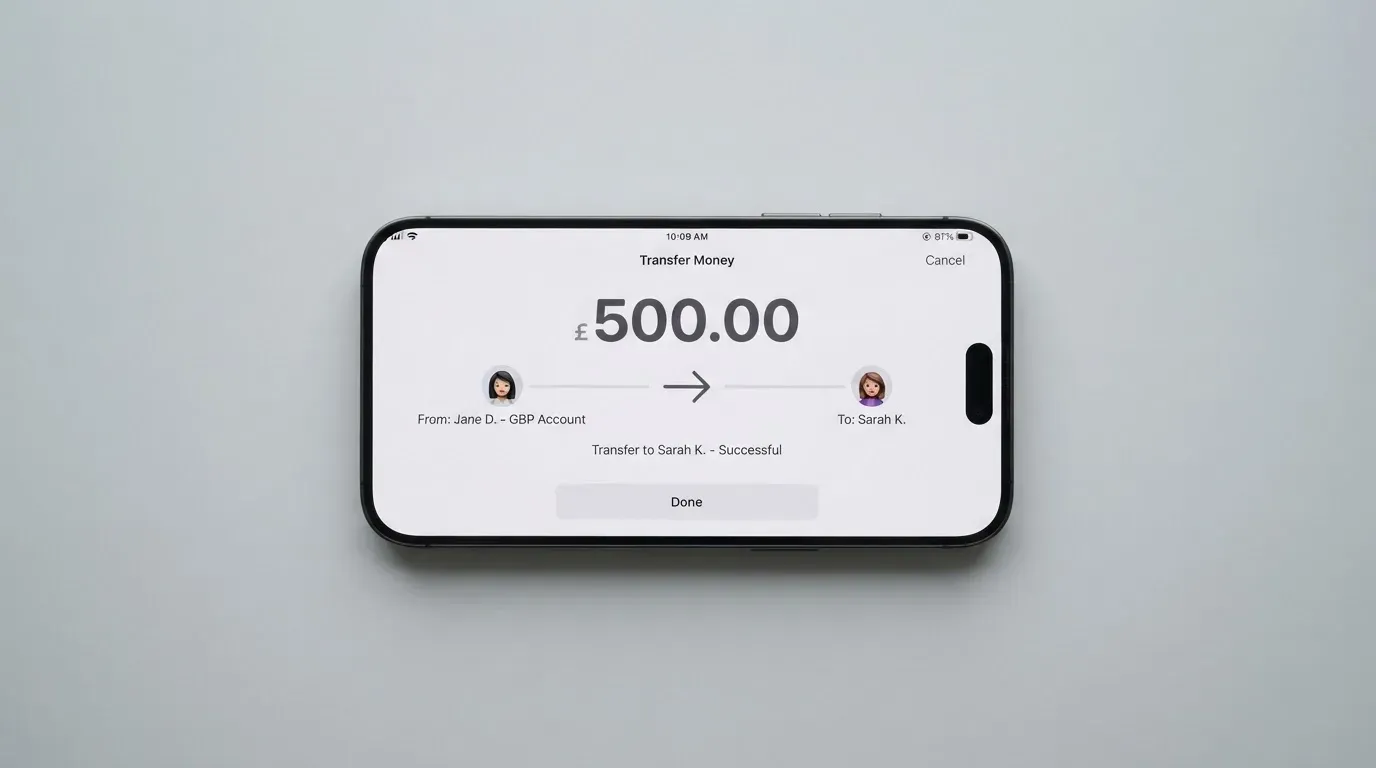
The 1% deposit fee applies here and nowhere else. This is the single most important number in the whole cost picture, because in practice the fee you pay depends on how often you load rather than on how much you spend. Someone who loads once a month pays 1% a month. Someone who tops up for every purchase pays 1% repeatedly and is quietly the worst-served user of the product.
On the way out, wire transfers are generally credited within 1–2 business days, with fees not stated. Transfers between balances — EUR24 to another registered account-NFT holder — are described as possible, which is a genuine feature if you use more than one wallet.
A practical warning about crypto transfers generally, not about this card: blockchain transfers are irreversible. Send funds on a network the provider does not support, or to an address belonging to a different network, and the money can be lost or need manual support recovery with no guarantee attached to the recovery.
Paying with it every day
For everyday spending the list is long and the caveats are short. Apple Pay, Google Pay, Samsung Pay, Alipay and WeChat Pay are all supported for offline spending — that is an unusually broad wallet list for a crypto card, and it covers most of the tap-to-pay situations you hit in a week. Categories that merchants block, though, are not stated, so you cannot tell in advance whether your card will work at a betting site, a fuel station or a department-store kiosk.
The card is managed entirely inside the TokenPocket app; I did not check store ratings, and app quality is the sort of thing that changes monthly anyway. Treat the app as the single point of control for freeze, replacement and disputes.
Refunds are the part people get wrong. When a merchant completes its refund process, the money is credited 15–30 business days later — that is three to six weeks, and chargeback rules are not stated. Plan around that rather than being surprised by it. Declined payments can also leave a hold on your balance that lingers for days.
For context on why some payments behave oddly: a merchant category code is a four-digit classification assigned when a business starts accepting cards, and codes covering gambling are commonly blocked by issuer policy rather than by law, with the blocked list differing per issuer. And because the card number carries an issuer identification code that merchants can look up, a card issued in one country can read as “foreign” at a till in another, which invites extra scrutiny or a decline.
What can go wrong
I found no official incident involving the card itself. The problems are quieter and structural.
Support is the biggest risk. The FAQ never names the issuer. Support emails point to Fiat24, and the account recovery material is handled by Fiat24 — but the FAQ does not state that Fiat24 is the issuer. On Trustpilot, Fiat24 scores 2.2 out of 5 from 8 reviews (read 2026-10-21), all of them one-star. The complaints are consistently about support going silent, funds being held or delayed, and payments or transfers failing. Eight reviews is a tiny sample and one-star bias is normal on review sites, but a 2.2 with every review at the floor is a signal, not noise.
Your key is your identity. There is no account and password; credentials are the Web3 wallet itself. Lose the key and Fiat24 verifies your identity, locks the account and resets it by moving the NFT and the funds to a new Arbitrum wallet, with a small fee possibly applying. Lose the key and have no access to that verification route, and the recovery path gets very thin. If the key is stolen, the guidance is to lock the card and move the funds if you are still logged in, and contact Fiat24. The custody model and whether 2FA exists are not stated.
The card’s own trust base. TokenPocket works jointly with “a compliant financial institution” — described as a Swiss-compliant bank — and no licences are named. Two implications follow. Regulated e-money providers must safeguard customer funds by segregating them or insuring them, and such funds are not bank deposits and may not carry deposit-guarantee cover. And in the EU, MiCA’s rules on asset-referenced and e-money tokens have applied since 30 June 2024, with the remaining provisions including crypto-asset service provider rules applying from 30 December 2024; the transitional period runs until 1 July 2026 or until a provider is authorised or refused. A card is regulated separately from the crypto side, so this product rests on more than one licence — none of which the pages name.
Programme-level risk exists in this category. Card programmes do close: Visa terminated its global agreements with FTX on 13 November 2022 and the FTX US debit card was wound down, and WaveCrest, a Visa issuer that supplied crypto card brands, was suspended by Visa in Europe in 2018, closing all its Visa programmes. Closures typically mean a notice period, then loading and spending stop, then you are asked to withdraw what is left.
Stablecoins are not risk-free. They aim to hold a stable value, but “despite the name, stablecoins are not necessarily stable” — TerraUSD collapsed in May 2022 and USDC briefly lost its peg in March 2023. Roughly 90% of stablecoin market capitalisation sits in USDT and USDC, and Tether disables tokens in wallets on the OFAC sanctions list and has frozen funds tied to illicit activity, so these balances are not censorship-proof.
Money movement can strand funds. Holding tokens is not the same as being able to move them: on Ethereum, fees are paid only in ETH, so a wallet with USDT and no ETH cannot send. Tether issues USDT on networks including Ethereum, Tron, Solana, Polygon and Avalanche; Circle lists USDC as natively supported on 38 networks as of 16 September 2026, including Ethereum, Solana, Base, Polygon PoS, Avalanche, Arbitrum and Stellar, and stopped supporting USDC on Tron in February 2024, so “USDC over TRC20” is not a native option. Tron prices fees with bandwidth and energy, often burning TRX. Pick the wrong network for your deposit and the fee, the chain and your card may not agree.
One practical safeguard worth using from day one: a tokenised number in a mobile wallet can be restricted by the issuer per channel, so freezing the card or the Apple Pay token stops spending without closing the balance.
What to take instead
Three alternatives came out of the same exercise with higher marks. They are not identical products, so I will say what each is actually better at rather than declare a winner.
| Card | Score | Card type | Up-front cost | Published fee highlights |
|---|---|---|---|---|
| MetaMask | 7.1 / 10 | Mastercard, virtual first, metal optional | Virtual free; metal $199/year | “Minimal fee for each transaction” (amount not stated on the pages read); no foreign transaction fee, Mastercard rate used |
| KAST | 6.1 / 10 | Visa, virtual and physical, up to 10 cards | Standard 0 USD/year; Premium 1,000 USD/year; Private 10,000 USD/year | Stablecoin top-up 0%; card spend in USD 0%; non-USD FX 0.5%–1.75%; declined transaction 0.50 USD |
| Zeal | 6.1 / 10 | Visa, virtual, addable to Apple Pay | Not stated | No additional FX fee; conversion at the Visa wholesale rate; Gnosis Pay fees may still apply |
MetaMask is the strongest of the three on score, and its cost structure is the clearest: free virtual, no foreign transaction fee, Mastercard rate. It also has real limits you can plan against — a fee table is linked even though the amount was not on the pages I read. Its signup is open in 45 listed countries and territories (Andorra, Argentina, Brazil, Canada, Mexico, Germany, France, Spain, Uruguay among them) with proof of residency required, and ineligible regions limit sign-ups rather than spending; US and UK sign-ups are temporarily closed per its FAQ. It pays cashback in mUSD into the Money Account: 1% on Virtual, and 3% on Metal capped at the first $10,000 spent then 1%, plus a $FLY bonus via a dining app. It spends from the connected wallet over Linea, Base, Monad and Solana.
KAST is the one with published numbers. It runs 0% on stablecoin top-ups, 0% on USD card spend and 0% on Apple/Google Pay, with a 0.5%–1.75% non-USD FX fee depending on your residence country, transaction country and card programme, 0.10 USD for non-USD transactions under 25 USD, and 0.50 USD for a declined transaction. Cashback is 1.5% up to 2,000 USD a month on Standard, 2% up to 10,000 USD on Premium and 3% up to 40,000 USD on Private, paid in USD when the transaction is authorised. The catch is its country list is shown only at KYC and not published, it accepts only the account holder’s own ID, a VPN does not bypass it, and you can create an account in an unsupported country with KYC permanently locked.
Zeal is the simplest model: spend in 150+ countries, no additional FX fee, conversion at the Visa wholesale rate, balances in EUR, USD and GBP stablecoin accounts, and up to 4% cashback paid in GNO if you hold GNO in the card Safe. Its own fee schedule is not published, which is exactly the gap that makes TokenPocket harder to judge.
| If you need | Look at | Because |
|---|---|---|
| The lowest headline cost with a published schedule | KAST | Every fee percentage is written down, including the awkward ones |
| A free virtual card and no FX markup | MetaMask | Free virtual, no foreign transaction fee, cashback stated |
| The broadest geographic coverage | Zeal | 150+ countries for spending |
| Spending an Arbitrum balance without leaving the wallet | TokenPocket | This is the one thing it is genuinely built for |
Who I would recommend it to
I would recommend this card to a reader who is already holding crypto on Arbitrum, already uses the TokenPocket app, lives in one of the named Visa or Mastercard countries, and wants to spend without routing through an exchange. For that person the 1% top-up fee is the honest cost of the product and everything else is a bonus.
I would not recommend it as a first crypto card. Someone choosing their first card wants to read a limit table, a fee table and a support policy, and this one publishes none of the three. I would not recommend it to anyone who needs a physical card, and I would not recommend it to anyone whose fallback for a frozen balance is a support desk that scores 2.2 out of 5 from eight reviews.
The question worth asking yourself is not whether the card works — on its own terms it does. It is whether you are willing to hold money in a product whose issuer is not named, inside a wallet whose key is your only way back in, with a refund timeline of 15 to 30 business days and a support record that mostly shows silence. If the answer is yes, this is a reasonable tool. If you want to know exactly what you are signing up for and the pages will not tell you, that absence is itself the answer.
Frequently asked questions
What is TokenPocket card?
The TokenPocket card is a virtual Mastercard or Visa debit card offered through the TokenPocket wallet app, running on Arbitrum. You mint an account NFT, register, and the card spends balances held as EUR24 and USD24. It is a crypto-wallet product rather than a bank account, with balances pre-loaded from your own wallet.
How does the TokenPocket card work?
You load crypto from your TokenPocket wallet into the card, paying a 1% deposit fee, and the balance is converted to EUR24 or USD24 that the card then spends. It behaves like a prepaid card rather than a bank debit card: it can only spend what has been loaded. EUR24 or USD24 can be transferred to another registered account-NFT holder.
Is TokenPocket a bank?
No. TokenPocket describes itself as working jointly with “a compliant financial institution” and a Swiss-compliant bank, but no licences are named in the public pages, and the FAQ does not name the card issuer. Support emails and account recovery both point to Fiat24. Treat it as a crypto wallet product, not a regulated bank relationship you can rely on.
Who owns TokenPocket?
TokenPocket is the crypto wallet company whose app hosts the card, and it is the front end for the programme rather than the issuer. The card’s public pages do not state who owns the issuing side, and the FAQ does not name Fiat24 as the issuer even though support and recovery run through it.
Who can get the TokenPocket card?
A Visa debit is offered for a list of European countries and territories, with Germany, France, Spain and Switzerland named as examples. A Mastercard debit covers Australia, Canada, Hong Kong, Japan, Taiwan, New Zealand, Singapore, South Korea and the UK. The Americas were listed as “planned for Q2 2025”.
How do I get and activate the TokenPocket card?
Download TokenPocket, create or import an Arbitrum wallet, mint the account NFT, complete registration, and receive the card. Verification runs through your on-chain wallet rather than a document list, and no separate document list or verification tiers are stated in the public pages. One account NFT is allowed per wallet.
What does the TokenPocket card cost?
The NFT creation fee is partly covered by TokenPocket and you pay a “small portion” that is not disclosed, and a 1% fee applies when depositing cryptocurrency. The FAQ states no other fees are charged, though extra costs can come from inter-institution settlement and no foreign-exchange fee is stated. Limits, ATM terms and a reward percentage are not published.
Is the TokenPocket card free?
There is no published price for the card itself; what is documented is a partly covered NFT minting fee with a “small portion” left to the user, plus the recurring 1% crypto deposit fee. Because the amount of your share is not stated, nobody can tell you from the public pages what entry costs today.
How do I top up the TokenPocket card?
The only route described is a crypto deposit from your TokenPocket wallet, with the Arbitrum wallet as the context. The 1% fee applies to that deposit, and the FAQ names no specific coins or networks, no minimum, and no fiat or bank-transfer option. Check the network before sending, because blockchain transfers cannot be reversed.
Is the TokenPocket card safe?
No official incident involving the card itself came to my attention, but the issuer is not named in the FAQ and Fiat24’s Trustpilot rating is 2.2 out of 5 from 8 reviews, all one-star, citing unresponsive support and delayed funds. There is no account and password, so your wallet key is your only route back in, and refunds are credited 15–30 business days after the merchant completes its refund.
Wallet cards put to the test – cryptocardtested
Content created by the «cryptocardtested» team