
A quick no-KYC virtual card paid in USDT, with a lot left unsaid
 Available in US
If you cannot get an ordinary bank card — because of where you live, because of your status, because a bank’s application keeps failing — then a card advertised as “NO KYC” is going to look interesting. That is exactly the pitch here. VCCHQ sells virtual Visa and Mastercard cards, paid for in USDT, ordered by email and delivered after support checks a transaction hash. There is no country list, no list of exclusions, and no list of anything else much either.
I went through the card’s own public pages carefully, and then I asked the questions a person in that position would actually ask: who will issue this to me, what does it cost me in practice, can I put money on it, can I use it in a shop tomorrow, and what happens if something goes wrong? My score for the card is 4.9 out of 10. That is a middling number, and I want to be straight about why: the idea is sound and the price is low, but the pages leave out the things you need in order to decide.
The conditions described here are current as of October 28, 2026.
My aim in the rest of this page is to walk you through it section by section, in the order you would hit these questions yourself — can I even get one, what does it cost, how do I load it, can I live on it, what can go wrong — and then tell you plainly who I would and would not hand this to.
Verdict: 4.9 out of 10
The card scores well on access and badly on everything that comes after the purchase. Access is genuinely its strongest point, and I want to give it credit there before I criticise anything else.
| Criterion | Mark | Why |
|---|---|---|
| Who can get it | 9 / 10 | Stated as “Global”, no country list and no exclusions, no KYC, ordered by mail |
| Cost | 2 / 10 | Issuance of $3 to $15, plus 8% on loads and $2 per load; a $30 top-up costs $34.40 |
| Top-up options | 6 / 10 | USDT only, on TRC20 or BEP20, address issued per order, minimum load $5 or $30 |
| Reliability and complaints | 4 / 10 | No legal entity, address or issuer named; footer says “© 2018 – 2026 VCCHQ”; Trustpilot 3.5 from 5 reviews |
| Everyday use | 3 / 10 | Virtual Visa or Mastercard only, no app, Apple Pay, Google Pay and ATM not disclosed |
Total: 4.9 / 10.
Who it suits: someone who already holds USDT, who genuinely cannot pass a bank’s identity checks, who needs a card number rather than a full current account, and who treats the balance as small and disposable. If your situation is that, the $3 entry fee is cheap enough to be worth a try.
Who it does not suit: anyone who needs a card for a monthly subscription, travel, or anything where a declined payment or a frozen balance would be a real problem. It also does not suit anyone who expects a regulated bank behind it, a phone app, or the ability to withdraw to a bank account — because none of those are described.
And I want to say plainly what this card is, in one line: a quick no-KYC virtual card paid in USDT. Everything positive and everything negative in this review follows from those seven words.
Will they give you the card?
Yes, on the card’s own account — and this is where it scores highest.
The eligibility statement is the single word “Global”. There is no country list. There is no list of exclusions. There are no KYC levels to pass, no documents to upload, no selfie, no proof of address. The card’s own description of its own process is “NO KYC”.
Now, a word of context, because “global, no KYC” is unusual and you deserve to know why it is unusual. Under anti-money-laundering law, regulated businesses are required to verify their customers and assess risk, which normally means identity checks, sanctions screening and ongoing monitoring. In the EU that due diligence covers name, address, date of birth, nationality, identity documentation, a sanctions check, the purpose of the relationship, and whether you are a politically exposed person. In the US, the customer identification programme requires name, date of birth, address and an identification number. And nationality is recorded and screened separately from residence, because sanctions screening and issuer risk policy often apply to citizenship and country of birth as well as to country of address.
A card with none of that is not necessarily illegal — some categories of product sit outside those regimes, and prepaid instruments often have lighter rules. But it does mean two practical things for you. First, you should not expect the card to be accepted everywhere a bank card is accepted, because the systems behind merchant acceptance are built around identification. Second, if a card is issued without any check on who you are, the protection you normally get from a bank in a dispute is largely gone with it. I will come back to that in the risks section.
One thing the card does not say: the minimum age is not stated. Most prepaid and debit cards are generally available to adults (18+), and some issuers set higher limits, but VCCHQ does not publish an age requirement anywhere on the pages I read.
How to get it
The order flow, as the card describes it, is four steps:
- Choose the card tier you want.
- Enter your email address.
- Pay in USDT.
- Submit the transaction hash (TXID), which support then verifies.
There is no application form, no document upload, and no waiting on a credit decision. The delivery is described as virtual, with “Instant Delivery” after TXID verification — meaning you get card details after the transaction has been checked, not instantly after you press buy.
Three card products appear on the pages:
- Standard — the entry tier, the cheapest issuance fee, the lowest minimum load.
- Premium — described with “Enhanced Approval BINs”, which is the card’s way of saying it uses BINs that shops tend to approve more often. Premium and Ultra Premium share BIN 428842.
- Ultra BIN 428842 — described as “Elite Flagship BIN”.
A note on what a BIN is, since the tier names lean on it. A card number starts with an issuer identification number — the BIN or IIN — of six or eight digits identifying the institution that issued it; the rest is an account identifier and a check digit. Merchants can look the BIN up to see which institution and which country issued a card, and may apply extra scrutiny if the issuer country differs from the customer’s billing address. That is why a card issued in one country can look “foreign” to a shop in another. When a card advertises an “elite” BIN, what you are reading is a claim about how the number looks in databases, not a promise about your experience at the till.
The card currency is not stated.
Fees: what it really costs
Here is the honest total, not the headline. Issuance is cheap. Loading is where money leaves you.
| Fee or limit | Value |
|---|---|
| Issuance — Standard | $3 |
| Issuance — Premium | $6 |
| Issuance — Ultra BIN 428842 | $15 |
| Monthly fee | not stated |
| Load fee | $2 plus 8% |
| Conversion fee | not stated |
| FX fee | not stated |
| ATM | not stated |
| Minimum load — Standard | $5 |
| Minimum load — Premium, Ultra | $30 |
| Daily limit | not stated |
| Maximum load | not stated |
Read that table twice, because the second line of it is the whole story. On a $30 top-up the card’s own example gives $34.40 — that is the $2 plus the 8%, on a small balance. The percentage does not shrink as you scale up; it applies the same way at any amount. So the card is cheap to open and permanently expensive to keep fed.
Now let me walk three ordinary payments through it, because that is where the arithmetic becomes concrete.
A $4.50 coffee. You cannot spend straight from USDT — the card spends a balance you have already loaded. So your first $4.50 of spending requires a top-up. On the $5 minimum load for Standard, you pay $2 plus 8%, which is $2.40, for $5 of balance. Your 48-cent coffee has cost you $7.40. On the Premium and Ultra minimum of $30, the same coffee costs you $34.40 to obtain.
A $60 monthly subscription. Same arithmetic, larger numbers: you need $60 on the card, so you load at least that much and pay $2 plus 8% on top — $4.80 of loading cost, every month, forever, to keep a $60 subscription running.
Anything paid in a currency other than the card’s. The FX fee is not stated and the card currency is not stated. I am not going to invent a figure for you, but I will say what the absence means: you cannot work out your own cost per transaction on a foreign-currency purchase, because one of the two numbers you would need is missing.
Two related costs sit outside the card but still hit your wallet. On-chain network fees for your deposit are charged by the blockchain, not by the card provider — so sending on a busy network costs more. And the card’s own pages state network fees as not stated, so the amount you will actually pay on a TRC20 or BEP20 transfer is not something the card commits to.
Also missing from the fee table above: any withdrawal cost, because withdrawal is not stated at all. There is no description of getting money back off this card, and that is a gap you should weigh heavily if the card is meant to hold anything more than spending money.
And one category-specific note on where the money goes. A merchant category code is a four-digit number classifying a business by goods or services, set when the business starts accepting cards. MCC 7995 covers gambling. Many issuers block that code on specific cards by policy rather than by law, and the blocked list varies by issuer — so whether your virtual card works for anything of that kind depends on a list the card does not publish.
Top up: how the money gets in
One coin, two networks. USDT on TRC20 or BEP20 only. The wallet address is shown per order, which means you get a fresh address for each top-up rather than one permanent deposit address.
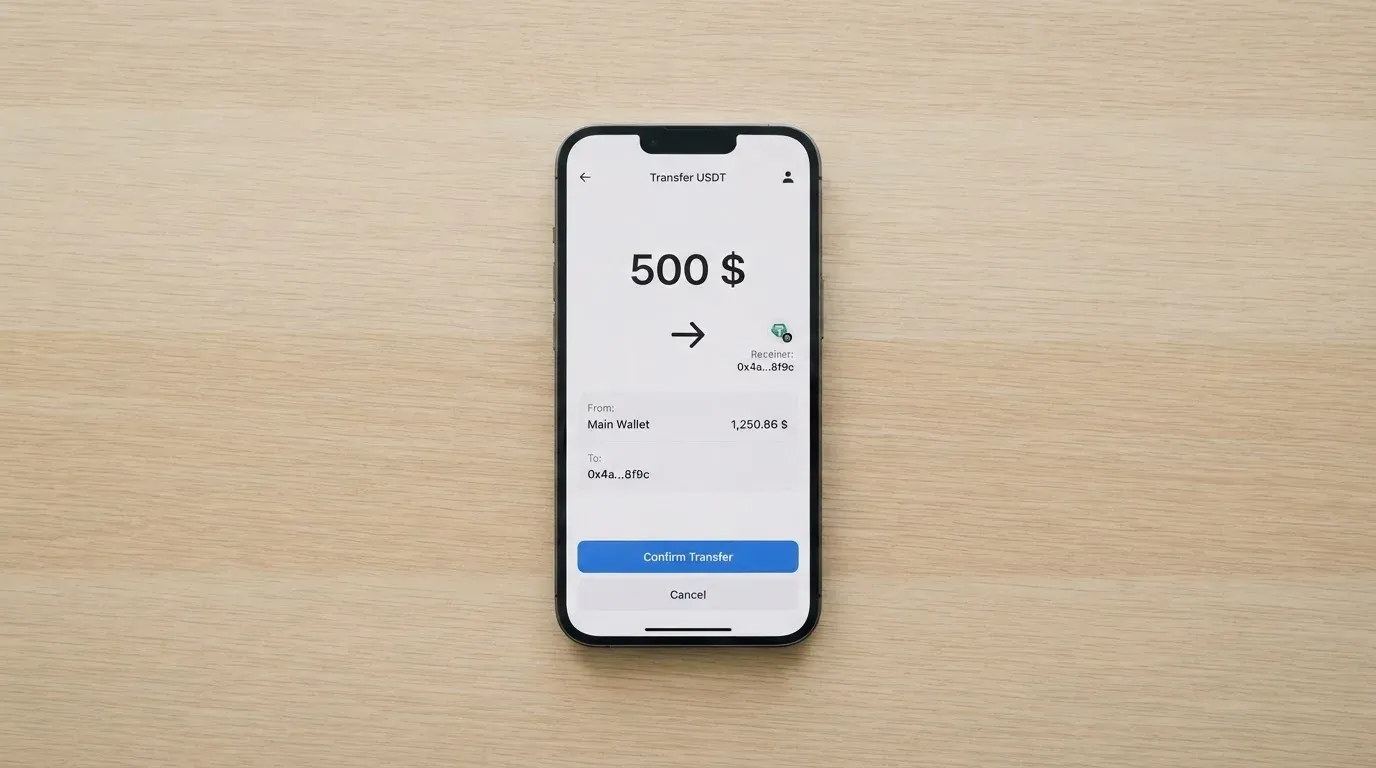
The top-up fee is $2 plus 8%, and the card gives its own worked example: “$30 Top-Up = $34.40”. Minimum load is $5 on Standard, $30 on Premium and Ultra. There is no stated maximum, no stated daily limit.
Three things about this that a first-timer should sit with.
The network choice is not recoverable if you get it wrong. Blockchain transfers are irreversible. If you send USDT on a network the provider does not support, or to an address belonging to a different network, the funds can be lost or may need manual support recovery with no guarantee. So the address they give you, and the two network names, are not decoration — they are the instruction that decides whether the money arrives. Before you send anything, confirm you can read the network you are about to use.
You need the right coin, not the right idea. USDT is one of two large dollar-pegged stablecoins; the BIS put about 90% of stablecoin market capitalisation in USDT and USDC as of July 2025. “Stable” is a description of intent: despite the name, stablecoins are not necessarily stable. TerraUSD collapsed in May 2022, and USDC temporarily lost its peg in March 2023 during the US banking crisis. If your balance is going to sit on this card for any length of time, that history is the relevant context.
Fees differ by network underneath. ERC-20 is the Ethereum token standard, and gas there is paid only in ETH — so a wallet holding USDT and no ETH cannot send. Tron prices transactions through bandwidth and energy resources, often burning TRX. That is part of why the provider supports TRC20 and BEP20 specifically: they are the cheap routes. It also means your deposit cost is not fixed, and the card declines to quantify it.
What you cannot do: nothing else is listed. Bitcoin is not mentioned, Ethereum is not mentioned, USDC is not mentioned, bank transfer is not mentioned. One coin, two chains.
Paying with it every day
This is where the card is weakest, and I want to be plain about it: there is no app. Not a thin app, not a companion app — the card states there is none. If you have used any mainstream financial service in the last decade, that alone will tell you what life with this card looks like.
What you do get is a virtual card — a card number, an expiry, a security code, delivered to you after TXID verification. Visa or Mastercard, depending on what you ordered. Nothing physical is sent; the word “Global” in the eligibility line refers to who can order, and the delivery line says virtual.
So, concretely, for everyday life:
- Apple Pay and Google Pay are not disclosed. Whether you can add the card to a phone wallet is simply not stated on the pages I read. I know this is one of the first things people want to know, and I know that even where a card number can be added manually, the issuer can restrict a tokenised number — blocking it on phone, magnetic-stripe or website use. Without a published answer, you should assume you may be typing numbers into websites, which is a worse way to spend money than tapping.
- ATM withdrawal is not stated. So cash is out of scope as far as the published information goes.
- Rewards are not stated. No cashback, no points, no incentive of any kind is mentioned.
- Wallets supported are not stated.
- Refunds and disputes: a Refund Policy is listed in the footer, and the text is not available. That is worth noticing. A refund policy that exists but cannot be read is not a policy you can rely on when you need one.
Then the category-level friction that applies to any virtual, foreign, or prepaid card, and which explains a lot of “it just gets declined” stories. 3-D Secure adds an identity check to online payments — the issuer assesses risk and either approves frictionlessly or challenges you with a one-time code or biometric. Where the card has no identification on file, some of those decisions get made conservatively. Address Verification Service compares the numeric parts of the billing address you typed with issuer records; it is mainly offered in the US, Canada and the UK and is generally unavailable for foreign-issued cards, which can cause declines. Some merchants decline prepaid or foreign BINs outright, because the lookup reveals the card type and issuer country. And a declined authorisation may leave a hold on your funds that can persist for several days — typically up to seven.
None of that makes the card unusable. It means your everyday use is narrower than with a normal bank card, and that you should keep a backup for anything time-sensitive.
What can go wrong
Let me split this into what the card itself discloses and what I found elsewhere, clearly labelled.
No official incident is on record. That is a statement about the absence of reports in official channels, not a clean bill of health.
Unofficial and not confirmed by the card — Trustpilot. The Trustpilot profile shows 3.5 from 5 reviews, with none in the last 12 months when read on 21 October 2026. There is one negative review, dated December 2021, about a delayed order. This is a user report on a third-party site, not something the card has confirmed, and a single old review on a thin review base is weak evidence either way — but it is the only complaint trace I could find, so you should know it exists.
The bigger issue is absence. The card does not name a legal entity, a registered address, or an issuer. All that appears in the footer is “© 2018 – 2026 VCCHQ”. A copyright line is not a company. When you are being asked to send USDT to a wallet address for a card that will hold money, the question you want answered is “who is behind this and under whose licence,” and the pages do not answer it. So I will not answer it either.
Some background makes that absence more consequential rather than merely annoying. Visa and Mastercard do not issue crypto cards to consumers themselves — they license issuers, and they can suspend a programme. Visa terminated its global agreements with FTX on 13 November 2022 and the FTX US debit card was wound down by its issuer. WaveCrest, a Visa issuer that supplied crypto card brands, was suspended by Visa in Europe in 2018, closing all WaveCrest-issued Visa programmes. The pattern in this category is that programmes close, and when they do, spending stops and loading stops, and users are asked to withdraw remaining balances. One 2026 closure reported by a secondary source had new loads ending 8 July 2026 and spending stopping 8 August 2026 — a single unconfirmed source, which is exactly how you should treat it: as a shape of risk, not a prediction.
What you would lose if the balance sat with a provider. Control of crypto belongs to whoever holds the private key or seed phrase. A seed phrase is typically 12 to 24 words and is an unencrypted form of the private key; anyone who obtains it can restore the wallet and spend the funds. Transfers are typically irreversible and there is no built-in recovery. The record of custodial platforms is not encouraging: Mt. Gox, about US$350 million reported stolen between 2011 and 2014; Coincheck, about US$400 million in 2018; Ronin Network, US$625 million in 2022. A card like this is a custodial arrangement, and the card pages say nothing about safeguarding, insurance, or how balances are held.
Security features: not stated. No two-factor authentication described, no instant freeze, no spending limits published. The usual safeguards in this category are app-based 2FA, instant card freeze, spending limits, 3-D Secure confirmation and tokenised mobile wallets — none of which the card mentions.
Sanctions are not a technical loophole. Tether says it disables tokens in wallets on the OFAC sanctions list and has frozen funds tied to illicit activity. Stablecoins are not censorship-proof, and neither is a card that runs on them. I am not going to write about how to get around any of that, and neither should anyone selling you a guide to it.
Support exists. Contact points listed are Telegram @worklinkx, WhatsApp +44 7723 833291, and email [email protected]. Hours and languages are not stated. Note that this is support for a card whose issuer is unnamed — support is not the same as a regulated complaint route, and a chargeback, which is a refund ordered by the issuer to settle a dispute, can only be ordered by an issuer. US debit card reversal rights come from Regulation E, credit card rights from Regulation Z, and prepaid-card coverage varies and should not be assumed.
And the thing nobody asks about. The IRS treats digital assets as property, so exchanging them for goods, services or dollars generally produces a taxable gain or loss. For personal or investment holdings that is a capital gain or loss, short-term if held a year or less, measured in local fiat currency at fair market value on the date of the transaction. Every card payment funded from crypto may therefore be a separate taxable disposal. I am not giving you tax advice and I am not going to tell you what your obligations are — but if you will be spending crypto regularly, take this to a professional in your own jurisdiction before you assume it does not apply to you.
What to take instead
I looked at three alternatives and scored them the same way. None of them is a triumph, which is itself informative about this corner of the market.
| Alternative | Score | Card | Issuance | Funding | Notable gap |
|---|---|---|---|---|---|
| Cardex | 5.6 / 10 | Debit crypto card on VERVE, Visa, Mastercard and UnionPay; virtual and physical; Naira per the store listing | not stated | USDT, USDC and BTC wallets | Store listing is Naira-focused; App Store listing reads pay in Naira |
| CardFlow | 4.9 / 10 | Virtual USD Mastercard, created in 3 minutes | Creating a virtual card is free per the site FAQ | Bitcoin, USDT, ETH or Naira bank transfer | Aimed at Nigeria; fees not stated |
| HyperCard | 4.7 / 10 | Prepaid; network not stated on the App Store page; balance in USD or EUR | not stated; app page lists no fees | Crypto such as USDT, BTC, ETH in the app, converted to USD or EUR | App Store says works in more than 176 countries — that is acceptance, not eligibility |
Three comparisons worth making explicitly.
On cost transparency, VCCHQ is ahead. Cardex states no fee percentage at all, describing only an “AI-Powered Conversion Rate” that scans global exchange rates and picks the best one when you spend. HyperCard lists no fees on its App Store page. VCCHQ at least prints its numbers: $2 plus 8%. An unfriendly known fee beats an unknown one.
On flexibility, Cardex is ahead. It takes three coins and offers both virtual and physical cards across four networks. If your holding is not USDT, or you want something in your hand, VCCHQ simply does not compete.
On focus, CardFlow is ahead. It is aimed squarely at Nigeria and also at “Nigerians and global users”. A card built for a specific market tends to work well inside it and be quietly mediocre outside. HyperCard’s “more than 176 countries” line is a description of where the card is accepted, not of who qualifies — and Cardex’s own listing is Naira-facing.
If you are outside those markets, the more honest answer is that none of these four solves your problem particularly well, and the better move is to look at regulated options first — an e-money account in a country where you have the right to hold one, or an EMI-issued card under EU payment law. An electronic money institution in the EU can issue e-money, payment cards and e-wallets but cannot lend, and may serve customers across the EU/EEA from a licence granted in one member state. Those institutions must safeguard customer funds, by segregating them in dedicated accounts or insuring them — though such funds are not bank deposits and may not be covered by deposit guarantee schemes. It is a slower route. It is also a route where the question “who is behind this” has an answer.
One thing worth knowing about the regulatory frame, so you can check things yourself: MiCA, Regulation (EU) 2023/1114, is the EU’s markets-in-crypto-assets regulation and ESMA states it took legal effect in June 2023. Its rules on asset-referenced tokens and e-money tokens applied from 30 June 2024, and the remaining provisions, including crypto-asset service provider rules, applied from 30 December 2024. Under MiCA, e-money tokens may be issued only by a credit institution or an electronic money institution. The transitional period lets providers already operating under national law continue only until 1 July 2026 or until they are authorised or refused, whichever comes first. ESMA keeps an interim register of authorised CASPs, white papers and non-compliant entities — you can look a provider up there before you send it money. Note also that a card is a payment service regulated separately: MiCA covers the crypto side, so a crypto card often depends on two licences.
Who I would recommend it to
Not to everyone, and I would rather be specific than diplomatic.
Consider it if: you hold USDT already; you cannot pass a bank’s identity checks for reasons that will not change; you need a card number for occasional online spending rather than a banking relationship; you are comfortable treating the balance as spendable money rather than savings; and you have read the “what can go wrong” section and accepted that your protection is thin. Open Standard first at $3, load the $5 minimum, and see how one payment goes before you put anything more in.
Skip it if: any of these apply to you.
- You need a card for recurring bills, travel, or anything where a decline is disruptive.
- You hold something other than USDT. There is no Bitcoin, no Ethereum, no USDC, no bank transfer.
- You want a physical card, a phone app, or Apple Pay and Google Pay support.
- You want to withdraw money to a bank account. Withdrawal is not stated.
- You want to know who is behind it. No legal entity, address or issuer is named.
- You are in a position where a frozen or closed programme would cost you real money.
- You need chargeback rights you can actually exercise.
- You are dealing with anything above a few hundred dollars. At $2 plus 8%, that is not an efficient way to move value.
My honest summary is that this is a small, cheap, useful tool with a thin published safety net and no published legal identity behind it. Used that way — small balances, low stakes, occasional spending — it is defensible. Used as a primary card, it is not, and the reason is not the price or the coin support. It is that the card’s own pages do not tell you who issued it.
Frequently asked questions
What is VCCHQ card?
It is a virtual payment card sold as “NO KYC”, available in three tiers — Standard, Premium and Ultra BIN 428842 — as a Visa or Mastercard. You order by email, pay in USDT, submit your transaction hash, and support verifies it before delivering card details. The card describes itself as “Global” with no country list and no exclusions. It is a prepaid-style product: you load a balance and the card spends only that balance.
Is VCCHQ a bank, and who owns it?
No, it does not present itself as a bank. More to the point, the pages I read name no legal entity, no registered address and no issuer — only a footer reading “© 2018 – 2026 VCCHQ”. So I cannot tell you who owns it, and I would not guess. This is the single biggest gap on the card’s site, and it is the first thing you should ask support before sending money.
Does VCCHQ require KYC?
No. The card states “NO KYC” and describes no KYC levels, no document upload and no identity checks. Age is not stated. In the EU, customer due diligence normally covers name, address, date of birth, nationality, identity documentation, a sanctions check and politically exposed person status, so a no-KYC product sits well outside that standard — useful to know when you consider what protection you are giving up.
How much does it cost, and is it free to open?
Issuance is $3 for Standard, $6 for Premium and $15 for Ultra BIN 428842, and a monthly fee is not stated. Loading is the expensive part: $2 plus 8% per top-up, and the card’s own example gives a $30 top-up at $34.40. The conversion fee, the FX fee, ATM costs and any withdrawal charge are all not stated. On-chain network fees are paid to the blockchain, not to the card.
How do I top up the card?
With USDT only, on the TRC20 or BEP20 network, sent to a wallet address shown for your order. Minimum load is $5 on Standard and $30 on Premium and Ultra. There is no stated maximum or daily limit. Get the network right: blockchain transfers are irreversible, so a deposit sent on an unsupported network or to an address of another network can be lost or need manual support recovery with no guarantee.
Can I use it with Apple Pay, and is there an app?
There is no app — the card states so plainly. Apple Pay and Google Pay support is not disclosed. That matters because even where a card number can be added to a wallet by hand, the issuer can restrict a tokenised number and block it on phone, magnetic-stripe or website use. ATM withdrawals are also not stated, so plan on paying by card number only.
Where can I use the card, and will shops accept it?
The card says “Global” about who can order it, which is not the same as where it is reliably accepted. Merchants can look up the issuer BIN and country, and some decline prepaid or foreign BINs on that basis; address verification is generally unavailable for foreign-issued cards, which causes declines. Declined authorisations can also leave a hold on funds lasting up to seven days. Expect occasional friction, especially on unfamiliar or high-value merchants.
Is it safe, and what happens if the provider disappears?
No security features are described — no two-factor authentication, no instant freeze, no published spending limits. A refund policy is listed in the footer but its text is not available. There is no official incident on record, and one unconfirmed user report on Trustpilot, where the profile shows 3.5 from 5 reviews with one December 2021 complaint about a delayed order. Programme closures do happen in this category, and when they do, loading and spending stop.
How do I withdraw money from VCCHQ?
I cannot tell you, because the card does not state it. There is no described withdrawal route, no destination account and no fee. If being able to get your money back matters to you, treat that as an unanswered question and press support on it specifically before you load more than you are willing to lose.
Is the VCCHQ card worth it?
Worth it for the narrow case: you already hold USDT, you cannot get a normal bank card, and you want a card number for occasional spending with small amounts you can afford to lose. Not worth it for monthly bills, travel, larger balances, or if you need an app, a physical card, a known legal entity behind the product, or usable chargeback rights. Start with the $3 Standard tier and the $5 minimum load before committing anything more.
Virtual cards put to the test – cryptocardtested
Content created by the «cryptocardtested» team