
A Telegram-first card you load with USDT — cheap to open, unclear who runs it
 Available in US
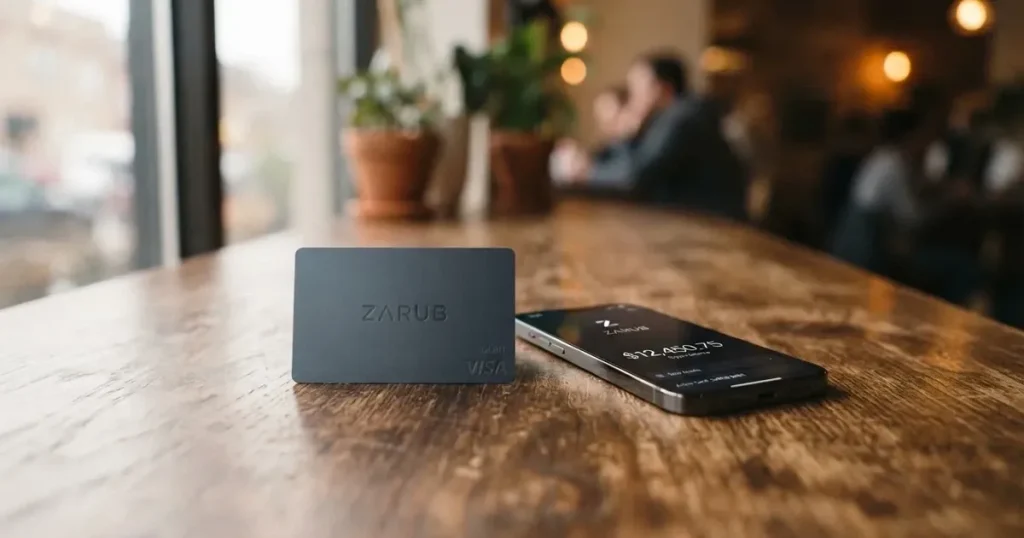
ZARUB is not a bank. It is, on the evidence available, a card that you reach through a Telegram bot, that you load with USDT or rubles, and that spends like an ordinary prepaid Visa until the balance runs out. That is the whole product, and for a particular kind of reader — someone who already lives in crypto and already uses Telegram as their banking app — that is genuinely useful. For everyone else, the gaps in what is publicly stated are the story.
I gave it 5.0 out of 10. Not because it is obviously a scam; I found no complaints against it at all, which is its own strange fact for a product of this age. The score is low because the card’s own public pages do not tell me who issues it, which country it belongs to, or what its limits really are. Everything specific I can give you comes from third-party write-ups, and I mark those as unofficial throughout.
Conditions on this page are current as of October 28, 2026.
Verdict: 5.0 out of 10, and the reason is disclosure, not fees
The single most useful thing I can tell you before anything else is this: the card’s official site did not give me the answers a person needs in order to decide. That is the dominant fact about ZARUB, and every section below is written around it.
Let me start with what suits you. ZARUB is built for someone who is already holding stablecoins, mostly USDT on Tron, and who wants to spend them at ordinary shops and online services without opening a bank account anywhere. If that is you, the top-up side is the strongest part of the offer, and I scored it accordingly. If you want a card your employer can pay into, or one with a banking app, a support line, and a name you can complain to, this is the wrong tool and you should keep looking.
| Criterion | Mark | Why |
|---|---|---|
| Who can get it | 5 / 10 | The official site shows nothing; unofficial sources list no countries, and say the cards work abroad with no currency restrictions |
| Cost | 2 / 10 | Unofficial figures: issuance 19 USD (virtual) and 30 USD (Apple Pay), 0.35 USD per operation, SBP top-up 7% plus 1.5%, crypto 3% plus network fees plus 1.5% |
| Top-up options | 9 / 10 | Unofficial: USDT TRC-20 and others, TRX, BTC, TON; rubles from Russian bank cards or SBP |
| Reliability and complaints | 4 / 10 | Issuer, company and card country are not disclosed; no complaints found for ZARUB; the usual risks of Telegram cards apply |
| Everyday use | 7 / 10 | Unofficial: a virtual Visa in USD, a separate card with Apple Pay, plastic at 149 USD; sources disagree on Google Pay; the ATM situation is not disclosed |
| Total | 5.0 / 10 | Strong at funding, untransparent everywhere else |
Two things I want to be clear about, because they are easy to misread. First, the low cost score is not a complaint that the card charges too much — 2 out of 10 is a harsh-sounding number, but the mark reflects the sum of the individual charges rather than one catastrophic fee. Second, the everyday-use mark of 7 is real: a virtual card in USD, a separate physical option, and Apple Pay support is a solid everyday setup. It is the *reliability* line, at 4, that drags the total down, and that line is almost entirely about what nobody has published.
Read the rest of this as a map of what is known, what is only claimed, and what you would be accepting on trust.
Will they give you the card?
Short answer: probably, but the card does not say, and that is worth knowing before you try.
The official material states nothing about eligibility. No country list, no citizenship rules, no residency test, no age requirement. That absence is not a green light — it means I cannot tell you whether you qualify, and neither can anyone who has not contacted the operator.
What the unofficial write-ups add is this. There is no country list published anywhere I could find. The travel section says the cards work abroad without currency restrictions, which reads as reassurance for a reader rather than as a formal promise. And the material that exists is written in Russian and aimed at Russian users, according to a dtf.ru piece from February 2026. So the intended customer is clear even though the eligibility rules are not.
That combination — no stated restrictions, Russian-language material aimed at Russian users — is exactly the shape of a card that was designed to be reachable from inside Russia without the applicant having to satisfy a foreign bank’s onboarding. Whether that is a feature or a warning sign depends entirely on what the issuer turns out to be, and I cannot tell you what that is.
One more general point that applies to every prepaid card in this category, not just this one: they are generally available to adults aged 18 and over, and some issuers set higher limits than that. ZARUB publishes no age rule of its own, so I am giving you the category default rather than a fact about this card.
How to get it
The honest answer is that the application is not described anywhere I could verify. What I can give you is a description of the route, from unofficial sources, and a warning about the missing piece.
The unofficial account, from Profinvestment in October 2026, is that there is no mandatory identity check at the start. If that holds, getting in is quick: no documents, no selfie, no waiting. It also means the card will not know who you are, which is not free for you. It is worth understanding what that trade does, because it is not only about the card company.
Every regulated business is required under anti-money-laundering and counter-terrorism-financing law to verify customers and assess risk, including ongoing transaction monitoring and reporting of suspicious activity. In the EU that due diligence typically covers your name, address, date of birth, nationality and identity documents, a sanctions check, the purpose of the relationship, and whether you are a politically exposed person. In the US, the customer identification programme requires name, date of birth, address and an identification number. Nationality is recorded and screened separately from residence, because sanctions rules and issuer risk policy are often applied to citizenship and country of birth as well as to country of address.
A card that skips this is not necessarily breaking the law — it may be operating under a lighter regime, or in a jurisdiction where the rules differ from the EU and US examples above. But it does mean the usual consumer protections that follow from verified identity are simply not in play, and it means a frozen account will be much harder to argue your way out of.
The missing piece is the card itself. The unofficial description is a virtual Visa in USD, plus a separate card for Apple Pay, with a physical card at 149 USD. The issuer and the BIN country are not disclosed, and I want to explain why that last one matters before you decide it does not.
Every payment card number starts with a 6- or 8-digit issuer identification number, the BIN, which tells any merchant who issued it and from which country. The rest identifies the account, plus a check digit. Merchants can look that number up in a second, and if the issuer country does not match the billing address, some will apply extra scrutiny. This is why a card issued in one country can look foreign to a shop in another. A card whose issuer and country are not published is a card where you cannot predict what the merchant’s systems will see when you pay.
Fees: what it really costs to use ZARUB
Every figure in this section is unofficial, from Profinvestment in October 2026. The card’s official pages publish no fee schedule at all, which is unusual and is the main reason this section is thinner than I would like.
Here is what the unofficial figures give, arranged by when you meet them:
| Fee or limit | Amount |
|---|---|
| Issuance, virtual card | 19 USD |
| Issuance, Apple Pay card | 30 USD |
| Physical card | 149 USD |
| Monthly maintenance | Free |
| Closure | Free |
| Per operation | 0.35 USD, including declined ones when the balance is sufficient |
| Non-USD payment | Interbank rate plus 0.3–0.35 USD |
| Crypto top-up | 3% plus network fees plus 1.5% |
| SBP top-up | 7% plus 1.5% crediting fee |
| Minimum first top-up | 10 USD; dtf.ru gives 100 ₽ for a ruble top-up |
| Daily limits | Up to 50,000 USD |
| Monthly limits | Up to 1,000,000 USD |
| ATM | Not disclosed |
The per-operation fee needs one line of context because it is unusual. 0.35 USD applies to declined operations too, provided your balance was sufficient to cover it. So a payment that a shop refuses still costs you 0.35 USD. That is the single most important line in the table, and I will come back to it in the risks section, because it is one of the standard complaints about Telegram cards in general.
Now, three everyday payments, so the abstract numbers mean something.
A 3 USD coffee in a local currency. You pay 3 USD equivalent converted at the interbank rate, plus 0.3–0.35 USD. On 3 USD the flat per-operation fee dominates, making this the least favourable case — the flat fee is a significant part of the total. On a 100 USD shop the same 0.35 USD is a rounding error, and on a 1,000 USD purchase it is invisible. The lesson is that this card works best for larger or repeated payments, and is expensive for one-off small ones.
A 60 USD subscription in USD. This is the card’s best case, and the one it was probably designed for. The interbank rate still applies if the merchant charges in another currency, but if everything settles in USD you are paying exactly 0.35 USD on 60 USD, with no percentage on top. Software services, hosting, domain renewals, digital subscriptions paid monthly — this is where the economics work.
A 200 USD purchase of anything, topped up with USDT. Here the funding side enters. 3% on 200 USD is 6 USD, plus the network fee the blockchain charges for moving your tokens, plus 1.5%. Add the 0.35 USD for the operation itself. That network fee is not the card company’s money and not something it controls — it is what the blockchain charges for the deposit — but it lands in your total either way.
The SBP route deserves separate mention because 7% plus 1.5% is a different order of magnitude. If you are topping up in rubles, you are paying that percentage, and no flat per-operation fee changes that arithmetic. For anyone spending small amounts regularly in rubles, this is the number that decides the question.
One thing I should not do here is total these up for you. How much ZARUB costs you depends on how much you move, in what currency, how often, and how you fund it — and the card publishes no tier structure or volume discount that would let me model it. I am not going to invent a monthly figure you would then rely on.
Top up: the strongest thing about this card
This is where ZARUB earns its best score, 9 out of 10, and it is the section I would point a friend towards first.
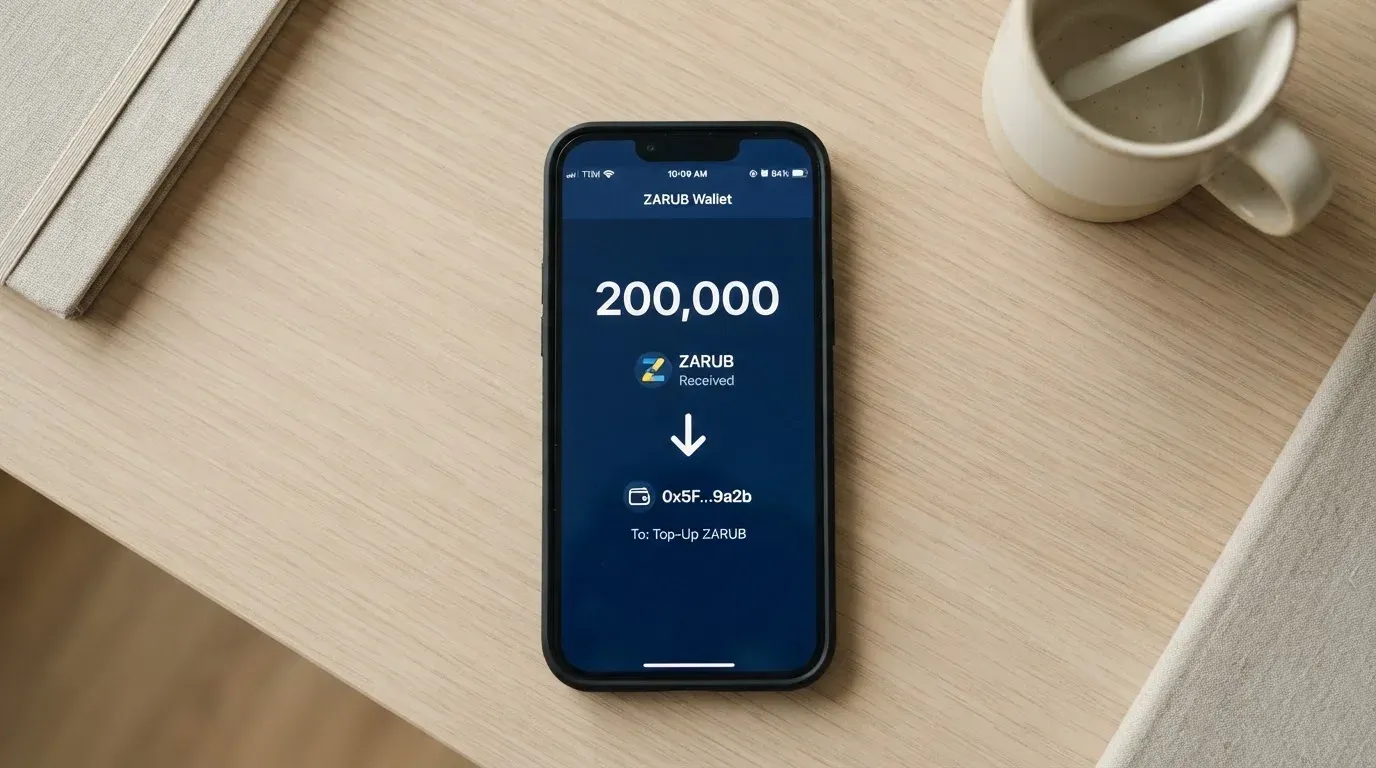
The unofficial funding options, from dtf.ru in February 2026 and Profinvestment in October 2026, are unusually broad for this category. You can send USDT on TRC-20 and other networks, plus TRX, BTC and TON. And you can fund in rubles from Russian bank cards, or through SBP, the domestic transfer system. Having both rails — a crypto rail and a domestic fiat rail into the same card — is the reason the top-up line scores so much higher than the cost line.
A word on the networks, because this is where people lose money. USDT is a token built on multiple blockchains with reserves intended to back it one-to-one, and it has been issued on networks including Ethereum, Tron, Solana, Polygon and Avalanche. Sending the same token over a different network is a different transaction, and blockchain transfers are irreversible. A deposit sent on a network the provider does not support, or sent to an address belonging to another network, can be lost or need manual recovery with no guarantee. Before you send anything, confirm the network the card expects — and note that the official pages, unusually, do not tell you.
On costs: crypto top-up is 3% plus network fees plus 1.5%, and SBP or card-to-card is 7% plus a 1.5% crediting fee. The minimum first top-up is given as 10 USD by one source and 100 ₽ for a ruble top-up by the other; these are unofficial figures, so treat both as provisional and check the bot’s actual screen at the moment you fund.
I cannot tell you how to withdraw money from ZARUB, and I want to flag that rather than let it pass. Withdrawing is a different feature from topping up, and no source I read states anything about it. If your plan for this card requires getting money back out into a bank account, that is an unanswered question you need to ask before you commit — not after.
Paying with it every day
The everyday-use score is 7 out of 10, and the shape of the card is: one virtual Visa denominated in USD, and a separate card for Apple Pay. Physical plastic, if you want it, is quoted at 149 USD.
Access is through a Telegram bot, @zarub_robot, with no store app mentioned. This is a design decision with real consequences, and I would rather name them than pretend it is merely convenient. Your card lives inside a chat app. There is no native iOS or Android application to download, no app-store presence, no push notifications in the usual sense. Telegram bots are a normal and often sensible way to run a small financial product, but it means your entire relationship with the card is mediated by a chat window and by whatever infrastructure Telegram is running that day.
The wallet situation is where the sources disagree, and I would rather show you the disagreement than pick a side. Profinvestment, October 2026, says Apple Pay only, and only on the separate Apple Pay card. dtf.ru, February 2026, says the cards link to Apple Pay and Google Pay. One of these is out of date. If Google Pay matters to you — and for Android users it often does — that is a question to put to the operator directly, because the answer determines whether the card is usable from your phone at all.
For completeness on how mobile wallet tokens behave: Apple Pay replaces the card number with a device-specific Device Account Number kept in the Secure Element, never on Apple’s servers, and each payment carries a one-time dynamic code. The issuer can also restrict that tokenised number, for example blocking it on phone or website use. So tokenisation protects the number, but the issuer still holds the levers.
Two more everyday facts you will not find on the official pages. 3-D Secure is declared, which for online payments means the issuer assesses risk and either approves without friction or challenges you, for example with a one-time code. And the ATM situation is not disclosed at all — no fee, no network, nothing. If you plan to take cash out, you are relying entirely on what your own bank’s teller screen shows you, which is a poor way to find out.
There is no rewards or cashback programme documented, and no tier structure. Whatever you pay, you pay.
What can go wrong
This is the section where the absence of information turns into actual risk, so I have split it into what is specific to ZARUB and what belongs to the category as a whole.
Nobody will tell you who is behind it. The company, the issuer, the country of the card — none of it is disclosed. That is not a small gap. A card payment involves several parties: the network, Visa or Mastercard, routes the messages and sets the rules; the issuer, a bank or electronic money institution licensed to issue under that network’s licence, holds the card programme; and the crypto brand is often only a programme manager or a front end that markets it. When something goes wrong, the party who can reverse a charge, freeze a card or answer a complaint is the issuer. ZARUB does not name one.
For context on how that ends: Visa terminated its global agreements with FTX on 13 November 2022, and the FTX US debit card was wound down by its issuer. In 2018 Visa suspended WaveCrest, a Visa issuer that supplied several crypto card brands, in Europe, closing all WaveCrest-issued Visa programmes. And one 2026 closure, reported by a single unconfirmed secondary source, saw new loads end on 8 July 2026 and spending stop on 8 August 2026. The pattern in each case is the same: a notice period, then spending and loading stop, then you are asked to withdraw whatever remains. If you have read that sentence as a threat rather than a possibility, you have understood this category correctly.
The usual Telegram-card risks. None of these are allegations about ZARUB specifically; they are the risks generally cited for cards sold this way. Payments can be declined on the basis of the BIN or region. A fee can be charged on a declined operation — and this card, per the unofficial fee schedule, charges 0.35 USD on declines when the balance is sufficient. Tariffs can change. The offer can come from an unexpected jurisdiction. And there is no balance insurance.
Some merchants simply will not take it. This is worth internalising before you rely on the card for anything important. A merchant category code is a four-digit number classifying a business, assigned when a business starts accepting cards. Some issuers block specific codes by policy rather than by law — MCC 7995, covering gambling, is the common one — and the blocked list varies by issuer. Separately, address verification compares the numeric parts of the billing address a buyer typed with the issuer’s records; it is mainly offered in the US, Canada and the UK and is generally unavailable for foreign-issued cards, which can cause declines. And some merchants decline prepaid or foreign BINs precisely because the BIN lookup reveals the card type and issuer country. A prepaid card cannot overdraw, which is a genuine benefit, but “cannot overdraw” and “always accepted” are not the same claim.
Declines can tie up your money. A declined authorisation may leave a hold on funds that can remain for several days, typically up to seven.
Security is declared, not demonstrated. 3-D Secure is stated. Beyond that, the usual safeguards — app-based two-factor authentication, instant card freeze, spending limits, tokenised mobile wallets — are not something I can confirm here. If you want to know what protections exist, ask.
Support is unstated. No contact route, no response time, no complaints process. I found no Trustpilot page for ZARUB, and no complaints about ZARUB at all — but absence of complaints is weak evidence, and weaker still when no complaints page exists to have been counted.
Deposits have a security cost. Whoever holds the private key controls the crypto. With a custodial wallet the provider holds the credentials and you must trust them completely; a seed phrase is typically 12 to 24 words and unencrypted, so anyone who obtains it can restore the wallet and spend its funds. Transfers are typically irreversible, and a stolen key has no recovery path — the network cannot freeze or return anything. Custodial platforms have a real record of failure: Mt. Gox, about 350 million US dollars reported stolen between 2011 and 2014; Coincheck, about 400 million in 2018; Ronin Network, 625 million in 2022. On the other hand, stablecoins are not censorship-proof either — Tether says it disables tokens in wallets on the sanctions list and has frozen funds tied to illicit activity — and stablecoins can and do depeg: TerraUSD collapsed in May 2022, and USDC temporarily lost its peg in March 2023.
What to take instead
If any of the above gives you pause, you are not deciding between ZARUB and nothing. There are three other Telegram-style cards I looked at, and one of them is probably better for you.
| Card | Score | Card type | Cost | Who it’s for |
|---|---|---|---|---|
| ZARUB | 5.0 / 10 | Virtual Visa in USD, separate Apple Pay card, plastic at 149 USD | Issuance 19 USD virtual / 30 USD Apple Pay; 0.35 USD per operation | Crypto already in hand, comfortable with undisclosed issuers |
| Azul Card | 5.3 / 10 | Virtual only, no physical card; works anywhere Mastercard is accepted | 20 USD creation, refunded after 2,000 USD of spending; 5 USD monthly | Someone who wants a published country list and Mastercard reach |
| Telecard | 6.1 / 10 | Virtual Mastercard, instant; no physical or metal card | Standard 5 USD once; VIP 49 USD then 19 USD/month; 99 USD minimum to activate, stated as not a fee | Someone who wants a named issuer, published fees and a support answer |
| OnCards | 4.6 / 10 | Virtual only, network not fixed; no amounts published | Not stated | Someone who just wants BEP20 funding and no bank rails |
Read that table as a set of trade-offs rather than a ranking, because that is what it is.
Azul Card, at 5.3, is the closest thing to ZARUB with better paperwork. It publishes its restricted countries in full: worldwide except Russia, Belarus, North Korea, Iran, Syria, Cuba, Sudan, Venezuela, Ukraine and the Crimea, Donetsk, Luhansk, Zaporizhzhia and Kherson regions, and it states that the restrictions apply regardless of the user’s nationality. If you live in one of those places, read that sentence twice. The costs are higher and less elastic — 20 USD to create, refunded only after 2,000 USD of spending, then 5 USD a month, with no FX fee stated — and there is no physical card, though one may come. Funding is crypto sent in Telegram, with coins and networks unnamed in the pages I read, taking up to ten minutes the first time and one to five minutes thereafter. Its referral programme pays up to 40% of fees from transactions made by your referrals.
Telecard, at 6.1, is the most fully specified card of the four. Its site says it is usable in over 150 countries wherever Mastercard is accepted, with identity checks available in most major regions and no list of supported or excluded countries; its terms only bar users blocked or sanctioned by the US government, including OFAC. It publishes its limits: 1.5% currency conversion on non-USD payments, 0.5 USDT gas per successful transaction, and FX and cross-border fees “up to 3% each”. It has tiers — standard 5 USD once, VIP 49 USD setup then 19 USD a month, VIP reissuance 15 USD — and a 99 USD minimum deposit to activate, which it stresses is not a fee. Funding is USDT on Tron or Ethereum, USDC on Ethereum, Polygon not supported; the main page also lists ETH and TRX, which the help page does not, and bank transfers are “coming soon”. The catch is that there is no physical card at all, and the basic plan’s monthly fee is described inconsistently across its own pages.
OnCards, at 4.6, is the thinnest. It publishes almost nothing: no country list, no fee amounts despite claiming “no hidden charges”, no card currency. It says you can fund with USDT BEP20 and that bank transfers are not accepted. I include it because it marks the floor — if a provider tells you less than OnCards does, you have not finished reading.
Who I would recommend it to
I would recommend ZARUB to someone who already holds USDT, mostly on Tron, who spends in USD or in places where a foreign-issued virtual card is accepted without fuss, and who treats a card balance as spending money rather than as savings. Someone who lives inside Telegram, who is comfortable with a bot as their only interface, and who is not planning to deposit a month’s rent into it.
I would not recommend it to anyone whose income arrives as a salary, to anyone who needs to be able to raise a chargeback, and to anyone who is uneasy about an issuer they cannot name. Nor to anyone planning to withdraw — I could not establish that this card supports withdrawal at all.
If you are in the second group, Telecard is the pick, because its costs are ugly but written down, and a published fee is worth more than a cheap one you cannot verify.
Two things that are category-wide rather than specific to this card, and that bear on any decision here. First, a card is a payment service regulated separately from crypto: an electronic money institution in the EU can issue e-money, payment cards and wallets but cannot lend, and MiCA — Regulation (EU) 2023/1114, which ESMA says took legal effect in June 2023 — covers the crypto side of custody, exchange and transfer. So a crypto card often depends on two licences, one of which you are not being told about. Under MiCA, e-money tokens may be issued only by a credit institution or an electronic money institution, and the transitional period lets providers operating under national law continue only until 1 July 2026 or until a MiCA authorisation is granted or refused. ESMA keeps an interim register of authorised crypto-asset service providers that you can search; that register is a reasonable first stop for any provider in this category, ZARUB included. Second, taxes: the IRS treats digital assets as property, so exchanging them for goods, services or dollars generally produces a taxable gain or loss, measured in local fiat currency at the value on the date of each transaction. I am not giving tax advice and you should not treat any of this as one — but each card payment funded from crypto may be a separate taxable event, and that is worth checking against your own jurisdiction before you start spending regularly.
Frequently asked questions
What is ZARUB card?
ZARUB is a prepaid-style payment card that you reach through a Telegram bot rather than a banking app. You load it with crypto or rubles and it spends that stored balance like an ordinary card. Third-party sources describe a virtual Visa in USD and a separate Apple Pay card, with plastic quoted at 149 USD. The issuer, the operating company and the card’s country are not publicly disclosed.
Is ZARUB a bank?
Not on any evidence available. It does not describe itself as one, and it does not publish the name of a licensed bank or electronic money institution behind it. A payment card normally involves a licensed issuer holding the programme, with the brand acting as a front end or programme manager. Because ZARUB names no issuer, you cannot check which licence, in which country, actually stands behind your balance.
Does the ZARUB card require KYC?
Unofficial sources from October 2026 say there is no mandatory identity check at the start. The card’s own pages say nothing either way. Keep in mind what that means: regulated businesses are generally required to verify customers under anti-money-laundering law, and an unverified card carries none of the protections that verified identity brings. Treat the unofficial answer as a starting point for a question, not a settled fact.
Is the ZARUB card free?
No. Unofficial figures put issuance at 19 USD for the virtual card and 30 USD for the Apple Pay card, with a physical card at 149 USD. Maintenance and closure are said to be free, but every transaction costs 0.35 USD, and that fee applies to declined payments too when your balance was sufficient. There is no tier structure and no rewards programme documented.
How do I top up the ZARUB card?
Unofficial sources list USDT on TRC-20 and other networks, plus TRX, BTC and TON, and also rubles from Russian bank cards or via SBP. Crypto funding is quoted at 3% plus network fees plus 1.5%; SBP or card-to-card at 7% plus a 1.5% crediting fee. Confirm the exact network before sending, because transfers are irreversible and a wrong-network deposit may be lost.
Can I use ZARUB card abroad?
Unofficial sources say the cards work abroad with no currency restrictions, and the card publishes no country list at all. Two practical cautions. Non-USD payments are charged at the interbank rate plus 0.3–0.35 USD, and some merchants decline prepaid or foreign-issued cards after checking the BIN. Availability in a given country is not the same question as acceptance by individual shops there.
How do I add the ZARUB card to Apple Wallet?
Sources disagree, which is the honest answer. One October 2026 write-up says Apple Pay works only on the separate Apple Pay card; a February 2026 piece says both Apple Pay and Google Pay work. The card itself publishes no instructions. If Apple Pay or Google Pay is central to how you would use it, ask the operator before you buy the Apple Pay card at 30 USD.
Is the ZARUB card safe?
I found no complaints against ZARUB and no Trustpilot page — which tells you very little, since there is nowhere to count. What I can say is that the issuer and its country are undisclosed, so the usual protections, chargeback rights, deposit handling and complaints routes are all unknown. Declines can still cost you 0.35 USD each. Use it for spending you can afford to lose, not for savings.
Is ZARUB worth it?
For its core case, yes: loading USDT or rubles into a card that works in ordinary shops is convenient, and the top-up options are genuinely broad for this category. Against that, you pay per operation, you cannot name the issuer, you cannot verify the fees from official pages, and the 149 USD plastic card and the Apple Pay uncertainty make the physical-card side a gamble. My mark is 5.0 out of 10 — usable, undocumented.
How do I withdraw money from ZARUB?
I could not establish that it can. None of the sources I read states anything about cashing out, converting the balance back, or moving funds to a bank account. That is different from topping up, and it is not covered by any of the fee or limit figures above. Before you rely on this card for money you expect to retrieve, put that question to the operator directly.
Virtual cards put to the test – cryptocardtested
Content created by the «cryptocardtested» team