
A Russian-language virtual card that spends your crypto balance, with fee questions left unanswered
 Available in US
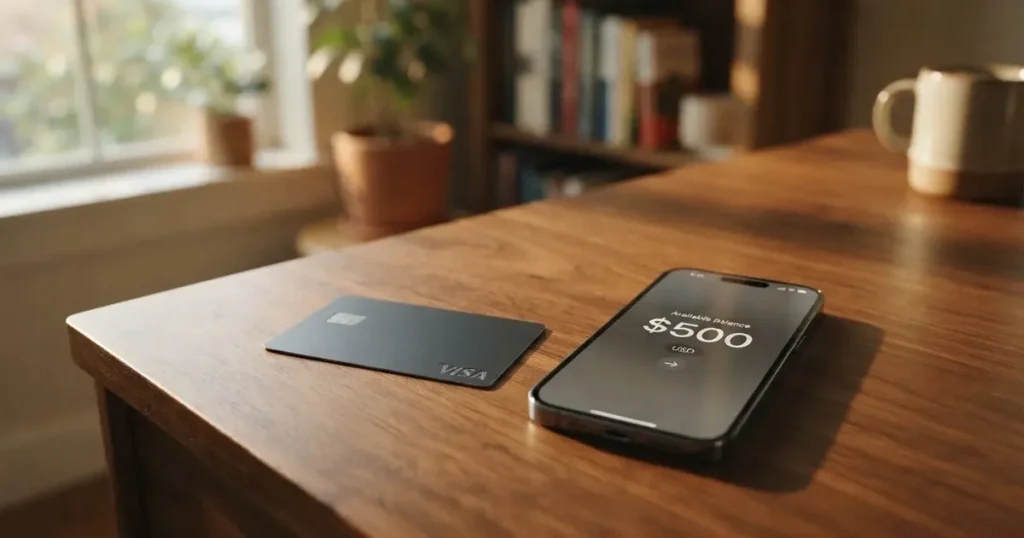
The Cashinout card is a virtual, US-dollar prepaid card funded from a crypto wallet. That single sentence covers most of what the service does: you hold crypto in an internal wallet, you move it into a card balance, and a card number appears in the app that you can load into Apple Pay or Google Pay and spend in shops. There is no physical card, no branch, and no banking relationship in the ordinary sense. It is a spending tool, and the questions worth asking about a spending tool are simple: what does it cost, can I load it, and what happens when something goes wrong?
My overall mark for the Cashinout card is 5.6 out of 10. The top-up side of the product is genuinely good — a 9 out of 10 — with eight listed coins and ruble transfers through SBP. Everything around it is thinner. The issuer is not named on the public pages I could read. The card’s eligibility rules are not stated. The official blog does not publish a price for issuing a card. Two third-party sources give completely different numbers, and neither is confirmed by the company. If you want a virtual card and intend to fund it from rubles through SBP, this is one of the more direct routes to that outcome. If you want a card with published fees, a named European issuer and a support team that answers in your language, the absence of those things is the reason for the score rather than a detail.
Conditions described here are current as of October 28, 2026.
| Criterion | Mark | Why |
|---|---|---|
| Who can get it | 5 / 10 | Not officially named; the service, its QR and SBP rails are Russian-language and Russia-only |
| Cost | 5 / 10 | Wallet-to-card top-up 2.5%, crypto into the wallet 0%, SBP 1%; one unofficial source mentions $0.5 per transaction |
| Top-up options | 9 / 10 | BTC, LTC, USDT, BNB, ETH, TRX, USDC, TON and rubles via SBP; the card itself is funded only from the internal wallet |
| Reliability and complaints | 4 / 10 | Operated by Platflow LLC in Georgia (unofficial listing); issuer unnamed; Trustpilot 3.0 out of 5 across 48 reviews, with unreturned balances the recurring theme |
| Everyday use | 6 / 10 | Virtual US-dollar cards only; Pay Card works with Apple Pay, Google Pay and cash withdrawals |
| Total | 5.6 / 10 | A strong funding rail wrapped in an undocumented card product |
Who the Card Is For — and Who Gets Turned Away
The honest answer is that the card’s public pages do not say. Country eligibility is not stated on the readable official sources. What you can establish is the shape of the service rather than its eligibility list: it is a Russian-language product, its QR and SBP payment rails are Russia-only, and it operates from Georgia. That combination reads as a card built for users in that region, but “built for” is an inference, not a published rule.
There is one eligibility rule the company does state, and it is a warning rather than a criterion. Paying for services in sanctioned countries leads to blocking without a refund, according to a partnerkin.com summary of the company’s own text. That is the closest thing to a published eligibility statement, and it is a negative one.
The three cards you can choose between are card types rather than pricing tiers. The Pay Card is the one for shops: it works with Apple Pay and Google Pay offline in 197 countries, supports cash withdrawals, and is funded in USDT. The Online Card is for subscriptions, AI services and SaaS platforms, and it does not work with Apple Pay or Google Pay. Two further products — an advertising-traffic card and an NFC Pay card — appear in third-party listings rather than in the company’s own description, so I would treat them as unconfirmed.
So: will you be given the card? If you read Russian, hold crypto or rubles, and want a virtual dollar card quickly, the practical answer is probably yes. If you are looking for a published list of eligible countries, a statement about whether you as an individual can open an account, or a card you can hold in your hand, that answer is not on the pages. Make sure your own nationality and country of residence are ones you are willing to declare at sign-up, because identity screening usually applies to citizenship and country of birth as well as to your address — that is how regulated institutions handle screening, and it is not something a card brand can waive for you.
How to Get It
The sequence the company describes is short: register in the app or the bot, fund the wallet, then issue a card from the wallet balance. There is no paper application, no branch visit and no mailing step, because the card is virtual only — physical delivery does not apply.
On identity checks, the picture is inconsistent. The RuStore listing for the Android app states that security relies on “AML checks, two-factor verification, KYC procedures, and Liveness verification”. Which documents are required, whether proof of address is required, and what minimum age applies are not stated. A third-party catalogue lists KYC as required as of 31 July 2026, while a Habr commenter claims KYC is mostly absent — that second one is user opinion, not a policy statement.
The verification status is shown inside the bot, and one summary of the company’s text says an identity document is required for cash pickup. What that means in practice: expect to hand over a document at some point, but do not assume the process is instant or identical for every country, because nobody has published the list.
If you want to see whether the app is real and maintained before you commit anything, the concrete number is on RuStore: version 2.4.6, released 4 May 2026, with 1K+ downloads and no ratings at all when I looked on 21 October 2026. An app store with no ratings tells you nothing about quality — it only tells you the listing is young or the audience is small.
Fees and What They Add Up To
Here is the most useful thing I can tell you, and it is not a number: the Cashinout card’s most important fee is not on any list. Because the official blog does not publish an issuance price, and because the two third-party sources I found disagree completely, the true cost of holding this card is not knowable from public information. You are being asked to trust a number you cannot verify.
| Fee or limit | What is stated | Source |
|---|---|---|
| Card issuance | Not published by the company; unofficial sources say $0 and $0, or $25 loaded onto the card | Company blog silent; third-party |
| Monthly fee | Not published by the company; one unofficial source says $0, one user reported a fee continuing on an expired card | Third-party and user report |
| Card top-up from wallet | 2.5% | Company blog |
| Crypto deposit into wallet | 0% on the listed coins and networks | Company blog |
| SBP ruble deposit | 1% | Company blog |
| Per-transaction fee | Not stated officially; unofficial figures range from $0.5 per transaction to $0.5 per successful transaction and up to $1 per decline | Third-party (unofficial) |
| FX fee | Not stated | — |
| ATM fee and allowance | Cash withdrawals supported on the Pay Card; fee and allowance not stated | Company blog |
| Minimum card top-up | $5 | Company blog |
| Non-reducible balance | Each card keeps $5 that cannot be taken out | Company blog |
| SBP deposit per operation | 1,000 to 100,000 WUD, where 1 WUD equals 1 ruble | Company blog |
Walk three ordinary payments through it and you will see where the money actually goes.
Paying 40 USD of groceries with Apple Pay, funded straight from USDT in the wallet: crypto into the wallet is 0% on the listed networks, wallet-to-card is 2.5%, meaning a 2.5% fee applies to the top-up. The card then spends 40 USD. If the shop is outside the dollar zone and the card applies a currency conversion, any FX fee applies — and no FX fee is published anywhere, so that part of your cost is unknown in advance. This is the single largest gap in the pricing.
Paying 40 USD of groceries after you have already topped the card up once: the 2.5% is already spent, so the payment itself should cost nothing extra unless an FX fee is applied. The card’s balance cannot be pulled back below $5, which is a small amount, but it is not recoverable.
Paying 9 EUR from rubles: you need euros on the card, and the wallet exchange covers RUB, EUR, USD and KZT according to RuStore. The exchange rate you get is not described in the facts I have, and neither is the fee. This is where the product gets hard to predict from outside.
Two further cost items live outside the card. Cardex-style per-transaction and per-decline charges are reported by third parties — $0.5 per transaction, or $0.5 per successful transaction and up to $1 per decline — and neither is confirmed (these figures are unofficial). A user reported in October 2025 that a monthly fee kept running on a card that had expired and had not been deleted, which is the kind of small leak that adds up if you forget to close cards you no longer use.
One thing that is definitely not a card fee: the blockchain network charges for your crypto deposit are paid by the blockchain, not by Cashinout. Who pays the network fee on a transfer is not stated either.
How to Top Up
This is where the card earns its 9 out of 10, and if there is one part of the product you can rely on, it is this.
You deposit crypto into the internal wallet, and the listed coins are BTC, LTC, USDT, BNB, ETH, TRX, USDC and TON, at 0% on the listed networks. USDT and USDC each have a separate address per network. This is the detail that costs people money: send on the wrong network and the funds can be lost. Blockchain transfers are irreversible, so there is no network that will reverse it for you.
You deposit rubles through SBP from more than 100 banks, at 1%, for transfers between 1,000 and 100,000 WUD per operation, where 1 WUD equals 1 ruble. Cards in your own name only. If the sender’s name does not match, the money is returned to their card within 24 hours.
You can also send money to another person by Cashinout ID, free of charge.
Then the last step, which constrains everything above it: the cards are funded only from the internal wallet. There is no direct card purchase from your exchange balance, and no bank transfer straight into a card. Everything passes through the Cashinout wallet first.
Getting money back out is less well documented. The wallet balance can be exchanged to RUB, EUR, USD or KZT. An SBP withdrawal is reported at 3.5%, and euro cash withdrawal via RIA points in 17 European countries. Whether a balance can be moved from a card back to a wallet is not stated — and given that each card keeps a $5 non-reducible balance, the answer for the last few dollars is probably no.
Before you commit money, check two things yourself. Send a small test deposit of the coin and network you intend to use, and only move the rest once it lands. And if you plan to fund from rubles, remember the SBP limits are per operation — a 100,000 WUD ceiling is 100,000 rubles, which is a meaningful limit if you are moving more than that at once.
Paying With It Day to Day
The Pay Card is the everyday product. It works with Apple Pay and Google Pay, and the company says it works offline in 197 countries, and it supports cash withdrawals. The Online Card is the other half: for subscriptions, AI tools and SaaS, and it does not work with Apple Pay or Google Pay.
That gives you two very different daily lives from one app. If your spending is subscriptions and software, the Online Card is the right tool. If it is a shop, a supermarket or a restaurant, the Pay Card is the only one that works, because a card that cannot be tokenised into a phone wallet is awkward everywhere.
There is no card cashback stated. There is a referral programme reported at 0.3% of referred users’ deposits, which is a number to recognise rather than a reason to switch.
Blocked categories are not stated. What is stated is the sanctions rule again, and a third-party claim that paying Russian services, or paying in rubles, may get the card blocked. Treat that third-party claim as exactly that — unconfirmed — but plan around the possibility, because a card that fails at the till is a much worse experience than a rule you read in advance.
Support is in Russian, daily 09:00–20:00 Moscow time, with a Telegram channel for users and the email [email protected].
What Can Go Wrong
The most important risk is that the money sits with a custodian. Cashinout’s wallet is custodial: the provider holds the credentials, not you. That means the balance is exposed to counterparty failure and to hacking. This is not a theoretical category — Mt. Gox, Coincheck and the Ronin Network bridge are the standard examples of what a custodial failure looks like, with reported losses in the hundreds of millions of dollars. And crypto transfers have no built-in recovery: nobody can freeze or return a transfer that went to the wrong address.
Underneath that sits a quieter problem: nobody will tell you who issued the card. The issuing bank is not named on the pages I could read. The operator is listed as Platflow LLC, registered at 88 Avtomshenebeli Street in Kutaisi, Georgia, in an unofficial catalogue listing. Advertising text claims registration in Georgia with two EMI licences, which I could not verify. That matters more than it sounds. A prepaid card is a liability of the institution that issued it, and if that institution is not named, you cannot work out whose regulatory regime protects your balance, whether your funds are safeguarded in a dedicated account, or what recourse you would have. Funds held by an electronic money institution are not the same as bank deposits and may not sit under a deposit guarantee scheme.
Then the complaints. On Trustpilot the card scores 3.0 out of 5 from 48 reviews, 6 of them in the last 12 months as of 21 October 2026, split 71% five-star and 23% one-star — a sharply bimodal profile, which usually means recent, unresolved problems rather than general dissatisfaction. The recurring themes, all from user reports: a balance not returned after a card was cancelled (June 2026 and September 2025), a payment deducted but not delivered (24 September 2025), support going unresponsive after a lost card (March 2026), advertised Apple Pay not delivered (November 2024) and slow withdrawals (December 2023). One Partnerkin review describes 50 USDT deposited on TRON and held for AML checks on 30 December 2025, with the funds later credited. The company does not reply to negative reviews.
What is not there is just as informative. No official incidents were found. Dispute handling terms are not stated, and chargeback rights depend heavily on whether your card is treated as prepaid or as something else — coverage varies and should not be assumed. Trustpilot users report refunds as slow or absent.
Practical consequences you can act on: do not keep a large idle balance on the card, because the $5 floor and the cancelled-balance complaints point the same way; close cards you stop using rather than leaving them alive, given the reported recurring fee; and take screenshots at the moment of a declined or duplicated payment, because a declined authorisation can also leave a hold on funds that sits for up to seven days before it releases.
Support is daily 09:00–20:00 Moscow time, with a Telegram channel for users and [email protected]. ForkLog has reported updated crypto-payment fees for QR over SBP, though I did not read the date. The service was founded in 2023 and the third-party listing was last updated 31 July 2026.
What to Take Instead
I scored the alternatives below on the same scale, and none of them scores higher than Cashinout. That is worth saying plainly before comparing them: this is not a case where a well-documented incumbent is being beaten. The field is uniformly thin, which is a comment on the category rather than on this card.
Cardex — 5.6 / 10. Debit crypto card on the VERVE, VISA, Mastercard and UnionPay networks, offered in virtual and physical form, with real-time crypto-to-fiat conversion at the moment of payment and an “AI-Powered Conversion Rate” that scans global exchange rates and picks the best one when you spend. No fee percentage is stated. Funded from USDT, USDC and BTC wallets, networks not stated. The App Store listing is Naira-focused, and the site claims one card for 200+ countries with no exclusions published.
CardFlow — 4.9 / 10. Aimed at Nigeria — “Nigeria’s smartest fintech card platform” — and at “Nigerians and global users”, again with no country list. Virtual US-dollar Mastercard, created quickly, funded from Bitcoin, USDT, ETH or a Naira bank transfer. Its one clear advantage: creating a virtual card is free, per its own FAQ. Fees not stated.
HyperCard — 4.7 / 10. A prepaid card with a balance in USD or EUR, funded by depositing crypto such as USDT, BTC or ETH in the app and letting it convert to the card balance. The App Store says it works in “more than 176 countries” — that is acceptance, not eligibility — and the network is not stated on that page. No fees listed at all.
Read across them and the pattern is obvious: Cardex is the only one of the four with a physical card option and a stated conversion mechanism, and the only one whose network lineup is documented. CardFlow is the clearest on cost, with free card creation and a three-minute timeline. HyperCard is the vaguest. Cashinout is the only one whose funding side is genuinely well built — eight coins, SBP from more than 100 banks, free user-to-user transfers — and also the only one whose card-side costs are entirely unpublished.
So the choice is not “better against worse.” It is which unknown you can live with. If your unknown is cost, CardFlow tells you creation is free. If it is network and currency coverage, Cardex documents it. If it is whether you can fund a card from rubles today, Cashinout answers that clearly.
Who I Would Recommend It To
I would recommend the Cashinout card to someone specific: a user with crypto already in hand, who needs a virtual US-dollar card for subscriptions or everyday online payments, and who can accept that the fee for funding it is 2.5% and that the card’s own pricing is not published. If SBP is how your money moves — no card from a local bank, or you need rubles in and a dollar card out — this solves a real problem that most alternatives do not attempt to solve at all.
I would not recommend it as a primary card, to anyone holding more than they can afford to leave on a custodial balance, or to anyone who needs to know before they pay what the cost will be. The missing issuer name, the unpublished FX fee, the $0.5-per-transaction figures that no one confirms, and the Trustpilot pattern of unreturned balances after card cancellation form a coherent picture: this is a service that works well on the funding side and is still finding its footing on the card side.
Two checks before you start. First, the currency your spending happens in — if it is not dollars, you are paying an FX fee that nobody has published. Second, the exit: understand what happens to money sitting on a card you want to stop using, because the $5 floor and the cancellation complaints are the two most likely places for your balance to become somebody else’s problem. The service was founded in 2023; that is young.
Frequently Asked questions
What is the Cashinout card?
It is a virtual prepaid card issued inside a crypto app, not a bank account. You hold crypto in Cashinout’s internal wallet, move value onto a card balance, and spend that balance through Apple Pay, Google Pay or an online card form. There are two main products: a Pay Card for shops, which works with Apple Pay and Google Pay offline in 197 countries and supports cash withdrawals, and an Online Card for subscriptions and software, which does not work with mobile wallets.
How does Cashinout work day to day?
Deposit crypto or rubles into the internal wallet, top up a card from that wallet balance, then pay with the card like any other card. Crypto deposits are free on the listed networks, wallet-to-card transfers cost 2.5%, and SBP ruble deposits cost 1%. The card can only be funded from the internal wallet — you cannot load it directly from an exchange or a bank account, so the wallet is a mandatory stop on every payment.
Is Cashinout a bank?
No, and this is the single most important question to ask about any card like this. The operating company is listed as Platflow LLC in Kutaisi, Georgia, in a third-party catalogue, and advertising claims registration in Georgia with two EMI licences, which I could not verify. Crucially, the issuing bank is not named on the public pages. An electronic money institution can hold safeguarded funds and issue payment cards without being a bank — but it cannot lend, and its funds are not bank deposits.
Who owns Cashinout?
Public listings point to Platflow LLC, with an address at 88 Avtomshenebeli Street in Kutaisi, Georgia — that comes from a third-party listing rather than the company’s own pages, so treat it as unofficial. The company was founded in 2023. The issuing bank behind the card programme is not named anywhere I could read, which means the institution your balance actually depends on is not identified.
Does Cashinout require KYC?
Probably, at some point, though nobody publishes the details. The RuStore listing says security relies on “AML checks, two-factor verification, KYC procedures, and Liveness verification”, and a third-party catalogue listed KYC as required as of 31 July 2026. Which documents, whether proof of address is needed, and the minimum age are all unstated. A Habr commenter claims KYC is mostly absent, but that is one user’s opinion, not a policy.
Is the Cashinout card free?
You will not find a published answer. The official blog does not state an issuance price or a monthly fee. Third-party sources conflict sharply: one says issuance and monthly fees are both $0, another says $25 issuance and a $31.5 minimum balance. Treat the free version as the optimistic reading. What is published is the 2.5% wallet-to-card top-up and the fact that each card keeps a $5 balance you cannot withdraw.
How do I add the Cashinout card to Apple Wallet?
Only the Pay Card supports Apple Pay, and only via Apple Pay or Google Pay tokenisation — the Online Card does not work in a mobile wallet at all. One Trustpilot complaint from November 2024 describes advertised Apple Pay not being delivered, so if that is the feature you want, verify it works on your account before funding it. Remember also that a card issued in one country can look foreign to a merchant, and some shops decline foreign or prepaid BINs as a matter of policy.
Can I use the Cashinout card in my country?
Acceptance and eligibility are different questions, and only the first is answered. The Pay Card is stated to work offline in 197 countries, and cash withdrawals are supported, but the country list for being issued the card is not stated. Eligibility also depends on your citizenship and country of birth, not just where you live, because sanctions screening is applied at that level. If your country is sanctioned, the company’s own stated rule is that paying for services there leads to blocking without a refund.
Is the Cashinout card safe?
Treat it as custodial and treat the balance as small. Cashinout’s wallet holds your credentials, not you, so your funds carry counterparty and hacking risk — the same category as Mt. Gox, Coincheck and Ronin. There is no named issuer, so you cannot establish whose regulatory regime protects the balance. On Trustpilot the score is 3.0 out of 5 across 48 reviews, with unreturned balances after card cancellation the most repeated complaint, and no dispute terms are published.
Can I withdraw money from Cashinout back to my crypto wallet?
That is not stated, and the reported $5 non-reducible balance per card suggests the last few dollars are simply not recoverable. What is documented runs the other way: the wallet balance can be exchanged to RUB, EUR, USD or KZT, an SBP withdrawal is reported at 3.5% by a third-party source, and euro cash withdrawal via RIA points in 17 European countries. Before you load, work out your exit route — and remember crypto transfers are irreversible, so a wrong-network deposit or a mistaken send is gone.
Virtual cards put to the test – cryptocardtested
Content created by the «cryptocardtested» team