
I read EMCD's own pages end to end, and the fee schedule is not friendly
 Available in US

EMCD is a virtual card you fund with USDT from the Coinhold Wallet and then spend like an ordinary prepaid card at any shop that takes cards. That is the whole product in one sentence, and the simplicity is real. What I could not make myself comfortable with is everything around that sentence: a card page that says Visa, a help centre that says Mastercard, a fee schedule that reads more like a brokerage tariff than a payment card’s, and no named issuer on any public page I read.
I gave it 4.9 out of 10. That is not a dismissal. For one specific reader — someone who already holds USDT in a Coinhold Wallet, already has verified identity, and wants a card number that works online without moving money out of the exchange — the card does a real job. For everyone else, the same reader pays a 1.5% fee to load, another 1.5% plus $0.50 to spend, and possibly 3% more on any purchase not in dollars, and gets a virtual card with no 3-D Secure and no cash withdrawals.
The conditions described here are current as of October 28, 2026.
Verdict: 4.9 out of 10
The score breaks down into six criteria, and you can see exactly where it comes apart. The strongest one is eligibility; the weakest is cost.
| Criterion | Mark | Why |
|---|---|---|
| Who can get it | 9 / 10 | Works wherever Mastercard is accepted, except that payments are not available in Afghanistan, Belarus, Cuba, Iran, North Korea, Syria, Venezuela, Russia, Myanmar, Somalia, Ukraine, Yemen, China |
| Cost | 2 / 10 | Plus issues at $19, Premium at $25; $5 a month maintenance; top-up 1.5%; purchase 1.5% + $0.50; 3% on conversion away from USD; an unofficial source quotes top-up at 2.5% |
| Top-up options | 4 / 10 | USDT only, from the Main account of the wallet, network not disclosed, minimum $20 |
| Reliability and complaints | 4 / 10 | Issuer and legal entity unnamed, the network described differently on two pages, Trustpilot reports of account blocks after KYC and slow support |
| Everyday use | 5 / 10 | Virtual only, Apple Pay and Google Pay claimed working but listed as coming soon, no ATMs, no 3-D Secure |
| Total | 4.9 / 10 | Good reach, thin wallet, expensive running |
So who is this for? The card suits a person who is already inside the EMCD ecosystem — USDT sitting in the Main account of the Coinhold Wallet — and who spends that balance online in dollars without touching a bank. It suits someone for whom a 1.5% loading fee is cheaper than the fee their bank charges to send money abroad, and who will set the card’s limits low and check the app after each payment.
It does not suit someone who wants cash, a physical card, or a stable total cost of spending. It does not suit a person in one of the thirteen listed countries. And it does not suit anyone who is uneasy about handing a card to a provider that does not name its issuing bank on the page you sign up from — because if something goes wrong with your money, the counterparty you need to know is the one that is missing.
Will they give you the card?
Almost certainly, and that is the good news in this review. The card page says it works “worldwide” wherever cards are accepted, with a notice that some EMCD services are unavailable in certain jurisdictions without naming them. The help centre is more specific: the card works wherever Mastercard is accepted, except that payments are not available in Afghanistan, Belarus, Cuba, Iran, North Korea, Syria, Venezuela, Russia, Myanmar, Somalia, Ukraine, Yemen, China.
That list is worth reading twice if you are in any of those countries, because the headline promise and the exception list are on different pages and say different things about the network. My advice, if you are outside those thirteen: assume the card works. If you are inside one of them, assume the loading and spending will fail and do not test it with money you need.
Beyond geography, the card is open to anyone who can pass standard EMCD identity verification, which the card describes as an ID and 5 minutes. There is no stated minimum age beyond the usual adult requirement for prepaid and debit cards, no stated proof-of-address requirement on the order page, and no stated income or employment test. Cards are generally available to adults of 18 and over, and some issuers set higher limits — EMCD sets none in public.
One thing the card page does not tell you is who you are dealing with. The legal entity, its country of registration, the card issuer and any licence are not stated on the card page. An unofficial source lists the network as Mastercard, the platform as Coinhold, the offer coming from EMCD.io, and still does not name the issuer. I searched and did not find it either. For a card that holds a dollar balance you top up with crypto, that is the gap I would want closed before I loaded anything substantial.
How to get it
The path is short. You open an EMCD account, complete identity verification, and order a card. Verification is standard: a valid government ID, “usually a few minutes”, and the card activates itself automatically once it passes. If it fails, the card says to retry with a different document.
The order requires $15 of funding that stays in the balance rather than being spent — worth knowing before you conclude that money has vanished. What you receive is a virtual Visa Platinum card; a physical card is not yet available, and the card page does not state the card currency. Cards are valid for two years, after which a new card with a new number is opened.
There is a second verification step that is easy to miss because it is described separately: identity verification is mandatory after your first top-up. In practice that means the flow is verify, load, verify again. Users of the company rather than the card report slow document checks, which is a theme I return to in the risks section. Levels and proof of address are not stated, so I cannot tell you what document will be accepted in your country or whether a utility bill will be asked for.
And the contradiction that would make me pause if I were applying: the card page says Visa Platinum; the help centre says the card runs on Mastercard, virtual, in USD. Both pages belong to the same company. At least one is out of date, and I could not tell which. Ask support which network your specific card runs on before you rely on a merchant that accepts only one of them.
What it really costs: the Fees
This is where the review gets uncomfortable, because the fees do not read like a payment card’s fees. There is a tier system — Active, Plus and Premium — and the Active tier is advertised with “0% fees” on standard purchases. The help-centre article describing fees does not say which tier it means, and lists numbers that no reading of “0%” can accommodate. Read them as the tier-dependent schedule, and treat “0%” as marketing for the entry level only.

| Item | Active | Plus | Premium |
|---|---|---|---|
| Issuance | Free to issue | $19 | $25 |
| Monthly maintenance | Not stated | $5 | $5 |
| Top-up | 1.5% | 1.5% | 1.5% |
| Purchase | 1.5% + $0.50 per transaction | 1.5% + $0.50 per transaction | 1.5% + $0.50 per transaction |
| Declined payment | $1.50 | $1.50 | $1.50 |
| Refund | $0.50 | $0.50 | $0.50 |
| Reversal | $2.00 | $2.00 | $2.00 |
| Chargeback | $35 | $35 | $35 |
| Card closure | $15 | $15 | $15 |
| Conversion on non-USD purchases | Issuing bank may apply 3% | Issuing bank may apply 3% | Issuing bank may apply 3% |
Whether the $19 and $25 are one-off or recurring is not stated. An unofficial source quotes a different schedule again — 2.5% top-up and conversion, no monthly or annual fee, no FX fees — which contradicts the company’s own fee article on both the monthly fee and the top-up percentage. I would plan around the official schedule and treat the 2.5% figure as unconfirmed.
The tier difference that actually matters to you is not the fee, it is the ceiling:
- Plus: $1,000 per transaction, $3,000 daily, $10,000 monthly.
- Premium: $10,000 per transaction, $50,000 daily, $400,000 monthly.
- Up to two active cards at once.
- No numeric limits are published for Active; the app lets you set limits yourself.
Now three ordinary payments, priced with the help-centre schedule. A $30 supermarket shop, in dollars, on Active: the 1.5% plus $0.50 purchase fee is $0.95, and if you loaded from USDT at 1.5% you paid about $0.45 to put the money there — $1.40 in total on $30 of groceries. A $60 restaurant bill in euros on Plus: 1.5% plus $0.50 is $1.40, the load cost was $0.90, the $5 monthly fee is $5 regardless of what you spent, and the issuing bank may add 3% on top — call it $1.80 — so roughly $9.10 for one dinner. And a $200 online subscription paid in dollars: $3.50 in fees, plus whatever it cost you to fill the balance, which is another $3.00.
Notice how the fixed $0.50 and the $5 monthly fee dominate small purchases, and how a card advertised at “0% fees” on Active is doing its work on the credit card sized purchases. If you spend a hundred dollars a month, the arithmetic is not close.
How to Top up
There is one documented route and it is narrow. You top up with USDT from the Main account of the Coinhold Wallet, manually. The help centre states plainly that there is no top-up by card number, so a bank transfer straight to the card is not a thing. The network for the USDT is not stated, which is the single most useful fact a user could be given and the one most conspicuously absent.
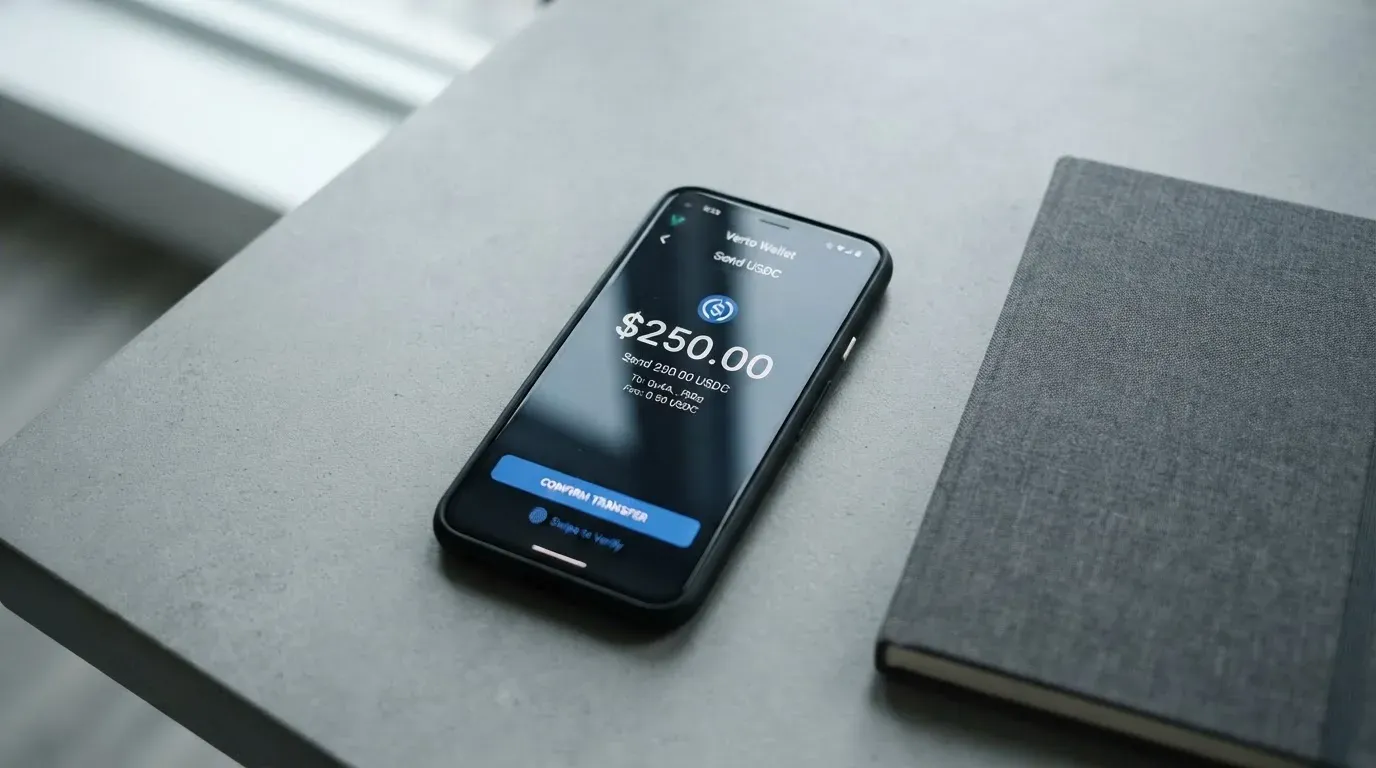
The mechanics: the minimum first top-up is $20, the top-up fee is 1.5%, and $15 of that first top-up is held as a reserve until your total card spending exceeds $2,500. So your first $20 leaves you with $5 of spendable balance and $15 parked. Transfers typically take 3-5 minutes. The terms depend on your card plan and may change. Who pays the blockchain network fee for the USDT transfer is not stated — normally that is charged by the blockchain rather than the card provider, and that is a real cost on top of the 1.5%.
Money going out again is the part that surprises people. A free transfer from the card balance back to the Main account is not supported. If you close the card, the remaining dollar balance is converted to USDT and credited to the main EMCD account. And the issuing bank may close the card if the balance is $20 or less, or if there is no activity for 30 days — so a card you use seasonally can be shut from under you.
The practical consequence: this is a one-way valve unless you close the account. You load USDT, you spend dollars, and getting value back means closing the card and accepting a conversion back into USDT. Plan your balances around that, not around a bank account’s reversibility.
Paying with it every day
The card is managed in the EMCD app, which also carries freeze and unfreeze and limit settings. Apple Pay and Google Pay both feature here: the FAQ says the card works with them, while the feature list marks them “Coming soon”. Same pattern as the network contradiction — two EMCD pages, two answers. Assume neither is ready until you have added it with your own card details.
The wallet help centre is more specific about where the card will not work. Blocked categories are fuel, ride-hailing, AI subscriptions, money transfers, crypto exchanges, gambling and brokerage, and most entertainment except cinemas and theatres. That list is long enough to change how you plan a week: no filling up on a forecourt, no ride-hailing app, no exchange purchases, no betting. Blocked merchants more generally are not stated.
Three further limits on daily life. Cash at an ATM is not supported — the card “does not currently support cash withdrawals”, and the FAQ says withdrawals “will be” available once a physical card launches, so today there is none. There is no 3-D Secure, which means any merchant that requires it will decline your payment rather than asking you for a code. And cashback is not mentioned anywhere.
One saving grace on declines: the balance is a stored one, so the card cannot overdraw. A declined authorisation may leave a hold on your funds that can last up to seven days, and a declined attempt costs $1.50 either way.
What can go wrong
I group these into the things that cost you money, the things that cost you access, and the things that are simply unknown.
Access, and this is the big one. The Trustpilot page for EMCD as a company — not the card — carries 190 reviews with the star score hidden “due to a breach of guidelines”, split 83% five-star and 11% one-star; EMCD says it removed fake reviews. The themes cluster in a period from November 2025 to April 2026: accounts blocked or banned after KYC and AML review, slow KYC and document checks, referral and welcome bonuses unpaid without completed KYC, slow or missing support replies. US users report being blocked since 1 May 2025. Positive reviews cite 12% annual interest and fast payouts, and a 2025 reviewer says they were always paid.
None of that is a card-specific complaint — I found no complaint aimed at the EMCD card itself and no Reddit threads about it. But the pattern matters for you if your money is on the platform and the card is the front door to it: a frozen account is a frozen balance. Regulatory due diligence requires institutions to verify customers and monitor transactions, and where it cannot be completed the expected outcome is that the transaction or the relationship stops. For companies outside the EU that is the general shape of anti-money-laundering law too, and nationality is screened separately from residence, so your citizenship can matter as much as where you live.
Cost. The fees above. Also: a chargeback costs $35, so disputing a payment is only worth it for something substantial.
Custody. The wallet is custodial — EMCD Coinhold Wallet holds the credentials. Your USDT is at the mercy of a provider’s security and its solvency. Custodial platforms have a history: Mt. Gox, about US$350 million reported stolen between 2011 and 2014; Coincheck, about US$400 million in 2018; Ronin Network, US$625 million in 2022. Transfers are typically irreversible and a stolen key has no recovery path.
Stuck funds. If the card is closed for low balance or inactivity, or your account is frozen mid-review, you are dependent on support. Support is listed as “Support 24/7” in the help menu, and the help centre at help.coinhold.io itself is in English, Portuguese, Russian and Spanish — but the languages the card’s own support actually answers in are not stated, and the email in the footer is obscured. If Russian is your only language, that is a question to ask before you load.
Unstated protections. No 3-D Secure. No insurance or safeguarding information on the card page. No named issuer. No published dispute procedure or time frames, despite the fee schedule pricing disputes.
What I found no evidence of: any official incident, any enforcement action, any news about the company in a fresh search on 20 October 2026. Silence is not a clean bill of health, but it is not a warning sign either.
What to take instead
If the EMCD economics do not work for you, three alternatives score better on my scale. The comparison is thin, and I want to be honest about that: for Young Card and MSX the card-level facts — who can get it, what it issues, what it costs, how you fund it — are simply not stated on any official page I could read. I am comparing a documented product with two thinly documented ones, which is itself a kind of information.
| Alternative | Score | What I can actually tell you |
|---|---|---|
| MSX | 6.4 / 10 | Nothing on card terms from an official page I could read |
| Bybit Card | 6.0 / 10 | Fuller detail: virtual and physical cards across named regions, no virtual issuance fee “until further notice”, crypto conversion 0.9% in most regions, FX 2% on top of the network rate in several, tiered cashback up to 10% for the top tier |
| Young Card | 5.7 / 10 | Card terms not stated; cashback paid in YNG tokens by Club tier, 0.1% Essential, 1.8% Gold, 3.6% Platinum |
| EMCD | 4.9 / 10 | Documented, but 1.5% to load, 1.5% + $0.50 to spend, $5 a month, no 3-D Secure |
Bybit is the one to look at if you want documentation before you deposit, and it is a genuinely different proposition: physical as well as virtual cards, three to six years of validity, and cashback tiers from 2% at Base up to 10% at Infinite — though from 5 October 2026 at 10:00 UTC only crypto-funded transactions earn points or cashback, and fiat-funded spending earns nothing. Its own strictures are worth reading too: the cards page says the product “is not meant for European Economic Area customers” and that EEA participation is “strictly prohibited”, and its fiat service restricted list includes Belarus, Russia, Serbia, China and the United States.
The wider lesson for anyone comparing crypto cards: the card is the small part. Ask who issues it, in which country, under which licence; ask what happens to your balance if the provider stops; and ask what it costs to load and to spend. Plenty of marketing pages answer none of those three.
Who I would recommend it to
I would recommend this card to one person: someone who already keeps USDT in a Coinhold Wallet, who is verified, who is not in one of the thirteen restricted countries, and who wants to spend dollars online from that balance without wiring money to a bank. For them it is a tool that works, and the $15 held on the first top-up is the price of the first few weeks of freedom.
To everyone else I would say: check the fee schedule against how much you actually spend, before you are excited about the card. If you spend under a few hundred dollars a month, the $0.50 per purchase and $5 monthly make this an expensive way to be normal. If you need cash, it cannot help. If a 3-D Secure prompt stands between you and a purchase, it will fail.
And if you do go in, three habits. Set the card’s limits in the app on day one, because the provider sets no published numbers for Active and your own ceiling is the only ceiling there is. Keep the balance small enough that a forced card closure at $20 or 30 days of inactivity does not strand anything. And ask support, before you load, which network your card runs on and which language they answer in — because the two public pages disagree, and the one that answers is not published.
Frequently asked questions
What is EMCD card?
EMCD is a virtual payment card that draws on a dollar balance you load with USDT from the Coinhold Wallet. You spend it wherever cards are taken online, much like a prepaid card. It is virtual only: there is no physical card, no ATM withdrawals and no 3-D Secure. Cards last two years before a new number is issued.
Is EMCD a bank, and who owns it?
Not a bank as far as the public pages show. EMCD operates the Coinhold Wallet, but the legal entity, its registration country, the card issuer and any licence are not stated on the card page, and an unofficial source still does not name the issuer. I searched and could not find it either. Treat the missing issuer as the first question to ask support.
How do I get the EMCD card?
You open an EMCD account, pass standard identity verification with a valid government ID — described as 5 minutes — and order the card, which requires $15 of funding that stays in your balance. Verification is also mandatory after your first top-up, and the card activates automatically once it passes. You receive a virtual card immediately, valid for two years.
Is EMCD card available in my country?
The card page says it works worldwide wherever cards are accepted, with an unstated note about some services being unavailable in certain jurisdictions. The help centre is concrete: payments are not available in Afghanistan, Belarus, Cuba, Iran, North Korea, Syria, Venezuela, Russia, Myanmar, Somalia, Ukraine, Yemen and China. Elsewhere, expect it to work.
Does EMCD card require KYC, and how long does it take?
Yes. Verification needs a valid government ID and the card says “usually a few minutes”, with a retry using a different document if it fails. It is mandatory again after your first top-up. Proof of address and verification levels are not stated. User reviews describe slow document checks between November 2025 and March 2026, so allow more than five minutes.
How do I top up the EMCD card?
With USDT held in the Main account of the Coinhold Wallet, topped up manually. The minimum first top-up is $20, the top-up fee is 1.5%, and $15 of that first top-up is held as reserve until total card spending passes $2,500. Transfers typically take 3-5 minutes. The USDT network is not stated, and there is no top-up by card number.
Can I withdraw money from EMCD?
Not as a free transfer — a transfer from the card balance back to the Main account is not supported. Cash at an ATM is also unavailable; the FAQ says withdrawals “will be” possible once a physical card launches. If you close the card, the remaining dollar balance is converted to USDT and credited to your main EMCD account. Plan around that.
Is the EMCD card safe and worth it?
Worth it if you are already holding USDT in that wallet and spend in dollars; not worth it for small monthly spend, cash, or anything needing 3-D Secure. On safety, the wallet is custodial, so EMCD holds your keys and your balance depends on the provider. There is no 3-D Secure and no safeguarding information published. Set limits in the app and keep the balance modest.
Can I add the EMCD card to Apple Wallet or Google Pay?
Possibly, but the card’s own pages contradict each other. The FAQ says it works with Apple Pay and Google Pay, while the feature list marks both “Coming soon”. The help centre also lists blocked categories: fuel, ride-hailing, AI subscriptions, money transfers, crypto exchanges, gambling and brokerage, and most entertainment except cinemas and theatres.
Which network does the EMCD card run on — Visa or Mastercard?
The card page says Visa Platinum; the help centre says Mastercard, virtual, in US dollars. Both are EMCD’s own pages and I could not resolve which is current. It matters because some merchants accept only one network. Ask support to confirm the network of your specific card before relying on it for a purchase.
Exchange cards put to the test – cryptocardtested
Content created by the «cryptocardtested» team