
A virtual USD Mastercard on a USDT balance — usable, but thin on safeguards
 Available in US
The EMCD Payment card is a virtual Mastercard that you feed with USDT and spend like an ordinary card online. That is the whole idea, and it works as described. The problem is everything around it: a $5 monthly maintenance fee, 1.5% on top-ups and again on purchases, no cash withdrawals, no 3-D Secure, and an issuing bank that the public pages never name. If you are spending USDT online anyway and you do not need an ATM or a physical card, it may be a reasonable fit. If you want a card that behaves like the one in your wallet, it will disappoint you. My score is 5.3 out of 10, and the reasoning is in the table below.
Conditions are current as of October 28, 2026.
The conditions described here are current as of 20 October 2026.
Verdict: 5.3 out of 10, and why
| Criterion | Mark | Reason |
|---|---|---|
| Who can get it | 9 / 10 | Works wherever Mastercard is accepted, except a long exclusion list; whether the test is citizenship or residence is not stated |
| Cost | 2 / 10 | Plus $19 issuance, Premium $25, $5 a month, 1.5% top-up, 1.5% + $0.50 per purchase; the press release says issuance is free and the help centre says otherwise |
| Top-up options | 5 / 10 | Only from the internal USDT wallet, converted to USD; networks are not named and you cannot top up by card number |
| Reliability and complaints | 5 / 10 | The card is run by KazeFi, EMCD “does not issue cards”; issuer country and licences are unstated, Light is closed to new issuance, and Trustpilot reports blocks after KYC |
| Everyday use | 5 / 10 | Virtual only, Apple Pay and Google Pay available; no ATM and no 3-D Secure |
| Total | 5.3 / 10 |
Read the marks in order of how much they will affect you. The nine for reach is real: the acceptance list is almost the whole world. The two for cost is the one that decides the purchase for most people, because it is not a cheap card and the marketing says it is. Everything else sits in the middle because the facts are thin rather than bad.
Who this suits: you already hold USDT, you spend it online rather than in shops, and you are comfortable with a card that lives only in your phone and cannot be used at a cash machine. Who it does not suit: anyone who needs physical plastic, cash, or a card that clears the extra security step many online shops ask for. It is also a poor fit if you pay in a currency other than the dollar often, because a 3% conversion fee may apply, or if you are put off by a provider whose issuing bank and licence you cannot verify from public pages.
Who will they give you the card to
They will give it to a great many people, and this is the strongest thing about the card. It works wherever Mastercard is accepted, with a list of exceptions: Afghanistan, Belarus, Cuba, Iran, North Korea, Syria, Venezuela, Russia, Myanmar, Somalia, Ukraine, Yemen and China. The help centre gives that list; it does not say whether the test is your citizenship or where you live, which matters if you are one of the people who lives in an allowed country but holds a passport from an excluded one. The February 2026 press release frames the card as “available to eligible users in Latin America” and gives no country list, which is a much narrower sentence than the help centre’s. Where the two disagree, ask support before you fund anything.
The reach is a genuine advantage if you are in a country where a bank account and a normal card are hard to get. It is less of an advantage if you simply want a second card for online spending, because a mainstream bank will usually do that more cheaply.
How to get it
The sequence is short and slightly unusual: top up from the USDT wallet first, then issue the card, then verify your identity. Identity verification with a valid government-issued ID is mandatory, and the card’s own pages say it is completed after the first top-up, not before. That order matters. You are asked to send money into an account before anyone has checked who you are, and the user reports collected on Trustpilot include accounts being blocked after KYC checks. Proof of address and age requirements are not stated on the pages I read.
If verification is rejected, the advice is to retry with a different document. If it is still not done after 30 minutes, the advice is to contact support. Processing normally takes minutes. There is no tiered KYC structure described — a single ID check, and no published list of what a pending or failed check means for money already transferred.
What you get is a virtual card only. The card’s own wording is “Currently, we only offer virtual cards — Plus and Premium”. It is a Mastercard, denominated in USD, valid for 2 years, with up to 2 active cards. There is no physical option, so delivery time is not a question that applies.
What it really costs: Fees, and what they do to an ordinary purchase
Cost is where this card loses most of its points. The numbers below come from the card’s help articles; where its press release says something different, I say so.

| Fee or limit | Plus | Premium | Light (legacy) |
|---|---|---|---|
| Issuance | $19 | $25 | No annual or monthly fee |
| Monthly maintenance | $5 | $5 | No annual or monthly fee |
| Top-up | 1.5% | 1.5% | 2.5% per top-up |
| Purchase | 1.5% + $0.50 | 1.5% + $0.50 | $0.25 per purchase |
| Non-USD conversion | 3% may apply | 3% may apply | not stated |
| Declined payment | $1.50 | $1.50 | not stated |
| Refund | $0.50 | $0.50 | not stated |
| Reversal | $2.00 | $2.00 | not stated |
| Chargeback | $35 | $35 | not stated |
| Card closure | $15 | $15 | not stated |
| Apple / Google Pay link | not stated | not stated | $0.02 |
| ATM / cash withdrawal | Not available | Not available | Not available |
| Per transaction | $1,000 | $10,000 | Spending limit: none |
| Daily | $3,000 | $50,000 | Top-up $2,000 per month |
| Monthly | $10,000 | $400,000 | not stated |
Two things stand out before you read a single receipt. The first is that the 13 February 2026 press release says “Issuance is free, with no monthly maintenance fee”, while the help centre lists $19 or $25 to issue and $5 every month. The help centre is the one I would believe, because it is the page with the detailed table on it, but you should price the card on the help-centre numbers. The second is the shape of the spending fee: 1.5% plus $0.50 on every purchase, on top of the $5 a month. That is not a rounding error.
Two or three everyday purchases, with the fees the card states:
- A $30 subscription in dollars: 1.5% is $0.45, plus $0.50 fixed, so $0.95 for that one payment. Across twelve similar payments that is $11.40 in fees, before the $60 a year in maintenance. The same twelve payments on a no-fee card cost nothing.
- A $120 flight in euros: 1.5% is $1.80, plus $0.50, plus a 3% conversion fee may apply on the non-USD amount. If the conversion fee lands, that is roughly $3.60 more. The card does not promise the conversion fee will or will not apply on a given purchase.
- Ten small purchases of $9: each costs $0.135 plus $0.50, so about $6.35 in fees on $90 of goods. Small purchases are where a flat per-transaction charge hurts most.
A note on who pays the network fee: on-chain network fees for your deposit are charged by the blockchain, not by the card provider. Who pays for that particular transfer, and whether any fiat top-up route exists, is not stated — funding is USDT only.
One more cost that is easy to miss: the $35 chargeback fee. If you need to dispute a payment, the process is not free, and that may discourage you from using it for anything you actually want to fight about.
How to Top up the card
Topping up is a manual step from the internal USDT wallet, through the card menu. The USDT converts to USD and lands as a card balance. The card’s balance sits separately from your main EMCD account and is not a bank account. That separation is the point of the design — you spend what you loaded, and the card cannot overdraw — but it also means you cannot get the money back out on demand.
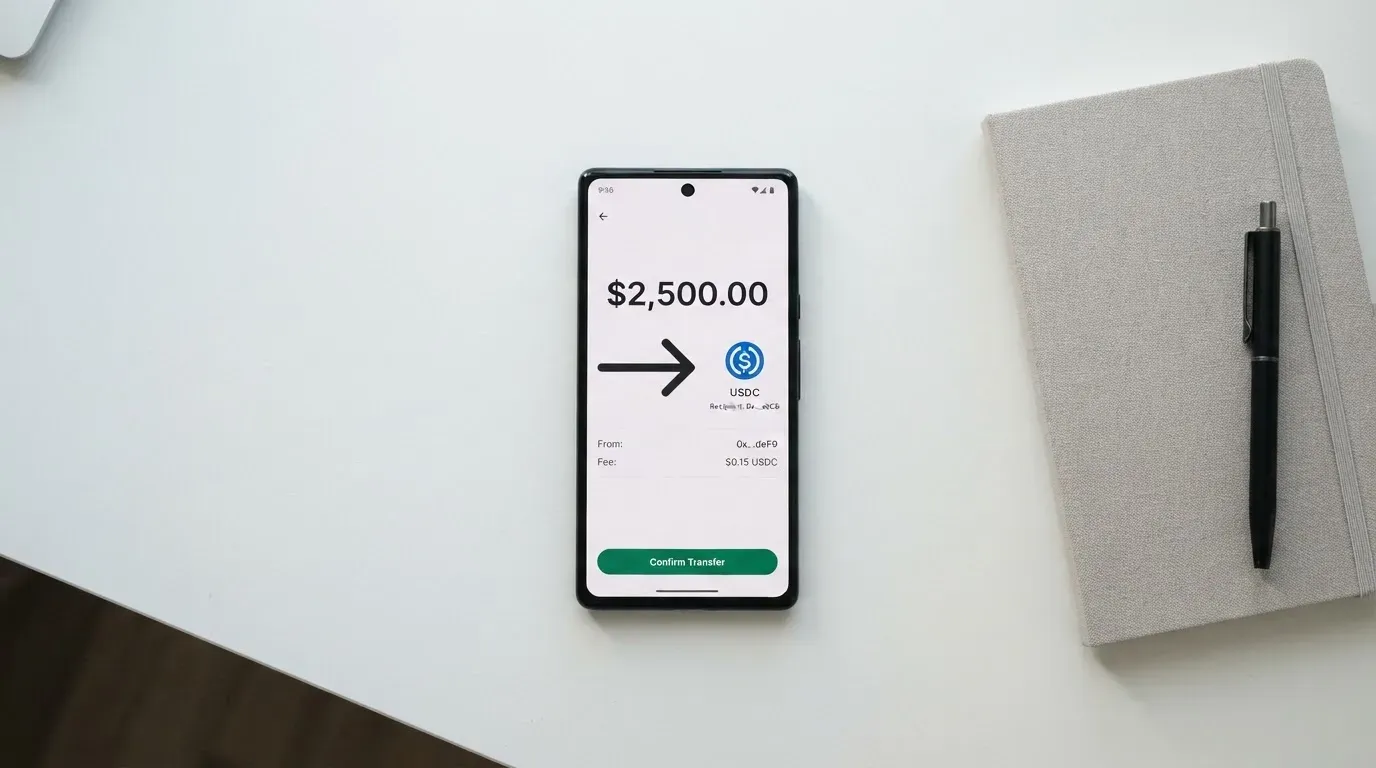
There is no top-up by card number. There is no bank transfer into the card. If you are comparing this to cards you can refill from a bank app in ten seconds, that difference is the whole comparison.
The minimum first top-up is $20, and $15 of that is held as a security reserve until your total spending passes $2,500. So on a small first load you have $5 of usable balance and $15 tied up. Top-ups and issuance typically take 3 to 5 minutes. Networks are not named, which is the practical risk: on-chain transfers are irreversible, and a deposit sent on a network the provider does not support, or to an address belonging to a different network, can be lost or need manual recovery with no guarantee. Ask which networks to send on before your first transfer, not after.
On the way out, there is no withdrawal of the card balance back to your EMCD account. The remaining balance is refunded only when the card is closed, and then converted to USDT, with a $15 closure fee. The bank may also close cards holding $20 or less, or after 30 days of inactivity — that is in the legacy Light article, so treat it as indicative of how the programme behaves rather than a promise about Plus and Premium.
Paying with it every day
Day to day, the card is Apple Pay and Google Pay. You add it through the wallet app and choose email verification; if you are asked for a phone call, support is the stated route. That is the normal modern path, and it works. Blocked merchant categories are not stated, so you cannot tell from public pages whether gambling or similar categories are closed.
The two limits that matter most are both about merchant acceptance rather than the card. 3-D Secure is not supported, so shops that require that extra identity check will decline the payment — and a growing share of online merchants do require it. And Address Verification, which compares the street number and postcode you type with the issuer’s records, is mainly offered in the US, Canada and the UK and is generally unavailable for foreign-issued cards. That combination — no 3-D Secure, foreign BIN — is where you will meet declines that look arbitrary.
There is no cashback mentioned anywhere in the card’s help articles or its press release; it is not stated whether the card earns any rewards at all. The EMCD app is on the App Store under Emcd Tech Limited, for iPhone and iPad. The Nepal storefront listing showed no rating — “not enough ratings” — when I read it, and I did not find a Google Play build. The card is not available through the App Store build, which is worth knowing before you plan around the app.
If money is deducted but the card is not credited, the card’s own advice is to contact support with the last four digits, the date and the amount. No time frames are stated for refunds, reversals or chargebacks.
What can go wrong
The things that could go wrong here are mostly structural rather than dramatic, and it is worth naming them one at a time.
Who is actually behind the card: EMCD, the app developer Emcd Tech Limited, markets it, but the card is operated by KazeFi under its regulatory authorisations. EMCD’s own statement is that it “does not issue cards, process payments, or convert crypto to fiat”. The press release is datelined Hong Kong. Registration country, issuing bank, issuing country and licences are not stated on the pages I read. That is not proof of anything wrong — plenty of legitimate programmes work exactly this way — but it means you are being asked to trust a structure you cannot verify from public information.
Programme change: the legacy Light card is closed to new issuance for cards issued after July 2025, and the Light help article explains it as a programme change. Programme closures typically run in a predictable order — a notice period, then loading and spending stop, then users are asked to withdraw remaining balances — and a secondary source reported one 2026 closure where new loads ended on 8 July and spending stopped on 8 August. That is a single unconfirmed source, but the shape of it is what to watch for.
Verification friction: on Trustpilot for emcd.io, read 21 October 2026, the company page showed 190 reviews with 83% five-star and 11% one-star, and the score itself was not shown — “rating unavailable due to a breach of our guidelines”. Themes in that user report were account blocks and bans after KYC, slow verification, and missing bonuses. Not one complaint on the page I read concerned the card itself, and the press side turned up no independent complaints about the card. So the reputational risk sits with the account and the exchange, not with the plastic you do not have.
The safety features you would expect are not described: two-factor authentication and an in-app freeze are not stated, and spending-limit controls are not yet available. The card balance is separate from the main account and is not a bank account; the custody model and how funds are safeguarded are not stated. Whether it is safeguarded like e-money — segregated accounts or insurance, which is not the same as a bank deposit guarantee — is exactly the question the public pages leave open.
And the ordinary category risks apply to any card of this kind: 3-D Secure liability shifts, holds left by declined authorisations that can sit for several days, and prepaid-card dispute coverage that varies by scheme and should not be assumed. If a purchase is charged and the goods never arrive, a chargeback is a defined process with reason codes — but on this card it costs you $35 to start.
What to take instead
Three alternatives came up in the same category. None of them is clearly better on cost, because none of them publishes costs as clearly as EMCD’s help centre does — that is worth saying plainly, because this card is at least honest about its price.
| Cardex | CardFlow | HyperCard | |
|---|---|---|---|
| Score | 5.6 / 10 | 4.9 / 10 | 4.7 / 10 |
| Reach | “200+ countries”, no exclusion list stated | Aimed at Nigeria; no list stated | App Store says “more than 176 countries” of acceptance, not eligibility |
| Card | Debit crypto card on VERVE, VISA, Mastercard and UnionPay; virtual and physical | Virtual USD Mastercard, made in about 3 minutes | Prepaid; network not stated; balance in USD or EUR |
| Cost | Not stated | Virtual card “completely free”; monthly fee not stated | Not stated; App Store page lists no fees |
| Spending fees | Real-time conversion at the moment of payment; an “AI-Powered Conversion Rate” scans rates and picks one; no percentage stated | Not stated | Not stated |
| Funding | USDT, USDC and BTC wallets; networks not stated | Bitcoin, USDT, ETH or Naira bank transfer; networks not stated | Crypto such as USDT, BTC, ETH, converted to USD or EUR |
Cardex scores highest of the three and is the only one with physical cards in the listing and four networks, but “not stated” on fees is not a smaller number than 1.5% plus $0.50 — it is an unknown, and unknowns have a way of turning into 3% later. Its App Store listing is Naira-focused. CardFlow is free to create and clearly aimed at Nigeria and Naira bank transfers. HyperCard describes acceptance in 176-odd countries but says nothing about who is eligible, and its network is not stated on the page I could read. On the evidence available, EMCD is the most transparent on what it charges and among the least transparent on who issues the card. If your decision turns on whether you can see the numbers, that is EMCD’s argument. If it turns on physical plastic or a named bank, none of these three published pages gave me that.
Who I would recommend it to
I would recommend the EMCD Payment card to someone specific: a person who already keeps USDT, spends it online in dollars, has no use for a cash machine, and has decided that the 1.5% plus $0.50 per purchase and $5 a month is an acceptable price for that. For that person it is a working, honest tool, and the reach score of 9 is not exaggerated.
I would not recommend it to someone paying rent, groceries or anything recurring in a non-dollar currency, because of the 3% conversion fee and the $35 chargeback. I would not recommend it to anyone who needs a physical card, cash, or shops that demand 3-D Secure. And I would think twice before funding it heavily if you cannot get an answer about the issuing bank, the licence, and what happens to your balance in a programme change — because those answers are not on the public pages, and you are the one left holding the balance.
If your main problem is that a bank card is hard to get, this card’s reach genuinely helps. If your main problem is that this card is expensive, it will not help at all, and the score of 2 on cost is the number to argue with.
Frequently asked questions
What is EMCD Payment card?
It is a virtual Mastercard, denominated in USD, valid for 2 years, with up to 2 active cards. You fund it by transferring USDT from your internal EMCD wallet, where it converts to USD, and then spend that balance online. Currently only virtual cards are offered, in Plus and Premium versions. The card is operated by KazeFi; EMCD itself markets the product.
How does the EMCD Payment card work?
You top up from your USDT wallet through the card menu, USDT converts to USD, and the card spends that stored balance — so it behaves like a prepaid card and cannot overdraw. The balance is separate from your main account and is not a bank account. The first top-up must be $20, of which $15 is held as a security reserve until your total spending exceeds $2,500.
Is EMCD Payment a bank?
Not on the public pages. EMCD states that it “does not issue cards, process payments, or convert crypto to fiat”; the card is run by KazeFi under its regulatory authorisations. The card balance is explicitly not a bank account. Registration country, issuing bank, issuing country and licences are not stated, so treat it as a payment product rather than a bank relationship.
Who owns EMCD Payment?
EMCD is the brand, with Emcd Tech Limited named as the app developer on the App Store. The card programme itself sits with KazeFi. The February 2026 press release announcing the Mastercard-linked USDT card is datelined Hong Kong. Ownership of the company behind the issuing side is not stated on the pages I read.
How do I apply for the EMCD Payment card?
The order is unusual: top up from the USDT wallet, issue the card, then verify your identity. Identity verification with a valid government-issued ID is mandatory and comes after the first top-up, so you send money before anyone has checked who you are. If verification is rejected, retry with a different document; if it takes over 30 minutes, contact support.
Does the EMCD Payment card require KYC?
Yes. A valid government-issued ID is mandatory, and the card’s own process runs it after your first top-up. There is no published tier structure, and proof of address and age requirements are not stated. Trustpilot user reports for the company include accounts being blocked after KYC checks, so read the failure path before you fund a large balance.
How do I top up the EMCD Payment card?
Manually, from the internal USDT wallet, through the card menu. USDT converts to USD and lands on the card. You cannot top up by card number, there is no bank transfer route, and the networks supported are not named. Top-ups and issuance typically take 3 to 5 minutes. Send on a network the provider supports — an irreversible transfer on the wrong one may be lost.
Can I withdraw money from the EMCD Payment card?
No. You cannot withdraw the card balance back to your EMCD account on demand. The remaining balance is refunded only when the card is closed, converted to USDT, with a $15 closure fee. The bank may also close cards holding $20 or less, or after 30 days of inactivity — that point appears in the legacy Light article.
Is the EMCD Payment card free?
No. Plus costs $19 to issue and Premium $25, and both carry $5 monthly maintenance. Top-ups cost 1.5% and each purchase costs 1.5% plus $0.50. The February 2026 press release says issuance is free with no monthly fee, but the help centre lists these prices; price your budget on the help-centre figures. The legacy Light card had no annual or monthly fee but is closed to new issuance.
Is the EMCD Payment card safe to use?
It is not a physical card, so there is nothing to lose to a thief, and Apple Pay and Google Pay tokenise the number. But 3-D Secure is not supported, so merchants requiring it will decline you, and two-factor authentication, an in-app freeze and spending-limit controls are not stated or not yet available. Treat the balance as money held with a provider you have verified as little as possible about.
Virtual cards put to the test – cryptocardtested
Content created by the «cryptocardtested» team