
A privacy-leaning virtual Visa that spends from a crypto balance, with limits worth weighing
 Available in US

Freedomia is a digital Visa that draws on a crypto balance. You top it up with Bitcoin, Lightning, Monero or a handful of other coins, the platform auto-converts everything to US dollars behind the scenes, and you spend the resulting balance anywhere Visa is taken online. There is no physical card, no bank app to install, and, up to a monthly cap, no identity check. That combination is the reason people look at it: it promises a working payment card where a regular bank has said no.
The catch is that “no verification” only stretches so far, the monthly cap is modest, and the company behind it is unusually quiet about who regulates it. I read through the public pages, the published fee table, and the terms, and I also looked for third-party reviews. What follows is what I found, what is not stated, and where I think the card fits — and where it does not.
The conditions described here are current as of October 28, 2026.
Verdict
Freedomia earns 6.1 out of 10 in my reading. That is a middling score, and it reflects a real split: a genuinely unusual product for the small audience it is built for, but a thin public record and modest limits for anyone planning to lean on a card day to day.

| Criterion | Mark | Why it lands there |
|---|---|---|
| Who can get it | 8 / 10 | Marketed as “Global” with no country list on the home page, though the FAQ references restricted countries without naming them. |
| Cost | 4 / 10 | Founder tier at $5/month or $60/year, top-up fee 1.3%, standard FX 2.5%, USD spending 0%; issuance fee is not stated. |
| Top-up options | 9 / 10 | Lightning plus BTC, XMR, ETH, LTC, SOL, TRX, BNB, USDT and USDC on Polygon, with auto-swap to USD. |
| Reliability and complaints | 5 / 10 | Operator is Freedomia Digital Group LLC in Delaware; the issuing bank and licences are not named, and no Trustpilot or Reddit reviews are available. |
| Everyday use | 5 / 10 | Virtual Visa only, instant issuance, 3DS on, Google Wallet supported, Apple Pay “coming soon”; no plastic, no ATM. |
| Total | 6.1 / 10 | A privacy-leaning product for a narrow audience, weighed down by missing disclosure and low caps. |
This is a card for someone who already holds crypto, wants a working Visa number without going through a full identity check, and is comfortable topping up to a few thousand dollars a month. If that is not you — if you want a card you can swipe in a shop, draw cash from an ATM, or load with a bank transfer — the fit is poor. I would not call it a primary card for most people, and I would be cautious about parking more on it than the monthly cap.
Who they will give the card to
The home page describes Freedomia as a “Global” card. There is no country list on the public pages, and no eligibility form to tick. The FAQ contains a question, “Which countries are restricted?”, but the answer is not readable on the page I checked. So in practice you only find out whether your country is on the restricted list by trying to sign up.
Two things do come across clearly. The first is the KYC position. Freedomia markets itself with the line “No verification. No approval.” Signup is by email, and you can get a card without sending in documents. The second is the threshold. Unofficial reporting, which I have not been able to confirm against the live terms, describes Freedomia as pseudonymous up to USD 5,000 of monthly spend, with the company reserving the right to run KYC and AML checks above that line. Treat that as unofficial, and expect that the platform can ask for documents once you push past the cap or if it sees activity it wants to look at.
That combination — no upfront paperwork, a cap, and the option to verify later — is the product. If you are someone who has been refused a bank card because of where you live, or who simply does not want their spending tied to a passport, the structure is the appeal. If you are looking for a card that comes with a full banking relationship, an address-verified debit account, and a customer due-diligence file on the issuer’s side, this is not it.
The published tier limits are tight. The available Founder tier caps at USD 5,000 per month and USD 60,000 per year. The HODL tier that is listed as “coming soon” carries the same monthly cap. Only the higher MOON tier, also listed as “coming soon”, raises the monthly ceiling to USD 10,000 and the annual ceiling to USD 120,000. None of this is a “premium” card in the bank sense; the limits are prepaid-style, and you can set your own ceiling lower inside the card interface if you want belt-and-braces.
How to get it
Getting the card is the easy part. You sign up with an email, the card is virtual, and issuance is instant. There is no plastic to wait for and no courier address to provide. If the card details ever leak, you re-issue through the same interface. 3-D Secure is on by default, which means online merchants will sometimes push a confirmation step through to you; that is a security plus rather than a friction point.
You should treat the issuance process as light, however, and that is not a complaint — it is what the product is for. Because there is no document check at the start, the platform has not validated your address, your date of birth, or your identity. That has two practical consequences. First, the moment a transaction looks unusual — larger than your history, in a high-risk MCC, or simply flagged by the system — there is a real chance the platform will ask for documents before letting it through. Second, because the card is virtual, you cannot fall back to “the shop took cash over the counter” if anything goes wrong. Your only purchase path is online or through a tokenised wallet.
Activation, in the sense of a bank “I have received and activated my new card” step, is not described on the public pages. The card appears in the web account interface, where you can see Card Data, Card Limits and a Freeze Card toggle, and you take it from there. The card currency is US dollars — important for the cost section, because it changes which fee applies.
What it really costs
This is where Freedomia is honest in some places and silent in others. The published fee table is short and the standard fees are clear, but a few numbers simply are not stated, and you should know that before you fund the card.
| Fee or limit | Founder (available) | HODL (coming soon) | MOON (coming soon) |
|---|---|---|---|
| Issuance | not stated | not stated | not stated |
| Monthly fee | $5 | $9.99 | $17.99 |
| Annual fee option | $60 | $119.88 | $215.88 |
| Top-up fee | 1.3% | 1.3% | 1.3% |
| Standard FX fee | 2.5% | 2.5% | 2.5% |
| USD spending fee | 0% | 0% | 0% |
| Monthly spend cap | $5,000 | $5,000 | $10,000 |
| Annual spend cap | $60,000 | $60,000 | $120,000 |
| ATM | not stated (virtual card) | — | — |
The $5 monthly fee on Founder is the headline cost. If you pay it annually it works out to the same $60, so there is no saving either way; it is just a question of whether you want the charge to be monthly or yearly. HODL at $9.99 a month and MOON at $17.99 a month both look expensive next to a normal bank account that charges nothing for a basic debit card. They buy you higher monthly caps (MOON only) and, in the case of Founder and MOON, priority support — the standard tier is HODL, which is also the only one without priority.
The top-up fee is 1.3% on every tier. That is a flat rate regardless of which coin you deposit. It is not unusual for the category, but it does mean that every time you move money in, you have already lost a little more than one percent of it before the conversion to USD has even happened.
The FX line is the one to read carefully. If you spend in US dollars — which, given that the card is denominated in USD, is the natural case for any US-based merchant — the fee is 0%. If you spend in any other currency, the standard fee is 2.5%. So a French traveller buying a coffee in Paris will pay the conversion; someone buying a server in Frankfurt from a US-hosted SaaS that bills in dollars will not. The cheaper path is to do your foreign-currency conversion before you top up, not at the point of sale.
What I find genuinely hard to evaluate is the issuance fee, which is not stated, and the question of whether there are inactivity, replacement, or dispute fees in the small print. The terms do carry a section called “Returns, disputes and chargebacks”, but the text was not readable on the version I checked, and the platform does not publish a full schedule I could confirm. I would ask support — the email is [email protected] — before loading the card, and I would keep a record of the answer.
Two or three everyday examples make the numbers more concrete.
- Buying a USD-priced subscription online. You top up $500 from Bitcoin at the 1.3% rate, so $6.55 is taken as a top-up fee and $493.45 lands on the card. The merchant charges in dollars, the FX fee is 0%, and the platform does not take a percentage of the payment. Your effective cost is the top-up fee only.
- Buying something priced in euros from a eurozone merchant. The same $500 of Bitcoin becomes $493.45 of USD balance, then the platform converts USD to EUR at the 2.5% standard rate when you pay. The subscription’s euro price, the platform’s rate, and the 2.5% all sit on top of the top-up fee, and the total is closer to 4%.
- Hitting the monthly cap early in the cycle. The Founder card stops spending at $5,000. There is no way to top up to cover a one-off spike, and there is no published over-limit fee — the transaction simply declines, with the usual hold on the attempted amount that can take a few days to clear.
Top up
Top-up is where Freedomia is most clearly differentiated. The platform supports Lightning plus a long list of chains and tokens, and on the way in everything is auto-swapped to US dollars.
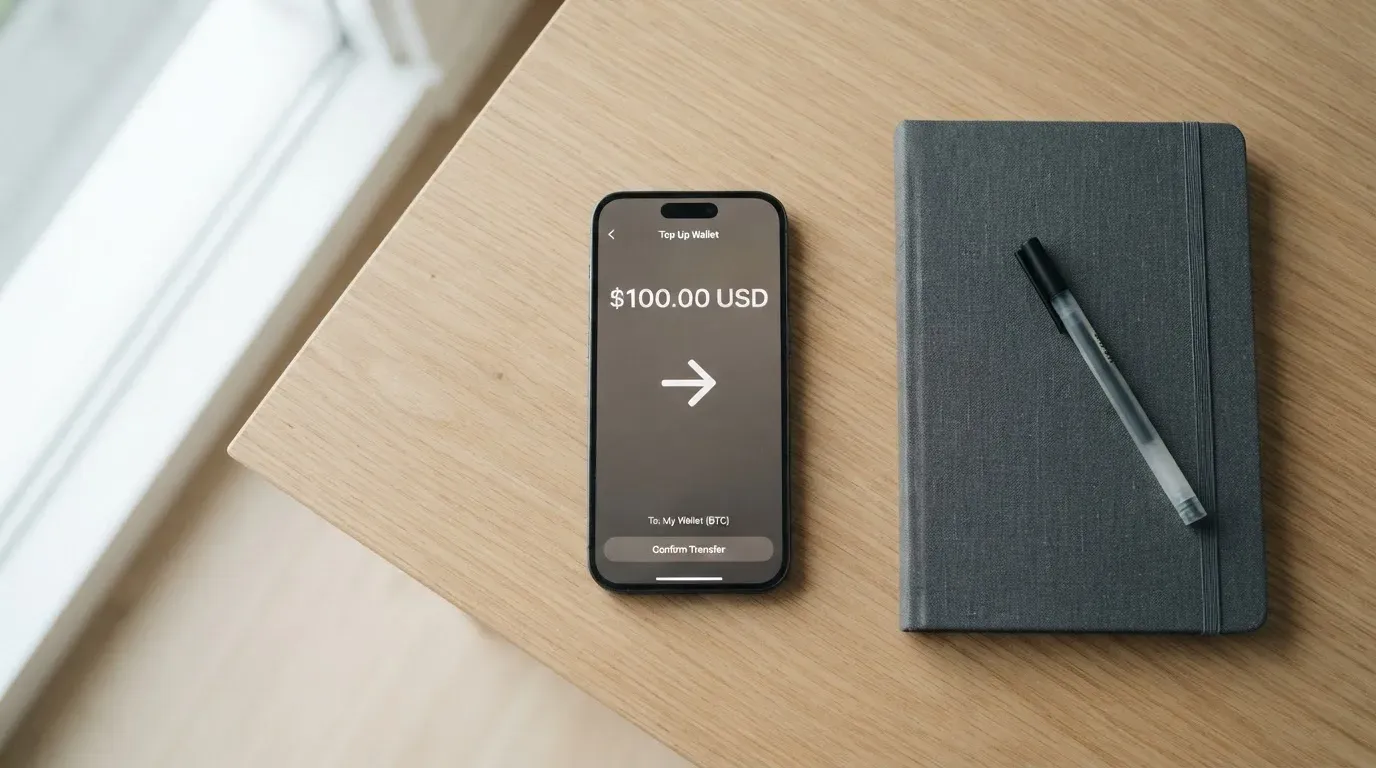
The accepted deposits, as published, are:
- Bitcoin via the Lightning Network, sent to a personal Lightning Address
- Bitcoin on-chain (BTC)
- Monero (XMR)
- Ethereum (ETH)
- Litecoin (LTC)
- Solana (SOL)
- Tron (TRX)
- BNB
- USDT on Polygon
- USDC on Polygon
The list is described as “and more”, so the platform may add coins without changing the public page. The important rule is the one the platform has not stated: which networks are supported for each coin, who pays the network fee, and what the minimum deposit is. None of those three answers is on the public page. That is unusual. With most crypto card providers, the network-fee policy and the minimum are part of the deposit screen; here they are not. I would treat the first top-up as a test, not as a commitment.
Two practical points to take with you. First, Lightning deposits are typically the cheapest and the fastest for Bitcoin, and a personal Lightning Address is a friendlier user experience than managing invoices. Second, when you deposit USDT or USDC, the public page names Polygon specifically. Polygon is cheap, but it is not the cheapest network for everyone, and the moment a stablecoin is sent on the wrong network the deposit is at risk. A blockchain transfer is irreversible, and the platform has not promised manual recovery.
After the deposit lands, the platform swaps the balance to USD and the card is ready. The 1.3% top-up fee is taken at this point, not when you spend. There is no fiat top-up rail — no card-to-card, no bank transfer, no Apple Pay cash-in. If you do not already hold crypto, there is no clean way onto Freedomia.
There is no withdrawal function described on the public pages. The platform calls itself a card, and the “out” direction from your balance appears to be the card’s own spending. If you need to get fiat back to a bank account, this is not the product for that.
Paying with it every day
Once the card is loaded, everyday use is mostly online. There is no plastic, and the ATM is not part of the product, so this is a virtual card that lives in your web account and in Google Wallet. Apple Pay is listed as “coming soon” on the public page; until it arrives, iPhone users have to type the card number in at checkout.
In a shop, that means Google Pay tap-to-pay on Android. In a browser, it means the standard Visa form fields. 3-D Secure is on, so for unfamiliar merchants or larger purchases you may be asked to confirm a one-time code. Address Verification Service is a separate question, and it is a frequent source of declines on foreign-issued cards — including virtual ones — because AVS is mainly offered in the US, Canada and the UK, and a card with no verified billing address will sometimes fail the check. If a US-only merchant declines you, that is a likely cause.
The platform does not publish a list of blocked merchant categories. Many card programmes block gambling (MCC 7995) and a few other categories, but the policy here is not stated, so you only find out by trying. The platform also does not publish a rewards or cashback programme. If you are used to a few percent back on a bank card, do not assume anything here.
The card interface itself is the web account, not a standalone app. From there you can see the card data, set a per-transaction or monthly limit lower than the tier maximum, and freeze the card at any time. Freezing is a useful safety feature, and it is the practical equivalent of the in-app kill switch that many crypto cards now ship with.
Disputes and chargebacks are addressed in the terms — section 19, “Returns, disputes and chargebacks” — but the text of that section was not readable in the version I checked. I would not rely on Freedomia for a high-value purchase where you expect a full bank-style chargeback process, because the platform has not been explicit about the timeline, the documentation, or the outcome if a merchant does not respond.
What can go wrong
Three categories of risk matter here: company risk, custody risk, and product risk. They overlap, but it helps to keep them separate.
Company risk. Freedomia Digital Group LLC is the operator, registered in Delaware. The page lists a Newark, Delaware address, but it does not name the issuing bank, the card programme manager, the regulator, or any licence. For a card product, the issuer is the licensed entity that puts the Visa BIN behind the card; Freedomia has not put a name to that role publicly. A CriptoNoticias review from September 2026 calls the service custodial and closed-source, which I have taken as unofficial and not confirmed against the issuer’s own disclosure. The combination — operator named, issuer unnamed, regulator unnamed, third-party description “custodial and closed-source” — is the single biggest gap in the public record.
Custody risk. Because the service is described by the same third-party source as custodial, the implication is that your deposited crypto sits with the platform until it is converted and loaded as USD balance. That makes Freedomia a custodian in the same broad category as a crypto exchange. The general category has a long record of failures, with Mt. Gox, Coincheck and Ronin among the larger incidents. None of that is specific to Freedomia, and the platform may well safeguard funds in segregated accounts, but the same rules apply: holding funds with a custodian carries counterparty and hack risk, and the platform has not described its safeguarding arrangements in the public materials.
Product risk. Several small things can hurt you in everyday use even when the company is sound:
- Wrong-network deposits. If you send USDT on a chain the platform does not support, the deposit may be lost. Blockchain transfers are irreversible.
- Sanctions and restricted countries. The FAQ asks which countries are restricted but does not answer on the readable page. If you are in a sanctioned jurisdiction, do not assume the card is open to you.
- AVS and foreign-BIN declines. A virtual card with no address on file can be declined by merchants that run AVS or screen for foreign-issued BINs.
- 3-D Secure friction. The card will sometimes be challenged at checkout, and the platform’s challenge flow is not described in detail.
- Closure of the programme. Crypto card programmes have been closed before. WaveCrest, a Visa issuer that supplied several crypto card brands, was suspended by Visa in Europe in 2018. FTX’s card programme was wound down by its issuer after Visa terminated its global agreements in November 2022. The standard pattern is a notice period, then a freeze on new loads, then a freeze on spending, then a window to withdraw the remaining balance. A crypto card that has no published issuer and no published regulator is harder to hold to account if that happens.
Two features on the safety side are worth naming. 3-D Secure is on by default, and you can freeze the card from the web interface at any moment. Freedomia also lists Tor and Onion support, which is unusual and consistent with the privacy-leaning positioning.
Support is by email at [email protected] and via Telegram at @Freedomiaio. Priority support is reserved for Founder and MOON customers; the standard tier sits on email. There is no in-app chat, no phone line, and no published SLA.
What to take instead
Freedomia is one of several cards aimed at users who want a Visa or Mastercard number tied to a crypto balance without a full bank-style onboarding. None of the alternatives below is a perfect substitute — they differ on cost, country coverage, card type and KYC — but they are the comparison set I would look at alongside it.
| Card | Score | What it is | Where it differs from Freedomia |
|---|---|---|---|
| Cardex | 5.6 / 10 | A crypto debit card on Verve, Visa, Mastercard and UnionPay, with both virtual and physical cards. | Wider network choice and a physical option, but the App Store listing is Naira-focused and there is no published fee schedule I could read. |
| CardFlow | 4.9 / 10 | A virtual USD Mastercard you can create in a few minutes. | Free to create, aimed at Nigeria and global users, accepts Bitcoin, USDT, ETH and Naira bank transfer; fee schedule not stated. |
| HyperCard | 4.7 / 10 | A prepaid card in USD or EUR, accepted in 176 countries (acceptance, not eligibility). | Deposits in USDT, BTC or ETH converted to USD or EUR on the card; no fees are published on the App Store listing. |
Cardex and CardFlow are the closer comparisons because they, like Freedomia, target users who cannot or do not want to go through a full bank onboarding. Cardex’s main differentiator is that it offers a physical card on multiple networks, which is something Freedomia does not. CardFlow is the cheapest to start with — creation is free — but its fee schedule is not public, so the cost comparison is incomplete. HyperCard is a prepaid card with a wider currency choice, but again without a published fee schedule it is hard to compare on price.
Two broader points are worth taking away. The first is that any crypto card that does not name its issuer, its regulator and its safeguarding arrangements is harder to hold to account than one that does. The second is that the “no verification” framing is, in practice, a cap rather than a rule, and the moment you push past the cap the platform can ask for documents. Plan around the cap, not around the marketing line.
Who I would recommend it to
I would recommend Freedomia to a specific kind of reader. If you already hold crypto, want a working Visa number you can use online, and are not looking for a card to swipe, draw cash, or load from a bank, Freedomia is a reasonable fit at the Founder tier. The $5 monthly fee and the 1.3% top-up fee are the cost; 0% on USD spending is the offset. The Lightning support is a genuine plus for Bitcoin users, and the 5,000 USD monthly cap is enough for normal online spend if you are not a heavy user.
I would not recommend it if any of the following applies to you. You want a card you can use in a physical shop on a regular basis — the lack of a plastic card and the limited wallet support is a real constraint. You want to draw cash from an ATM — the product does not offer one. You need a high monthly spend — the standard cap is $5,000 and only the still-unreleased MOON tier raises it. You care about the regulatory chain — the issuer, the regulator and the licence are not named in the public materials. Or you need a card that you can lean on with a high level of confidence that the programme will still exist in two years — the same lack of disclosure applies.
If your situation is somewhere in the middle, the test is straightforward. Open the card, fund it with a small amount, run a couple of small purchases, and only load the balance you actually need to spend. Treat the platform as a custodian, keep your own seed phrases and your own backups, and do not park funds on the card that you cannot afford to be locked out of if the programme changes. That is not a uniquely Freedomia warning — it is the same warning that applies to every crypto card where the issuer and the licence are not on the public page.
Frequently asked questions
What is the Freedomia card?
Freedomia is a digital Visa card you fund with crypto. The platform accepts Bitcoin (including Lightning), Monero, Ethereum, Litecoin, Solana, Tron, BNB, USDT and USDC on Polygon, then auto-swaps the balance to US dollars, and you spend that balance anywhere Visa is taken online. There is no physical card, and there is no fiat top-up option.
How does the Freedomia card work?
You sign up with an email, get a virtual card instantly, deposit crypto from your own wallet, and the platform converts it to USD balance behind the scenes. The card draws on that balance, with 3-D Secure on for online purchases, and you can freeze the card or change the limit from the web interface at any time.
Is Freedomia a bank?
No. Freedomia describes itself as a global card, and the operator is a Delaware LLC. The public pages do not name a bank, an e-money institution, or a regulator. That means the card does not come with the protections of a bank account — there is no deposit insurance and no banking-licence-backed dispute process.
Who owns Freedomia?
The operator is Freedomia Digital Group LLC, with a registered address in Newark, Delaware. The public materials do not name individual owners, investors, or a parent group. That thin disclosure is part of the reason the card scores middling on the reliability criterion in this review.
Is the Freedomia card available in my country?
The home page calls the card “Global” and does not publish a country list. The FAQ asks which countries are restricted, but the answer was not readable on the version I checked. In practice, the only way to know is to attempt sign-up. Some users will be asked for documents above a monthly spend cap, which a third-party source puts at USD 5,000.
Does the Freedomia card require KYC?
Not at sign-up, and not at all below the monthly cap. The marketing line is “No verification. No approval.” Above the cap — described by a third-party source, which I have not been able to confirm against the live terms, as USD 5,000 per month — the platform can require identity documents under its KYC and AML rules.
How do I top up the Freedomia card?
You send crypto from your own wallet to a deposit address. Lightning goes to a personal Lightning Address; on-chain coins go to the address shown in the deposit screen. The 1.3% top-up fee is taken at the conversion step, and the network fee on your side is paid to the blockchain, not to Freedomia. The minimum deposit and the network-fee policy are not stated in the public materials.
Is the Freedomia card free?
The Founder tier is $5 a month, or $60 a year. The HODL and MOON tiers are listed as “coming soon” and cost more. There is also a 1.3% top-up fee on every deposit. The card itself does not charge a fee for spending in US dollars, but a standard 2.5% fee applies to non-USD spending.
Can I add the Freedomia card to Apple Wallet or Google Wallet?
Google Wallet is supported, with tap-to-pay on Android. Apple Pay is listed as “coming soon” on the public page, and is not yet available at the time of writing.
Is the Freedomia card safe to use?
It uses 3-D Secure, supports card freezing and Tor/Onion, and the card details can be re-issued at any time. What the public materials do not describe is the issuer, the regulator, or the safeguarding arrangement for customer funds. A third-party review calls the service custodial and closed-source, which I have taken as unofficial. Treat it as a custodian, keep balances modest, and do not assume the same level of recourse you would have with a regulated bank.
Virtual cards put to the test – cryptocardtested
Content created by the «cryptocardtested» team