
Gate Card reviewed: cheap to hold, costly to spend, and silent on who can actually get one
 Available in US

The Gate card is not really a bank account with a card attached. It is a payment card tied to a crypto exchange, and on its public pages Gate describes it as “a digital assets credit card offered by Gate” without naming the institution that actually issues it. That single sentence shapes most of what follows. If you are already holding USDT, BTC or ETH on Gate and want to spend them like ordinary money, the value proposition is legible: a virtual card almost immediately, a physical one by post, conversion at 0.90%, and no monthly or inactivity fee. If you are looking for a reliable everyday card, or you are outside the countries where it works, the same silence becomes the main problem. I gave it 6.8 out of 10 — a good instrument for a narrow job, not a general answer to having trouble with ordinary banking.
The conditions described here are current as of October 28, 2026.
Who the Gate card suits, and who it does not
| Criterion | Mark | Why |
|---|---|---|
| Who can get it | 6 / 10 | Available in “non-restricted countries or regions”, but that list is never published; third-party directories disagree with each other |
| Cost | 8 / 10 | Virtual and physical issuance free, no monthly fee, no inactivity fee; conversion 0.90%, FX 1.00%, ATM 2% |
| Top-up options | 7 / 10 | Instant Spend Mode covers USDT, BTC, ETH and GT; prepaid mode is broader but its networks are not disclosed |
| Reliability and complaints | 5 / 10 | Issuer not named officially; 1.5/5 on Trustpilot for the exchange overall; card reports about paused cashback and slow replacements |
| Everyday use | 8 / 10 | Virtual card immediately, ATM at 2%, a help article on adding the card to Google Pay and Apple Pay |
| Total | 6.8 / 10 | Strong on price and speed, weak on clarity about access and support |
The 6 out of 10 for access is not a judgement about Gate’s willingness to approve people. It reflects that the card page tells me only that “Gate Card is only available to users in non-restricted countries or regions”, and never names those regions. There is no citizenship-versus-residence rule stated either, which matters more than it sounds: sanctions screening and issuer risk policy are commonly applied to citizenship and country of birth as well as to country of address, so “I live in X” and “I am a citizen of Y” can lead to different answers.
A third-party listing from August 2026 puts the Classic card in 24 European countries — Belgium, Bulgaria, Croatia, Cyprus, Czech Republic, Denmark, Estonia, Finland, Greece, Hungary, Iceland, Ireland, Italy, Latvia, Liechtenstein, Lithuania, Luxembourg, Norway, Poland, Portugal, Romania, Slovakia, Slovenia, Sweden — and lists the US, UK, Germany, France and Canada among the missing. That is unofficial, and the card does not confirm it. Another directory lists Austria and Spain and leaves out Italy and Lithuania. Two directories, two answers, no official list. If your country is not in either, you have no way to know from the card’s own pages whether to bother.
The short version of who this is for: people with a balance of USDT, BTC, ETH or GT sitting on Gate who want to convert small amounts and pay for things without opening a bank relationship. Who it is not for: anyone who needs a card in a specific country, anyone who wants a named issuing bank they can complain to, and anyone who plans to hold a large balance on it.
Will they give you the card?
The requirement on the official pages is identity verification at Level 2. You must “complete Level 2 identity verification and provide the required identification documents”, and for some card types you also need proof of address from the past three months. An age requirement is not stated on the pages I read, which is unusual rather than reassuring — most card issuers in this category work to adults only, so assume you need to be of age.
Beyond verification, the application needs a linked email address and phone number, completed KYC, and the card application must use the same identity document as your Gate KYC. In the app you enter ID details, facial information and address. Reasons for rejection are not listed, which means you cannot tell in advance whether a given document will pass.
The country question remains the open one. The rule as written is “non-restricted countries or regions”, and no list follows it.
How to get it
The route is short: a Gate account, then Level 2 KYC, then apply for the virtual or physical card inside the app. There is no separate application portal.
The two card forms differ in how fast you get them. The virtual card is “typically reviewed within 3–5 minutes”. The physical card “usually it takes around 7 to 45 days” depending on your country of residence. If it has not arrived after 45 days, the help flow is to confirm your address with support and then use “Resend”. A third-party source estimates 15–45 days where it is supported; that is unofficial, and the official help page’s wider 7–45 day window is the figure I would plan around.
On the card itself: Gate says it “primarily supports the Visa or Mastercard network”, which leaves some ambiguity about which network you actually receive. The card’s own currency is not stated, though in prepaid mode the funds are converted to the corresponding fiat currency. Whether the physical card is metal is not stated. Standard card issuance is free for both virtual and physical; a replacement costs 25 USD.
Fees: what it really costs to spend
Here is where the card is unusually well specified, at least for the Standard tier. The catch is that this is the fee table for one card family; if you are offered a different variant, the numbers may differ, and I will come back to that.

| Fee or limit | Standard card |
|---|---|
| Virtual card issuance | Free |
| Physical card issuance | Free |
| Monthly fee | Free |
| Inactivity fee | Free |
| Crypto conversion | 0.90% for transactions of 2 USD or more; 0.05 USD below 2 USD |
| Foreign exchange (non-USD) | 1.00% |
| ATM withdrawal | 2% |
| ATM daily limit | $5,000, up to 10 withdrawals |
| ATM monthly limit | $15,000, 100 withdrawals |
| ATM yearly limit | $50,000, 1,000 withdrawals |
| ATM per transaction | $5,000 |
| Card spending limit, all tiers T0–T4 | $50,000 daily, $990,000 monthly |
| Chargeback | 30 USD |
| Replacement card | 25 USD |
A few observations before I run everyday payments through it. A virtual card that is free, a physical card that is free, no monthly fee and no inactivity fee is genuinely generous — most of this category takes something monthly, and an inactivity fee punishes exactly the behaviour of loading a little and spending it slowly. The conversion fee of 0.90% is the number you will actually feel, and it sits on top of whatever spread the exchange itself charges at the moment of conversion.
Note also what is not in this table. There is no “withdrawal to your own wallet” fee here, and no separate ATM free allowance: the 2% is charged per withdrawal with no stated minimum. Higher spending limits than the T0–T4 default are available on request to [email protected].
Three ordinary payments
Coffee at 4 USD, paid with USDT. The transaction is above 2 USD, so conversion is charged at 0.90% — about 0.04 USD on 4 USD. If the café is in your local currency and your card currency is not that currency, the 1.00% foreign exchange fee also applies. So roughly 0.08 USD of fees on a 4 USD coffee. That is the case where the fee structure is at its most visible, because the amounts are small and the percentages are not.
A 120 USD online subscription, paid from a BTC balance. Conversion at 0.90% is about 1.08 USD. Online payments also go through the network’s fraud check — Visa Secure or Mastercard Identity Check — which may send you a one-time code or a biometric prompt. Address verification can also apply: the system compares the numeric parts of the billing address you typed with the issuer’s records, and it is mainly offered in the US, Canada and the UK, so a foreign-issued card is more likely to be declined for an address mismatch. Not a fee, but a cost in the currency of failed payments.
Withdrawing 200 USD in cash. 2% of 200 USD is 4 USD, charged on top of whatever rate difference applies at the ATM. That is a meaningful number to weigh against the convenience, and if your card currency is not the local currency, the 1.00% foreign exchange fee sits beside it.
One thing to keep in mind when you compare tiers: the help centre lists several card families — Classic & Platinum, Standard, Signature, and Essential, AI Elite & Heritage — and mentions “up to 8% cashback” depending on tier. The Standard card’s fee page states that spending limits are identical across tiers T0 to T4. Per-tier perks and whether any of these cards is metal are not stated on the pages I read.
Top up: how money gets onto the card
In Instant Spend Mode the card draws on USDT, BTC, ETH or GT. Prepaid mode supports a wider range, with availability varying by card, issuer and region — which is a polite way of saying the list is not fixed and not published. Networks are not stated, and that omission matters more here than anywhere else in this review.
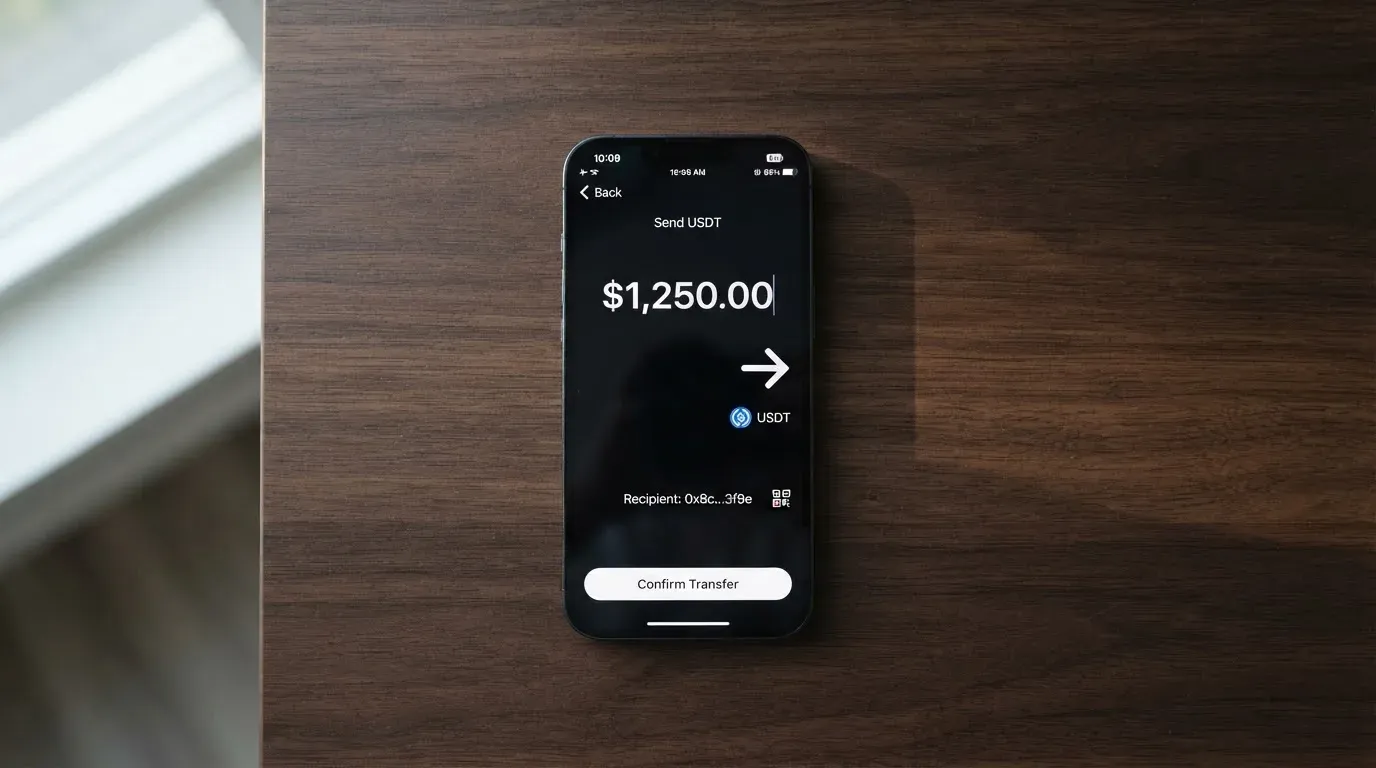
Topping up starts with a blockchain transfer or a conversion inside Gate. If you send USDT on a network the card provider does not support, or to an address belonging to a different network, the transfer can be lost or need manual recovery through support with no guarantee of success — blockchain transfers are irreversible by design. Before your first transfer, find out which networks are accepted. The card’s own pages do not say.
Fees on the way in: the top-up fee is not listed, and the minimum top-up is not stated. What is stated is the Standard card conversion rate — 0.90% for transactions of 2 USD or more, 0.05 USD below 2 USD — which applies when crypto is converted into spendable fiat. Prepaid Mode converts funds from Gate Pay or Spot into fiat.
There is also a “Card Balance Withdrawal” headline on the card page pointing to an announcement I did not read; the card balance is linked to your Gate Pay payment account. Whether the card balance can be closed out, and what happens to funds in it at that point, is not stated.
Worth knowing about stablecoins generally, since this is the fuel: USDT and USDC are dollar-pegged and together make up about 90% of stablecoin market capitalisation by the BIS’s July 2025 reckoning. Neither is immune from losing its peg — TerraUSD collapsed in May 2022, and USDC wobbled in March 2023 during the US banking crisis. Tether also disables tokens in wallets tied to OFAC-sanctioned addresses, so these balances are not censorship-proof.
Paying with it every day
You apply and manage the card through Gate Pay and the Gate app. A help centre article titled “Add Your Gate Card to Google Pay & Apple Pay” exists, which tells you the feature is supported but not which cards. A third-party FAQ for the Classic card lists Google Pay only, while Standard and Signature help pages reportedly cover both — unofficial, and worth confirming in your own app before you rely on tapping to pay.
Whether Apple Pay and Google Pay are available to you depends on your card. Merchant categories that are blocked are not stated anywhere I could read, and that is a real gap: many issuers in this category block gambling (MCC 7995) by policy rather than by law, and the blocked list differs per issuer.
The rewards structure is where the pages contradict themselves. Up to 8% cashback on eligible purchases depending on tier. The FAQ says “Rewards are issued as points”, redeemable for USDT or GT. A banner on the same site says cashback in BTC, ETH, USDT or USDC. Caps and conditions are not stated officially. An unofficial breakdown of Classic tiers by monthly spend runs T0 at 0 USDT spend for 1% with a 5 USDT cap, up to T5 at 15,000 USDT spend for 8% with a 400 USDT cap, with 100 points worth 1 USDT and points not expiring.
Disputes have a shape you should know before you need it. Contact the merchant first, then start a chargeback through Gate with proof of your communication with them. The FAQ says a $25 processing fee “typically” applies regardless of outcome, while the Standard card fee table lists chargeback at 30 USD — two numbers from the same company. Resolution can take up to three months. There is no separate refund timeline; pre-authorisation holds are released after the service ends. And a declined authorisation can leave a hold on your funds for several days, typically up to seven.
Store ratings are not on the official pages. One unofficial figure: the Apple App Store listing for the US shows 4.3 out of 5 from about 5,200 ratings — but that is the whole exchange app, not the card.
What can go wrong
Start with the issuer, because it is the thing you would want most in a dispute and it is not named. Gate describes the card as offered by Gate and refers to “the issuing institution’s review”, but the card page names no issuer, no sponsor bank and no licence. Third-party sources name Stanhope Financial UAB, a Bank of Lithuania e-money institution with code LB002039, for the EEA, and Lead Bank with Bridge as programme manager in the US. Unofficial, not confirmed by the card.
This distinction matters structurally. A card payment passes through three parties: the network (Visa or Mastercard) routes the messages and sets the rules; the issuer, a bank or licensed e-money institution, holds the programme; the crypto brand is often just the programme manager and the face of it. Visa and Mastercard do not issue crypto cards themselves — they license issuers and can suspend a programme. In November 2022 Visa said it had terminated its global agreements with FTX and the FTX US debit card was wound down. WaveCrest, a Visa issuer that supplied crypto card brands, was suspended by Visa in Europe in 2018, closing all its Visa programmes. Programme closures typically mean a notice period, then spending and loading stop, then users are asked to withdraw remaining balances. Gate joined the Mastercard Crypto Partner Program, which is not the same as the card being issued under a licence you can read.
On complaints, no Gate Card-specific complaints or Reddit threads surfaced in what I looked at. Trustpilot for gate.com sits around 3.5 out of 5 from roughly 121 reviews, mostly about non-card services, with one card-data complaint resolved by support. Trustpilot for gate.io, the exchange, is around 1.5 out of 5 from about 1,000 reviews; a third party puts Gate at 1.5 out of 5 from about 1,400 reviews with 77% one-star, describing account access, withdrawal checks, verification and support delays. Those are exchange-wide, undated, and not about the card. The card-specific reports that do exist are from 2024: the cashback pause from June 19, a card retained by an ATM with a delayed replacement, card funds inaccessible for six days, merchant refund delays with five-to-six-week waits for chargeback responses, and cards frozen after small purchases in small unverified samples. Read that as a sample of what gets reported, not as a rate.
Freezing is not only a fraud response. A lost or stolen card can be “temporarily” frozen, and cards are often frozen after several wrong PIN entries. A negative card balance “will risk having your card getting permanently blocked”. You can change your PIN in the Gate Card app. Custody arrangements, two-factor authentication details and any insurance are not stated.
Where you can check for yourself: ESMA keeps an interim register of authorised crypto-asset service providers, their white papers and non-compliant entities. A card is also a payment service regulated separately from the crypto side, so a crypto card often rests on two licences — one for the exchange activity, one for the money. And note that e-money funds must be safeguarded, usually by segregation or insurance, but they are not bank deposits and do not carry deposit-guarantee cover.
Support is [email protected] and the Help Center. Hours and languages are not stated.
What to take instead
None of these is a recommendation, and all of them have gaps of their own. I list them because the comparison is more useful than a single verdict.
| Card | Score | Where it is available | Issuance cost | Crypto conversion | Cashback |
|---|---|---|---|---|---|
| Gate | 6.8 / 10 | “Non-restricted countries or regions”, list not published | Free virtual and physical, Standard tier | 0.90% | Up to 8% depending on tier, as points or one of several tokens depending on the page |
| Bybit | 6.0 / 10 | Argentina, AIFC (Kazakhstan), Georgia, Kazakhstan, Australia, Mexico, Brazil, Peru, Asia Pacific; explicitly not for EEA customers | Free virtual everywhere “until further notice”; physical 29.99 USD Australia, 29.99 USDT Georgia and Kazakhstan, 5 USD or USDT Argentina and Asia Pacific, none in Brazil and Mexico | 0.9% over the One-Click Sell rate; 0.5% Argentina | Up to 10%, but only crypto-funded transactions earn, from 2026-10-05 |
| MSX | 6.4 / 10 | Not stated on an official page I could read | Not stated | Not stated | Not stated |
| Young Card | 5.7 / 10 | Not stated | Not stated | Not stated | In YNG tokens: 0.1% Essential, 1.8% Gold, 3.6% Platinum |
Bybit Card is the one alternative with real published detail, and it is more candid than Gate about where it works. Its help centre names its regions, and its cards page states plainly: “This product is not meant for European Economic Area customers. All European Economic Area customer participation is strictly prohibited.” That is the opposite of Gate’s unlisted “non-restricted” wording, and if you are in the EEA it settles the question immediately. Its own fiat restricted list — which covers deposits, withdrawals and One-Click Buy rather than the card itself — includes Belarus, the Russian Federation, Serbia, China and the United States, and says Russian users can only make RUB transactions in fiat.
Bybit also discloses more mechanics. The card has no balance of its own: it draws on the Funding Account and the Flexible Easy Earn balance, fiat first, and only sells crypto if fiat is insufficient. Supported coins are BTC, ETH, XRP, USDT, USDC and GRAM, with a reorderable default priority starting USDT. Its foreign exchange fee runs 2% on top of the network rate in several regions, 7% in Argentina, 1.5% in Brazil, 1% in Peru — higher than Gate’s 1.00%. Card currency depends on the country of your identity verification. Validity ranges from 3 years in several regions to 6 in Argentina.
The rewards detail is worth a second look. Bybit’s tiers run Base 2% up to Infinite 10%, with monthly caps from 5 to 600 USD and monthly spend to unlock from 0 to 25,000 USD. But since 5 October 2026, only crypto-funded transactions earn points or cashback — fiat-funded spending does not.
MSX and Young Card I can tell you very little: on the pages available, neither publishes a country list, issuance cost, conversion fee or top-up method. Young Card’s one concrete feature is that cashback is paid in its own YNG token at 0.1%, 1.8% or 3.6% by Club tier. A token-denominated reward is worth what the token is worth on the day, which is not a promise.
If your priority is a card in a named country with published numbers, Bybit publishes more of both than Gate does today.
Who I would recommend this to
I would recommend the Gate card to you if all three of these are true: you already hold a balance on Gate, that balance is in USDT, BTC, ETH or GT, and you want a virtual card within minutes to spend small amounts without a bank application. The economics work at that scale — 0.90% conversion with no monthly fee and no inactivity fee is a good deal for someone loading 50 USD at a time.
I would hold off if you need any of these: a card confirmed in your country of residence; a named issuing bank with a complaints process you can use; a large balance you would be comfortable leaving on the platform; or cashback figures you can rely on. And if your difficulty with ordinary banking is that your country is sanctioned or restricted, this card is not a route around that — eligibility is set by the issuer’s compliance obligations.
Two things to do before you apply. Find out which networks your top-up must use, because the card pages do not say and a wrong network is unrecoverable. And confirm which mobile wallets your specific card supports, since the help centre’s joint article and the unofficial per-card answers do not agree.
Frequently asked questions
What is the Gate card?
The Gate card is a Visa or Mastercard payment card linked to a Gate exchange account rather than to a bank account. Crypto in your Gate balance is converted to fiat and spent from the card’s balance. Gate describes it as “a digital assets credit card offered by Gate”. Spending USDT, BTC, ETH or GT is the core use case, and it suits people who already hold crypto rather than people opening a first account.
Is Gate a bank?
No, and the card page does not say it is. Gate is described as offering a “digital assets credit card”, and the issuing institution is referred to only as “the issuing institution’s review” — no issuer, sponsor bank or licence is named on the pages I read. Third-party sources name an EEA e-money institution and a US bank, but the card does not confirm either.
Does the Gate card require KYC?
Yes, Level 2 identity verification, meaning you must “complete Level 2 identity verification and provide the required identification documents”. Some card types also require proof of address from the past three months. The application also needs a linked email and phone, and it must use the same ID as your Gate KYC. An age requirement is not stated.
Is the Gate card free?
On the Standard card, yes in the ways that usually cost money: virtual issuance free, physical issuance free, monthly fee free, inactivity fee free. Spending is not free — crypto conversion is 0.90% (0.05 USD below 2 USD), foreign exchange outside USD is 1.00%, and ATM withdrawals are 2%. A replacement card costs 25 USD and a chargeback is listed at 30 USD.
How long does it take to get the Gate card?
The virtual card is “typically reviewed within 3–5 minutes”. The physical card “usually it takes around 7 to 45 days” depending on country of residence. If it has not arrived after 45 days, the help flow is to confirm your address with support and then use “Resend”. One third-party source estimates 15–45 days instead; that is unofficial.
Can I use the Gate card in my country?
You can only know by asking, which is the honest answer. The card page says it “is only available to users in non-restricted countries or regions” and never publishes that list. Unofficial directories list 24 European countries for the Classic card, with the US, UK, Germany, France and Canada missing, and a second directory disagrees. There is no stated citizenship-versus-residence rule.
How do I top up the Gate card?
In Instant Spend Mode the card spends USDT, BTC, ETH or GT directly; prepaid mode supports a wider range with availability varying by card, issuer and region. Prepaid Mode converts funds from Gate Pay or Spot into fiat. The top-up fee and minimum top-up are not stated, and neither are the accepted networks — so verify the network before your first on-chain transfer, because blockchain sends are irreversible.
Does the Gate card work with Apple Pay and Google Pay?
A help centre article titled “Add Your Gate Card to Google Pay & Apple Pay” exists, so the feature is supported for some cards. Unofficial sources say Google Pay only on the Classic card and both wallets on Standard and Signature. Confirm in your own app, since a wallet added but not working is discovered at the till rather than at home.
What is the Gate card cashback rate?
Up to 8% on eligible purchases, depending on card tier. The pages contradict themselves on the form: the FAQ says rewards are issued as points redeemable for USDT or GT, while a banner says cashback in BTC, ETH, USDT or USDC. Caps and conditions are not stated officially, and an unofficial breakdown puts the top tier at 8% capped at 400 USDT monthly.
Is the Gate card safe?
That depends on what you mean by safe. The card gives you instant freeze, a changeable PIN, and spending limits, and it converts crypto at a published 0.90% rather than an unknown spread. But the issuer is not named, the balance sits with a custodian rather than in your own wallet, custody arrangements and insurance are not stated, and a negative balance “will risk having your card getting permanently blocked”. Treat it as a spending tool for small amounts, not as a place to park money.
Exchange cards put to the test – cryptocardtested
Content created by the «cryptocardtested» team