
Anytap: a crypto Visa card with broad eligibility and thin published detail
 Available in US
If you hold USDT or USDC and want to spend it like ordinary money — online, in shops, on your phone — Anytap is one of the cards built for exactly that. On the scorecard it comes to 7.7 out of 10: strong on who can get it, how you fund it and how you pay with it, and noticeably weaker on the things you actually need in order to trust a card with your balance — the fee schedule, the issuing entity, the licences, and what happens when something goes wrong.
The conditions described on this page are current as of October 28, 2026.
The single most important thing to understand before you read further is this: Anytap’s public pages confirm a good deal less than you would expect. Eligibility, identity checks, the fact that it is a Visa, the coin types, the mobile wallets — those are stated. The issuance fee amount, the monthly fee, the conversion fee, the FX rate, the ATM fee, the limits, the issuer, the licences, the complaint procedure, the support channels — those are not stated on the pages I could read. Some of them appear in a press release carried by third-party news sites, which I mark as unofficial throughout. You will not find figures here that the card does not publish, and I have not filled any of the blanks with guesses.
The score at a glance
| Criterion | Mark | Why |
|---|---|---|
| Who can get it | 9 / 10 | Per starting data, worldwide except OFAC-sanctioned countries; unofficial: launch aimed at Asia, starting with South Korea, Japan and Indonesia |
| Cost | 6 / 10 | Issuance is paid, amount not disclosed; unofficial: cross-border 1% + $0.30, ATM 2% minimum $1, minimum top-up 30 USDT |
| Top-up options | 9 / 10 | USDT and USDC, USDT on TRC-20 “faster and cheaper”, 350+ supported coins |
| Reliability and complaints | 6 / 10 | U.S.-headquartered per starting data, issuer and licences not named; no reviews, Trustpilot page or Reddit threads found |
| Everyday use | 9 / 10 | Virtual or physical Visa, Apple Pay, Samsung Pay, Google Pay, ATM; unofficial: wallets rolled out progressively by card type and market |
| Total | 7.7 / 10 | Strong access and usability, thin on published fee and issuer detail |
Who this suits: a crypto holder paying in USDT or USDC who wants a card accepted everywhere Visa is accepted, holds a passport or ID, and is comfortable reading the fine print themselves. Who it does not suit: anyone who needs a bank statement they can hand to an employer or a landlord, anyone who needs published fee figures before committing money, and anyone for whom an unnamed issuer and unnamed licences are a dealbreaker.
Who they will give the card to
Per the starting data — which I could not verify on the page itself — Anytap is available worldwide except in OFAC-sanctioned countries. The application form lists a set of country options: United States, Singapore, UAE, United Kingdom, Vietnam, Japan, Other. That is a helpful hint about where the company expects applicants, and it is not the same thing as a published eligibility list with stated exclusions. Whether a given country is actually accepted is something the signup flow will tell you and the public pages do not.
There is also an unofficial thread to be aware of, because it shapes who the product seems designed for. A press release describes a launch aimed at Asia, “starting with South Korea, Japan and Indonesia”. That is not confirmed by the card, and it is a launch intention rather than a guarantee of service in those countries today. But it explains why the country list on the form leans Asian.
Two things the public pages do not say, which I want to name plainly rather than bury: whether there are country-specific rules beyond the OFAC exclusion, and what happens if you apply from a country that is not on the form. Neither has an official answer that I could find. The US listing on the form is worth a second thought too — a U.S.-listed application is not a statement that the card is offered under U.S. law, and I am not going to guess at the regulatory position.
How to get it
The process the card describes is short. You sign up on the web with your email, name and address. You pay an issuance fee. You activate the card. The card’s own wording is that applications are “approved in minutes”.
Identity verification is required. It asks for a passport or ID plus a selfie. It does not say whether proof of address is required, and it does not state an age requirement. In practice, regulated businesses in most jurisdictions verify name, address, date of birth and identity documentation, and screen nationality and country of birth separately from residence — so an age and address check is common across this category even where the marketing page does not spell it out. Expect to be asked. Do not treat the “minutes” as a promise that nothing will be requested later.
The card itself is a Visa debit card, available virtual or physical. The currency the card holds is not stated. Unofficial information in the press release describes both physical and virtual cards, all on the Visa network, with up to three cards per person.
| Item | What the card says |
|---|---|
| Card type | Visa debit card, virtual or physical |
| Card currency | Not stated |
| Identity check | Passport or ID plus a selfie; approval “in minutes” |
| Proof of address / age requirement | Not stated |
| Delivery time | Not stated |
| Verification tiers | Not stated |
Fees: what it really costs
Here is where I have the most to say, and the least to report. An issuance fee is paid before activation. The card’s public pages do not disclose the amount, and do not state whether there is a monthly fee. They do not publish an official fee schedule. The starting data describes the model as crypto converted to fiat at the point of sale, which tells you the mechanism but not the cost.
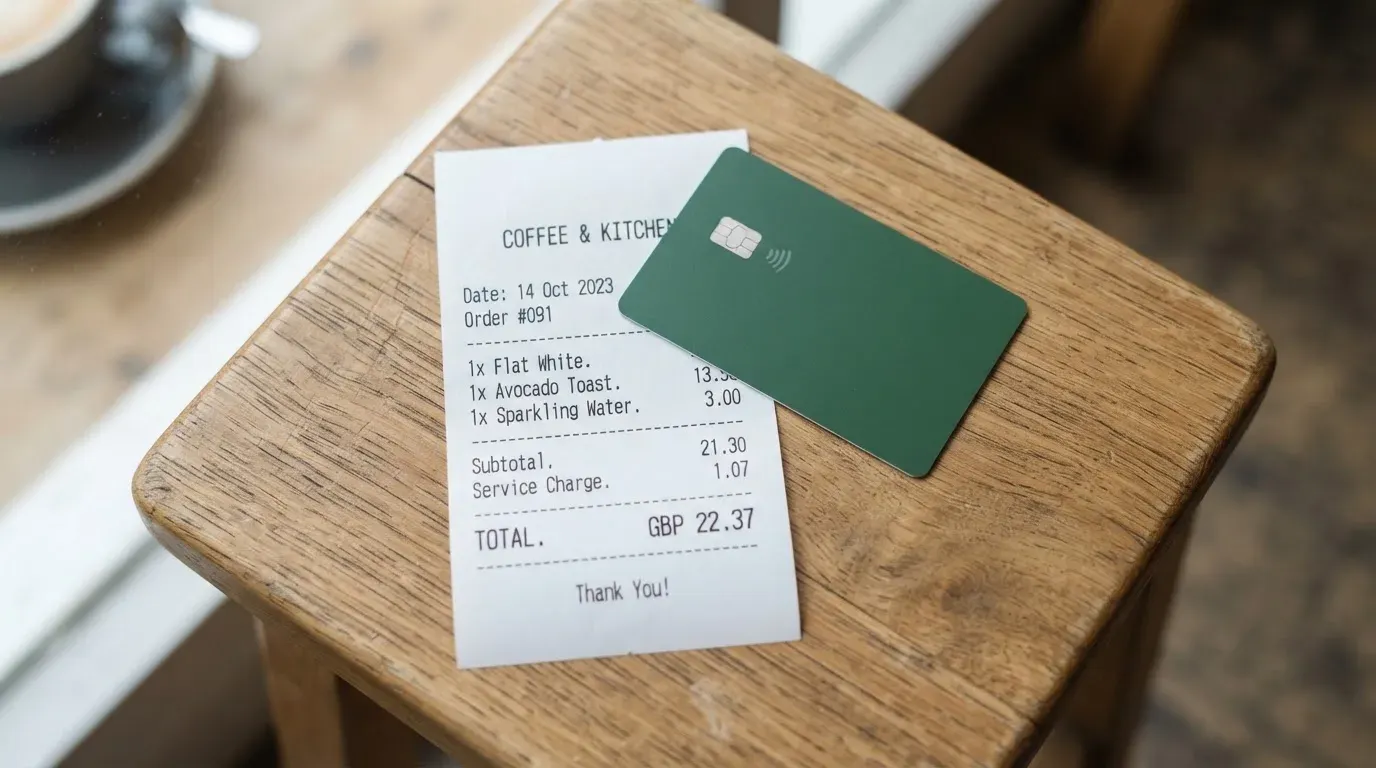
What appears in a press release — unofficial, date not read, not confirmed by the card — is a cross-border transaction fee of “1% plus $0.30 per transaction”, an ATM cash withdrawal fee of 2% of the amount with a minimum of $1, and a minimum top-up of 30 USDT. Take those as figures to verify with support before you rely on them, not as terms.
| Fee or limit | Value |
|---|---|
| Issuance fee | Paid before activation; amount not stated |
| Monthly fee | Not stated |
| Conversion fee | Not stated officially; crypto converted to fiat at point of sale (starting data) |
| Cross-border transaction fee | Unofficial: 1% + $0.30 per transaction |
| FX fee | Not stated |
| ATM withdrawal fee | Not stated officially; unofficial: 2% of amount, minimum $1 |
| Top-up fee | 3% per starting data (not verified on page) |
| Minimum top-up | Unofficial: 30 USDT |
| Daily / monthly limits | Not stated |
Two or three everyday payments, and which fees actually bite:
- A $30 online subscription paid in USDT. The conversion happens, whatever it costs, and if the merchant is foreign you may be crossing a border — the unofficial 1% + $0.30 would apply on top. There is no official FX rate disclosed, so you cannot predict the final amount from the card’s own materials.
- A €40 dinner abroad from a balance loaded in USDT. This is the clearest case for the unofficial cross-border fee, and it is also where the missing FX figure hurts most, because the conversion cost depends on how the rate is set.
- A $40 ATM withdrawal. The unofficial figures — 2%, minimum $1 — would make this the most expensive way to get cash, on top of whatever your own bank’s ATM fee is. Neither the official allowance nor the official fee is published.
None of these three figures can be checked against an official schedule, because there isn’t one on the public pages. That is the honest state of things, and it is why the cost criterion scores 6 out of 10.
Top up options
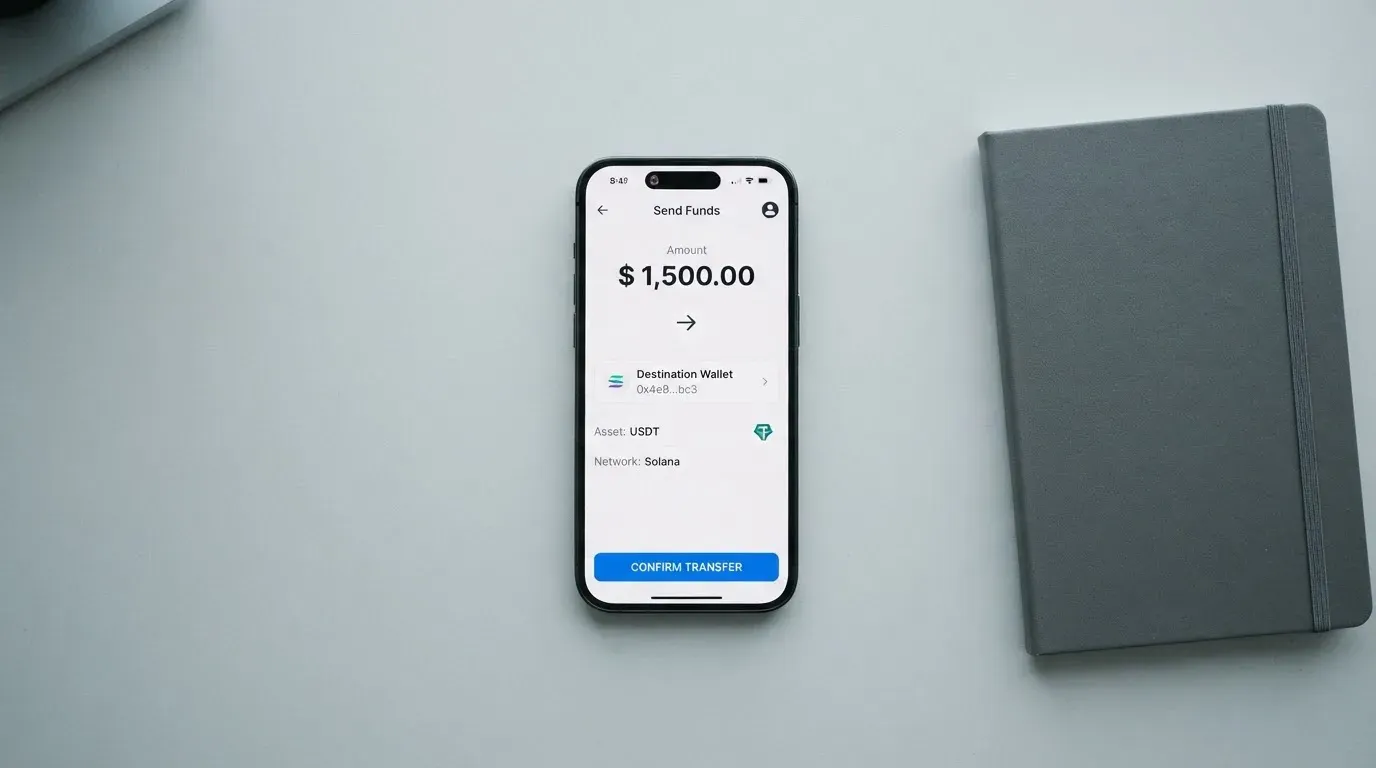
Funding is the strongest part of the card. It accepts USDT and USDC. USDT on TRC-20 is described by the card as “faster and cheaper”. The starting data says USDT (TRC-20 or ERC-20) or USDC, and the card also claims 350+ supported coins. A top-up fee of 3% appears in the starting data, not verified on the page, and who pays the underlying network fee is not stated.
| Funding detail | What is stated |
|---|---|
| Coins | USDT and USDC; 350+ supported coins claimed |
| USDT networks | TRC-20 (described as faster and cheaper) or ERC-20 |
| Top-up fee | 3% (starting data, not verified on page) |
| Network fee payer | Not stated |
| Minimum top-up | Unofficial: 30 USDT |
Two unofficial details from the press release matter for how you think about the account: balances can be moved between your own cards, and loaded funds can be withdrawn to an external wallet. The official pages do not state a withdrawal process or fee, so if being able to get money out is important to you — and for many crypto holders it is — that is a question to ask before you load anything substantial.
One practical warning that belongs here even though it is not about Anytap specifically. Network choice matters. Sending USDT on a network the provider does not support, or to an address belonging to a different network, can be lost or require manual recovery with no guarantee, because blockchain transfers are irreversible. Pick TRC-20 or ERC-20 for USDT exactly as the card directs, and double-check the address character by character.
Paying with it every day
Everyday use is the other thing Anytap does well, on paper. You get a virtual or physical Visa. Apple Pay, Samsung Pay and Google Pay are listed as supported. ATM withdrawals are available. That is a standard, useful set of rails — card at a terminal, card online, card in a phone, cash when needed.
Two things are unstated. The list of blocked merchant categories is not stated, which matters if you expect to pay anywhere in particular. Rewards are not stated, so do not assume there is a cashback rate. And the mobile wallet rollout is described in the unofficial press release as having been “rolled out progressively depending on card type and local market conditions” — so the fact that your phone wallet lists the card today does not promise it will still, and that which wallet works may depend on which card you hold.
What I could not find at all, and you should notice the absence: there is no Anytap card app in the App Store search as of 2026-10-22 — only an unrelated app called “AnyTap Accessible Camera” — and no Google Play listing was found. If your plan involves freezing the card, checking transactions, moving money between your own cards or setting limits from an app, that app is not something I can point you to. The dispute procedure for a disputed payment is also not stated.
For a sense of why the wallet support matters, Apple Pay replaces your card number with a device-specific number kept in the phone’s Secure Element, not on Apple’s servers, and each payment uses a one-time dynamic code. That is a real safeguard, and it is one of the reasons a tokenised mobile wallet is preferable to handing over a card number.
What can go wrong
The honest answer is that most of the risk here is unknown-issuer risk rather than known-bad risk.
- No published issuer or licences. Per the starting data, Anytap is a U.S.-headquartered fintech. The issuer and the licences are not named. In this category that matters more than it might seem: a card programme involves a network that routes payments, an issuer licensed to issue under that network’s licence, and the crypto brand often acting only as programme manager or front-end. An issuer you cannot name is an issuer you cannot hold to account.
- No published fee schedule. Without figures for issuance, conversion, FX and ATM, you cannot calculate what a month of spending will cost you.
- No published limits. Daily and monthly limits are not stated, so you do not know the ceiling on a single purchase or a day’s total.
- No reviews found. I found no reviews, no Trustpilot page and no Reddit threads for Anytap. That is not evidence of anything either way — a new card with no track record can be perfectly sound or can be nothing — but it means you have no outside account of how support behaves when a payment goes wrong.
- No stated security or support arrangements. Safeguards typical of this category — app-based two-factor authentication, instant card freeze, spending limits, 3-D Secure confirmation — are not described, and no support channel is stated.
- Programme risk is real in general. Card programmes do close. WaveCrest, a Visa issuer that supplied crypto card brands, was suspended by Visa in Europe in 2018, closing all its Visa programmes; Visa terminated its global agreements with FTX in November 2022 and the FTX U.S. debit card was wound down. A closure typically means a notice period, then loading and spending stop, then you are asked to withdraw what remains. A 2026 closure reported by a single secondary source had new loads ending 8 July and spending stopping 8 August — unconfirmed, but it shows how the timeline can look.
- Prepaid cards are not bank deposits. If the balance sits with an electronic money institution rather than a bank, it is safeguarded rather than deposit-guaranteed, and you should not treat it as the same kind of money as a current account.
- Stablecoins can depeg. TerraUSD collapsed in May 2022 and USDC lost its peg temporarily in March 2023. Your spending balance is only as steady as the asset behind it.
- Merchant and issuer friction. Some merchants decline prepaid or foreign-issued cards because the BIN lookup reveals the card type and issuer country, and address verification is generally unavailable for foreign-issued cards, which can cause declines. Holds from declined authorisations can sit on your balance for up to seven days.
None of this is a reason to run. It is a reason to load a small amount first, and to keep enough elsewhere that a freeze or a closure would not hurt you.
What to take instead
If you want a published fee schedule, a named issuer or a card with an existing review history, the alternatives below are worth a look. I have scored them on the same basis; none is dramatically better, but each trades something differently.
| Alternative | Score | Card | Notable points |
|---|---|---|---|
| Cardex | 5.6 / 10 | Debit card on VERVE, VISA, Mastercard and UnionPay; virtual and physical | “One crypto card, 200+ countries”; conversion at point of sale with an “AI-Powered Conversion Rate”, but no fee percentage stated; card currency Naira per the App Store listing |
| CardFlow | 4.9 / 10 | Virtual USD Mastercard, created in about 3 minutes | Aimed at Nigeria and “Nigerians and global users”; creating a virtual card is free per the site FAQ; funds with Bitcoin, USDT, ETH or Naira bank transfer |
| HyperCard | 4.7 / 10 | Prepaid card, network not stated on the App Store page; balance in USD or EUR | No country list on official pages; App Store says it works in “more than 176 countries” (acceptance, not eligibility); deposit crypto such as USDT, BTC, ETH; no fees listed |
Two comparisons worth making explicit. First, none of these three publishes a complete fee schedule either — the honest answer to “which of these is cheapest” is that the public pages do not let you work it out, so you would be asking each provider the same questions. Second, Cardex and CardFlow are both visibly built around Nigeria, and HyperCard accepts widely but states no eligibility list; Anytap’s world-wide-except-sanctions framing and its Asian launch orientation are, on paper, the broadest of the four. If your reason for wanting a crypto card is that ordinary banking is difficult where you live, that breadth is the differentiator, and it is the main reason Anytap scores above the others despite publishing less.
Who I would recommend it to
I would recommend Anytap to someone who already holds USDT or USDC, mainly in Asia, who has a passport or ID, who wants a Visa that works online, in shops and on their phone, and who is the kind of person who will send a message to support and ask “what is the conversion fee” before loading a few thousand dollars. For that person it is a sensible, flexible card with good funding options and broad acceptance.
I would not recommend it as a first crypto card, and I would not recommend it to anyone who needs the fee schedule, the issuer’s name or the dispute procedure to be written down somewhere public — because none of those are. Load a small amount first, keep the rest where it is, use the mobile wallet where it is offered rather than handing over card numbers, check that the network matches the coin before you transfer, and treat the card as a convenience tool rather than as a bank account.
Frequently asked questions
What is the Anytap card?
The Anytap card is a Visa debit card, available virtual or physical, that spends a balance funded from cryptocurrency rather than from a bank account. The card describes the mechanism as crypto converted to fiat at the point of sale, and it accepts USDT and USDC, with 350+ supported coins claimed. What is not published is the fee schedule, the issuer and the limits.
Is Anytap a bank?
Not on the evidence available. Per the starting data, Anytap is a U.S.-headquartered fintech, and the issuing institution and its licences are not named on the public pages. In this category the brand is often only a programme manager while a licensed bank or e-money institution issues the card. Because the issuer is not identified, I cannot tell you what your balance is legally or how it is safeguarded.
Who owns Anytap and is it regulated?
The public material I could read does not state ownership, the issuer, or any licence. No reviews, Trustpilot page or Reddit discussions were found for the brand either. That silence is not evidence of a problem, but it does mean you are being asked to trust a card on the strength of its own marketing. If the answer matters to you, ask support for the issuer’s name and the licence, and treat the answer you get as something to verify elsewhere.
Which countries can get the card?
Per the starting data, Anytap is available worldwide except OFAC-sanctioned countries, and the application form lists the United States, Singapore, UAE, United Kingdom, Vietnam, Japan and Other. An unofficial press release describes a launch aimed at Asia, starting with South Korea, Japan and Indonesia. Neither source gives a definitive per-country eligibility list, so the only reliable test is whether the signup flow accepts you.
Does the Anytap card require KYC?
Yes — identity verification is part of the process. The card asks for a passport or ID plus a selfie and says applications are “approved in minutes”. It does not state whether proof of address or a minimum age is required, though regulated providers in most jurisdictions verify name, address, date of birth and nationality. Have your documents ready and expect the standard checks.
How much does the Anytap card cost?
The issuance fee is paid before activation but the amount is not published, and no monthly fee is stated. Unofficial figures from a press release carried by a third-party site put cross-border transactions at 1% plus $0.30 and ATM withdrawals at 2% with a $1 minimum, and the starting data shows a 3% top-up fee. Verify all of these with support before relying on them.
How do I top up the Anytap card?
You fund it with USDT or USDC. For USDT the card directs you to TRC-20, described as faster and cheaper, or ERC-20. Check that the network you use matches the one the provider supports and that the destination address is exactly right — blockchain transfers are irreversible and a mismatch can mean lost funds. An unofficial minimum top-up of 30 USDT appears in a press release.
Can I add the Anytap card to Apple Wallet?
Apple Pay is listed as supported, as are Samsung Pay and Google Pay. The press release describes mobile wallet support as having rolled out progressively depending on card type and local market conditions, so availability may depend on which card you hold and where you are. Apple Pay stores a device-specific number on your phone rather than your actual card number, which is a genuine security benefit.
Is the Anytap card safe to use?
There is no published incident to report — but also no published evidence of safety: no reviews, no Trustpilot page, no security arrangements and no support channel are stated. Weigh that against the category’s own track record, which includes WaveCrest’s Visa programmes being closed in 2018 and FTX’s card being wound down after Visa terminated its agreements in November 2022. Load small, keep backups elsewhere, and use the card as a tool rather than as storage.
Is the Anytap card worth it?
For someone spending USDT or USDC in Asia who wants broad Visa acceptance and a mobile wallet, and who is comfortable doing their own due diligence, it is worth considering — the funding options and everyday reach are its real strengths. It is not worth it if you need published fees, a named issuer, a documented dispute process or a track record of reviews, because the card does not currently offer any of those.
Virtual cards put to the test – cryptocardtested
Content created by the «cryptocardtested» team