
A Visa card for people who fund it with stablecoins — priced sensibly, thin on disclosure
 Available in US

HoneyCoin is a Visa card you load with crypto rather than salary. It is aimed squarely at people in Africa and emerging markets who already hold stablecoins and want to spend them like ordinary money, and on anyone without easy access to a conventional bank card. On those terms it does the job: issuing and keeping the card are free, spending in US dollars costs nothing, and there is a real choice of ways to load it. What stops it scoring higher is not the pricing but the paperwork — the issuing bank is not named, the crypto conversion fee is not published, the ATM situation is not mentioned, and the company’s own blog admits its card payments were switched off for months during 2025 after card-testing attacks. I scored it 6.7 out of 10.
The conditions described here are current as of October 28, 2026.
| Criterion | Mark | Why |
|---|---|---|
| Who can get it | 8 / 10 | Accepted wherever Visa is accepted; live in 45+ countries; “some countries, merchants, and MCCs may be restricted”, with no list |
| Cost | 7 / 10 | Issuance, monthly and yearly fees are free; USD transactions cost 0%; FX spread up to 3% on other currencies; crypto conversion fee not stated |
| Top-up options | 6 / 10 | Mobile money, bank transfer, card, on-chain stablecoins; the token table lists only USDC on Base, the FAQ also mentions USDT |
| Reliability and complaints | 5 / 10 | HoneyCoin, Inc., Nairobi; issuing bank not named; card payments on the consumer app paused for months due to attacks (August 2025); App Store rating 1.0 from 1 rating |
| Everyday use | 7 / 10 | Virtual card instantly, physical card 2–3 weeks; Apple Pay and Google Pay; ATM not disclosed |
Total: 6.7 / 10.
So who should keep reading? If your income already arrives as USDC or USDT, you shop mostly online, and you want to hold a balance and spend from it, this card is a reasonable tool and the free-in-US-dollars part is genuinely attractive. If you need cash from a machine, want a card with a well-known European issuing bank on it, or you are deciding whether to trust a young Nairobi company with your money, you will find the gaps annoying — and you should read the risk section before you fund anything.
Will they give you the card?
Yes for most applicants, with one honest caveat: the card’s own pages say “some countries, merchants, and MCCs may be restricted” and do not publish which ones.
That single sentence is the whole of the eligibility story. There is no country list, no explanation of whether the restriction applies to your nationality or where you live, and no list of blocked merchant categories. That matters more than it might sound, because “wherever Visa is accepted” is doing a lot of work in the marketing. A card is only as good as the places that honour it, and a card programme with an unpublished restriction list is one where a decline can be genuinely puzzling.
The one thing that *is* clear is the network. This is a Visa card, so in the ordinary case it works wherever Visa works, in shops and online. You also get a virtual card and physical cards as well; the card currency is USD, which is why USD transactions carry no fee.
Your instinct is probably to search “is the HoneyCoin card available in my country?” and the truthful answer is: probably yes, but nobody has published a list you can check. Treat the live-in-45-plus-countries line as a rough scale rather than a guarantee for your address. If your country matters to you, the only real verification is a small test load followed by an ordinary purchase somewhere you actually shop.
How to get it
Identity verification is required before you can use the card. That much is stated. What is not stated is which documents count, whether proof of address is needed, what age you must be, or whether verification happens in tiers with different limits attached. If you have been turned down by a mainstream bank or you travel with documents that are not in a standard format, these unknowns matter — plan to have your registration document and a proof of address ready anyway, and expect a conversation with support rather than a self-serve flow.
On the card itself: a virtual Visa card activates instantly, which is the bit most people actually want, because it can go into a phone wallet and be used the same day. Physical cards take about 2–3 weeks, and the card’s pages do not say what they cost — though issuance is listed as free, so this is likely an area where the terms are less clear than the summary suggests. Assume you are starting with the virtual card.
Put the practical sequence together and it is short: sign up, complete identity verification, receive the virtual card instantly, add it to Apple Pay or Google Pay, fund it, spend. The step that could surprise you is the fifth one, because funding is where the detail is thinnest.
Fees: what it really costs
Here is the published picture. It is short, and two of the most important lines are blank.

| Fee or limit | What the card states |
|---|---|
| Issuance | Free |
| Monthly fee | Free |
| Yearly fee | Free |
| Card use in USD | 0% |
| Other currencies | FX spread fee up to 3% |
| Crypto conversion fee | Not stated |
| ATM withdrawal | Not stated |
| Default daily limit | 10,000 USD/day for both spending and loading, “Increases with Usage” |
| Custom limits | Lower limits available in-app; higher limits after review |
So the honest summary: for spending in dollars this card is free, and the only disclosed cost of spending elsewhere is a currency spread of up to 3%. Issuing and holding it cost nothing.
The blanks are the story. The conversion fee is the one that should worry you most. If you load USDC and pay in dollars, the spread is 0% — but the moment your money is not already in the card’s balance in the form it wants, some conversion has to happen somewhere, and the card does not say what it charges for it. Anyone telling you this card is completely free is reading only the lines that are printed.
Let me walk three ordinary payments through, because that is where the difference between “0%” and “cheap” shows up.
A coffee in Nairobi, about 1,500 Kenyan shillings. This is not a dollar payment. Your balance is USDC or dollars, the till is in shillings, so an FX conversion happens and the up-to-3% spread applies. The listed fee for this transaction is 0% if you pay in USD; if the terminal charges you in shillings, you are inside the FX spread instead. The published numbers do not tell you which currency a given merchant will present.
A $12 subscription paid online. The cleanest case on the card. USD transaction, 0% fee, and if your balance holds dollars the conversion question does not arise. This is what the card is best at.
A withdrawal from an ATM. Here I cannot walk you through the arithmetic, because the card’s pages do not mention ATM withdrawal at all — no fee, no daily cap, no partner network. If cash machines matter to you, treat this as an unknown you must ask support about before you rely on it.
Two more everyday details worth knowing. Limits default to 10,000 USD a day for both spending and loading, and the card says this “Increases with Usage” — so your ceiling is tied to how much history you build, and higher limits come after review rather than automatically. There is a single tier, no paid upgrades, no subscription with perks. And no cashback is stated anywhere.
Top up: four ways in, with one list that keeps changing
The card gives you four routes: mobile money, bank transfer, card, and on-chain stablecoins. For someone in Africa funding from a phone-based wallet, that first option is the whole point of the product.
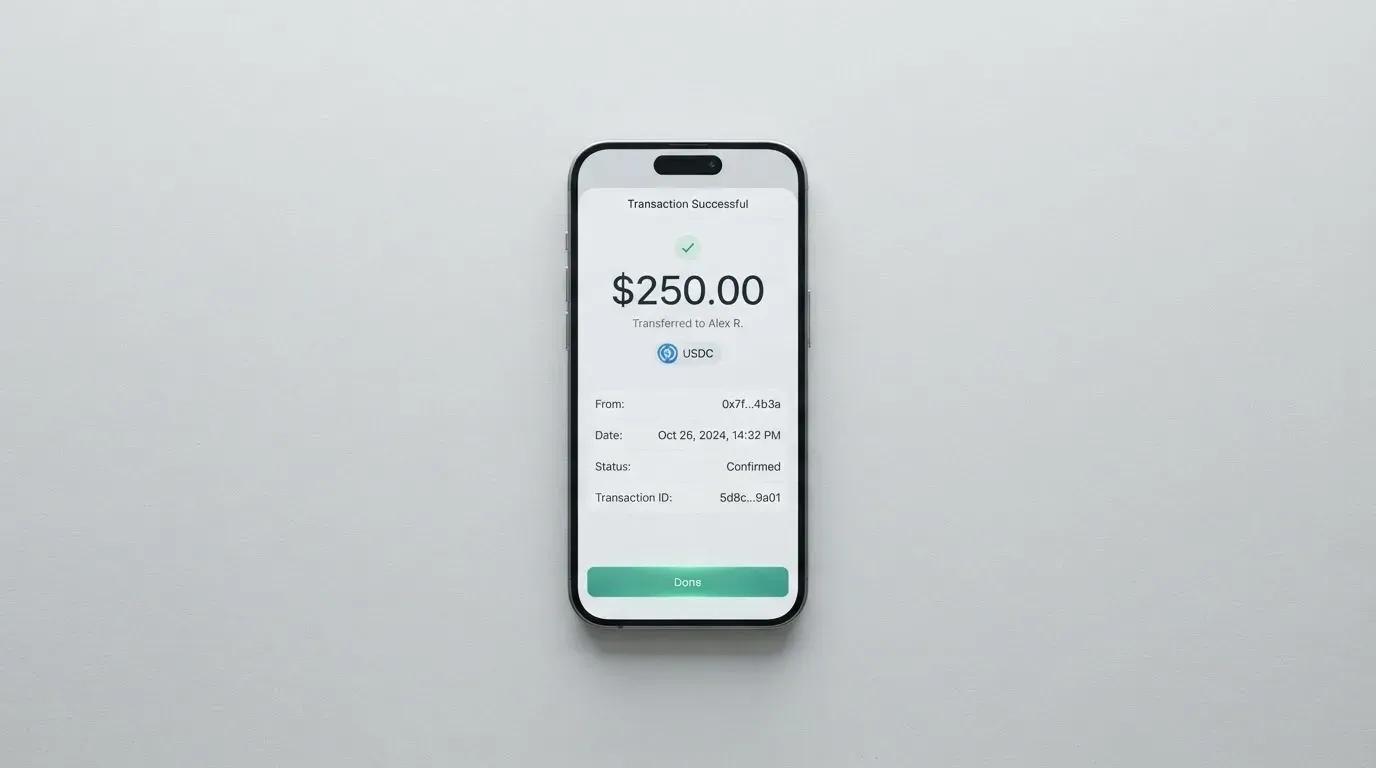
The detail that needs care is the token side. The token table lists only USDC on Base. The FAQ widens it to USDC and “select other assets where enabled”, and the funding section also mentions USDT. In practice this means the supported set is narrower than the marketing language suggests, and it may vary by where you are — which is exactly the kind of thing that turns into a stuck deposit rather than a clean one.
Not stated anywhere: the fees for each top-up method, the minimum top-up, and who pays the network fee.
That last one deserves emphasis, and it is not HoneyCoin-specific. Blockchain transfers cost a network fee charged by the blockchain itself, not by the card provider, and someone has to pay it. If you send USDC on Base, the chain charges a small fee in ETH, and a wallet holding a token but no ETH for gas cannot complete the transfer at all. So the practical question is not only “which token” but “does the account I’m sending from hold a little of the network’s own currency”. Getting that wrong is how deposits end up needing manual support intervention.
One more route out, which is a platform feature rather than a card feature: the site says “Payout to local accounts or wallets on demand”. Card-balance withdrawal fees are not stated.
A sensible order for a first test: top up a small amount by the method you already use daily, make one ordinary purchase, and only then send a meaningful on-chain transfer. That way you learn whether your funding route and network choice work before money is at risk. Blockchain transfers are irreversible — a deposit sent on an unsupported network, or to an address belonging to a different network, can be lost or require manual recovery with no guarantee attached.
Paying with it every day
Everyday use is where the card scores well, and the reason is mundane: the virtual card is instant, and both phone wallets are supported.
Apple Pay and Google Pay are both there. That is more than many crypto cards manage, and it is what makes the difference between a card you use daily and one you use reluctantly. When you put a card in a phone wallet, the card number is replaced by a device-specific number stored in the phone’s secure hardware, never on Apple’s servers, and each payment carries a fresh one-time code — so the everyday security story is in reasonable shape, assuming you enable it.
Three caveats belong in the same breath.
First, blocked merchant categories are not listed. A merchant category code is the four-digit number that classifies a business, and issuers block categories by policy rather than by law — gambling (MCC 7995) is the classic example. The card says some MCCs may be restricted without saying which, so you cannot predict in advance whether a given purchase will go through.
Second, a foreign-looking card can be declined. Merchants can look up the issuer identification number at the front of the card number and see which institution and country issued it, and some apply extra scrutiny or refuse prepaid and foreign-issued cards outright. Address verification is also mainly a US, Canada and UK system and is generally unavailable for foreign-issued cards, which is a common cause of declines at checkout. Any of this can produce a refusal that has nothing to do with your balance.
Third, the app itself is thin on evidence. In the US App Store, “Peer – the everything app” by HoneyCoin, Inc. carries a rating of 1.0 from 1 rating. One rating is not a reputation, but it is not a foundation either, and the Google Play listing was not read. How disputes are handled is not stated anywhere on the pages I could see — no description of a chargeback process, and prepaid-card coverage varies by scheme and should not be assumed. If a payment goes wrong, you are relying on support rather than on a documented process.
A declined authorisation can also leave a hold on your balance that stays for several days, typically up to seven, which is worth remembering before you conclude you have been shortchanged.
What can go wrong
This is the section where the card is weakest, and the strongest single fact is one the company published itself.
In August 2025 the company’s own blog reported card payments on the consumer app paused for months because of card-testing attacks — the practice where fraudsters use stolen card numbers to test whether they are live. The same announcement covered a $4.9M funding round and a presence in 45+ countries. An attack on other people’s cards took your payments down with them. Nothing since tells me how long it lasted, whether card controls have changed, or how the risk is managed now.
Beyond that, four structural risks.
You do not know who issued the card. The issuing bank is not named; the pages refer to “licensed partners”. The company is HoneyCoin, Inc., with starting data under Quicknode Technologies Ltd, a Nairobi address (The Cube, Riverside Drive), founded 2021, and it describes itself as licensed in key markets including the US, Canada, the EU and several African jurisdictions. Licences are not the same as naming the institution that holds your balance, and the person you would approach in a dispute is not identified.
Your money sits with someone else. Client money is stated to be safeguarded and held completely separate from the company’s own — that is the standard promise, and in the EU an electronic money institution must safeguard customer funds, usually by segregating them or insuring them. But such funds are not the same as bank deposits and are generally not covered by deposit guarantee schemes. The reason to think about this is not the promise being false; it is that custodial platforms have failed before, and the sector history is long: Mt. Gox (about US$350 million reported stolen, 2011–2014), Coincheck (about US$400 million, 2018) and Ronin Network (US$625 million, 2022). Crypto transfers are also irreversible by design — a stolen key has no recovery path because the network cannot freeze or return funds.
The regulatory ground is shifting underneath cards like this. In the EU, MiCA took legal effect in June 2023; its rules on stablecoins applied from 30 June 2024 and the remaining provisions, including crypto-asset service provider rules, from 30 December 2024. Under MiCA, e-money tokens may be issued only by a credit institution or an electronic money institution. Providers operating under national law have a transitional period running until 1 July 2026, or until they are authorised or refused under MiCA, whichever comes first — and ESMA maintains a public interim register of authorised providers, white papers and non-compliant entities that you can consult. In the US, FinCEN guidance (FIN-2013-G001) treats administrators and exchangers of convertible virtual currency as money transmitters. A card is regulated separately again, as a payment service, so a crypto card frequently rests on two licences rather than one. None of this makes HoneyCoin unsafe; it makes the licence list worth a look before you size up your balance.
Programmes get closed. Visa itself does not issue crypto cards to consumers — it licenses issuers, and it can suspend a programme. Visa terminated its global agreements with FTX on 13 November 2022 and the FTX US debit card was wound down; WaveCrest, a Visa issuer that supplied crypto card brands, was suspended by Visa in Europe in 2018, closing all its Visa programmes. A closure follows a pattern: notice, spending and loading stop, and you are asked to withdraw the balance. In this category that is not a hypothetical.
A note on where complaints live: I found no Trustpilot or Reddit page for HoneyCoin. Trustpilot results under a similar name belonged to an unrelated business. So there is no independent complaint record either way — which is not the same as a clean record.
Two smaller exposures. Support is stated as 24/7 for institutional and corporate clients; consumer support hours are not stated, and the contact addresses are [email protected] and [email protected]. And there is no mention of an instant card freeze on the security page, although there is 2FA on login and on privileged actions and PCI DSS Level 1 certification.
What to take instead
If something about the gaps above is a problem for you, the honest answer is to compare rather than pick. Here are three alternatives, scored on the same scale.
| Option | Score | Cost | Key strength | Key limit |
|---|---|---|---|---|
| HoneyCoin | 6.7 / 10 | Free issue and upkeep; USD 0%; FX up to 3% | Mobile money and stablecoin top-ups for Africa and emerging markets | Issuing bank, crypto conversion fee and ATM terms unstated |
| International Visa Card | 6.7 / 10 | $5 issuance; no maintenance fee; plans Classic free, Pro $9.00/month, Max $19.00/month | Clear fees; USD use free, foreign currency “Visa exchange rate + 2% FX fee”; deposits of any kind free | Long exclusion list by residence or registration; physical card “Coming soon” |
| UNi Card | 6.1 / 10 | No annual fee, no foreign transaction fee | Multicurrency on Mastercard, converted at “live OTC rates”, “No hidden exchange fees”; spend-to-Earn rewards up to 3% | Eligibility, funding routes and physical/virtual format not stated |
| Whop Cards | 5.2 / 10 | “No extra fees” with no amounts listed | 5% cashback at select merchants, currently Uber; works anywhere Visa is accepted | US-state limited for consumers; no fee or funding detail; stablecoin backing not detailed |
Two things stand out from that comparison.
The International Visa Card is the closest competitor and it wins on disclosure, not on features. Its costs are stated precisely — $5 one-time issuance, no maintenance fee, three plans at free, $9.00 and $19.00 a month, USD spending free on all plans, foreign currency at the Visa exchange rate plus a 2% FX fee, and deposits of any kind free. It publishes a real exclusion list: the account and card are not available to residents or legal registrants of Belarus, mainland China, North Korea, Cuba, India, Iraq, Iran, Israel, Myanmar, Nepal, Nicaragua, Russia, Syria, Turkey, Ukraine, Venezuela and Vietnam, with FATF grey-list countries reviewed case by case; purchases are blocked in North Korea, Cuba, Iran, Russia, Syria, Ukraine and Venezuela. Note the basis — residence or registration, not citizenship — and note that this is a US-issued Platinum Visa, virtual, with the physical card listed as “Coming soon”.
The UNi Card looks cheaper on paper for anyone not spending in dollars: no annual fee, no foreign transaction fee, assets converted at live OTC rates with “no hidden exchange fees”, and up to 3% back. But it tells you less about how you get money onto it, and eligibility is not stated.
Whop Cards is the narrowest of the four — 31 US states for consumers, 41 for businesses — and the reward is concrete (5% cashback at select merchants, currently Uber). Its fee details are the thinnest, though, and the stablecoin backing is only described in general terms without coins or networks named.
Who I would recommend it to
I would recommend HoneyCoin to someone who already holds stablecoins, already has a working way to receive money — mobile money or a bank transfer — and wants a Visa number to spend them with. The free issuance, free upkeep, zero cost on dollar spending, instant virtual card and both phone wallets make that person genuinely well served, and the mobile money route is something most cards in this category simply do not offer. Ten thousand dollars a day of default headroom is more than most people need, and a single tier with no subscription is a clean proposition.
I would not recommend it as a first crypto card, as a place to hold a large balance, or as a card for someone who needs cash machines. The conversion fee is unpublished, the ATM terms are absent, the issuer is unnamed, and the company has publicly documented a months-long outage of its own card payments caused by fraud attacks on other people’s cards. If you are choosing where to keep real money, an unnamed issuer in a young Nairobi company is not the answer, and there is no independent review record to lean on either.
The middle position — a modest balance, loaded through the route you already trust, spent online and in dollars — is where this card makes sense. Try that first, at small scale, and let your own experience of a purchase and a withdrawal do what the marketing cannot.
Frequently asked questions
What is the HoneyCoin card?
HoneyCoin is a Visa payment card funded from crypto rather than from a bank account. You top it up — by mobile money, bank transfer, card or on-chain stablecoins — and it spends a stored balance, so it behaves much like a prepaid card. A virtual card activates instantly, physical cards take 2–3 weeks, and the card currency is USD. The company is HoneyCoin, Inc., based in Nairobi.
How does the HoneyCoin card work?
You verify your identity, get a virtual Visa card, load it, and spend from the loaded balance. Because the balance is pre-loaded, the card cannot overdraw it. Payments run through Visa’s network; the issuer — the licensed institution that actually holds the card programme — is not named on the card’s public pages, which is worth knowing before you size up a balance. Apple Pay and Google Pay are supported.
Is HoneyCoin a bank?
Not as far as its public pages describe. HoneyCoin, Inc. is a company founded in 2021 with a Nairobi address that says it is licensed in key markets including the US, Canada, the EU and several African jurisdictions, and it refers to “licensed partners” rather than naming an issuing bank. Your funds are stated to be safeguarded and held separately from the company’s own, which is the standard arrangement for an electronic money institution — but safeguarded funds are not bank deposits.
Who owns HoneyCoin?
HoneyCoin, Inc., with starting data under Quicknode Technologies Ltd, at The Cube, Riverside Drive, Nairobi, Kenya. The company reported a $4.9M funding round in August 2025 and says it is live in 45+ countries. It also reported in the same post that card payments on its consumer app were paused for months because of card-testing attacks — which is the single most important thing to weigh about the business.
Does HoneyCoin card require KYC?
Yes — identity verification is required before use. The card’s pages do not say which documents are accepted, whether proof of address is needed, what age applies, or whether verification happens in tiers. If you travel with less standard documentation, or if a mainstream bank has declined you before, this is the part to raise with support early rather than after a failed attempt.
How do I top up the HoneyCoin card?
Four routes are listed: mobile money, bank transfer, card, and on-chain stablecoins. For crypto deposits the token table lists only USDC on Base, while the FAQ mentions USDC and selected other assets where enabled and the funding section also refers to USDT. Fees, minimums and who pays the network fee are not stated — and if you send on-chain, check you hold a little of the network’s own token for gas.
Is the HoneyCoin card free?
Issuance is free, as are the monthly and yearly fees, and spending in USD costs 0%. Spending in other currencies carries an FX spread of up to 3%. Two costs are simply not published: the crypto conversion fee and any ATM withdrawal fee. So the card is free to hold and cheap to use in dollars, but you cannot compute a full cost for a non-dollar payment or a cash withdrawal from what’s published.
Can I use the HoneyCoin card in my country?
Probably — it is a Visa and the company says it is live in 45+ countries — but there is no published country list. The card states that “some countries, merchants, and MCCs may be restricted” without saying which, so nobody can confirm your specific country for you. The small test is the only real check: load a modest amount and make one ordinary purchase.
Is the HoneyCoin card safe?
The building blocks are reasonable: client funds safeguarded and held separately, 2FA on login and privileged actions, PCI DSS Level 1, and tokenised card numbers in Apple Pay and Google Pay. What holds it back is the record — card payments paused for months in 2025 after card-testing attacks, an unnamed issuing bank, no independent Trustpilot or Reddit history to check, and no stated consumer support hours. Keep balances modest.
How do I withdraw money or delete my account?
For payouts, the site says “Payout to local accounts or wallets on demand” as a platform-level feature; fees for withdrawing a card balance are not stated. For ATM withdrawals the card’s pages say nothing at all. If cash access or closing an account is important to you, ask support directly in writing before you deposit anything substantial — how you close an account, and what happens to a remaining balance, is exactly the question that card-programme closures have left unanswered for other users.
App and neobank cards put to the test – cryptocardtested
Content created by the «cryptocardtested» team