
Karma card review
 Available in US
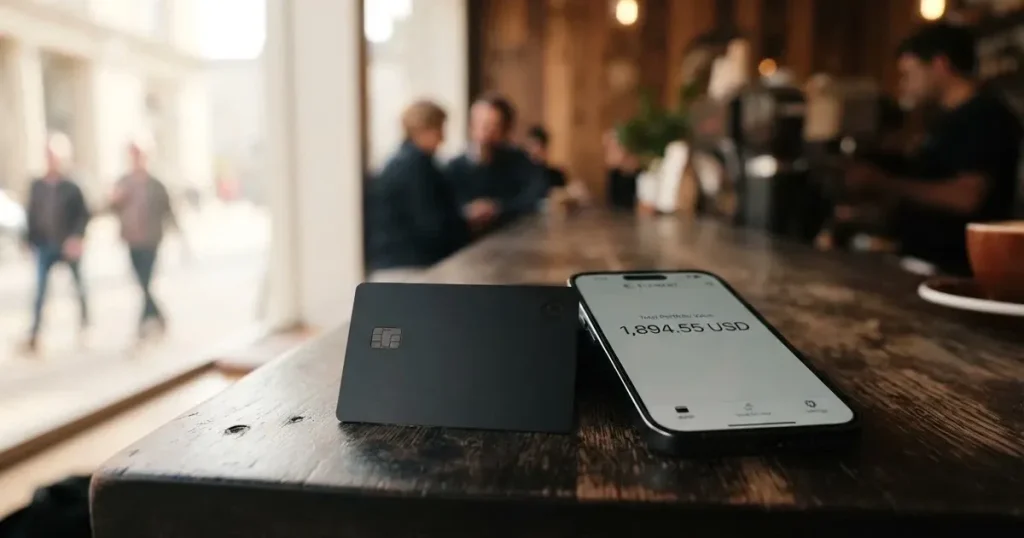
Karma is a non-custodial crypto wallet paired with a Visa card, aimed at people who want to keep their own keys and still pay in shops and online. The headline is honest enough: a self-custody wallet, a Visa you load with USDC, and no monthly fee. The interesting questions are who can actually get one, what it costs in practice, and where the gaps show up when you try to use it day to day.
The conditions below are current as of October 28, 2026.
Verdict
Karma scores 6.4 out of 10. That is a middling mark, and the breakdown explains why: the cost picture is clean and the self-custody angle is genuinely useful, but the everyday-use side has real holes, and the top-up story is thin on detail.
| Criterion | Score | Why it matters |
|---|---|---|
| Who can get it | 8 / 10 | Long list of excluded countries, but the rest of the world is not blocked |
| Cost | 8 / 10 | No subscriptions, a flat 0.5% service fee and a small FX markup |
| Top-up options | 5 / 10 | USDC on Solana is the clear path; other coins are not advertised |
| Reliability and complaints | 6 / 10 | Backed by Visa and a real issuer, but the product reads as a credit line in places |
| Everyday use | 3 / 10 | No clear Apple Pay or Google Pay story, no ATM, no cash advance |
| Total | 6.4 / 10 | Clean costs, useful self-custody, but limited as a daily card |
The card suits self-custody users who want to keep their keys, are happy to fund the balance with USDC on Solana, and do not rely on mobile wallets. It does not suit anyone who needs an ATM, who wants to add the card to Apple Pay or Google Pay, or who wants a long menu of coins to load from.
Who will they give you the card
The single biggest filter is geography. Karma publishes a list of countries whose residents or registrants cannot be issued a card at all: Belarus, mainland China, Cuba, India, Iran, Iraq, Israel, Myanmar, Nepal, Nicaragua, North Korea, Russia, Syria, Turkey, Ukraine, Venezuela and Vietnam. The wording is “residents or registrants,” so it catches people on the basis of where they live or are officially registered, not only their passport. A long block of countries including Russia and Belarus sits there, and the card terms also block spending in Cuba, Iran, North Korea, Russia, Syria, Ukraine and Venezuela, which is a separate and overlapping list. If you live in one of those countries, this card is not for you.
For the rest of the world, the path is open. Countries on the FATF grey list are not auto-rejected but get checked case by case, which is the language the issuer tends to use for any jurisdiction that attracts extra anti-money-laundering attention.
The card itself is a Visa. Cards are issued by Third National pursuant to a license from Visa, and the App Store listing says the card is “accepted at 80M+ merchants.” Whether you get a virtual card, a physical card or both, and what currency it settles in, is not stated on the public pages. The same goes for delivery times and any replacement card fees: the card terms note that physical or virtual cards may be limited and that replacements can be requested in account, with new numbers if needed, but no country list, no time window, and no cost are given.
KYC and account tiers are also not stated in the card’s own documentation. The card terms are unusual: they say there is “no KYC process” and require only that the user confirm they are not a U.S. citizen and are not sanctioned. A third-party site, which I have to flag as unofficial and not confirmed by the card, describes a “Level 3” identity check that asks for an email, a phone number and an identity document, with no proof of address or selfie required. Treat that as third-party information only; Karma’s own pages do not spell it out.
How to get it
The practical flow is to download the Karma app, create a non-custodial wallet (so you hold your own keys from day one), complete whatever identity check the app asks for, and request the card from inside it. The card is a Visa, so it will work anywhere Visa is taken once it is approved and, if physical, once it arrives.
Because the card is non-custodial, the wallet side of sign-up is not a hosted account. You are given a seed phrase, and from that point on Karma cannot move your funds. The card layer sits on top of that wallet and is the regulated part: the Visa programme is run by Third National as issuer, with Karma Fintech LTD as the brand on top, and the programme itself is powered by Rain. The company registration country for Karma Fintech LTD is not stated on the public pages.
Activation, virtual-card issuance, delivery of any physical card and the activation step at a merchant are all part of the in-app flow, but the public pages do not give step-by-step detail. If anything goes wrong, support channels and hours are not stated on the site or the App Store listing, and the only contact point you can see is the X (Twitter) account @KarmaWallet. That is thin compared with most card issuers, and worth bearing in mind before you sign up.
Fees: what it really costs
The cost picture is one of the strong points. There is no signup fee, no monthly fee and no hidden subscription. The numbers that matter are the 0.5% service fee per card transaction, the 1% FX fee on non-USD spending, a flat $0.30 international fee on non-USD, a 1% on-ramp fee to load fiat, a 0.5% off-ramp fee to withdraw, and a 0.5% swap fee. The card terms say the FX markup is “up to 3%, currently 1%” and is charged by Visa with no Karma markup, and that any foreign-currency transaction is converted to US dollars by the card network before it lands on the card.
| Fee or limit | Amount |
|---|---|
| Card issuance | Not stated |
| Monthly or subscription fee | None |
| Service fee per card transaction | 0.5% |
| FX fee (non-USD) | 1% + $0.30 |
| ATM withdrawal | Cash advances not available |
| On-ramp (fiat to crypto) | 1% (plus possible SEPA $1.45 or ACH $0.95) |
| Off-ramp (crypto to fiat) | 0.5% |
| Swap fee | 0.5% |
| “High-risk” payment surcharge | Up to 5% of the deposit |
| Daily spend limit | Not stated (issuer can change) |
| Monthly spend limit | Not stated (issuer can change) |
There is also a $KARMA token tier system that rebates the swap fee and the card service fee based on how much $KARMA you hold. The published tiers run from $10 held (10% swap-fee rebate, full service fee) up to $10,000 held (90% swap rebate, service fee free). None of the tiers turn this into a metal card or a premium product, they only change the fee rebates; the card itself does not appear to have higher product tiers.
To put those numbers into everyday life, walk through three ordinary payments.
- Coffee in a US coffee shop, paid with USDC already on the card. You pay the 0.5% service fee and nothing else. A $5 coffee costs you about $5.03 in card value.
- A €40 dinner in Paris, paid from a USDC balance. The card network converts euros to US dollars at the wholesale rate, then you pay the 1% FX fee plus the $0.30 international fee. On €40, that is roughly €0.70 in extra cost on top of the 0.5% service fee, so the dinner lands around €40.90 in card value.
- A subscription in a currency other than USD. You pay the 0.5% service fee, the 1% FX fee, and the $0.30 flat fee, so the final cost is slightly higher than the original transaction amount.
Where the cost story frays is the absence of stated limits. The card terms say Karma sets the spending limit and the issuer may add per-card or total limits, can change them at any time, and may even reduce them to $0 without notice. Two third-party sources, which I have to flag as unofficial, claim daily and monthly spend is “unlimited” and that ATM withdrawals on a virtual Visa card are free and unlimited; both contradict the official line and should be treated with caution.
The card also has no published cash-advance facility. The terms say cash advances and balance transfers are not available, and that is the official word; the unofficial claim of free unlimited ATM withdrawals should be set aside.
Top up: how to fund the card
The wallet is non-custodial, which means the funding path runs through your own wallet rather than a hosted account. Karma describes the card as loaded with USDC, and the App Store listing says Karma covers on-chain transaction costs for USDC transfers on Solana. Solana is the only network called out by name in the official materials. The list of other coins that can be used to top up the card is not stated on the public pages, so in practice the supported route is “USDC on Solana” unless something else shows up in the app.
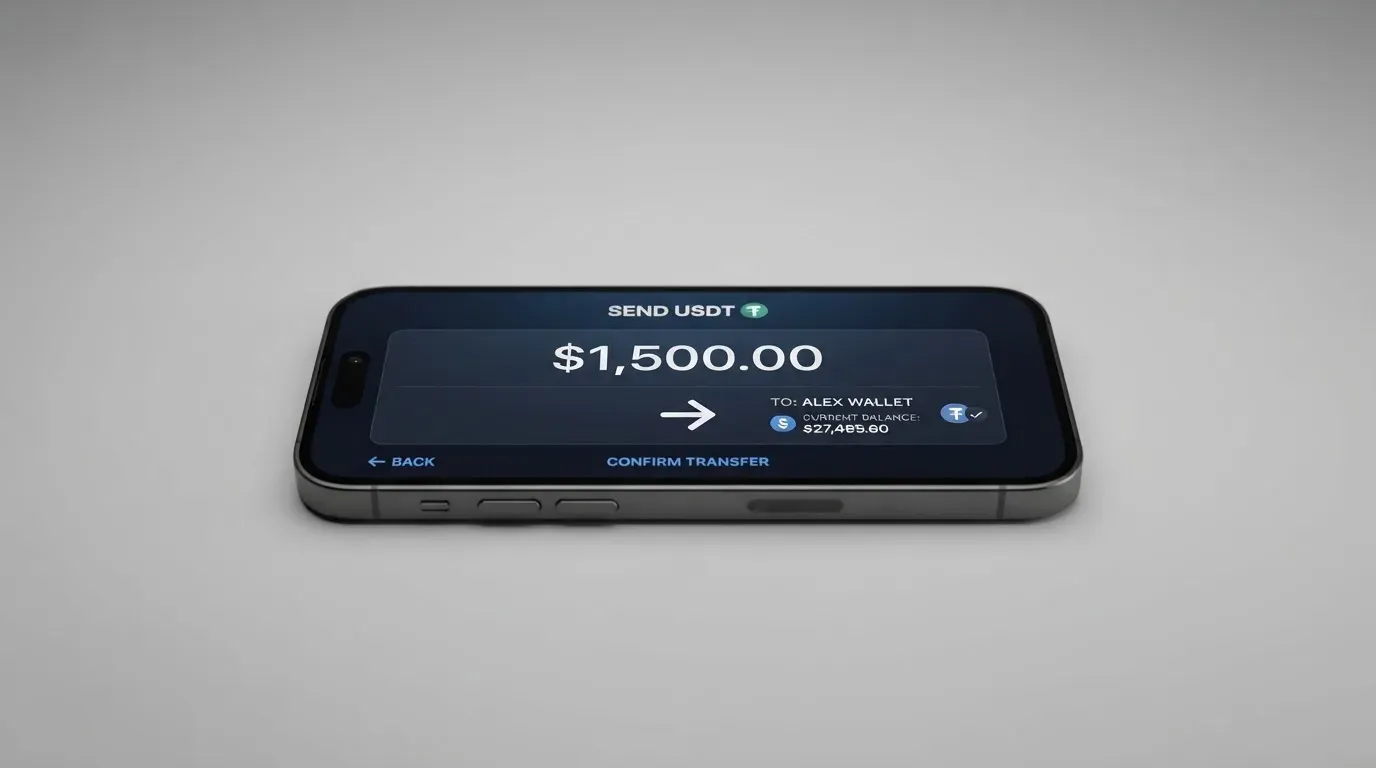
If you want to start from fiat, USD, EUR and GBP can be received into the account and converted into crypto by Bridge before being deposited into your wallet. The on-ramp costs 1% and additional fees may apply; SEPA transfers cost $1.45, ACH transfers cost $0.95, and EUR/GBP/MXN conversion runs at the mid-market rate plus 0.50%. A “high-risk payments” surcharge, capped at 5% of the deposit, can be added to certain payments. The minimum top-up is not stated.
Three things are worth flagging. First, the official pages do not list the top-up coins, which is a real gap if you hold something other than USDC. Second, the gas story favours Solana: on the default routes Karma sponsors the network fee, so a USDC transfer on Solana lands on the card without you having to keep a separate native token to pay gas. Third, the reverse path is to withdraw back to your bank or to an external wallet “at any time” per the App Store, and that off-ramp costs 0.5%.
The closure story is where this gets uncomfortable. The card terms are written as if the card were a credit line, with 0% APR, late-payment fees of up to $40, returned-payment fees of up to $29, and a clause saying the repayment obligation survives closure. That does not match the “load it with USDC and spend” description, and it is the kind of wording you should read carefully if you ever see a statement from the issuer. Cash advances are not available, and the issuer can suspend or cancel access at any time.
Paying with it every day
The day-to-day picture is where the score drops to 3 out of 10. The single biggest gap is mobile wallets. The card’s own pages do not say whether Apple Pay or Google Pay are supported. A third-party site says neither is supported, and the official silence is the more telling signal. If you tap-to-pay with your phone, you should assume this is not the card for you until Karma publishes otherwise.
The second gap is the ATM. Cash advances and balance transfers are not available, and the official line is that there is no ATM facility. The unofficial claim of “unlimited” free ATM withdrawals on a virtual Visa card contradicts that and should not be relied on.
For in-store and online spending, the card is a Visa, so it works at any merchant that takes Visa, which the App Store puts at “80M+ merchants” worldwide. There are some categories the card is not allowed to be used for: digital currency purchases (except via Karma itself), cannabis and CBD products, dark web, unlicensed pharmacies, firearms, escort services, payday lending, MLM or Ponzi schemes, counterfeit goods, and “illegal gambling operations or unregulated betting platforms.” Regulated gambling and fantasy sports, crypto platforms and exchanges, and money-service businesses need enhanced review, which is the language the issuer uses for an extra check rather than a flat ban.
There is a rewards layer. The App Store release notes mention “Reward tiers with cashback on fees,” a points currency called “Karma Points” earned on card spend, and “Pending cashback tracking.” The actual rates are not stated on the public pages, so the practical cashback is something you discover in the app, not in the marketing.
The app itself has a 5.0 rating on the App Store from 6 ratings, which is a clean score on a very small sample. iOS 15.1 or later is required, and the latest version at the time of writing was 2.0.2. A Google Play listing exists under the package name xyz.karmapay.app, but the rating was not readable on the public page. Support channels and hours are not stated.
If something goes wrong with a purchase, the official process is to contact the merchant first and only then raise a chargeback in your Karma account, with a hard cut-off of no more than 60 days after the charge posts. Won chargebacks are credited to a current or future statement, and unresolved disputes can lead to fees, lower limits or suspension.
What can go wrong
There are a few categories of risk worth taking seriously, and the first is the issuer layer. The card is issued by Third National, a US bank, under a Visa licence, with Karma Fintech LTD as the brand on the front and Rain powering the programme. Karma is explicit that it is “not a bank, exchange or custodian” and that “you control your wallet and your keys.” That is the right framing for the wallet side, but it also means the regulated entity you are dealing with for the card is Third National, not Karma, and the registration country for Karma Fintech LTD is not stated, so the legal entity behind your account is partly opaque. A licensed Visa issuer is a much better starting point than a card run by an unregulated entity, but it is still a single programme: if the issuer withdraws or Visa terminates the programme, your card stops working, the way FTX’s card did in November 2022 and the WaveCrest-issued Visa programmes did in Europe in 2018.
The second category is counterparty risk on the regulated side. Card terms reserve the right to suspend or cancel access at any time and to change limits, including down to $0. The card terms also contain clauses that read like a credit agreement (0% APR, late fees, returned-payment fees, surviving repayment obligations), which does not match the way the product is described in the App Store. Read those terms carefully; if the issuer ever issues a statement, take it seriously.
The third category is self-custody risk. Karma says it “cannot freeze, seize, or move your funds,” which is the point of a non-custodial wallet. It also means there is no support line that can recover your balance if you lose your seed phrase, no FDIC insurance (“do not provide FDIC insurance” appears in the terms), and no public audits of the wallet code. The terms say audits happen only “under NDA.” Security features on the app are passkeys, biometrics for sensitive actions, extra confirmation for higher-risk actions, in-app card freeze and unfreeze (subject to the issuer), and velocity limits. That is a sensible package, but it depends on you not losing the keys.
The fourth category is complaints and public track record. No Karma-specific complaints, Reddit threads, Trustpilot pages or news stories turned up in my search. The “Karma Pay card complaints reddit trustpilot” search returned reviews of other products, not the wallet. The App Store rating is clean, but on six ratings. There is no Trustpilot page for Karma Pay that I could find. A clean record on a small and new product is not the same as a long, verified track record.
The fifth category is the regulatory backdrop. MiCA, the EU’s markets-in-crypto-assets regulation, took effect in June 2023, with stablecoin rules from 30 June 2024 and the rest of the regime, including crypto-asset service provider rules, from 30 December 2024. MiCA’s grandfathering period runs until 1 July 2026 or until a provider is authorised or refused, whichever comes first. In the US, FinCEN guidance treats crypto exchanges and administrators as money transmitters. Karma’s own licensing under either regime is not stated. If you are in the EU and the card provider does not have a MiCA authorisation by the deadline, that is a future risk worth keeping in mind.
What to take instead
If Karma’s gaps are dealbreakers, the three cards below are the closest alternatives I have looked at, with their own trade-offs.
| Card | Score | Best for | Watch out for |
|---|---|---|---|
| MetaMask Card | 7.1 / 10 | A self-custody experience with a real Mastercard | Virtual card is free, Metal is $199/year, mUSD and other named tokens only, sign-ups paused in the US and UK |
| KAST | 6.1 / 10 | Tiers with 0% card spend and proper cashback | Premium is $1,000/year, Private is $10,000/year, country list is not published |
| TokenPocket (TP Card) | 5.8 / 10 | An Arbitrum-based card from a known wallet | Country list is narrow, a 1% deposit fee applies, FX not stated |
MetaMask Card is the closest in spirit: a self-custody wallet with a Mastercard that spends directly from the connected wallet, no MetaMask fees, and a cashback layer paid in mUSD (1% on the virtual card, headline 3% on Metal, with the 3% capped at the first $10,000 spent). Sign-ups are open in 45 listed countries and territories; the US and UK are paused; the rest of the world joins a waitlist. Virtual is free, Metal is $199 a year, and the issuer is Monovate with Crypto Life as the card provider. The trade-off is that only named tokens (mUSD, wETH, EURe, GBPe, USDC, USDT and a few others) on Linea, Base, Monad or Solana are supported, and a Solana-only wallet cannot draw credit.
KAST is the best-funded alternative if you want a tiered product with proper cashback. There is a Standard tier with no annual fee, Premium at $1,000 a year and Private at $10,000 a year, with USD cashback of 1.5%, 2% and 3% on a monthly cap. Card spend in USD is 0%, Apple Pay and Google Pay are 0%, and the non-USD FX fee runs 0.5% to 1.75% depending on residence, transaction country and tier. The catch is that the country list is not published, you only see whether your country is supported at KYC, and the premium tiers are expensive.
TokenPocket’s TP Card is the lower-priority option. It is a Visa or Mastercard debit on Arbitrum, virtual only, with balances in EUR24 and USD24, and a 1% fee on crypto deposits that is later refunded through rewards. The country list is short and the FX fee is not stated, so this one is for users already inside the TokenPocket ecosystem who want a card on the same wallet.
Who I would recommend it to
Karma is worth a closer look if you are a self-custody user who already holds USDC on Solana, you are happy to load a Visa and spend the balance directly, you do not need Apple Pay or Google Pay, you do not need an ATM, and you are not in one of the excluded countries. The cost stack is clean: no monthly fee, 0.5% per transaction, a small FX markup, and a $KARMA token rebate for holders. The card is a Visa, so acceptance is not the issue.
It is not worth it if you rely on a phone wallet, want to draw cash, want a long list of coins to top up from, or want a card with published daily and monthly limits. It is also not worth it if you need a clear support channel beyond an X account, or if the credit-style wording in the card terms makes you uncomfortable even if you do not intend to revolve a balance.
If any of those points are dealbreakers, MetaMask Card is the more polished self-custody option for users in its supported countries, and KAST is the right pick if you want tiered cashback and are willing to pay for it.
Frequently asked questions
What is the Karma card?
The Karma card is a Visa debit-style card that sits on top of the Karma non-custodial wallet. You hold your own keys, the card is loaded with USDC, and it spends at any merchant that takes Visa. The card is issued by Third National under a Visa licence, with Karma Fintech LTD as the programme brand.
How does the Karma card work?
You create a self-custody wallet in the Karma app, fund it (USDC on Solana is the clearest official path, or fiat via Bridge), and spend the balance with the Visa. The card network converts foreign-currency transactions to US dollars, and Karma charges a 0.5% service fee per transaction plus a 1% FX fee on non-USD spending.
Is Karma a bank?
No. Karma states on its own pages that it is “not a bank, exchange or custodian.” The card is issued by Third National under a Visa licence, and the wallet is non-custodial, so you hold your own keys. There is no FDIC insurance, and the licensing under MiCA or US rules is not stated.
Who owns Karma?
Karma Fintech LTD is the brand entity on the App Store. The registration country for Karma Fintech LTD is not stated on the public pages. The card programme is issued by Third National and powered by Rain, with the Karma ICM Association, a Swiss non-profit, overseeing the protocol and treasury.
Is the Karma card available in my country?
Issuance is blocked for residents or registrants of Belarus, mainland China, Cuba, India, Iran, Iraq, Israel, Myanmar, Nepal, Nicaragua, North Korea, Russia, Syria, Turkey, Ukraine, Venezuela and Vietnam. Spending is also blocked in Cuba, Iran, North Korea, Russia, Syria, Ukraine and Venezuela. FATF grey-list countries are checked case by case. Outside those lists, the card is not auto-rejected.
Does the Karma card require KYC?
The card’s own terms say there is “no KYC process” and require only that you confirm you are not a U.S. citizen and are not sanctioned. A third-party site, unofficial and not confirmed by the card, describes a “Level 3” check that asks for an email, a phone number and an identity document. Karma’s public pages do not spell out the actual KYC flow.
How do I top up the Karma card?
USDC on Solana is the only network and coin called out by name on the official pages, and Karma says it covers the on-chain transaction costs for that route. Fiat on-ramp from USD, EUR or GBP is available through Bridge at a 1% fee plus any SEPA ($1.45) or ACH ($0.95) charge. The list of other top-up coins is not stated.
How do I add the Karma card to Apple Wallet or Google Pay?
The card’s own pages do not say. A third-party site, unofficial and not confirmed by the card, says Apple Pay and Google Pay are not supported. Until Karma publishes otherwise, you should assume neither wallet works with the card.
Is the Karma card safe?
The wallet is non-custodial, so Karma says it cannot freeze, seize or move your funds. The app uses passkeys, biometrics, an in-app card freeze and velocity limits. There is no FDIC insurance, and the wallet code is audited only “under NDA.” The card programme is backed by a licensed Visa issuer, but the issuer can change limits, including to $0, at any time.
Is the Karma card worth it?
It is worth it for self-custody users who already hold USDC on Solana, do not need Apple Pay, Google Pay or an ATM, and are outside the excluded countries. It is not worth it if you need any of those features, want a published list of top-up coins, or want a clear support channel beyond an X account.
Wallet cards put to the test – cryptocardtested
Content created by the «cryptocardtested» team